Turnitin has become a lucrative business by selling the promise of certainty in an age of AI uncertainty.
But the evidence keeps reminding us that AI detection is not as straightforward as many institutions would like to believe.
I recently read Lucky E. Atamhenwan’s 2026 paper, How are combinations of human-written words and LLM-generated words by ChatGPT, Copilot, Gemini and Grammarly detected by Turnitin?, and the findings are important for anyone involved in teaching, assessment, or academic integrity.
The study tested 81 scripts with different combinations of human-written and LLM-generated text, ranging from 100% human-written to 100% AI-generated. The AI-generated text came from ChatGPT, Copilot, Gemini, and Grammarly.
One of the key findings is that Turnitin did not flag fully human-written texts. It also did not produce AI scores when only 5% or 10% of the text was AI-generated.
But once AI-generated content reached around 15%, Turnitin began producing AI scores. The problem is that those percentages were often inaccurate.
At lower levels of AI-generated text, Turnitin tended to overestimate AI use.
At higher levels of AI-generated text, Turnitin tended to underestimate AI use.
Even more striking, detection varied depending on the tool used. ChatGPT-generated text, for instance, was often underdetected. In one case, a script that was 100% ChatGPT-generated received a Turnitin AI score of only 60%.
The study also showed that some “humanizing” or paraphrasing tools can significantly reduce detection. In some cases, Turnitin returned 0% AI scores for texts that were originally 100% LLM-generated and then humanized.
AI detectors may provide a signal, but they should never be treated as proof. A Turnitin AI score is not a verdict and should never be a confession!
I think instead of asking: “Was AI used?”, we better ask: “How was AI used, why was it used, and does that use align with the learning goals and policy expectations?”
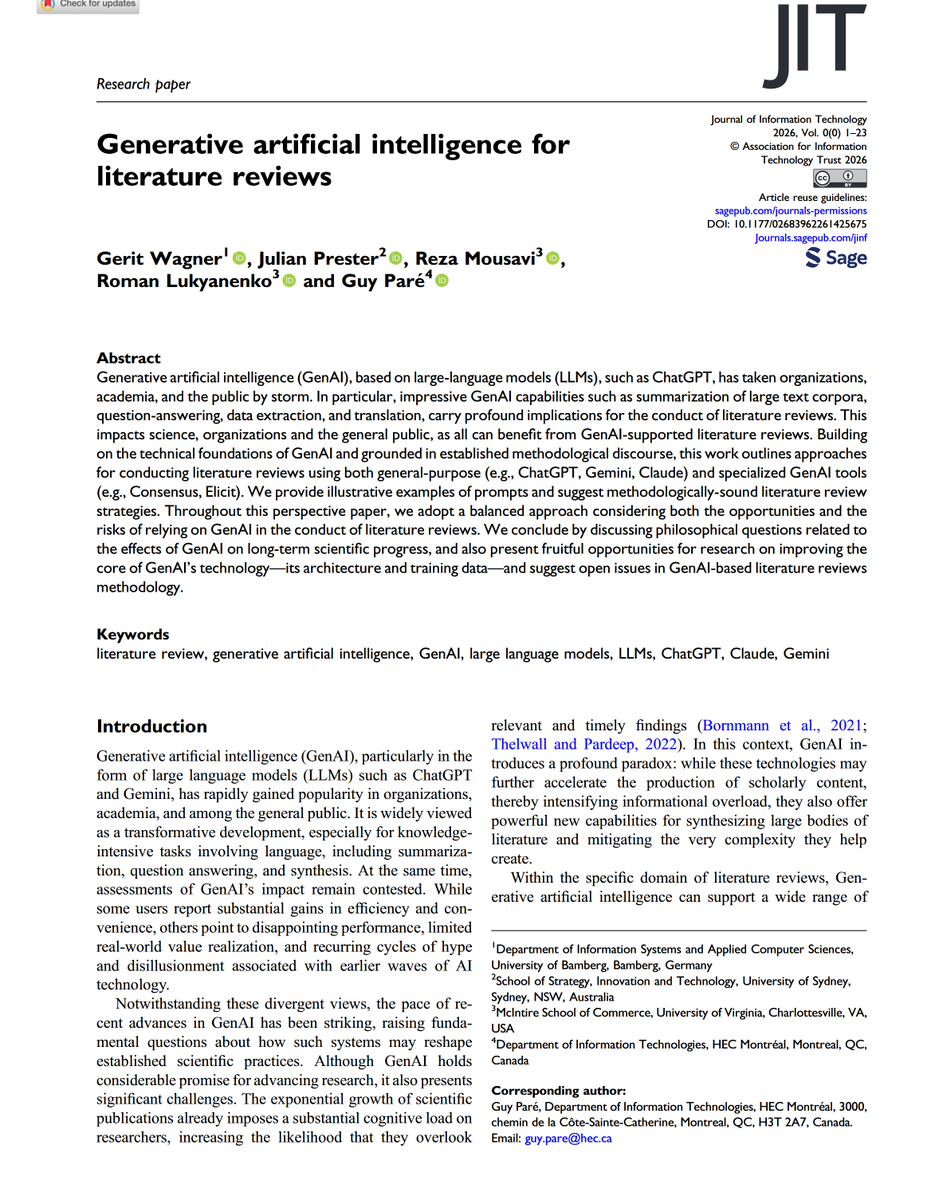
📄 Wagner et al. (2026) sobre GenAI en revisiones: copiloto en búsqueda→cribado→síntesis, pero exige salvaguardas (RAG, verificación, transparencia) ante alucinaciones y sesgos.
🔍 Novedad: 4 escenarios de futuro + “prompt data management”.
🔗https://t.co/TDa2yAdfKQ
#AI
Difficult colleagues are an unfortunate but common feature of some workplaces.
We hear from three experts about how to handle these situations
https://t.co/tBGkbWW4VF
Clinicians can enhance patient understanding by using numerical data instead of verbal probabilities, consistent denominators, absolute risk comparisons, and clear context for unfamiliar data types.
https://t.co/cdjVDcZfvq
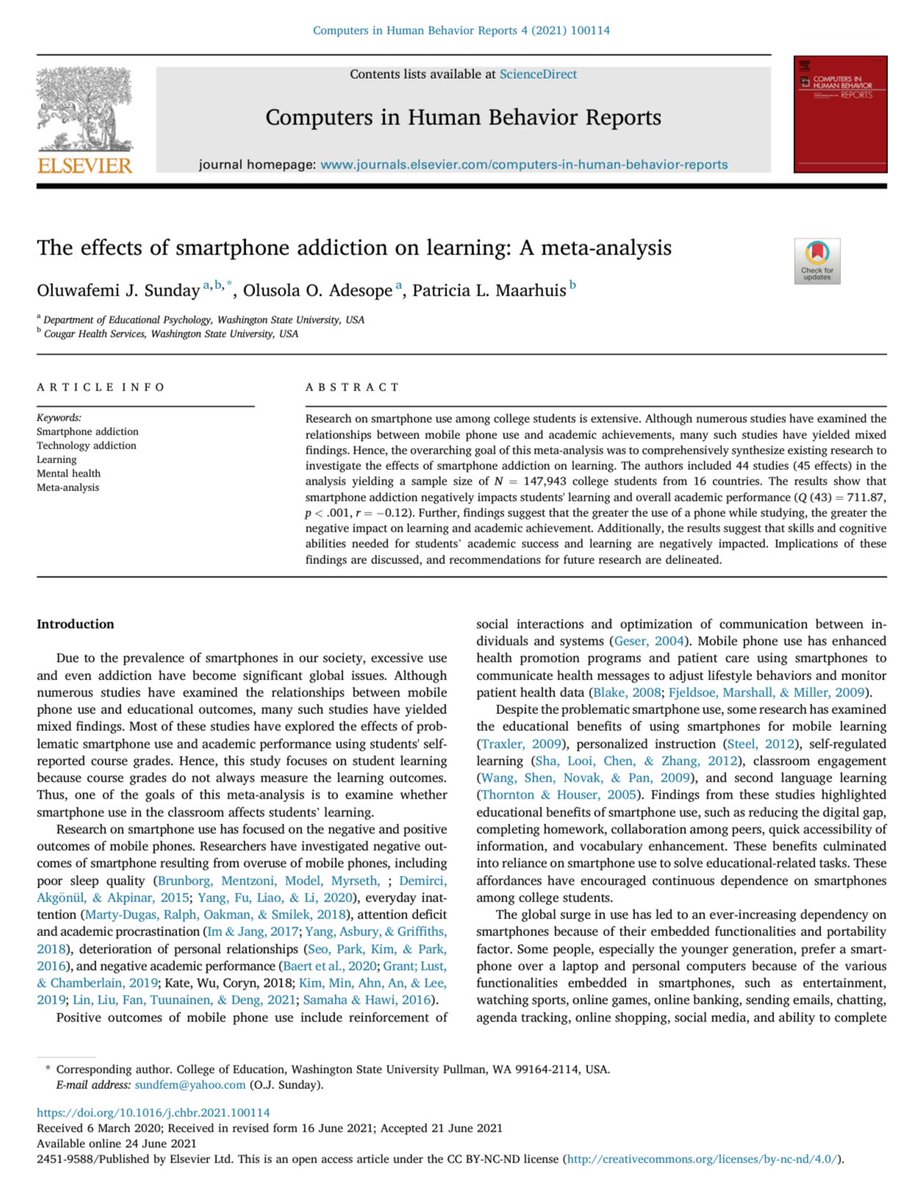
Smartphone addiction has negative impacts on student learning and overall academic performance. The greater the use of a phone while studying, the greater the negative impact on learning. The skills and cognitive abilities students needed for academic success are negatively affected by excessive phone use. The results of this meta-analysis implied that addicted users show a diminished level in learning.
From the art of reading minds to a robot that can do your chores, these are the most-watched TED Talks of this year — did any of your favorites make the list?
Watch them all here: https://t.co/4e1mbW4ldX
Lit reviews aren't hard if you follow a strategy.
Here is how you can finish yours in 8 weeks, from zero to finish:
🔵 Step 1: Understand the basics (1–2 weeks)
Read 3–4 key review papers slowly.
Use LitMaps, SciSpace, or Undermind to find high-impact reviews with many citations.
Take notes. Google every term you don’t fully understand.
This sets the foundation for everything else.
🔵 Step 2: Write a zero-draft outline (1 week)
Write 300 words that map the logical flow of your paper using one short sentence per paragraph.
Forget references for now. Just focus on narrative.
Use the hourglass model: start broad, go narrow.
If your logic doesn’t work here, it won’t work in the full paper either.
🔵 Step 3: Expand each paragraph (2–4 weeks)
Take each sentence from your outline and run it through an AI search engine like Consensus.
You’ll get 20+ relevant papers per topic.
Skim them. Note useful insights.
Build the paragraph out using bullet points: one sentence + one reference each.
5–10 of those is usually enough.
🔵 Step 4: Polish your narrative (1 week)
Before fixing grammar, fix structure.
Academic paragraphs are self-contained, so you can usually rearrange them without major edits.
Make sure the entire story still flows.
🔵 Step 5: Polish your writing (1 week)
Now fix your words.
Add domain-specific language.
Use a tool like Writing Wanda (a custom GPT) to speed this up.
You can automate 90% of this step with AI.
Writing a lit review isn’t hard.
It’s just a process.
Do it in the right order, and the whole thing gets 10x easier.
💙 We are happy that the Open Webinar on the topic 'Highlights from the ERC Resuscitation Guidelines (BLS, Epidemiology, Systems Saving Lives, PLS) was a successful event.
❤️ We are pleased to share the YouTube Link of the webinar for you. If you missed the live session, tune in here to learn about the important updates. 👇
✅🔗 https://t.co/qPD5GuGrNL
#ERC #ERCGuidelines #Guidelines2025 #savelives #CPR #Resuscitation