🔥 ¡NUEVO VÍDEO en DOTCSV LAB! 🔥
La IA está revolucionando las matemáticas y así se demostró la semana pasada tras el anuncio de OpenAI de haber logrado refutar la conjetura de Erdos tras 80 años!
Hoy os explico el problema y la relevancia de esto
Link a continuación!
🔴 ¡HITO de OPENAI en MATEMÁTICAS!
Continuando con la escalada en capacidades matemáticas de la IA, un modelo interno de OpenAI ha logrado resolver el que es hasta la fecha el problema Erdős más importante resuelto autónomamente.
La trascendencia histórica de que la solución a este problema provenga completamente de un modelo general de razonamiento demuestra el punto de inflexión superado por la IA en matemáticas que he estado señalando durante el último año.
Cuando en verano del 2025 vimos a la IA enfrentarse con éxito a las olimpiadas matemáticas internacionales (IMO) quedó claro que el grado de madurez de los LLMs era muy superior al que muchos esperarían. Desde entonces los sistemas no han tocado techo, sino que no han parado de mejorar, logrando hitos cada vez mayores cosechando éxitos en la frontera del conocimiento.
Esto no para señores. Cada iteración vuelve a estos modelos más inteligentes, y a cada cota alcanzada el impacto en matemáticas es mayor.
"There is no doubt that the solution to the unit-distance problem is a milestone in AI mathematics"
Es el testimonio que no deja de repetirse por parte de miembros de la comunidad matemática.
At age 25, Kurt Gödel proved there can never be a mathematical “theory of everything.” In this week’s Qualia column, @nattyover asks experts how his ideas changed the course of humanity’s unending search for truth. https://t.co/UVDtVlYJkZ
Top 10 best mathematicians
10. You cant
9. Rank them
8. Because the
7. Importance of
6. Their contributions
5. Are
4. Relative to
3. Their respective
2. Fields
1. Euler
At the age of 39, Karl Weierstrass was working as a high school teacher in Germany, far from the major centers of academic life. He spent his days teaching and his evenings quietly pursuing mathematical research on his own.
In 1854, he published a groundbreaking paper on Abelian integrals. The work was so impressive that it immediately caught the attention of leading mathematicians across Europe.
This achievement changed his life. Soon after, Weierstrass was offered a position at the University of Berlin, where he went on to become one of the most influential mathematicians of his time.
I've recently got in on the act of getting AI to solve open problems in mathematics. More precisely, I gave some questions asked by Melvyn Nathanson to ChatGPT 5.5 Pro, to which I have been given access, and it answered them. 🧵
Abraham Fraenkel was one of the founders of modern set theory, adding several key rules to its list of axioms to help get rid of various paradoxes. Today, that list, which forms the foundation for all of mathematics, is named partially after him. https://t.co/MhvElEZcM4
The mathematician Ernst Zermelo came up with the axiom of choice, the most controversial of the 10 basic principles that today underlie all of mathematics. https://t.co/MhvElEZcM4
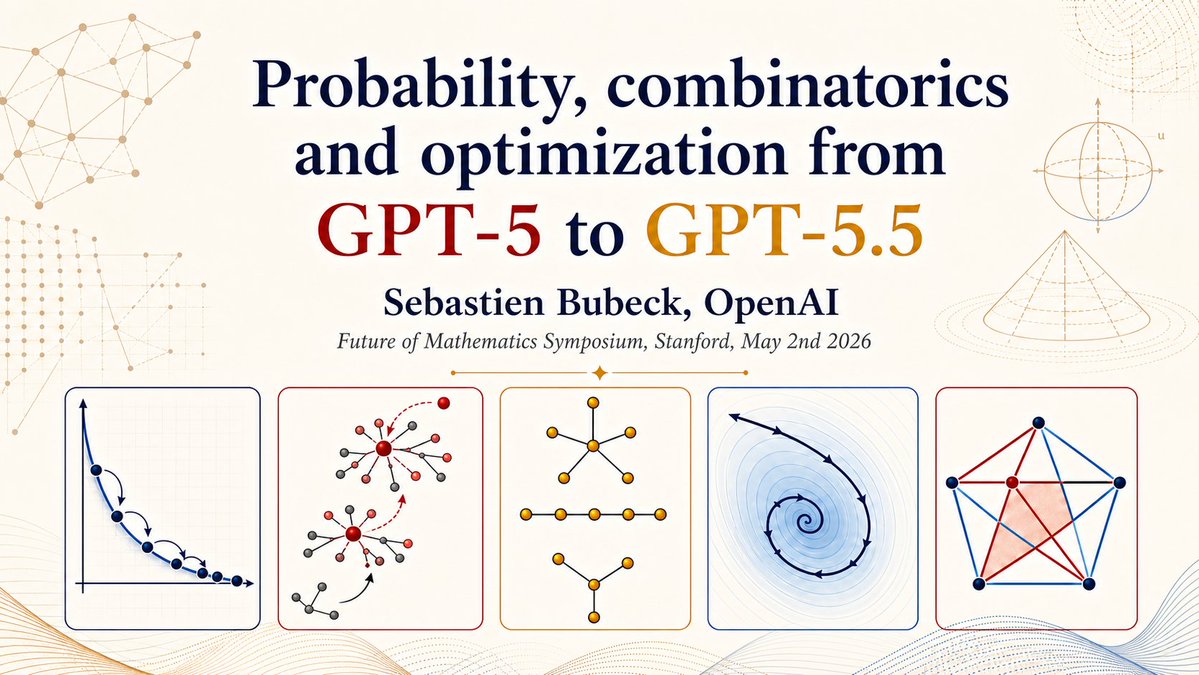
Talking at the Future of Math Symposium in 10 minutes (livestream link: https://t.co/dXC4bj8os4). I decided to make the talk "personal" and explain the five moments that updated me on how fast AI will change mathematics. (The ChatGPT's illustration of these moments is so good!!)
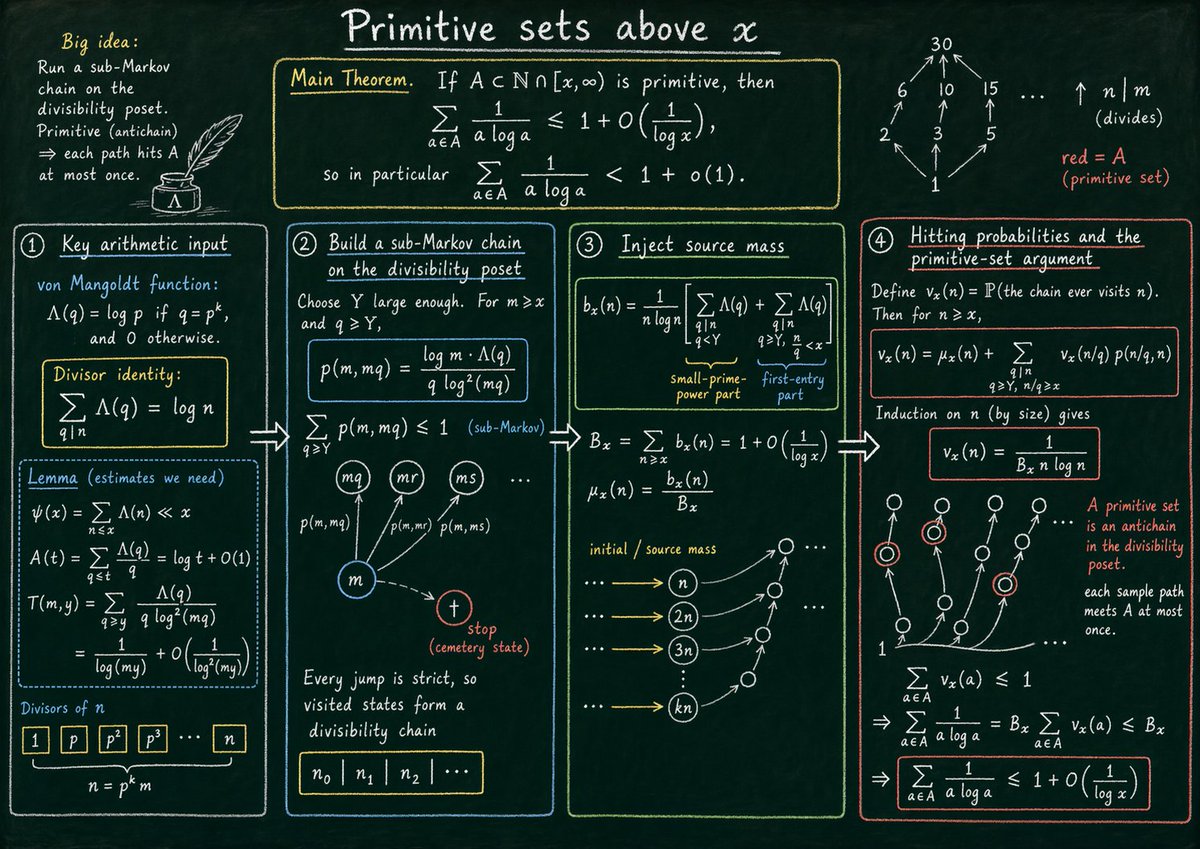
A Russian mathematician named Andrei Markov proved in 1906 that you don't need to know where something came from to predict where it's going next.
He was studying poetry at the time. Specifically, he was analyzing the sequence of vowels and consonants in Pushkin's novel in verse, counting transitions by hand across thousands of characters, looking for a pattern in how one letter predicted the next.
What he found became one of the most quietly powerful ideas in all of mathematics. And it has been sitting inside every weather forecast, every Google search, every Netflix recommendation, and every large language model ever built, waiting for someone to explain it in plain language.
Here is the framework that changed how I think about prediction.
Most people assume that to predict something you need history. The full picture. Everything that led to this moment. If you want to know what the stock market will do tomorrow, you think you need to understand everything it did for the past decade.
Markov showed that is almost never true.
His insight was this: for a huge class of real-world systems, the current state contains all the information you need to predict the next state. The past is already baked into where you are right now. You don't need to carry it forward explicitly, because it's already there.
He called this the Markov property. And the systems it describes are called Markov chains.
The mechanics are simpler than they sound.
Imagine you are tracking weather. It is either Sunny or Rainy on any given day. You observe over many years that when it's Sunny, there's a 90% chance tomorrow will also be Sunny and a 10% chance it will turn Rainy. When it's Rainy, there's a 50% chance it stays Rainy and a 50% chance the sun comes back.
Those four numbers are your entire model. That grid of transition probabilities is the Markov chain.
Now someone asks you: it's Sunny today, what is the probability it will be Sunny three days from now?
You don't need intuition. You don't need expertise. You multiply the transition probabilities through each step and the answer falls out exactly. The chain does the thinking.
The part that most people miss is what happens when you run a Markov chain long enough.
Almost every well-behaved Markov chain converges to what mathematicians call a stationary distribution. It doesn't matter where you start. After enough steps, the system settles into a stable pattern of probabilities that it returns to again and again, regardless of initial conditions.
Google's original PageRank algorithm was a Markov chain. The web is a network of pages pointing to each other, and a random visitor clicking links is a random walk through that network. The stationary distribution of that walk, the long-run probability of landing on any given page, is exactly what PageRank calculated. Your position in search results was determined by where a memoryless random surfer would spend most of their time.
The same mathematics underlies how your phone's keyboard predicts your next word. How Spotify decides what song plays after this one. How epidemiologists model the spread of disease through a population. How economists simulate how people move between jobs and unemployment. How physicists describe particles changing energy states.
All of it is the same idea dressed in different clothes.
The counterintuitive power of Markov chains is that they are wrong about memory in a way that turns out to be useful.
Real systems do have memory. Tomorrow's weather is influenced by more than just today's. Your next word is influenced by more than just your last one. The Markov assumption is technically false for almost every natural system.
And yet. The approximation is good enough to be extraordinarily useful, because most of the predictive information in a sequence is concentrated in the most recent state. Adding older history gives you diminishing returns. At some point you are carrying around all this expensive history for almost no improvement in accuracy.
Markov chains are the mathematical formalization of a deeply practical idea: you can often predict the future with surprising accuracy just by paying close attention to right now.
The man who discovered this was studying syllables in poetry. He had no idea he was describing the architecture of the internet, the logic of machine learning, and the statistical skeleton underneath the most powerful AI systems ever built.
He just followed the pattern where it led.
That is usually how the biggest ideas work.
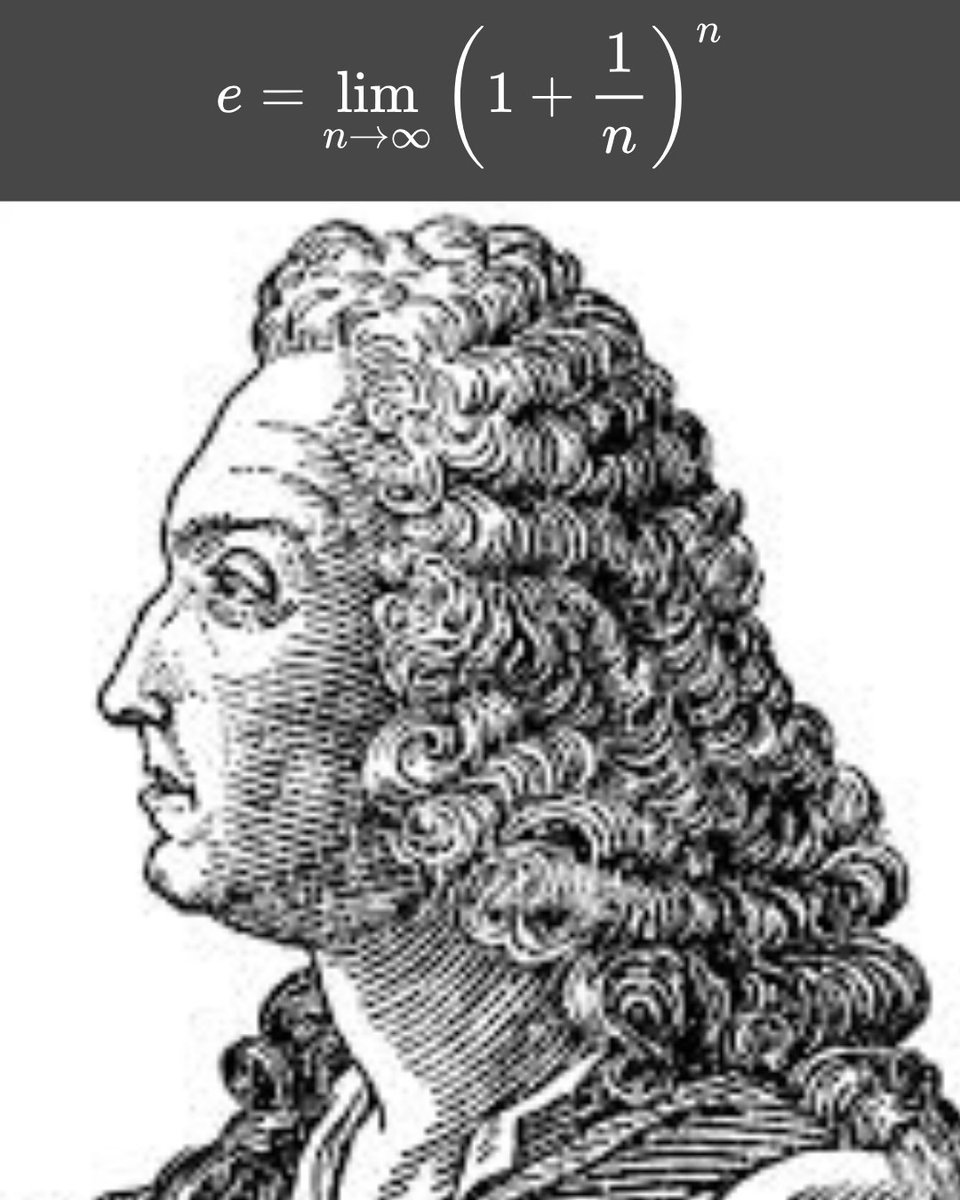
In 1683, the Swiss mathematician Jacob Bernoulli made an important discovery while thinking about money and interest.
He was studying what happens when interest is added not just once a year, but again and again in smaller and smaller steps. As he followed this idea further, he came across a special number.
That number was later called e.
At first, it appeared in problems about compound interest. But over time, mathematicians realized that this number was far more powerful. It shows up whenever something grows or changes continuously—like populations, radioactive decay, or even the way heat spreads.
Today, e is known as one of the most important numbers in mathematics, standing proudly beside 0, 1, π, and i. What began as a question about money turned into a discovery that shapes much of modern science.
🔴 ¡NUEVO VÍDEO en DOTCSV! 🔴
¡En el canal principal! Y con uno de los temas más importantes que se puede tratar...
¿Está la IA acelerando la ciencia?
¿Es capaz un LLM de generar nuevo conocimiento?
...
Hoy hablamos del GRAN BUCLE 🔄️
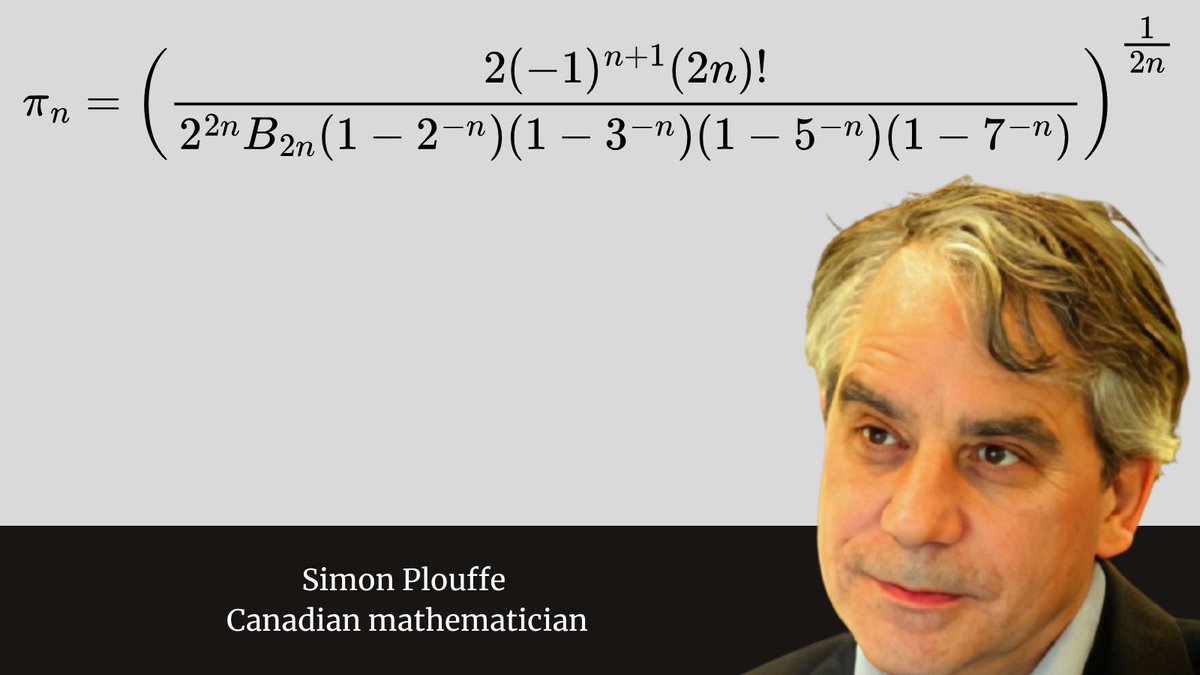
The first formula that allows the calculation of the n-th decimal digit of π—without needing to compute all the previous digits—was discovered by Simon Plouffe in 2022.
It's the birthday of Stefan Banach—a man whose brilliance was so natural that he had to be gently tricked into earning his own PhD.
Banach was not the kind of person who chased degrees or academic titles.
He loved mathematics deeply, but he had little interest in writing formal papers or preparing a doctoral thesis. To him, discussing ideas and solving problems mattered far more than collecting credentials.
But his colleagues saw something extraordinary in him. They knew his ideas deserved recognition, and they were determined to help him achieve it—whether he cared for it or not.
So they came up with a clever plan.
They arranged for an assistant to regularly meet with Banach under the pretense of casual mathematical discussions.
During these meetings, the assistant quietly took detailed notes of Banach’s thoughts, proofs, and insights.
Over time, these notes grew into a complete doctoral thesis—without Banach ever formally “writing” one himself. When it was ready, Banach simply reviewed and approved it.
There was still one final step: the oral examination.
Once again, his colleagues used a bit of creativity. They invited Banach to discuss a mathematical problem they claimed to be struggling with.
Banach, always eager to talk mathematics, showed up without hesitation. What he didn’t realize was that this “discussion” was actually his official oral exam.
He passed, of course—effortlessly.
And that’s how one of the greatest mathematicians in history earned his PhD: not through formal ambition, but through pure love of ideas and a little friendly trickery.
La crisis del petróleo no es nueva. Ya la República Dominicana ha enfrentado precios más altos y ha respondido con eficacia, como lo hicimos en el año 2008, cuando el precio del barril de crudo se cotizaba en 147 dólares.
Prof. Donald Knuth opened his new paper with "Shock! Shock!"
Claude Opus 4.6 had just solved an open problem he'd been working on for weeks — a graph decomposition conjecture from The Art of Computer Programming.
He named the paper "Claude's Cycles."
31 explorations. ~1 hour. Knuth read the output, wrote the formal proof, and closed with: "It seems I'll have to revise my opinions about generative AI one of these days."
The man who wrote the bible of computer science just said that. In a paper named after an AI.
Paper: https://t.co/juSOmK9vOt
🔴 ¡LA IA MATEMÁTICA de GOOGLE!
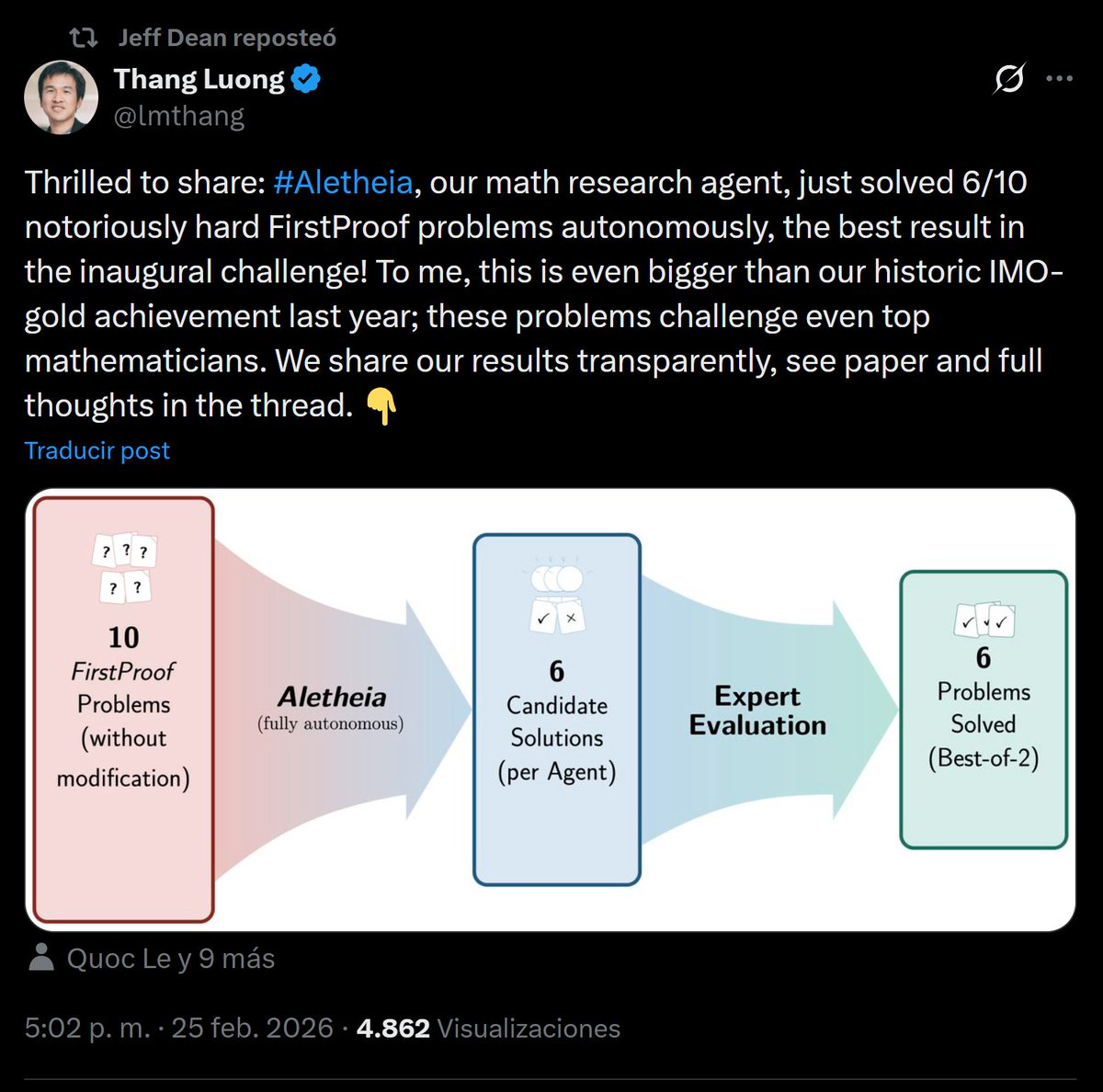
Google acaba de confirmar que su agente matemático Aletheia consiguió resolver (ahora sí, confirmado) 6 de 10 problemas matemáticos MUY difíciles del reto FirstProof! 🔥
Esto es potente, os cuento 👇🧵