When an athlete is told to run at 85% they run faster than if they're told to run at 100%.
It's called the 85% rule and here's why it works:
Carl Lewis was a 9 time Olympic gold medalist who was known as a master finisher but a slow starter.
He began races 2nd to last but usually ended up finishing first.
It became known that he's wasn't performing at full throttle.
He was going at 85% the whole time.
Why 85%?
When you have your best performances it's never when you're trying your hardest.
Instead the task usually feels easy & effortless.
Going at 85% is a mindset about relaxation & performing at a high level while being in flow.
It's about pacing, form & finishing.
At 85% you're not striving or straining by operating at the very limit of your ability.
You have room to think, focus & adapt.
Applying the 85% rule helps you balance intensity while being focused & relaxed.
Here's a few example of how to do it:
At work:
Instead of going full throttle, take your time, release the pressure & focus.
Put an emphasis on optimizing your systems & adopt a mentality of expending 85% of your mental energy towards a task.
Your perception of energy is the biggest component to your productivity.
In your diet:
Instead of trying to be perfect aim to get 85% of your food choices right.
This takes the pressure off of you and gets you away from an "all or nothing" mindset.
You want to be adaptable to any situation and hitting 85% is enough to get your body in shape.
In your workouts:
Instead of going to failure for every exercise aim for 85% intensity so you can focus on good form & keep your body injury free.
We have a rule to keep 1-2 reps in the tank when lifting and this fits perfectly into it.
Keys to the 85% rule:
1) Relax
2) Focus on form
3) Set your mind to 85% intensity
4) Work just below your maximum threshold
5) Stop when you feel close to 100% of your mental/physical capacity
Instead of putting the pressure by trying to go 100 aim for 85% instead.
Doing so might help you unlock new levels of performance.
My recent one-pagers are free to download from my website: https://t.co/QKGJjjeiKT
🟢 Why Don’t Students Like School?
🟡 Cognitive Load Theory Explained
🔵 Making Every Lesson Count
🟠 Explicit Instruction
🔴 Formative Assessment
☕️ Support my work! https://t.co/290oB1U6xN
This course 👇 provides an evidence-based overview of why and how effective questioning helps promote and assess thinking, and what great teachers do to use it effectively for these different purposes.
https://t.co/V2a2305tJS
I've made a visual Literacy Map for 2023-24 to bridge literacy with literary/worldly events for our school. A few ideas attached to each but could be adapted! @Team_English1@LitdriveUK feel free to adapt or share: https://t.co/OVIerqzF73
A meta-analysis of 16 studies of the effects of physical activity on preschoolers' cognitive function find that short bursts of activity have little impact, but multiple sessions per week over many weeks improve inhibitory control and perception: https://t.co/1vhDKNpjEj ($).
Looking for tips or articles about setting up/ layout of a good primary classroom... and whiteboard management - particularly to assist those where English may not be their first language??
Appreciate any suggestions.....
Check out Primary Maths Hub! Launched 🚀 today and just £1.99 for a whole school to sign up for a year!
https://t.co/yAA3ecOmDz
✅ Follow at @PrimaryMathsHub
Please hit the ReTweet ♻️ Share 🥰
#maths#teacher#school#resource
***NEW Episode***
This week’s guest on The (Un)official Teacher’s Manual Podcast is popular, best-selling author - and perhaps the most quoted person in any discussion on literacy - @AlexJQuigley
Here Alex offers 5 tips for teaching vocabulary:
11 min
https://t.co/SOMr17M0o9
Fully resourced INSET session based on the ‘Great Teaching Toolkit: Evidence Review’ and ‘Model for Great Teaching’.
💻PowerPoint slides
🛣️Structured activities
🗒️Digital materials
👩💻Delivery notes
𝗔𝗹𝗹 𝗳𝗼𝗿 𝗳𝗿𝗲𝗲 👇
https://t.co/EoS0MqUqs6
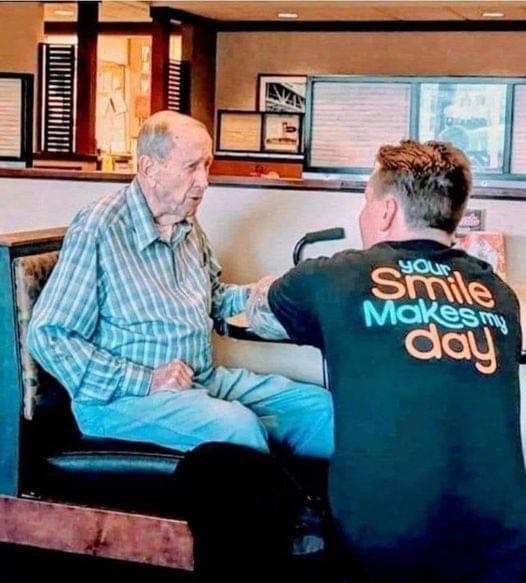
"The elderly gentleman was seated in the booth directly across from my family as we ate dinner Saturday night at Eat'n Park in Belle Vernon. We really didn't see him come in. But we did notice when our server, Dylan, dropped to one knee to look him eye-to-eye as he got ready to take his order.
The man apologized for not hearing too well. He had forgotten to put in his hearing aids. He talked about how he lost his hearing during his time in the war. He was 91 years old with many stories to tell. Dylan patiently listened giving him his full attention.
Eventually the man apologized for talking so much. 'I'm alone now,' he said, 'and I don't often have someone to talk to.' Dylan smiled and said he enjoyed listening. He then helped him figure out what to order and left to take it to the kitchen. It was a touching sight.
I wanted offer to pay for the man's dinner, but before I could flag down Dylan, a man seated at a nearby booth asked Dylan to bring him his check. 'Someone's already taken care of it,' Dylan smiled.
I guess we weren't the only ones eavesdropping on the conversation. After the man received his food Dylan came back to say he was on a break.
He asked if he could sit with the gentleman as he ate. As we left the restaurant the two of them were conversing and many people seated nearby were smiling. It was a touching sight.
With all of the negative stories about our youth today this was a breath of fresh air. I wonder if I would have been as kind and attentive if I were the one working there.
One thing's for sure, if you are ever at Eat'n Park in Belle Vernon, ask for Dylan. If he's your waiter you're certain to get great service."
Credit: Lisa Meilander
Last term we decided to focus on teaching behaviour explicitly to our pupils.
We had recently maintained our outstanding grade but felt like behaviour wasn't quite where we wanted it to be. We decided to explicitly teach pupils our values.
This is how it went 🧵