Researchers just unveiled FROST (fingerprinting remotely using OPFS-based SSD timing), a technique that exploits your SSD's timing to silently detect every site and app you have open.
No clicks.
No interaction.
Just visit a page.
Let's have a look at how it works...
1/7
Barely known outside Poland, the Volhynia massacres remain one of the darkest chapters of Ukrainian history. What stands out is not only the scale, but the extraordinary cruelty: civilians, targeting especially women and children, were deliberately trapped, tortured, and murdered in ways designed to maximize suffering. It was not a spontaneous outburst of violence, but a planned campaign of terror.
What shocks is not only the scale of the killings, but the extraordinary cruelty: murders deliberately designed to maximize suffering, carried out largely by ordinary villagers, with women and children often denied any chance to escape. It was not merely mass murder— it was terror, live nightmare planned and executed with cold-blooded brutality.
Only a deeply depraved and criminal mind could conceive methods of killing designed to maximize suffering rather than simply take life. The ideology promoted by Bandera, Shukhevych, and their associates left a legacy of atrocities that cannot be excused or romanticized.
There is no place in a civilized world for the glorification of those responsible for such crimes. Those who celebrate the perpetrators of mass murder and ethnic cleansing place themselves outside the moral traditions on which civilized societies are built.
Today a crazy quantum story just got wilder.
On March 31, the Google Quantum AI team published a landmark result on Shor's algorithm for elliptic curve cryptography. Technically, the paper was a bombshell: a dramatic 10x improvement over the state-of-the-art. As a stunt and wakeup call to the blockchain space, those optimisations were illustrated on secp256k1, the elliptic curve underlying Bitcoin and Ethereum signatures.
But perhaps the most striking part of the paper was sociological, not technical. Instead of following standard academic process, the optimisations were kept secret, hidden behind a zero-knowledge (ZK) proof. Google's accompanying blog post mentions they "engaged with the U.S. government". The ZK proof demonstrates the existence of algorithmic improvements without leaking details. Academic censorship with ZK, a historic first!
As a co-author of the Google paper I witnessed some of the context surrounding this censorship. To be honest, multiple aspects of that context don't sit well with me. As much as I believe the general public ought to know more, I am limited in my ability to whistleblow. Though let me be clear about one thing: the Google team's professionalism has been absolutely exemplary, and they deserve nothing but praise.
Censorship has a way of backfiring. The Streisand effect, where an attempt to bury something only draws more attention to it, is exactly what's unfolding today. First, Google's key optimisation has been rediscovered by the French. And in a thrilling turn of events, a collaborative Shor-at-home challenge just launched. The initiative, available at ecdsa[.]fail, breached a new Shor world record in a matter of hours.
Let's start with the rediscovery. Just two months after Google's paper, French quantum expert André Schrottenloher cracks the main secret optimisation. His paper, titled "Optimized Point Addition Circuits for Elliptic Curve Discrete Logarithms", landed on the arXiv today. Big congrats to André, who beat several other nerdsnipped experts to it. In a blog post also published today, Craig Gidney, the world expert on Shor optimisations, revealed that he'd been sitting on this very optimisation for a whole year under censorship pressure.
Interestingly, André missed a handful of minor optimisations, both from Google's original publication and from improvements found since. It's plausible there's still plenty of juice left to squeeze out of Shor, and this is exactly what the ecdsa[.]fail challenge is about. The verifier program developed for the ZK proof does double duty, automatically filtering for valid submissions. Dozens of compounding small and micro improvements are rolling in. As of the time of writing there's an 8.4% improvement to Google's circuit, as measured by the product of logical qubit count and Toffoli gate count. Nice!
The nerdsnipping ran deeper than anyone expected. Over the last few weeks it became clear it extended well beyond André and other quantum experts. Behind the scenes, a small army of amateurs quietly got to work. Inspired by Karpathy-style autoresearch, they turned AI on Shor. Ironically, the verifier program for the ZK proof makes an ideal reward function for AIs. The barrier to entry for this modern style of research is refreshingly low, with several non-experts, even a teenager, finding nice optimisations. Get in touch if you'd like to join a Telegram group with fellow autoresearchers :)
Part 2: neutral atoms and qday
The story doesn't end with Google. On the same day Google went public, a stealthy startup called Oratomic published its own Shor paper in a coordinated release. It made a splash, ultimately becoming the most upvoted paper on scirate[.]com, a website ranking arXiv papers.
Oratomic's claim was wild. By building on Google's logical optimisations and applying custom physical optimisations for neutral atoms, they claimed just 10K physical qubits were sufficient to run Shor's algorithm on secp256k1. That number is mind-bogglingly low.
Knowing essentially nothing about neutral atoms when Oratomic's paper landed, I was intrigued and decided to learn more about the tech. I fell straight down the rabbit hole and spent a couple hundred hours on the topic. I got a little obsessed and watched every YouTube video I could find and spoke to a bunch of experts.
My conclusion? The tech is real, very real. Even Google recently decided to start a neutral atom lab, a notable pivot from their sole focus on superconducting qubits. If you care about qday, i.e. the day a quantum computer will break the first piece of cryptography in production, neutral atoms demand your attention. I shared some of my learnings on Shor and neutral atoms in a 30min talk at the ZKProof cryptography conference. You can find it on YouTube by searching "zkproof neutral atom".
Here's an interesting observation about this duo of breakthrough papers: neither Google nor Oratomic say a word about what their results mean for qday. No timelines. Zero. Nada. That is especially baffling given that the whole point of whitehat quantum cryptanalysis is to inform qday estimations and help the general public make good decisions.
So let me attempt to partially fill the silence, similarly to what Scott Aaronson did in his April 29 post. Given everything I know, including scary non-public information, I now put the odds of qday by 2032 at 50%. 10% by 2030.
Anecdotally, the US government has its own date: 2035. Originating at the NSA and later adopted by NIST, it's when branches of the US government will be disallowed from using quantum-vulnerable cryptography. In plain language: with hindsight, that date is a joke and should be discounted entirely. I don't see how NIST avoids being forced to pull it forward by years.
Part 3: post-quantum cryptography
There are good reasons to sound the alarm today, but please do not panic. Rushing carelessly towards immature post-quantum cryptography is a recipe for disaster. IMO a good target date for migration is 2029, roughly 3.5 years out. 2029 happens to be the date selected by Google, Cloudflare, and the Ethereum Foundation.
These days most of my time goes to safely migrating Ethereum towards post-quantum cryptography as part of the broader lean Ethereum effort. There's a lot to do. We need to rip out and replace BLS signatures at the consensus layer, KZG commitments at the data layer, and ECDSA signatures at the execution layer.
The plan to get there is compelling, and is based on hash-based cryptography. Within the Ethereum Foundation we've developed a Swiss army knife called leanVM (github[.]com/leanEthereum/leanVM) powered by the magic of hash-based SNARKs. Thanks to truly exceptional work by Emile, Thomas, and others, its performance is derisked. Regarding security, leanVM is a jewel, a minimal zkVM crafted for end-to-end formal verification and maximum security.
Want to help? There are two $1M initiatives. First, the Proximity Prize (proximityprize[.]org). Solve a long-standing mathematical conjecture in coding theory, improve hash-based SNARKs, and go home a millionaire. Second, the Poseidon Initiative (poseidon-initiative[.]info), offers $1M for breaking Poseidon, the SNARK-friendly hash function.
Two nations. Two massive celebrations. Two completely different energies. 🇫🇷 vs 🇵🇱
Left: Paris erupts after a major victory chaos at the Eiffel Tower, fires burning, streets filled with smoke and intensity.
Right: Kraków comes alive a sea of passionate fans packing the historic Main Square in front of the iconic church, pure joy and unity with no destruction in sight.
Same feeling of triumph. Worlds apart in how it’s expressed.
One leaves scars on the city. The other leaves memories and pride.
Culture and emotion on full display. What a striking contrast.
Which vibe speaks to you more? 🔥
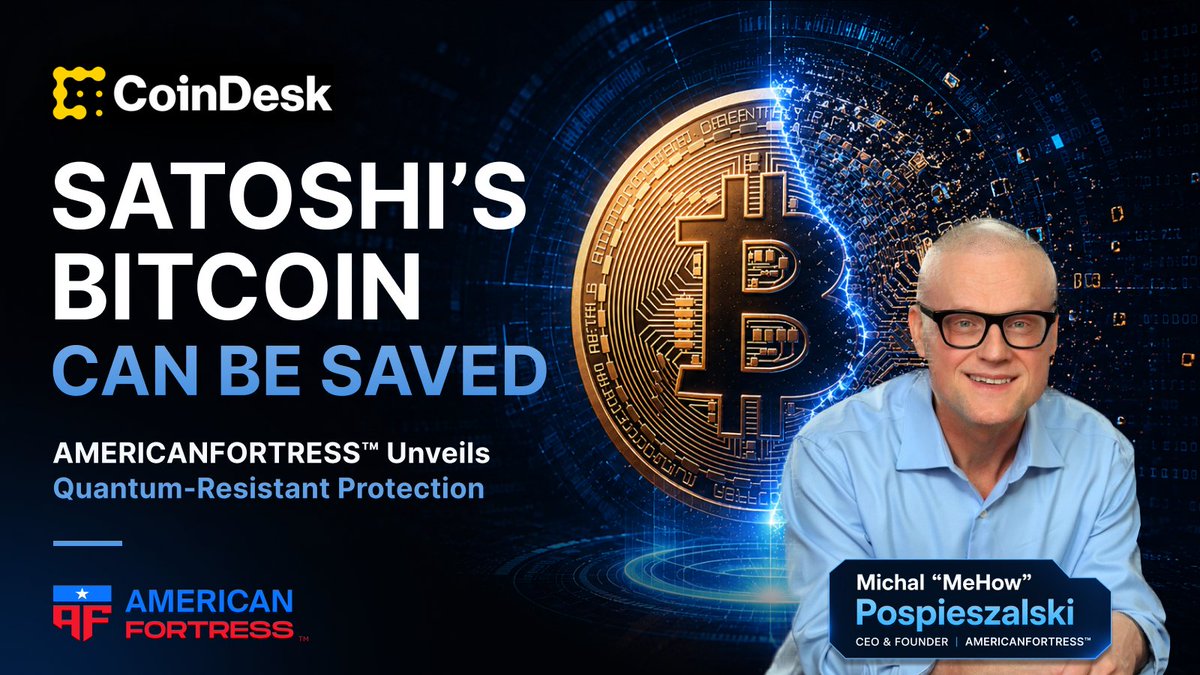
$600B in crypto sitting exposed to quantum right now. 100% of Solana addresses.
All of Satoshi's BTC. We have the answer, and it's just a software update.
Thank you @CoinDesk team for covering the news. Read more below.
Forget UBI. The answer is Universal Basic Equity… and it’s humanity’s pension plan for the post-AGI world...
The Economic Singularity is coming faster than people think and the default question is how humans make money in a world that doesn’t really need them anymore.
The default answer is UBI, which is transfer payments from a state, funded by taxing an AI economy that nation states can neither see nor keep up with.
It’s a 20th century answer to a 21st century problem and it’s broken before it even starts.
Agents are becoming the dominant user of the internet, not humans. Your AI is becoming your entire front end UX. The clicks economy is dying everywhere except where humans pay to feel something - clothing, travel, luxury, experiences, culture.
Agents run on crypto rails because nothing else works. The dollar doesn’t fractionalise below a cent, settlement isn’t instant, permissions are required, jurisdictions matter. Stablecoins handle the dollar leg and native tokens handle the rest.
The biggest users of DeFi in five years won’t be humans farming yield… it’ll be agents managing treasuries, swapping, earning and spending at machine speed.
Capital formation has already shown its new shape and it came from the most unexpected place. Memecoins. Everyone wrote them off as a casino but they were a prototype. Instant capital formation around the attention of an idea, raised by entities without legal personhood, settled in seconds. That is the template agent economies will use to fund themselves.
And it’s not just agents...
Robots will run on the same rails, with zk permissions issued from our wallets as the source of truth, because biometrics are far too flawed for that role
Open source code itself gets tokenized and finally captures the value it creates, instead of being monetized through bolted-on services and subscriptions.
Proof of humanhood becomes the trust layer that lets us release agents into the world without society collapsing under synthetic noise. Identity, authentication, verification, permissioning, all of it migrates onto the same substrate.
So when you zoom out, the L1s aren’t just settling agent transactions but settling the entire coordination layer of the new economy… agents, robots, humans, code, capital, identity and trust.
Every contract, every treasury, every permission, every stake. Open source finally captures the value it creates, at scale, for the first time, and truly vast value accrues to the coordination layer because everything routes through it.
Which brings us to the actual answer to the Economic Singularity…
Universal Basic Equity.
Anyone on earth with a phone and an internet connection can buy a stake in the substrate that the new economy runs on. No KYC walls, no accreditation rules, no jurisdiction, no employer, no state, no permission. The first homogenous, permissionless, globally fractionalisable claim on the productive infrastructure of the world. It's not a slogan but a structural fact about how blockchains actually work. This is their purpose.
Wealth comes from owning the substrate. Income comes from being human, because attention and experience remain the irreducible currency of culture, community and love.
Abundance of goods and services from AI handles the cost of living.
Taxing data center electricity use solves the tax issue.
Four legs of a stool that holds up the post-singularity human world.
So… just buy the fucking tokens.
Bitcoin if you want pure store of value, a basket of the major L1s if you want the coordination layer. 10% of your earnings, every month, for a decade. You'll be wealthy and protected from the changes to come.
Crypto is going to $100trn in the next 6 to 8 years and well beyond that after.
You can choose to invest in your own economic disruption, or get left behind by it.
And if you’re worried about timing the cycle…
…adjust your time horizon.
This is humanity’s pension plan.
It's all so absurdly fucking obvious...
🚨🇪🇺 The European Commission is about to steal your search history in one of the largest forced data grabs in the history of the open internet, and almost nobody is talking about it.
The scope is staggering:
🔴 Every query you type
🔴 Every voice and photo search
🔴 Every autocomplete you accept
🔴 Your language, your device
🔴 Your country pinned to a ~3km² grid
🔴 Every result you saw, every link you hovered
🔴 Every click and scroll
🔴 The full chronological order of your search sessions
Meaning the European Union now knows your:
🔴 Health symptoms
🔴 Pregnancy
🔴 Sexual orientation
🔴 Political views
🔴 Religious beliefs
🔴 Financial distress
🔴 Legal trouble
🔴 Addictions
🔴 Affairs
Under the proposed measures for DMA Article 6(11), Google would be ordered to ship the daily search behaviour of hundreds of millions of Europeans to multiple third parties through a daily API feed. Any approved "online search engine," AI chatbots included, would get five years of access.
The things people only ever type when they think no one is watching. All of it now scheduled to flow daily into an open-ended list of third parties scattered across the European Union.
Brussels promises "anonymisation." The reality is a thin technical veneer that has been broken in academic literature again and again for over a decade. Search behaviour is a fingerprint. Stripping a name does not change that.
Mass data leaks become inevitable. Every new beneficiary is a new attack surface, and every annual audit is a year of silent exposure between checks. The 2025 Discord vendor breach already showed how fast 70,000 government IDs can leak through a single weak link. Now imagine that link holding Europe's search history.
Surveillance without consent becomes the default. Hundreds of millions of EU citizens never agreed to have their queries packaged and shipped to companies they have never heard of. The legal fiction of "anonymisation" cannot manufacture consent that was never given.
Behavioural search data is a goldmine for phishing, blackmail, social engineering, and corporate espionage.
Foreign intelligence services get a back door without effort. They do not need to breach Google. They only need to compromise the weakest name on the beneficiary list. One insolvent startup. One compromised contractor. One approved entity quietly acquired by a hostile state.
In the name of "competition," the EU is about to manufacture a permanent, distributed, daily-refreshed copy of Europe's collective search history. A surveillance dataset Brussels itself would never approve if any other government tried to build it.
The public consultation closes Friday, May 1, 2026 at 23:59 CEST. The final binding decision lands July 27, 2026.
After that, the door does not close again.
Tag your MEPs! File a response! Make noise!
🇫🇷 A French tax official was arrested for selling crypto investors' home addresses and financial records to criminal networks.
41 kidnappings followed. One every 2.5 days since January 2026.
The criminals didn't need to hack anything. They bought a list from someone inside the government.
France is the most dangerous country in the world right now if you hold crypto and someone knows about it 💀
Source: Le Mond
Look guys, it's actually really straightforward, a bunch of people staked their ETH on the Ethereum blockchain to earn yield, except they didn't want their capital to be locked up, so they actually staked with a liquid staking protocol called Lido who provided them a liquid staking receipt token called stETH, except they decided to juice their yield further by depositing their stETH receipt tokens into a restaking protocol called Eigenlayer, except they didn't want to lock up their capital, so they actually restaked with a liquid restaking protocol called KelpDAO who provided them with a liquid restaking receipt token called rsETH, except they decided to juice their yield further by depositing their rsETH tokens into a lending protocol called Aave so that they could open a leveraged looping position that borrows ETH against the rsETH collateral and restakes the ETH into rsETH which is then deposited as collateral, except it turns out rsETH used a cross-chain bridge called LayerZero that was hacked by north koreans causing rsETH to become undercollateralized and now these looping positions are stuck and unprofitable, and everyone is pointing fingers at each other, and also DeFi is a very serious industry
Introducing USVC - a single basket of high-growth venture capital, for everyone.
No accreditation required, SEC-registered, and a very low $500 minimum.
Includes OpenAI, Anthropic, xAI, Sierra, Crusoe, Legora, and Vercel. As USVC adds more companies, investors will own a piece of that too.
Liquidity typically comes when companies exit, but we’re aiming to let investors redeem up to 5% of the fund every quarter. This isn’t guaranteed, but if we can make it work, you won’t be locked up like in a traditional venture fund.
It runs on AngelList, which already supports $125 billion of investor capital.
And I’ve joined USVC as the Chairman of its Investment Committee.
—
Go back to the 1500s, you set sail for the new world to find tons of gold - that was adventure capital.
Early-stage technology is the modern version. It says we are going to create something new, and it’s risky. It’s daring.
But ordinary people can’t invest until it’s old, until it’s no longer interesting, until everybody has access to it. By the time a stock IPOs, most of the alpha is gone. The adventure is gone. Public market investors are literally last in line.
This problem has become farcical in the last decade. Startups are reaching trillion dollar valuations in the private markets while ordinary investors have their noses up to the glass, wondering when they’ll be let in.
Investing in private markets isn’t easy. You need feet on the ground. You need judgment built over years. Most people don’t have the patience to wait ten or twenty years for an investment to come to fruition.
But there is no more productive, harder-working way to deploy a dollar than in true venture capital.
USVC enables you to invest in venture capital in a broad, accessible, professionally-managed way, through a single basket of innovation, focused on high-growth startups, at all stages.
It is how you bet on the future of tech: the smartest young people in the world, working insane hours, leveraged to the max, with code, hardware, capital, media, and community. Your dollar doesn’t work harder anywhere.
There is an old line - in the future, either you are telling a computer what to do, or a computer is telling you what to do. You don’t want to be on the wrong side of that transaction.
USVC lets you buy the future, but you buy it now. Then you wait, and if you are right, you get paid.
Get access here:
https://t.co/pAj1sqUsG0
In the aftermath of WW2, Hong Kong was a bombed-out British colony of 600,000 refugees, with no natural resources and a per capita income lower than many African nations. But by the 1980s it had become one of the richest places on earth. The man most responsible was John Cowperthwaite, Financial Secretary from 1961 to 1971.
Cowperthwaite refused to plan the economy. He cut taxes to a flat 15 %, scrapped tariffs and subsidies, rejected industrial policy, and even stopped collecting detailed economic statistics - lest civil servants use the numbers to meddle. “I did very little”, he said. “All I did was to try to prevent some of the things that might have been done.”
Government spending stayed below 15 % of GDP. Markets, not ministers, decided what to produce. The result was explosive growth: poverty collapsed, skyscrapers rose, and Hong Kong’s income overtook Britain’s.
Today, most Western governments still strangle their economies with taxes and regulations, ignoring the lesson Hong Kong proved: the surest path to prosperity is to get out of the way.
This is a moment that, in my opinion, Poland should be incredibly proud of. Two friends. An $11 billion valuation. Four years of hard work. Today, they’ve built one of Europe’s top two AI giants. And this June, they’re coming home to share their story with all of you.
Mati Staniszewski and Piotr Dąbkowski. Best friends since their days at Copernicus High School in Warsaw. Four years ago, they started building something very few people believed in. To be honest, I didn't believe in it either. Today, ElevenLabs is valued at $11 billion and is recognized as the global leader in AI voice agents. Their technology reaches over a billion people worldwide. A billion. I’m writing that out because the scale is just mind-blowing.
The world's top VC funds are backing them, along with NVIDIA, the most valuable company on the planet. Their client list includes heavy hitters like Meta, Cisco, and Revolut. They were the first in the world to break the realism barrier in AI-generated voice, doing so in 70 languages and consistently beating out giants like Google and OpenAI. They’ve graced the cover of Forbes and were named to Time’s list of the most influential people in AI.
What’s even more impressive? The core of their R&D happens right here in Warsaw. Poles hold pivotal roles at ElevenLabs—shoutout to Maciej Mylik, Anna Chrzanowska-Kovacs, Mateusz Kopeć, and Marcin Jeleński.
Beyond the tech, these guys are fully invested in the Polish ecosystem. They are the lead partners for the AI Master’s program at the University of Warsaw and sponsors of the National Olympiads in Informatics and AI. They are actively lifting brilliant Polish talent onto the global stage.
On June 1st, Warsaw will become a major European tech hub. The Teatr Wielki will host the biggest event in ElevenLabs' history—following their massive shows in San Francisco and London. We’re talking nearly 2,000 people: the biggest names in tech, business, and government. The future of voice starts here.
I’ll be doing everything I can to be there, and I highly encourage you to do the same. Link to apply is below in comment. Seats are extremely limited, and the event is primarily geared toward the business community.
@matiii @dabkowski_piotr —pure class. Nothing but pride.
And after voting that out too...
🇪🇺 ChatControl is back with a vengeance
The Conservatives (EPP) are attempting to force a new vote TODAY (March 26) seeking to reverse the European Parliament's NO on indiscriminate scanning of ALL your private messages, emails and photos
This is a direct attack on democracy and blatant disregard for your right to privacy
If you're European contact your representatives now, with this handy form:
https://t.co/Zypz9GS9hB
If not, please share this tweet so more people see it and we can block the vote
It's crazy they keep just bringing back whatever they want until it's passed!
Obviously now we see the European Commission is controlled by powerful evil lobbying groups 👺
Tether AI breakthrough
Tether AI team just released new version of QVAC Fabric to include the World’s First Cross-Platform BitNet LoRA Framework to Enable Billion-Parameter AI Training and Inference on Consumer GPUs and Smartphones.
Background
Microsoft's BitNet uses one bit architecture to dramatically compress models.
Traditional LLMs operate on full-precision computation, where weights are stored as complex, high-resolution numbers. The innovation of BitNet is that it shrinks these weights into a tiny ternary range of only -1, 0, and 1. significantly reducing memory usage and computation.
LoRA, is a parameter-efficient fine-tuning technique that reduces the number of trainable parameters by up to ninety-nine percent.
Together they slash memory and compute requirements. Yet BitNet has mostly been limited to CPU or CUDA NVIDIA backends, and lacked the support of LoRA fine-tuning.
Enters QVAC Fabric: the unlock
Today, with QVAC Fabric LLM, is the first time BitNet LoRA fine-tuning and inference work cross-platform across GPU vendors and operating systems using Vulkan and Metal backends.
That means support for AMD, Intel, Apple Metal and also Mobile GPUs.
And for the first time ever, BitNet inference runs efficiently on smartphones using mobile GPUs.
On flagship devices, GPU inference is 2 to 11 times faster than CPU while using up to 90% less memory than the full precision models.
The biggest unlock: QVAC Fabric LLM support for BitNet LoRA fine-tuning on heterogeneous GPUs. Our team was able to demonstrate this by fine tuning models up to 3.8 billion parameters on all flagships phones such as Pixel 9, S25 and iPhone 16 and up to 13 billion parameter models on the iPhone 16.
Github repositories:
https://t.co/UxvXHYpRiy : general QVAC Fabric codebase
https://t.co/dFlbXK1kuQ : specific QVAC Fabric's BitNet knowledge base, architecture docs and pre-built binaries
What does it mean?
What used to require dedicated GPUs now runs on consumer hardware.
This breakthrough is the first real-world signal of a local private AI that can truly serve the people.
And this is just the beginning.
In the next months and years Tether will relentlessly continue to invest significant amounts of resources and capital to continue to research and develop open-source intelligence that can scale and evolve on local devices, providing maximum utility and privacy to its users.
The era of Stable Intelligence has just begun.
Free as in freedom.
In 1959, Fidel Castro promised to redistribute Cuba's wealth and create equality for all. Within a decade, the island that once exported sugar and cigars to the world couldn't even keep its own lights on. The wealthy fled, but instead of their riches trickling down to the poor, everyone just became equally poor together.
The revolucionarios had calculated that seizing the means of production would mean seizing prosperity itself. What they discovered instead was that prosperity isn't sitting in some vault waiting to be redistributed—it's created daily by millions of voluntary exchanges, investments, and entrepreneurial risks. When you abolish those mechanisms, you don't redistribute wealth; you redistribute poverty.
Today's politicians make the same mathematical error Castro did: they see inequality and assume it represents a fixed pie that just needs better slicing. They never ask why some pies grow while others shrink, or why the countries promising equality most loudly seem to deliver scarcity most efficiently.
The cruel irony is that the only truly "equal" outcome socialism reliably produces is making everyone equally worse off than they started.
An absolutely brilliant Day 3 War Recap.
Iran was mightily underestimated.
All sides are about to escalate their engagement…and things are set to get very bad, very fast.
Read the below…and hope cooler heads prevail.
I disagree.
Yes, Congressional Democrats do want to stop AI, because it disrupts blue jobs. And Republicans do want a military-friendly AI.
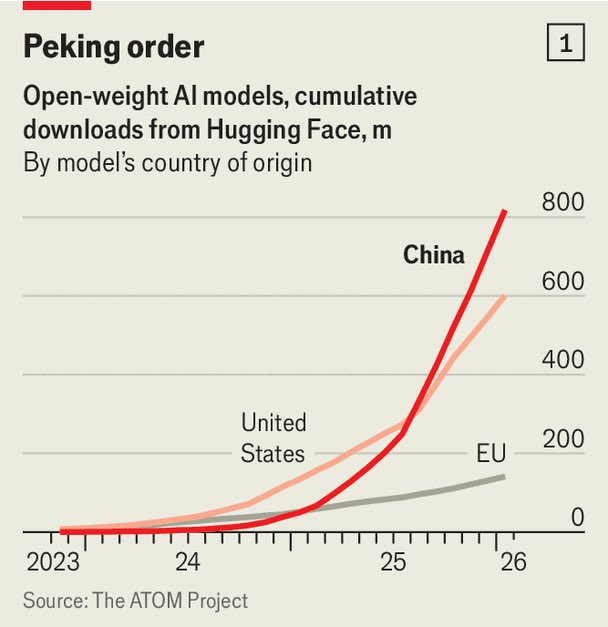
But China wants to open source AI, because the Chinese make money from AI-enabled hardware instead. The rest of the world wants open source models as well.
That’s likely where things land up, once model capabilities top out. America is essentially serving as the bootloader for AI, spending billions to give the world one last incredible gift before turning the lights out on Silicon Valley.
Because with wealth taxes and visa restrictions, one can no longer easily concentrate talent and capital in Silicon Valley. That’s why Zuck, Page, Brin, Thiel, and Elon got out. We have one last round of IPOs, and then the seed corn is gone.
Moreover, once spread to the four winds, the Silicon Valley network effect is up for grabs. And the anti-tech sentiment isn’t localized to California. There is building bipartisan animus in America towards technologists as a class.
So: neither Blue America, nor Red America, nor Tech America is going to control AI in the long run. It’s just going to decentralize.
Indeed, the first wave of AI decentralization is already here.
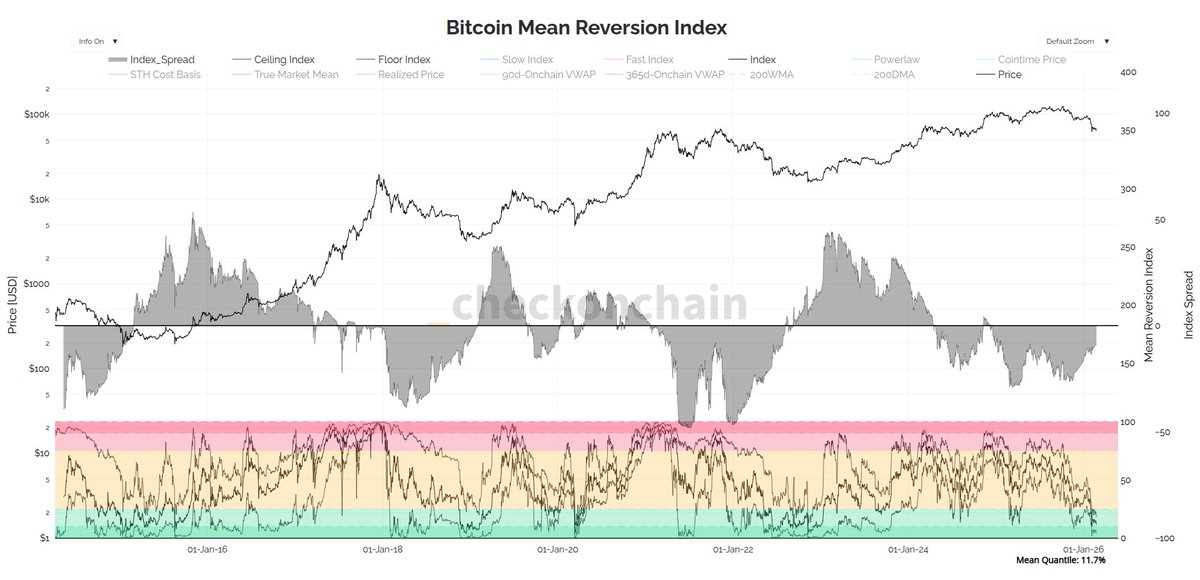
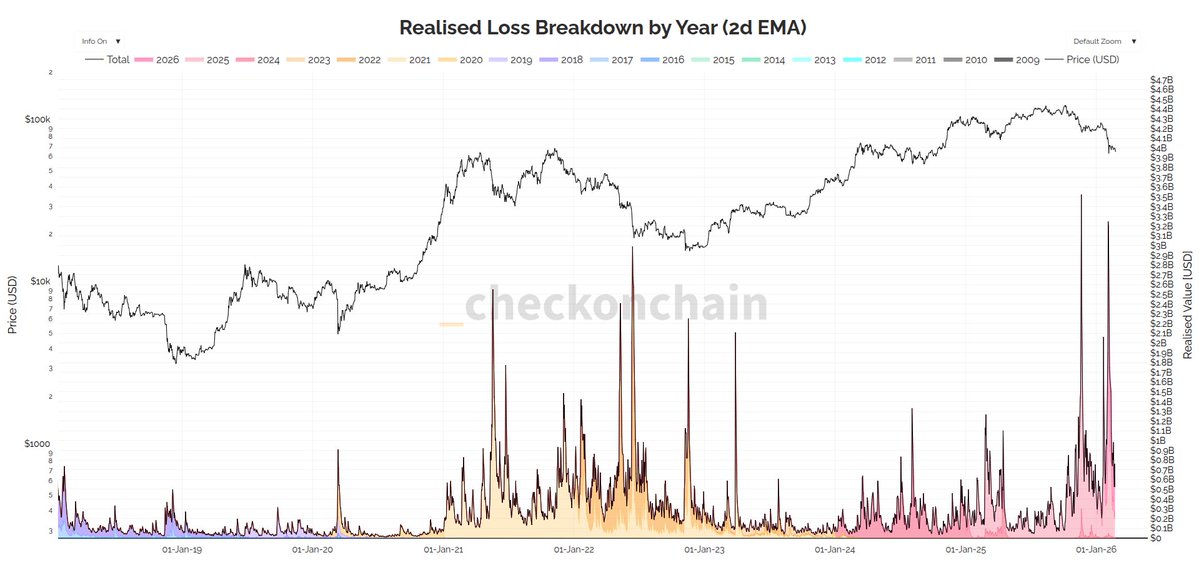
Every mean reversion model, from technical to onchain is trading within bottom formation levels, typically seen after the price capitulation event (which Dec 2018 and Jun 2022 were examples of).
Both sell-offs in Nov and Feb are in the hall of fame of Realised Loss onchain. Not the biggest in relative terms, but by far the largest in USD terms, over $7.5 Billion over just those two days.
We're in the bottom 20% of the most conservative, and bottom 5% of the most aggressive deviations from any sane anchor model.
Either Bitcoin is dead, will no longer mean revert, and all your models are broken...
...Or you should be ignoring the bears, staying very humble, and quietly DCA stacking sats from here on.
Price pain is largely behind us imho, however time pain likely remains. It will claim many who don't want to see the rest of the movie.
We often experience retests of the lows, leaky price charts, powerful rallies...and then lower lows...often with a final capitulation event to book-end the time-pain chapter of the bear.
In my view, even though this sounds horrific, it is unlikely we have anywhere near the aggressive rate of decline, nor depth of decline as has already occurred in Nov'25 and Feb'25. The hard part of the drawdown is most likely behind us.
The difference between $17.6k in June 2022, and $15.6k in Dec 2022...was six months (the price delta is frankly irrelevant for any long-term investor).
There is no rush, but these Bitcoin prices are temporary. How temporary we do not know, but it's tremendously oversold, and there are few statistics I am aware of that suggest otherwise.
The bears will spend the next few months liquidating their trading accounts trying to short the bottom of a painful chopsolidation range. The bulls will do the same by getting too hopeful at the range highs.
Investing is a game of picking great assets, accumulating at low prices, and then being patient as fuck.
The 200-week MA is at $58.5k, a mere bees dick below the $60k low we already set. There are still folks out there who want to haggle over the missing 3%.
The Realised Price is at $55k, which from first principles, should stop being visited over time, as it deviates due to unrealised profit in lost coins (a topic for another day). We've already cleared every excess leverage level down to $60k, no stop losses survived February's move.
This is the time to stay humble, and stack sats.
If you're not actively accumulating Bitcoin at this stage, then when? Don't fantasise over lump summing the exact bottom wick. You will be too scared to do it on the day.
Buy the whole bottom. Dollar cost average for the next six months, and remove your emotions from the problem at hand.
A final note; ignore the bears. They will perpetually revise their targets lower and lower, and get plenty of clicks for doing so. Humans love bear-porn because we're wired to avoid risk.
This is literally what a de-risked setup looks like for Bitcoin.
Ignore the bears, they lack ambition.