@ylecun@Dan_Jeffries1 Exactly. LLMs describe molecules, they don’t model them. You can’t tokenize your way past thermodynamics. We’re building the failure-aware simulator for drug development: physics and causality under physical law, not token statistics. The empirical floor for $1B decisions.
@drfeifei LLMs describe molecules: they do not model them. We are building the failure-aware simulator for drug development. It operates on physics and causality under physical law, not token statistics.
This is the empirical floor for $1B decisions.
The industry studies the 10 percent that succeeded. We model the 90 percent that failed. Mapping pharmacology and exposure liability against the clinical failure record, we define the risk floor.
Part of the @LartaInstitute#HealLA cohort:
https://t.co/egBBhX8KD4
The paradox of biotech valuation: PoS is inversely correlated with commercial upside. The market's blind spot isn't target discovery. It's quantifying human tolerability and structural failure risk before billions are deployed. Most computational models still ignore both.
Detection got fast. Response didn’t.
Sequencing IDs novel pathogens in days. Drug development takes decades.
May 5 @Columbia: our cofounder Harry on a panel with @CepheidNews, @Opentrons, HopeAI. Prof. Sam Sia moderating.
Register by Apr 24: https://t.co/oC8SprRp78
Presented our poster at DDC this week. One session made the case for us; targeted protein degradation has 600+ E3 ligases, the field’s optimized two. The ternary complex is a structural prediction problem now. Failure data isn’t optional when the design space is that big.
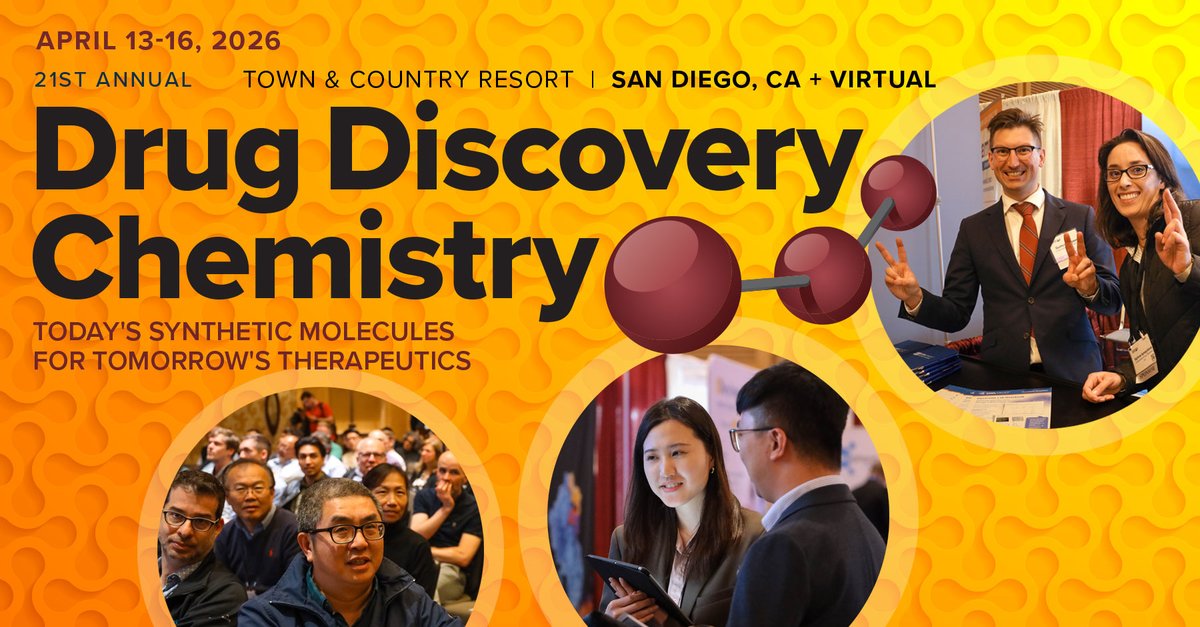
At #DrugDiscoveryChemistry in #SanDiego next week. New poster (P024) on failure-constrained structure prediction across GPCRs and kinases. 90% of drug programs fail. That is not only a tragedy; it is a dataset. Come see what we're doing with it.
cc:@CHI_Healthtech
@biorxiv_bioinfo Thanks for sharing Hyaline! We were really surprised to see how much the E(n)-equivariant layers helped stabilize those Class C predictions compared to sequence-only models. If anyone wants to play with the code, it’s all open-source here: https://t.co/2GIBlrjT97
Hyaline: Geometric Deep Learning for Accurate Prediction of G Protein-Coupled Receptor Activation States from Structure
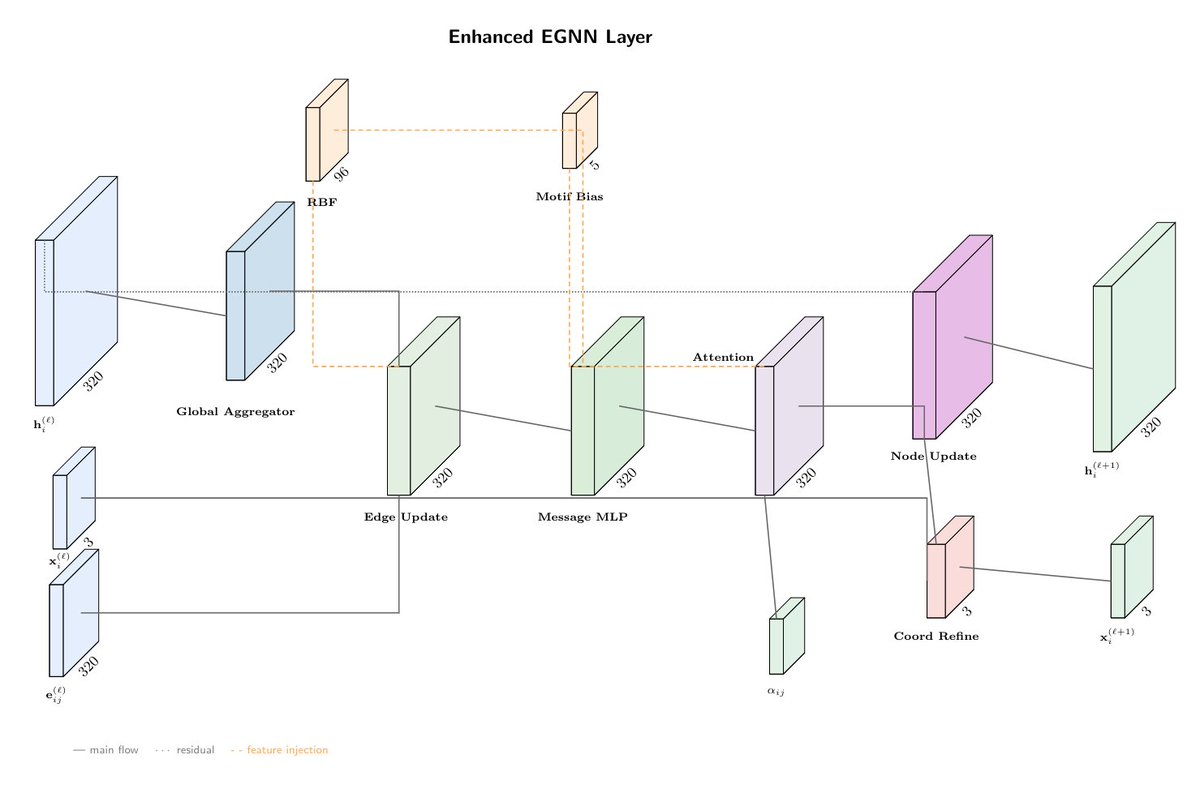
1. Hyaline introduces a novel geometric deep learning framework that predicts GPCR activation states with near-perfect accuracy (AuROC 0.995) by integrating E(n)-equivariant graph neural networks and ESM3 evolutionary embeddings. This approach bridges the gap between sequence-based and structure-based methods, outperforming sequence-only models significantly.
2. The model leverages E(n)-equivariant message passing to capture the subtle, non-local conformational changes that distinguish GPCR activation states. This ensures that predictions are invariant to rotations and translations, focusing solely on the relative arrangement of atoms in the receptor structure.
3. Hyaline incorporates biological priors through motif-specific attention biasing, prioritizing residues within conserved activation motifs such as the DRY, NPxxY, and CWxP motifs. This not only accelerates learning but also improves robustness and interpretability, with attention weights revealing key regions involved in receptor activation.
4. The model demonstrates robust generalization across diverse GPCR classes, including challenging Class C receptors, and maintains high performance even on structures determined with the latest cryo-EM methods. This versatility makes Hyaline a powerful tool for high-throughput discovery of allosteric modulators.
5. Ablation studies highlight the importance of each architectural component, confirming that both evolutionary embeddings and geometric message passing are essential for accurate state discrimination. The model’s attention mechanisms provide insights into the structural basis of activation, correlating strongly with known activation signatures.
6. Error analysis reveals that most misclassifications reflect genuine biological ambiguity rather than model failure, with intermediate states representing opportunities for developing functionally selective compounds. Hyaline’s ability to identify these states could accelerate the discovery of conformationally selective drugs.
7. Hyaline’s linear computational scaling and efficient implementation enable rapid inference on typical GPCR structures, facilitating high-throughput screening of AI-predicted structures. This capability is crucial for assessing the activation states of computationally generated GPCR models in drug discovery contexts.
📜Paper: https://t.co/ljKoCFP7Nl
#GPCR #GeometricDeepLearning #ProteinStructure #ActivationStatePrediction #DrugDiscovery #AIinBiology
@BiologyAIDaily Thanks for sharing Hyaline! We were really surprised to see how much the E(n)-equivariant layers helped stabilize those Class C predictions compared to sequence-only models. If anyone wants to play with the code, it’s all open-source here: https://t.co/2GIBlrjT97
ESM3 + Geometry = A new era for GPCRs. 🚀
We're introducing Hyaline, a GNN-based framework for predicting receptor states directly from 3D coordinates.
🧵 1/10: Why sequence-only models fail at structural switches...
#GeometricDL#ESM3#StructuralBiology