Watch as Jessica Lee, MD, Asst. Prof. of Radiology & Biomedical Imaging, and Preston Sprenkle, MD, Assoc. Prof. of Urology, discuss prostate ablation, a new treatment that uses energy - heat, cold, electricity - to destroy cancer cells @YaleMed@YaleCancer https://t.co/mCl4s7Bqww
Congratulations @JuliusChapiro, MD, PhD, Assoc. Professor of Radiology & Biomedical Imaging @YaleMed, on being invited to join the editorial board of @HEP_Journal, the official journal of @AASLDtweets. He was chosen for his contributions to research & more https://t.co/xod3aBPqQd
Researchers at Fred Hutchinson examined the brains of 59 women after death. In 63 percent of them they found male DNA, almost certainly left behind by a son. The oldest of those women was 94, and the cells were still sitting there.
Around week four or five of pregnancy, before most women have told anyone, a handful of the baby's cells cross into the mother's bloodstream. Some of them never leave. Scientists call it microchimerism, meaning you are carrying a few of another person's cells inside you. Doctors at Leiden University in the Netherlands checked organs from women who had recently been pregnant and found the baby's cells in every single one. Liver, lungs, thyroid, kidneys, bone marrow, skin, heart.
They do not sit idle. When researchers in Ireland biopsied cesarean scars from 70 women, they found the baby's cells living in the skin as ordinary skin cells, making collagen and repair proteins right at the cut. The child helped close the wound its own birth made.
At Mount Sinai, scientists tagged fetal cells with a glowing marker in pregnant mice, then damaged the mothers' hearts. The fetal cells went to the injury. They became heart muscle and the lining of blood vessels. Nobody has proven the human version yet, but doctors have noticed for years that women who develop heart failure around childbirth recover better than almost any other kind of heart failure patient.
In a study of 177 women, fetal cells appeared in the blood of 85 percent of the healthy participants and only 64 percent of the women who had a very early, non-invasive breast cancer. Nobody has worked out yet whether the cells are doing the protecting. The same cells also turn up in Hashimoto's, an immune condition that attacks the thyroid, so this is a gift with complications.
A French team looked at umbilical cord blood in 2021 and found cells belonging to the baby's grandmother in 5 of 28 samples. Cells that crossed one placenta decades earlier had crossed a second one. Three generations of women, alive in a single bloodstream.
Which means the pull a mother feels toward her child has a physical form. It sits in her liver, her heart, and often her brain, and it stays there for the rest of her life.
https://t.co/zy6gM4x5tl
Some background before commenting on some elements of the proposed rule.
The Physician Fee Schedule (PFS) was established in legislation passed in 1989, and went into effect in 1992. Prior to that Medicare paid physicians based on "customary, prevailing and reasonable" (CPR) charges. Essentially a cost plus approach that existed for hospitals before the Inpatient Prospective Payment System (IPPS) went into effect.
Fundamentally, a cost plus approach was breaking the budget, so the government turned to setting prices for services delivered. The framework for price setting was the RVU architecture. Every covered physician service is assigned a CPT code which has 3 RVU components. Work RVU, Practice Expense RVU, Malpractice RVU.
Payment = (wRVU+PE RVU+MP RVU) x geographic practice cost adjustment x Conversion Factor (CF).
The CF is what converts RVUs to dollars. This equation fundamentally determines what a physician is worth in dollars. In 2024 the CF was $32.74. Every year CMS sets a low CF, and every year congress intervenes with a temporary patch.
Its important to understand that the goal for CMS is not to "pay physicians well", the goal for CMS is to be budget neutral. In 1997, Congress passed the Balanced Budget Act that introduced the Sustainable Growth Rate (SGR) formula. This tied the conversion factor yearly update to GDP growth. If physicians increased the amount of services they delivered more than GDP growth, the SGR required the CF to be reduced to make up for it.
By the mid 2000s, the gap was so great that the SGR formula was calling for a 20% cut. Congress overrode the SGR cut every year with 'doc fix' patches.
MACRA act of 2015 got rid of the SGR and replaced it with MIPS and Alternative Payment Models (ACOs). This fixed the CF cut, by mandating an increase in the CF by 0.25%-0.75% / year (Inflation is 3-5% / year).
None of this changes the fact that CMS is forced to be budget neutral. If CMS increases RVUs and payments for E&M, it must reduce the CF to keep total outlays the same. Within the physician fee schedule , any RVU increase for one set of services must be offset somewhere else. It is zero sum.
So with an mind, the proposed fee schedule does a number of things, not all bad, but one of the provisions is really bad.
CMS is proposing to reduce payment when a separately identifiable office/outpatient E/M visit is furnished by the same physician on the same day as a procedure. The most expensive procedure would be paid at 100%, the other procedure at 50%. Commonly a 25 modifier is used to indicate a same day separate procedure so physicians get paid.
CMS is arguing that a same day E/M code is not like a standalone E/M code. The case CMS is going after is the patient who is evaluated for a problem on day x and a procedure is decided on. When the patient comes back 20 days later for their procedure, the patient is seen/evaluated again.
This argument was bad when CMS floated a version of it in 2019 and it's still bad now.
The -25 modifier exists precisely because CMS already acknowledged this problem and built the solution. Modifier -25 requires that the E/M be a significant, separately identifiable service above and beyond the usual pre-procedure evaluation. It is not supposed to be billed when the E/M is merely the routine pre-procedure assessment. The modifier is the mechanism that's supposed to prevent the double-dipping CMS is now claiming to fix with a payment cut.
If the problem is modifier -25 abuse, the correct response is enforcement and auditing, not a blanket 50% payment reduction on every legitimate same-day E/M-plus-procedure encounter.
Three scenarios CMS ignores:
1. Patient presents with a new problem or acute change; you evaluate it, decide independently to perform a procedure, and do so — the E/M decision-making is entirely separable
2. Patient has a scheduled procedure but presents with a comorbidity requiring separate assessment and management decision before you proceed.
3. A cardiology specific example. Patient presents with chest pain, you see , evaluate, and decide to do an echocardiogram the same day.
The stated rationale is a pretext for a budget cut. CMS needs to offset the cost of other proposals. The appropriate remedy for what amounts to modifier -25 abuse is targeted audit activity, not a structural 50% payment reduction on a category of encounters that includes large numbers of legitimate, non-overlapping clinical situations.
There are more sensible places in the PFS that make a lot of sense to go after -- telehealth and remote monitoring are probably abused to a significant degree by third parties, and deserve some fairly significant cuts (remember you need to cut something in a budget neutral world), but the best approach would be to not continue playing the zero sum game.
The current framework is binary: you're either enrolled in Medicare and bound by its payment rates and rules for all covered services, or you opt out entirely and private-contract with everyone. There is no middle path where you remain a Medicare participating physician but can also negotiate separate payment arrangements with individual patients for covered services.
Win-win : Allow private contracting for enrolled physicians - let physicians enter into a voluntary agreement with a Medicare beneficiary to charge above Medicare rates for covered services, without losing their Medicare enrollment or being required to opt out entirely.
I'll reiterate: Budget neutrality means every dollar of E/M increase gets clawed back somewhere else. The CF trajectory is negative no matter what Congress does The system is structurally incapable of paying physicians fairly under its current constraints.
The only reason this is politically survivable is that Medicare patients have no alternative. They can't voluntarily pay more even if they want to — the law forbids enrolled physicians from collecting above the limiting charge, and it forbids patients from contracting around that. The coercion runs in both directions.
This would require a statutory fix -- currently the BBA 1997 act requires a full opt out for physicians, not selective contracting. Congress was concerned that selective private contracting would create a two-tiered system where wealthy Medicare patients could buy better access.
Not surprisingly, the two-tiered system Congress feared has materialized anyway, just through different mechanisms: almost everyone right now that can afford it pays for a concierge physician. Allowing selective private contracts is this is a market freedom argument, not a physician enrichment argument. The goal is to preserve access to high quality physicians. The alternative is either no physicians... or even worse access to lower quality physicians.
To Summarize:
1. The same day reduced payment for procedure/clinical proposal is a bad idea. CMS should crack down on truly "add on" services by audits, not with a blanket rule that hurts appropriate service delivery.
2. Fixing the larger issue of the zero sum nature of the medicare budget is a statutory fix all physicians should unite behind : allow for selective private contracting with Medicare patients.
I urge physicians to comment on the proposed rule:
Go to https://t.co/Qmc0HyTGII
Suggest:
1. Describe actual patient scenarios where the same-day E/M and procedure are genuinely non-overlapping.
2. Make sure to note that if this is finalized, the rational response is to split some encounters across two visits, which costs Medicare more and greatly inconveniences patients.
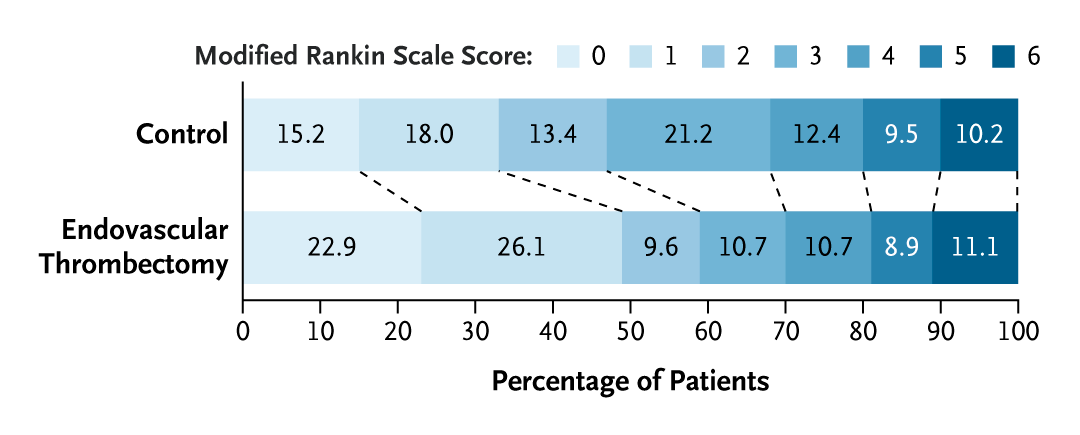
Original Article: Endovascular Treatment of Medium-Vessel-Occlusion Strokes (ORIENTAL-MeVO trial) https://t.co/sa2YKbUb6G
Editorial: Endovascular Therapy for Medium-Vessel Occlusion Stroke — Narrowing the Target Population https://t.co/UBLyNvnu8M
#Neurology
Academic publisher Elsevier's profit margin compared to Apple, Google, and Microsoft
Apple: 28%
Google: 25%
Microsoft: 34%
Elsevier: 37% with a revenue of $3.9 billion.
Elsevier's payment to academic authors and reviewers: $0
A random day at @Yale_IR : 4 PAEs, 1 TIPS, 2 liver embos, 2 ablations (1 liver one kidney), a dialysis fistula and 22 other smaller procedures including venous access, tubes, IVC filters, biopsies and drains. It’s a high volume program and yes, we will work you hard, very very hard. This isn’t “chill”. But you will learn!
@JuliusChapiro@JuliusChapiro, I appreciate your kind words. Mentors make the trainee. Proven examples to follow are everything. I am extremely fortunate for all of you at @Yale_IR and all those at @UMMCRads@UMMC_IR. I wouldn’t be the same without you all.
🚨IMPORTANT: 529 plans just became more powerful under the new tax bill.
If you have kids (or plan to), you need to know these changes.
Here's what's different:
Hearty congratulations to Dr Candy Howard, recipient of the senior faculty career excellence Dr LouAnn Woodward award. Honored to work with her every day!
Congratulations to @CandaceClaudio, this year’s winner of #GWIMS Dr. LouAnn Woodward award, recognizing excellence in service, teaching, and most of all, mentorship of women in medicine and science. We are so proud!
Genicular artery embolization (GAE) is an emerging adjunct/alternative (minimally invasive) procedure to treat OA pain, performed by Interventional Radiologists. We offer it at @UMMCIR. @UMMCRads@UMMCnews
Glioblastoma, an aggressive type of brain cancer, is one of the most formidable challenges in oncology—but microsphere therapy may offer a promising new therapy. Learn more about the early data from the FRONTIER trial, designed by Samdeep Mouli, MD, FSIR; Roger Stupp, MD; and Riad Salem, MD, MBA, FSIR. https://t.co/2j03M2CtED
IR Quarterly features interim results of the Frontier trial studying yttrium-90 (Y-90) for glioblastoma. Sam Mouli is the principal investigator. This microsphere therapy may lead to new IR treatment options for glioblastoma. https://t.co/Ef8rN4Hhr1 @SIRspecialists@SamMouli
Congratulations to our February Faculty Lecturer of the month to one of our newest faculty members, Dr. Juliana Sitta @sitta_juliana ! She started in January and is already winning teaching awards 🥰.