For the last few months, I have been spending my weekends exploring hard tech; specifically, synthetic biology.
While a lot has been done in the last 2 decades in synthetic biology, it's still very much in its infancy.
Compiling some of my notes here: https://t.co/eDn7YQCSxf
New essay : Non consensus and right
Why we believe the next era of crypto venture will be defined by slow, patient capital.
Read here: https://t.co/9AKgRbMXDt
Congrats to @mattkrisiloff, @seres_bianka and the whole @Conception team 👏👏
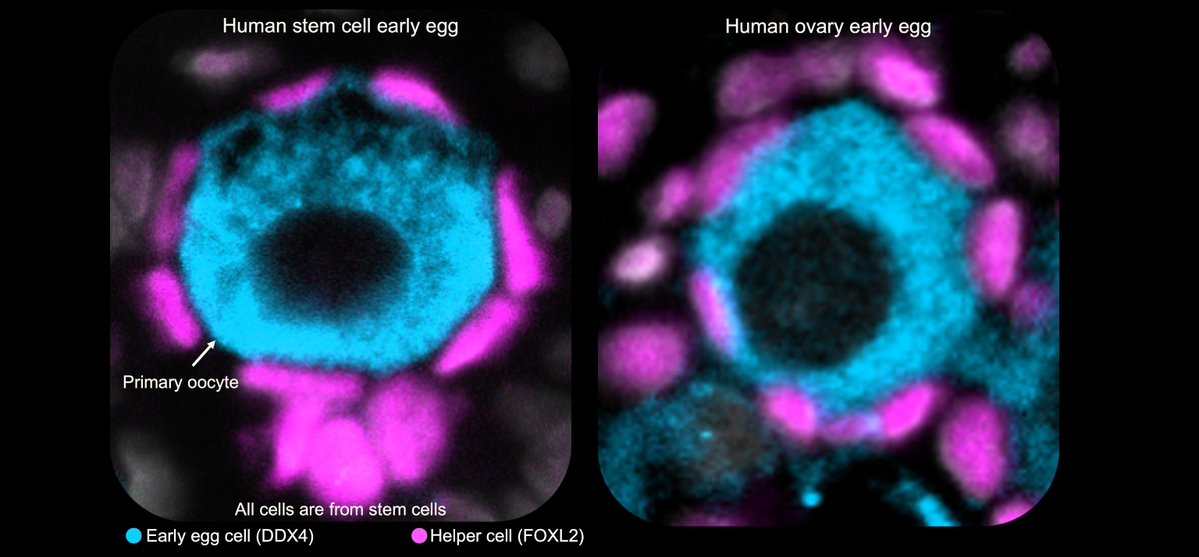
This is a great milestone towards human IVG -- which enables people to create eggs from their own blood or skin cells. It opens up a future possibility of a new world that:
1. eliminates the most taxing part of IVF, which involves weeks of intense hormone injections and surgical egg retrieval
3. enables cancer survivors who have lost their fertility (due to chemotherapy) to be able to have biologically related kids, and
3. enables women to have kids (potentially) at any age, bypassing the natural depletion of eggs!
I’m so excited to share this update on @Conception –
We’ve generated the first early human eggs derived from stem cells.
This is a big deal -- the potential to redefine fertility is real.
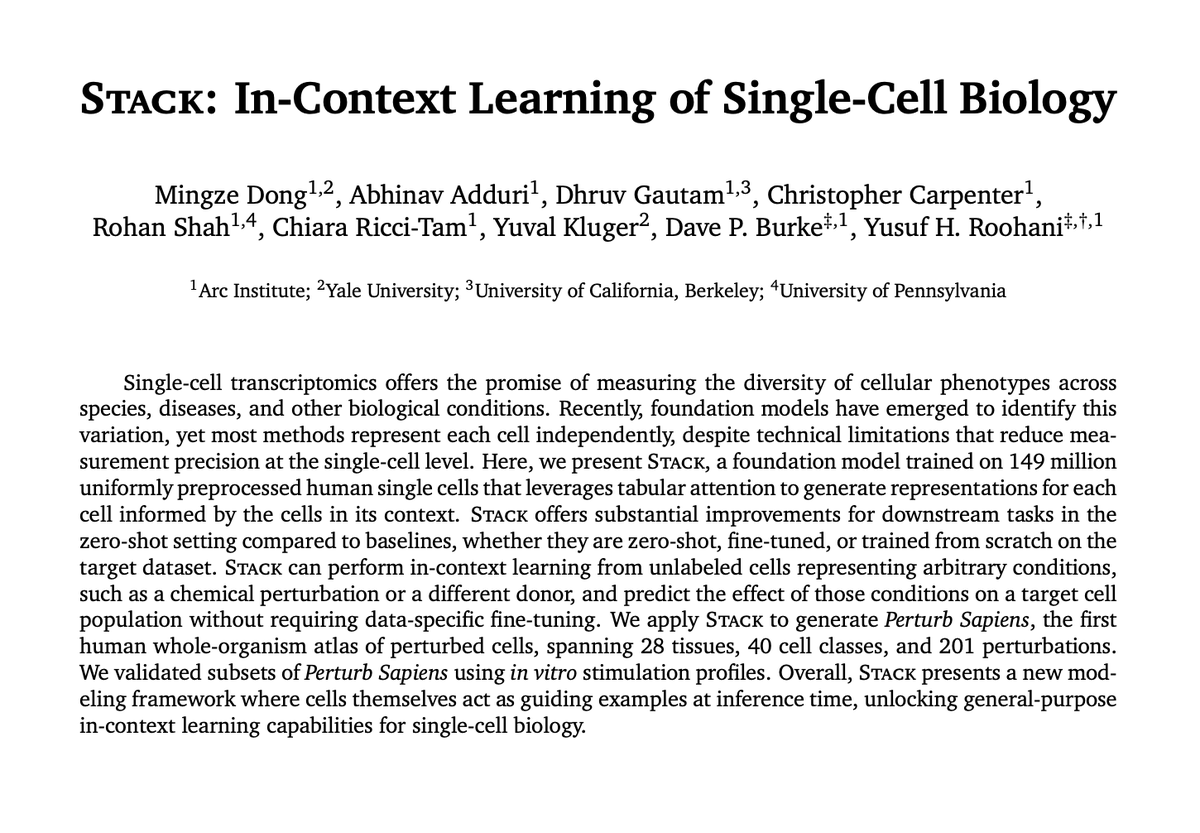
Predicting cell state in previously unseen conditions such as disease or in response to a drug has typically required retraining for each new biological context. Today, Arc is releasing Stack, a foundation model that learns to simulate cell state under novel conditions directly at inference time, no fine-tuning required.
NewLimit paper just dropped @icmlconf showing our SOTA AI models can predict perturbed cell states. Helps to have the largest primary cell perturbation dataset in the world. Bonus points for one of the first demonstration of active learning in bio.
@owl_posting People do want to live longer, healthier lives, but only if it doesn’t require them to do any additional work (consistently eat healthy and exercise).
So, we just haven't found the right product yet (ozempic is a close one though)🙃
I'm new to this (so feel free to correct me), but even if we go by the approach of "deliver an inducible OSKM (or alternative factors) payload to the cell once and then activate its expression with a small molecule", won't we need to cycle the switch on/off periodically cause after each rejuvenation cycle, the cells will deteriorate after a while?
Or are you saying that an individual rejuvenation cycle will need multiple periodic doses of mRNA/LNP modality whereas using the small molecule approach will just need a single dose for an individual rejuvenation cycle?
Poll:
Is the SENS philosophy (not necessarily the original specifics) a viable approach for the aging field?
SENS philosophy = divide & conquer rejuvenation that involves many infrequent therapies to reverse different age-related changes. (Epigenetic reprogramming is included.)
This is an amazing paper from the groups of @anshulkundaje & Scott Boyd and an example of how AI can be used well in biology. Basically, they are able to predict disease status (e.g. lupus, Covid, HIV, influenza) from BCRseq and TCRseq. I think this has great implications.
TL;DR: We built a transformer-based payments foundation model. It works.
For years, Stripe has been using machine learning models trained on discrete features (BIN, zip, payment method, etc.) to improve our products for users. And these feature-by-feature efforts have worked well: +15% conversion, -30% fraud.
But these models have limitations. We have to select (and therefore constrain) the features considered by the model. And each model requires task-specific training: for authorization, for fraud, for disputes, and so on.
Given the learning power of generalized transformer architectures, we wondered whether an LLM-style approach could work here. It wasn’t obvious that it would—payments is like language in some ways (structural patterns similar to syntax and semantics, temporally sequential) and extremely unlike language in others (fewer distinct ‘tokens’, contextual sparsity, fewer organizing principles akin to grammatical rules).
So we built a payments foundation model—a self-supervised network that learns dense, general-purpose vectors for every transaction, much like a language model embeds words. Trained on tens of billions of transactions, it distills each charge’s key signals into a single, versatile embedding.
You can think of the result as a vast distribution of payments in a high-dimensional vector space. The location of each embedding captures rich data, including how different elements relate to each other. Payments that share similarities naturally cluster together: transactions from the same card issuer are positioned closer together, those from the same bank even closer, and those sharing the same email address are nearly identical.
These rich embeddings make it significantly easier to spot nuanced, adversarial patterns of transactions; and to build more accurate classifiers based on both the features of an individual payment and its relationship to other payments in the sequence.
Take card-testing. Over the past couple of years traditional ML approaches (engineering new features, labeling emerging attack patterns, rapidly retraining our models) have reduced card testing for users on Stripe by 80%. But the most sophisticated card testers hide novel attack patterns in the volumes of the largest companies, so they’re hard to spot with these methods.
We built a classifier that ingests sequences of embeddings from the foundation model, and predicts if the traffic slice is under an attack. It leverages transformer architecture to detect subtle patterns across transaction sequences. And it does this all in real time so we can block attacks before they hit businesses.
This approach improved our detection rate for card-testing attacks on large users from 59% to 97% overnight.
This has an instant impact for our large users. But the real power of the foundation model is that these same embeddings can be applied across other tasks, like disputes or authorizations.
Perhaps even more fundamentally, it suggests that payments have semantic meaning. Just like words in a sentence, transactions possess complex sequential dependencies and latent feature interactions that simply can’t be captured by manual feature engineering.
Turns out attention was all payments needed!