What are you worth when nothing is scarce?
For most of human history, economic value came from what you could do and how fast you could do it. If the machines end up smarter, faster, and stronger at every task, what's left? @alexolegimas wrote a great piece arguing that in the world the only thing left to price is human presence itself.
Which raises a set of questions I couldn't stop thinking about. What skills do you actually need when being human is the product? Does everyone end up competing on one likability leaderboard, or does status fracture into a thousand fields with their own hierarchies? Is a market in warmth coercive or any less of a meritocracy than the one it replaces?
New essay on Girard, Versailles, meritocracy, and the revenge of the jocks: https://t.co/6sJ85GJGBz
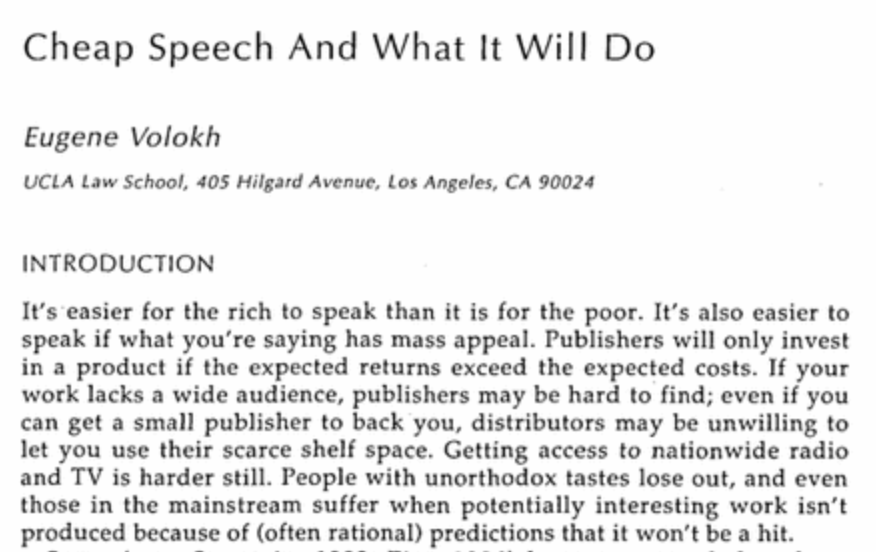
In 1995, my @HooverInst colleague Eugene Volokh published "Cheap Speech and What It Will Do"---the most prescient article ever written about the internet.
In a single piece he predicted Spotify, the Kindle, Substack, and filter bubbles (and more)!
His key insight was: when the cost of speaking drops to near zero, power shifts from intermediaries to speakers and listeners.
Today, the cost of speaking has gotten even closer to zero, and the collapse of intermediaries is accelerating.
Prediction markets are replacing polls, AI tools are replacing experts, and Substacks are replacing newspapers and academic journals.
Yesterday @MTSlive launched, an a16z-backed live show going direct to audiences, bypassing traditional media entirely.
What to make of all this? Volokh predicted the collapse of intermediaries would cause problems--a "possible dark side" he called it--and it has. But he bet that, ultimately, the benefits from unleashing more free expression outweigh the costs.
Will that be true with the strange new media ecosystem we're seeing arise today?
It will probably depend on the choices we make in the coming years to structure AI, prediction markets, and other new tools in ways that align with free societies.
AI writing has so many tells. Once you see it, it's fairly easy to identify (and exhausting to see everywhere).
If you don't know how to spot it, please read: https://t.co/FU3hIq9Opn
The best way to see if you're cut out for trading? Challenge yourself at our Trader Assessment Day
March 6 in London: solve real problems, compete on quant challenges, meet Wintermute traders
Top performers move to final interview
For 2026 graduates
Apply by Feb 15
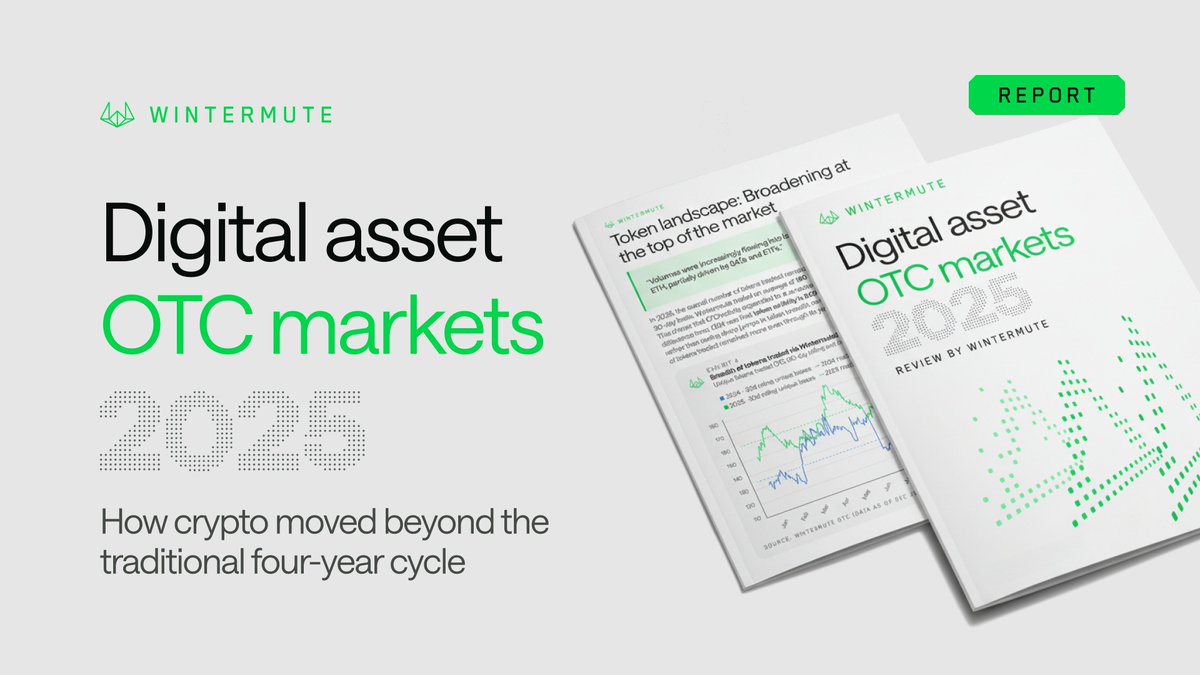
Liquidity came into crypto in 2025, but where did it go?
Using Wintermute’s proprietary OTC flow, our Digital asset OTC markets 2025 report shows where capital actually went and why market structure fundamentally changed
Read on for our key findings ↓
Never be discouraged if you don't feel like you meet a JD's qualifications. Just apply and shoot your shot!
Everybody has impostor syndrome all the time...
We're finally live, and compared to the last year, there are a bunch of significant improvements🛠️
Thanks to our friends from @DefiLlama, @Dune, @LighthouseOne_ and @TenderlyApp for providing the best tools for Alpha 2025 winners
It's just the beginning, steady lads...🛣️
I’m in an airport and the guy next to me has been watching videos with NO HEADPHONES. It’s so annoying. I finally took out my phone and started doing the same. But I made sure to slowly increase my volume over his. He looked over at me like he was super annoyed. And then turned off his phone. Maybe we just need to start matching the energy of these main character narcissists.
Dee Hock on the founding of Visa in his work "Chaordic Organization".
Visa was perhaps the first successful case of a permissionless platform with decentralized governance and ownership.
Many lessons to be learned here half a century later for crypto networks.
Also, while we're at it, throwback to this excellent thread by @ohaiom on extraterritorial application of the US securities laws.
https://t.co/K4q6lnii5M
A significant appellate court decision today in Williams v. Binance , on the extraterritoriality of the US securities laws (i.e. when US laws apply to potentially “offshore” transactions. Important for web3 companies trying to avoid the US because of our lack of legal clarity. 1/
Understanding where the law stops matters as much as understanding what it says. Jurisdictional restraint isn’t just a legal issue. It’s good regulatory policy. Two reasons why ⬇️
1. Regulators have finite resources. They should act where there's a clear mandate and maximum impact. It might feel ambitious to tackle global problems with domestic tools - especially when real harm is involved. But just because you can reach doesn't mean you should. Focus matters.
2. Investor accountability. Sometimes the best protection is making clear where protections don't apply. If you trade on foreign venues, you're taking on the risk of opting out of your home jurisdiction's protections. That risk is part of the decision.