This 2-hour Stanford lecture breaks down how models like ChatGPT and Claude are actually built, clearer than what many people in top AI roles ever get exposed to.
Save this and set aside two hours today. It might end up being the most valuable thing you learn all week.
Amazon Research Awards - Grants for researchers working on agentic AI, robotics, AI security, ML infrastructure, etc. Open globally.
Awards are structured as unrestricted grants & recipients also get AWS credits and access to Amazon scientists
Deadline: May 6, 2026
https://t.co/fJBf9qYfaC
There's a physicist at Stanford named Safi Bahcall who modeled this exact principle and the math is wild.
He calls it "phase transitions in human networks." When you're stationary, your probability of a lucky event is limited to your existing surface area: the people you already know, the places you already go, the ideas you've already been exposed to. Your opportunity window is fixed.
When you move, your collision rate with new nodes in a network increases nonlinearly. Double your movement (new conversations, new cities, new projects) and your probability of a serendipitous encounter doesn't double. It roughly quadruples. Because each new node connects you to their entire network, not just to them.
Richard Wiseman ran a 10-year study at the University of Hertfordshire tracking self-described "lucky" and "unlucky" people. The single biggest differentiator wasn't IQ, education, or family money. Lucky people scored significantly higher on one trait: openness to experience. They talked to strangers more, varied their routines more, and said yes to invitations at nearly twice the rate.
The "unlucky" group followed the same routes, ate at the same restaurants, and talked to the same 5 people. Their networks were closed loops. No new inputs, no new collisions.
Luck isn't random. Luck is surface area. And surface area is a function of movement.
The lobster emoji is doing more work than most people realize. Lobsters grow by shedding their shell when it gets too tight. The growth requires a period of total vulnerability. No protection, no armor, soft body exposed to the ocean.
That's the cost of movement nobody posts about. You have to be uncomfortable first. The new shell only hardens after you've already moved.
Applications for the global Google PhD Fellowship Program are open! Fellowships directly support grad students doing exceptional and innovative research in computer science and related fields as they pursue their PhD. Learn more and apply by April 30 at https://t.co/8HxVR8625d.
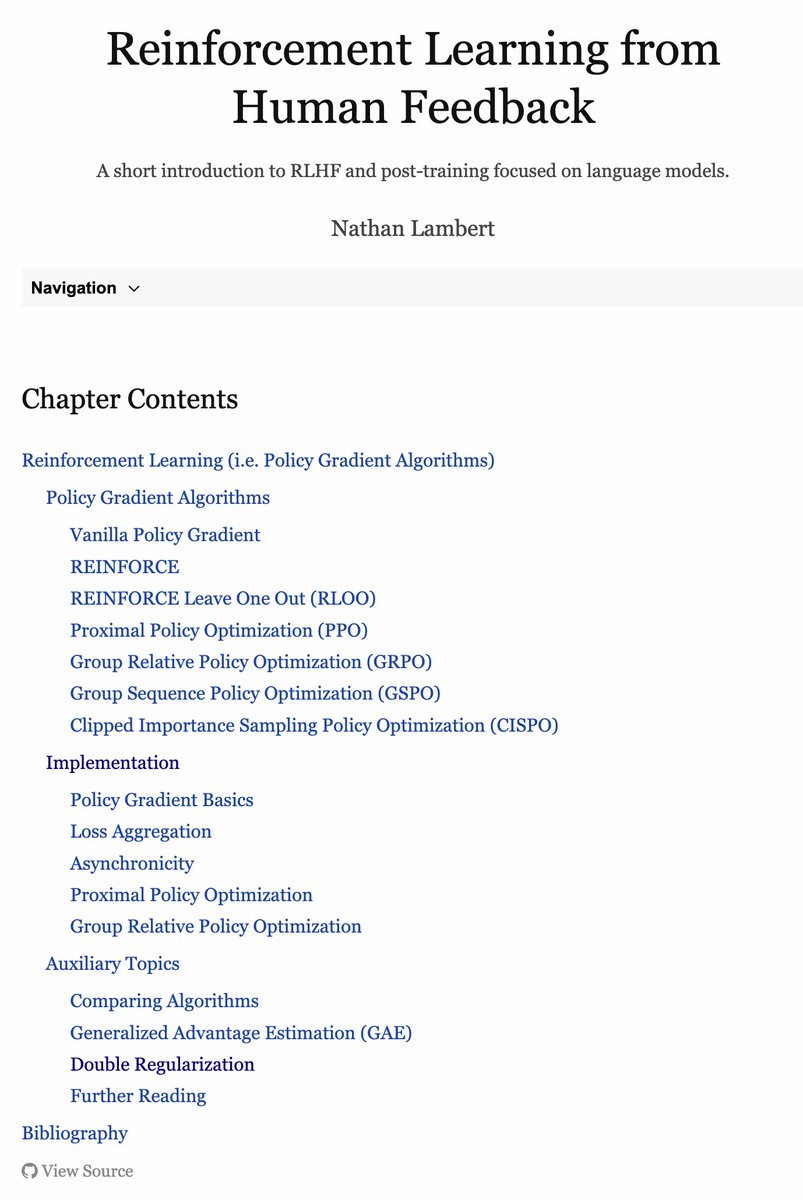
While RL for LLM reviews are in, a good time to remind people I've slowly added a ton of content with new algorithms and implementation tradeoffs to the RLHF book chapter on RL.
Proud of it, and I find it very useful myself.
https://t.co/QjnOE3T24L
If you're an entrepreneurial scientist, you should definitely consider applying for one of the @AsteraInstitute 12-18 month fellowships. Current residents are working on mass-manufacturable space telescopes, reliable fusion energy TEAs, protein-based fibers, terraforming Mars, and more.
They've got three tracks in the current call: Neuro/AI, life sciences, and “other.”
Residents get:
--Salary of between $125,000-250,000 annually (commensurate with experience) and benefits for the duration of your residency
--Additional negotiated budget to cover project expenses (e.g. lab, infrastructure, compute, licenses, personnel), which can range from $0-$1.5M depending on project needs
--Compute resources via Voltage Park, including on-demand access to 24,000 NVIDIA HGX H100s and access to a reserved fleet of B200s and GB300s
--Dedicated workspace at our Emeryville hub with shared amenities and events
--A community of like-minded technologists tackling bold challenges in intelligence and the life sciences
Apply here (deadline is April 17)
https://t.co/0D08rCdN9X
An unsolicited guide to being a researcher: super instructive slides by @EugeneVinitsky https://t.co/sclj1rY930
- different goals of a PhD student
- how to be a good collaborator
- how to keep up with literature
- tracking your ideas & experiments
- stress & productivity
We have 10MW AI compute live in Arkansas and 25MW in Ohio.
Now onboarding partners.
Infrastructure only — no GPUs provided.
If you need serious AI infrastructure, let’s talk.