One of the Zoho group companiee, Vipus Advanced Materials, is focused on carbon fiber composites. A retired ISRO scientist is one of the key people behind it.
Vipus has supplied advanced composite components to Skyroot Aerospace. So Skyroot's successful launch feels even more special!
Vipus is among the fastest companies to qualify as a HAL Class I supplier, with orders for LCA Tejas aircraft structures, and is working with L&T Precision Engineering Systems.
Proud of you Vipus, make Bharat manufacturing great! 🙏
Honoured to meet Hon’ble Prime Minister Shri @narendramodi ji along with my co-founder, Bharath.
From two engineers who started out with a bold idea which had low chance of success��to standing together with the Prime Minister after Vikram-1 became India’s first private orbital launch vehicle to reach orbit, it was a deeply humbling moment.
Your vision and bold reforms opened India’s space sector to private enterprise and empowered a new generation of innovators. We are proud that @SkyrootA could contribute to this national journey.
Committed to building from India, for the world. 🇮🇳🚀
The internet was busy debating jantar Mantar & a quiet facility in India witnessed something straight out of science fiction. An engine fired up. But it did not hum & it did not roar like a normal jet.
It detonated. Continuous supersonic shockwaves raced around a circular chamber 1000s of times/sec, harnessing controlled explosions to generate thrust.
The startup D-Propulse just gave the world a sneak peek of their air-breathing Rotating Detonation Engine (RDE) with an integrated aerospike nozzle.
Every jet engine on a commercial airliner, every fighter jet & every rocket we have ever seen operates on deflagration. We mix fuel with air/oxygen, ignite it & it burns relatively slowly at subsonic speeds. It is effective, but humanity has pushed this tech to its absolute physical limits.
RDEs throw that century-old playbook into the fire. Instead of burning fuel smoothly, an RDE explodes it intentionally. A continuous detonation wave sweeps around an annular (ring-shaped) channel at supersonic speeds, reaching over 2000 m/s. This is called Pressure-Gain Combustion.
It extracts 15-25% more thermal efficiency out of the exact same amount of fuel. In the world of high-speed flight, a 25% jump in efficiency is a completely different league.
Why this Matters for India?
For decades, the narrative surrounding Indian engineering was tied to catching up on legacy systems, spending billions trying to replicate 1970s turbofan engine metallurgy/importing critical defense tech.
D-Propulse is proving that India does not need to play catch-up anymore.
By leapfrogging straight to Pressure-Gain Combustion, an Indian deep-tech startup, guided by veteran scientists & built by young engineers is standing on the frontlines alongside research labs in the US, Japan & China.
Imagine hypersonic cruise missiles, ultra-long-range combat drones & spaceplanes that do not need heavy, complex moving turbopumps to break speed records. That is the realm this technology unlocks.
The future does not belong to those who build better versions of old machines. It belongs to those who rewrite the physics of how machines work.
Hello space, we have arrived! Vikram-1's Test Flight-1 has completed it's mission.
The first ever Indian private sector launch has been successfully completed.
#Vikram1#MissionAagaman#OpeningSpaceForAll
I will give the benefit of the doubt to Ramesh ji here, because he is a satirist & we should treat his statement exactly like that, as a punchline. But beneath the joke lies a deeply rooted, systemic issue within our collective psychology.
Many look at a finished Western product (like a mature WhatsApp/X) & treat it as a static, perfect system, while looking at an Indian alternative as an isolated, flawed event.
In control systems engineering, no system can reach peak performance or stability w/o going through a continuous, iterative Closed-Loop Feedback loop. Silicon Valley products did not drop out of the sky perfectly formed. They spent a decade inside a massive, highly forgiving home market that acted as a positive validation loop.
When an Indian company tries to build a foundational alternative, parts of our own demographic act as an unfiltered noise vector rather than a correction filter. By trying to crash/ridicule/dismiss the product at version 1.0, they starve the engine of the operational data & evolutionary runway it needs to reach version 10.0. They demand a mature output while actively sabotaging the developmental cycle.
In ancient Indian logic (Nyaya), an argument must be rooted in valid validation (Pramana). The immediate tendency to look at a growing domestic product & declare "We can never build a global tech giant" is a textbook logical defect known as Asiddha (unproved premise), heavily driven by a colonial hangover.
Ancient logicians categorized this kind of lazy intellectualism as empty cynicism that confuses a temporary state of development with a permanent lack of capability.
We cannot mock a sapling for not yielding timber on day 1, while proudly importing wood from an older forest. If we want our own Google/X/WhatsApp, our mindset must shift from being cynical consumers to being active stakeholders in our own technological ecosystem. Sridhar Vembu disabling a feature to comply with regulatory changes is how a robust system adapts to changing real-world parameters.
Thanks to the determination & hustle of 2 young Indian physicists, the 1st English book edition of Einstein’s relativity papers was born in Calcutta, not London.
In 1919, the world was thrown into a frenzy when British solar eclipse expeditions dramatically proved Albert Einstein’s Theory of General Relativity. Overnight, everyone wanted to read Einstein’s groundbreaking 1905 & 1916 papers. There was just 1 problem: they were written only in German & no proper English translations existed.
In Calcutta, a brilliant but cash-strapped young physicist named Meghnad Saha saw an opportunity. Along with his colleague Satyendra Nath Bose, Saha decided to translate the papers themselves. If they could bring Einstein’s revolutionary ideas to English-speaking students & scientists, they could finally earn some money to support their own struggling laboratory.
Working tirelessly, the 2 young Indians translated the key papers of Einstein & Hermann Minkowski. In 1920, the University of Calcutta published the book The Principle of Relativity, the very 1st comprehensive English edition of Einstein’s relativity papers in book form.
Einstein later learned of their work & gave the translation his personal approval and blessing. Far from objecting, he was supportive of these young scientists from India who had worked so hard to spread his theory.
While British lawyers were busy fighting over copyright, scientists in distant Calcutta had already mastered his mathematics & brought it to the English-speaking world.
This entire Gig Economy debate reminds me of what they did to Kanpur.
Kanpur was THE ONLY industrial town in North India. It produced some of India's best brands, including a scooter to rival the mighty Bajaj during its peak and other pan-India textile brands.
Then the "pro workers' Communists swopped in.
The agitators became Lok Sabha MPs. Gave nice lectures in five star hotels and satellite TV. Even acted in films.
The industries however became non-competitive. Eventually they shut down. The workers, who were promised the moon if they agitated, soon became jobless. New jobs stopped being created. The region regressed. The city which once provided local employment to India's top minds (from IIT-K) was reduced to a dust bowl.
The Communists won. Everyone else lost.
The story has been repeated over and over again.
The latest target is the Gig Economy and Q-Commerce companies.
The fact is, in the entire history of India's IT revolution, Gig Economy is the first time products have been built by Indians for Indian markets employing Indians at mass scale. And it has succeeded at a scale with few parallels.
There are genuine made-in-India innovations. They fill a need in the market and give a gig to people to earn decent money while they are figuring out what they want to do in life.
Thus the effort to cripple it. And useful idiots (willing or otherwise) latching on to the agenda for quick fame (and some obviously for dubious money).
What happened to Kanpur (and Naini and Kolkata and multiple other places) must not be allowed to happen to India's tech sector.
Last one on this topic, and I have been holding this in myself for a while.
For centuries, class divides kept the labor of the poor invisible to the rich. Factory workers toiled behind walls, farmers in distant fields, domestic help in backrooms. The wealthy consumed the fruits of that labor without ever seeing the faces or the fatigue behind it. No direct encounter, no personal guilt.
The gig economy shattered that invisibility, at unprecedented scale.
Suddenly, the poor aren't hidden away. They're at your doorstep: the delivery partner handing over your ₹1000+ biryani, late-night groceries, or quick-commerce essentials. You see them in the rain, heat, traffic, often on borrowed bikes, working 8–10 hours for earnings that give them sustenance. You see their exhaustion, their polite smile masking frustration with life in general.
This is the first time in history at this scale that the working class and consuming class interact face-to-face, transaction after transaction. And that discomfort with our own selves is why we are uncomfortable about the gig economy. We want these people to look our part, so that the guilt we feel while taking orders from them feels less.
We aren't just debating economics. We are confronting guilt. That ₹800 order might equal their entire day's earnings after fuel, bike rent, and app cuts. We tip awkwardly, or avoid eye contact, because the inequality is no longer abstract. It's personal.
Pre-gig era, the rich could enjoy luxury without moral discomfort. Labor was out of sight. Now, every doorbell ring is a reminder of systemic inequality. That's why debates explode. It's not just policy. It's emotional reckoning. Some defend the system (“they choose it”), others demand change (“this isn't progress, its exploitation”).
And here’s the uncomfortable twist: the unsaid ask of clumsy ‘solutions’ isn’t dignity. It is about returning to invisibility.
Ban gig work and you don’t solve inequality. You remove livelihoods. These jobs don’t magically reappear as formal, protected employment the next day. They disappear, or they get pushed back into the informal economy where there are even fewer protections and even less accountability. Over-regulate it until the model breaks, and you achieve the same outcome through paperwork instead of slogans: the work evaporates, prices rise, demand collapses, and the people we claim to protect are the first to lose income.
And then what happens?
The rich get their old comfort back. Convenience returns without faces. Guilt dissolves. We go back to clean abstractions and moral posturing from a distance. The poor don’t become safer, they become invisible again: back in cash economies, back in backrooms, back in shadows where regulation rarely reaches and dignity isn’t even debated.
The gig economy just exposed the reality of inequality to the people who previously had the luxury of not seeing it. The doorbell is not the problem. The question is what we do after opening the door.
Visibility is the price of progress. We can either use this discomfort to build something better (which we keep doing continuously as delivery partners are our backbone), or we can ban and over-regulate our way back into ignorance. One of those choices improves lives. The other simply helps the consuming class feel virtuous in the dark.
Wise words
“My name’s Frank. I’m 64, a retired electrician.
Forty-two years I spent running wires through houses, fixing breakers, making sure people had light in their kitchens and heat in their winters. Never once did anyone ask me where I went to college. Mostly, they just wanted to know if I could get the power back on before their ice cream melted.
Last May, I was at my granddaughter Emily’s school career day. You know the drill — doctors, lawyers, a software guy in a slick suit talking about “scaling startups.” I was the only one there with a tool belt and work boots.
When it was my turn, I told the kids, “I don’t have a degree. I’ve never sat in a lecture hall. But I’ve wired schools, hospitals, and your principal’s house. And when the hospital generator failed during a snowstorm in ’98, I was the one in the basement with a flashlight, keeping the lights on for newborn babies upstairs.”
The kids leaned forward. They had questions — real ones. “How do you fix stuff in the dark?” “Do you make a lot of money?” “Do you ever get zapped?” (Yes, once, and it’ll curl your hair.)
When the bell rang, one boy hung back. Small kid, freckles, hoodie too big for him. He mumbled, “My uncle’s a plumber. People laugh at him ’cause he didn’t finish high school. But… he’s the only one in the family who can fix anything.”
I looked that boy in the eye and said, “Kid, your uncle’s a hero. When your toilet overflows at midnight, Harvard ain’t sending anyone. A plumber is.”
Here’s the thing nobody told me when I was young — the world doesn’t run without tradespeople. You can have all the engineers you want, but if nobody builds the house, wires the power, or lays the pipes, those blueprints just sit in a drawer.
We’ve made it sound like trades are what you do if you can’t go to college, instead of a path you choose because you like working with your hands, solving problems, and seeing your work stand solid for decades.
Four years after high school, some kids walk away with diplomas. Others walk away with zero debt, a union card, and a skill they can take anywhere in the world. And guess what? When your furnace dies in January, it’s not the diploma that saves you.
A few weeks ago, that same freckled kid’s mom stopped me at the grocery store. She said, “You probably don’t remember, but you told my son trades are important. He’s shadowing his uncle this summer. First time I’ve seen him excited about anything in years.”
That’s the part we forget — for some kids, knowing their path is respected changes everything. It’s not about “just” fixing wires or pipes. It’s about pride. Purpose. The kind that sticks with you long after the job’s done.
So next time you meet a teenager, don’t just ask, “Where are you going to college?” Ask, “What’s your plan?” And if they say, “I’m learning to weld,” or “I’m starting an apprenticeship,” smile big and say, “That’s fantastic. We’re going to need you.”
Because we will. More than ever. And when the lights go out, you’ll be glad they showed up.”
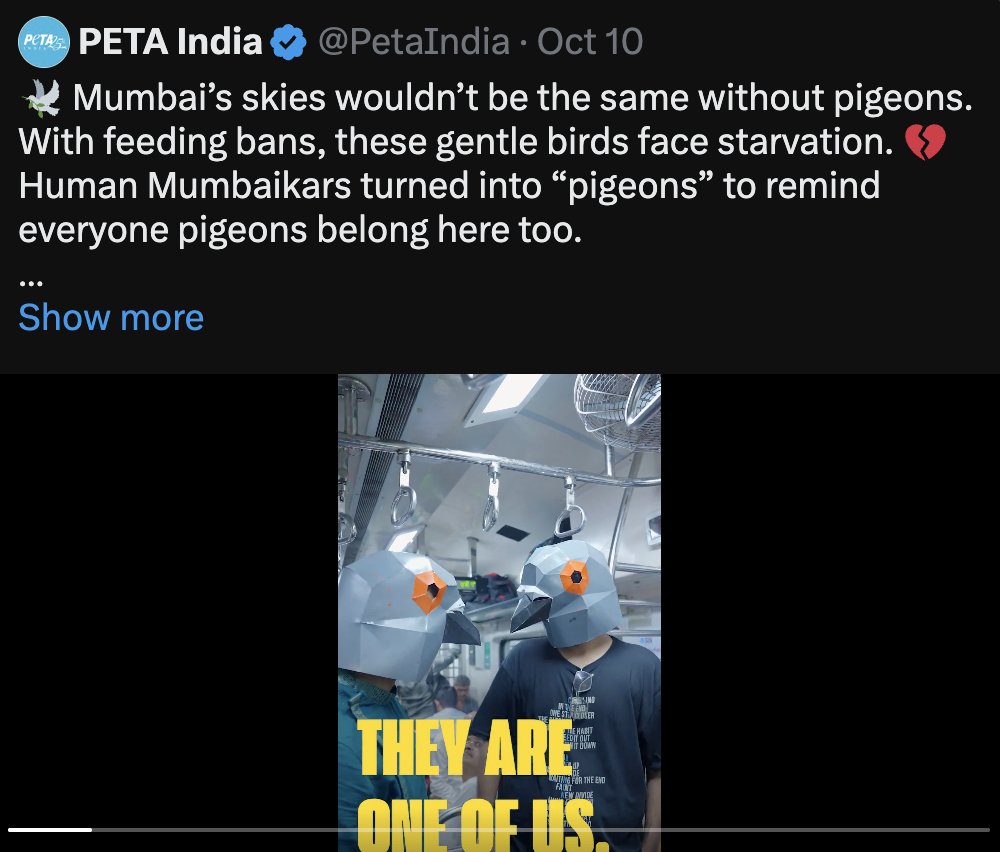
Pigeons are not one of us.
They are a foreign bird species introduced to India by Arabs and Portuguese in the medieval times. And increased in population by the Mughals for 'Kabootarbazi', their elite cruel sports, and imperial messaging.
Further, Pigeons transmit diseases like histoplasmosis, cryptococcosis, salmonellosis via droppings. They cause allergies/asthma in 10-15% of urban Indians affecting our children and killing our weak and elderly.
Their fouling contaminates food/water in cities. They reproduce quite fast, doubling every 6-8 months. In foreign cities, they cull Pigeons every now and then killing them in their hundreds for the same reasons.
But somehow in India, some foreign orgs, using their local chapters, program Indians to keep feeding and multiplying pigeons.
For what?
Why should Indians keep feeding and helping multiply thousands of Pigeons, a foreign invasive species that reduces local fauna like Sparrows and Mynas?
Why some supposedly "animal protection" foreign orgs, that you follow because you are a compassionate animal lover, are NOT campaigning for our native birds like Sparrows and Mynas that help control pests that help Indian people (they eat 5-15% of mosquitoes daily), and importantly, our food security?
Is it that these foreign orgs want Indians to suffer diseases so the foreign Private Equity bought medical system can profit from it? Is it that they want India's agriculture to be affected by pests that our Sparrows and Mynas keep in check?
I don't know.
You decide as a intelligent, animal loving, compassionate Indian with best interests to your own health and the country's. And spread your message once you decide rationally. This is quite important.
So apparently China has several top models now. I can understand India’s manufacturing challenges. I can understand the infra gaps.
What I can’t understand is how Indian IT giants sitting on billions have made no real AI progress while their core business is under direct threat. And they continue to peddle nonsensical visas and what not. That business is over!
And no I’m not talking about cash starved startups. No. This isn’t even about India. It just makes business sense to own SOTA models if you’re an IT leader with 100k+ employees. AI will eat your own business alive in ten years. It’s just common sense!
You have the cash. It’s sitting on your balance sheet. Use it. There’s absolutely no cope except that you’re intellectually lazy and nobody is calling this out
This is a historic L. Monumental mistake. One for the history books.
Big big blackpill lads I can’t lie.
India has to value people who do hands-on work, including electricians, plumbers, welders and nurses. We need people who build things.
We do not need more Economics or Political Science or History majors. I study history, philosophy and economics but I would never want to get a degree in any of them.
Opening ever more degree colleges does not build skills and does not offer livelihoods.
You want cream of core engineering talent to startup in core engineering and defence hardware making, help them.
1. Capital
VCs are finding it very hard to fund hardware startups in Indian defence bcos the defence establishment works on No Cost No commitment basis. With sharing product development costs or giving a commitment it is near impossible for startups to keep putting in their own money or of the VCs. Some risk underwriting and to be there from Govt. IDEX NIIO etc help but nowhere close to being enough. Early stage seed funding from govt necessary for people to take confidently where upfront capital expenditure and long lead times to development are common.
2. Timely payment and contract enforcement
Today startups are forced to run multi year operational expenses cash reserves cos they won’t get paid by govts org on time. No use holding a purchase order when payments are pending for 15 18 months on delivered goods and services.
It is daylight robbery by the govt. payments should be settled within a 30-45 day window without kickbacks.
3. Access to resources
While places like T-Hub and IIT-M Research Park, IISc ArtPark are useful the capacity is nowhere close and it is not easily accessible for everyone. Need more labs and prototyping centres.
4. Equal Opportunity
Today someone working on a defence related problem needs the network of a retd Colonel or Commodore or Gp Captian who had the network inside to be able to get even the first meeting with the services to understand and propose solution. It is not equal opportunity. Only those with network
5. Corruption
Today anyone wants to register a company and start a workshop there’s corruption. Local councillor to MLA’s goondas will see when you bring in equipment to a place. And then the corruption in MoD procurement. This is why most millennials go for a software startup which is B 2 B. A room in a Koramangala block won’t attract attention of local councillor or politican or the orders aren’t dependent on Indian babudom.
Challenges of funding in startups and how the govt(MoD) can help overcome that. Excellent points. “If a founder is worried at paying salaries at the end of every month until the next funding round, how will they focus on the product/technology? They’ll focus on keeping it alive”
@zoomcarhelpdesk Please send me the invoice for my booking JPSNJA3XN. It has been over a month since the booking was complete, and it still says the invoice is being generated.
@Zoomcar_India Please send me the invoice for my booking JPSNJA3XN. It has been more than 15 days since the booking was complete, and it still says the invoice is being generated.