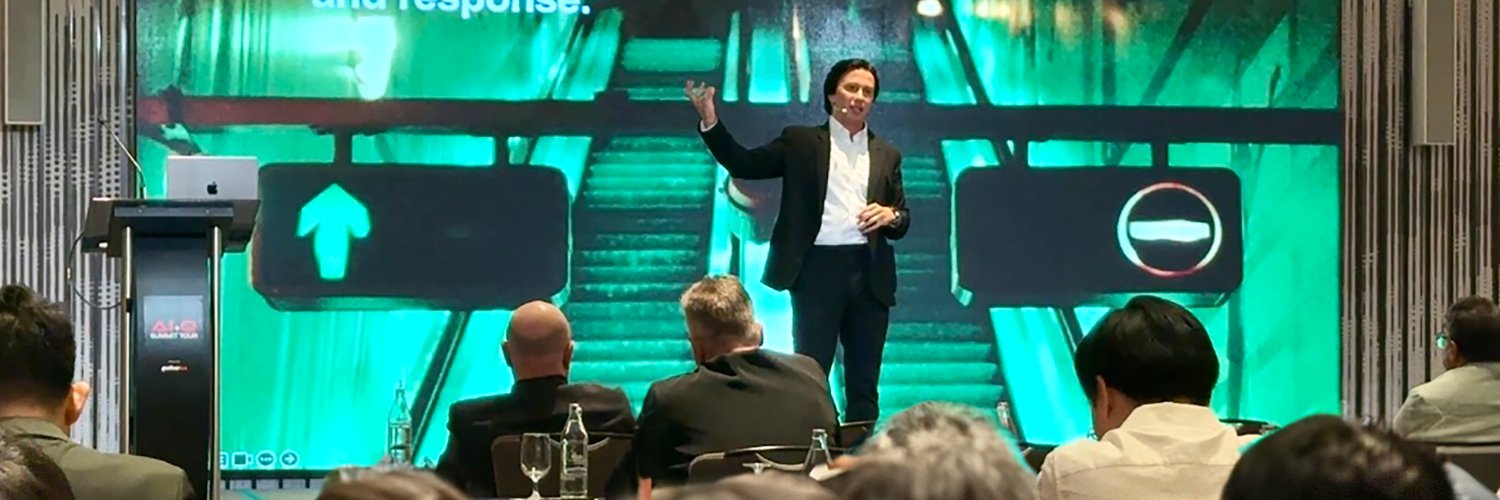
Last week I spoke to Noland Arbaugh @ModdedQuad about his journey & his views on a BCI future.
Then we drew some lines together on a shared canvas: him controlling the cursor using his thoughts (via @neuralink), and me - the old school way, using a computer trackpad.
Going to space was the favourite tech-billionaire side project of the 2000s and 2010s.
Now it is going deep inside the brain.
Musk, Gates, Altman, Thiel.
But Jeff Bezos has more positions in neurotech than any peer. And on multiple layers.
@Coincidenceig Oxley is somewhat active on LinkedIn, Synchron has a decent following there too.
Also on X: @tomoxl@synchroninc
Agreed, the Stentrode by Synchron is a revolutionary BCI that deserves way more attention than it gets
The man who built Internet Explorer at Microsoft in 1994, sold a neural-interface startup to Meta for $500m - $1b in 2019, and spent five years building the Meta Neural Band, has now raised $500m for Flourish, his brain-inspired AI startup.
Bezos invested nearly $100m
Jeff Bezos puts nearly $100M into Internet Explorer creator Thomas Reardon's new brain-inspired AI startup, in a $500M round at a $2.5B valuation https://t.co/MtcEFqghfG
#BCI#Neurotech#BrainComputerInterface
Neuralink hires its first federal lobbyists, with former House Ways and Means Rep. Ron Kind on the brain-computer interface coverage account https://t.co/nFfIyy0LzS
#BCI#Neurotech#BrainComputerInterface
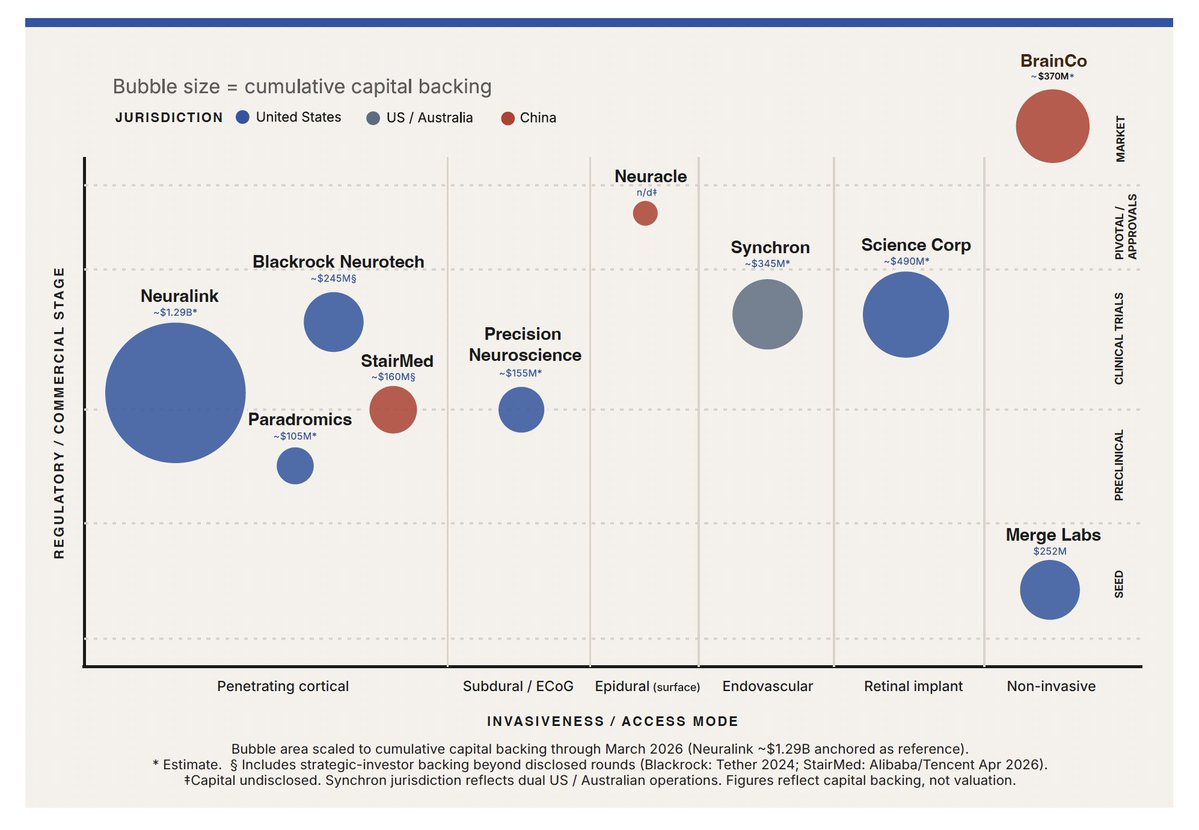
Here is an overview of the 10 leading BCI companies - there is an entire BCI universe outside of Neuralink, doing very important work:
https://t.co/SpoxMDIxDB
Ten leading companies are racing to commercialize Brain-Computer Interfaces across various access modes.
Here is a brief summary of the leading startups in the space:
@neuralink is the most heavily funded in the category at $1.29 billion cumulative capital backing. Its 1,024-electrode N1 array operates under the FDA-approved PRIME study, recently expanded to 21 participants. Targeting high-volume production and thousands of implants annually by 2030.
@synchroninc (US/Australia) offers the most advanced endovascular approach with its Stentrode; it closed a $200 million Series D, achieved Apple BCI HID integration, and is developing the Chiral cognitive foundation model with NVIDIA.
@BlackrockNeuro_ brings the longest clinical track record in implantable BCI, over 40 human implants since 2004. Its 96-channel Utah Array remains the academic research standard across published BCI literature. Tether acquired a majority stake for $200 million in 2024.
@PrecisionNeuro_ Neuroscience uses ultra-thin surface electrodes (1,024 channels per array, 4,096 demonstrated) and closed a $102 million Series C in December 2024; its lower-risk approach secured FDA 510(k) for its electrode arrays in April 2025.
@ScienceCorp_ is closest to Western commercialization with its PRIMA retinal implant; it raised $230 million in March 2026 and expects CE mark approval by mid-2026.
@paradromics achieved 200+ bps in preclinical testing with its 421-electrode* Connexus array. First chronic human implant expected H1 2026. (*Single module; full Connexus system links up to four modules for 1,600+ channels at full deployment.)
@merge closed a $252 million seed round led by OpenAI in January 2026 at an $850 million valuation. Pursuing non-invasive sonogenetics. Stealth mode, no public product timeline released yet.
Neuracle Medical Technology secured the world’s first regulatory approval for an implantable BCI in March 2026 (NMPA clearance for its NEO device).
Stairmed Technology is the most heavily capitalized invasive Chinese player after a $72.5 million round backed by Alibaba and Tencent.
BrainCo Inc leads non-invasive BCI globally with scaled products in education and prosthetics; closed a $286 million Series B-II round in January 2026 at a $1.3B pre- IPO valuation, with a Hong Kong IPO targeted.
Analysis and map from Dargentic's BRAIN-COMPUTER INTERFACES: THE TAKEOFF ERA Report, Released April 2026 (data cut off 31 March 2026).
'As the technology evolves, it has the potential to expand to more regions of the brain — opening new possibilities for treatment, communication, and scientific discovery.'
I am constantly surprized at the asymmetry between Neuralink's following (and awareness around it) and that of any other serious BCI player in the space. Precision Neuroscience is doing incredible work in high resolution invasive BCIs and has already secured FDA 510(k) for its electrode arrays in April 2025.
Follow @PrecisionNeuro_
For more than two decades, @PrecisionNeuro_ co-founder Dr. Benjamin Rapoport has worked to close the gap between the engineers and scientists building BCI technology and the real-world needs of the people it’s meant to serve — along with their physicians and caregivers.
Today, our BCI tech is designed to help people living with paralysis operate digital devices using only their thoughts, restoring independence and connection for millions. And this is only the beginning. As the technology evolves, it has the potential to expand to more regions of the brain — opening new possibilities for treatment, communication, and scientific discovery.
Learn more here: https://t.co/FThBss3qjN
@petrkonicek Yes I feel that ‘a decade’ can be taken as very ambitious but also as very generous at the same time, subject to many factors (tech advancements, approvals, adoption, etc).
One thing I am convinced of, is that is absolutely inevitable
The era of the enhanced human is not too far ahead of us.
Brain-Computer Interface headlines are still entirely medical. Amazing (and incredibly important) work is being done in restoration.
But we will soon approach a tipping point where BCIs don't just fix what was lost, they start adding capabilities humans never had.
NeuroXess says its Mandarin-decoding brain implant runs at 300 characters a minute, faster than native speech https://t.co/RLbkrg7toB
#BCI#Neurotech#BrainComputerInterface
This is a once-in-human-history moment. Rethink how you spend time. Rethink how you spend money. Whatever you do, don't stay stuck or frozen in the past.
Ten leading companies are racing to commercialize Brain-Computer Interfaces across various access modes.
Here is a brief summary of the leading startups in the space:
@neuralink is the most heavily funded in the category at $1.29 billion cumulative capital backing. Its 1,024-electrode N1 array operates under the FDA-approved PRIME study, recently expanded to 21 participants. Targeting high-volume production and thousands of implants annually by 2030.
@synchroninc (US/Australia) offers the most advanced endovascular approach with its Stentrode; it closed a $200 million Series D, achieved Apple BCI HID integration, and is developing the Chiral cognitive foundation model with NVIDIA.
@BlackrockNeuro_ brings the longest clinical track record in implantable BCI, over 40 human implants since 2004. Its 96-channel Utah Array remains the academic research standard across published BCI literature. Tether acquired a majority stake for $200 million in 2024.
@PrecisionNeuro_ Neuroscience uses ultra-thin surface electrodes (1,024 channels per array, 4,096 demonstrated) and closed a $102 million Series C in December 2024; its lower-risk approach secured FDA 510(k) for its electrode arrays in April 2025.
@ScienceCorp_ is closest to Western commercialization with its PRIMA retinal implant; it raised $230 million in March 2026 and expects CE mark approval by mid-2026.
@paradromics achieved 200+ bps in preclinical testing with its 421-electrode* Connexus array. First chronic human implant expected H1 2026. (*Single module; full Connexus system links up to four modules for 1,600+ channels at full deployment.)
@merge closed a $252 million seed round led by OpenAI in January 2026 at an $850 million valuation. Pursuing non-invasive sonogenetics. Stealth mode, no public product timeline released yet.
Neuracle Medical Technology secured the world’s first regulatory approval for an implantable BCI in March 2026 (NMPA clearance for its NEO device).
Stairmed Technology is the most heavily capitalized invasive Chinese player after a $72.5 million round backed by Alibaba and Tencent.
BrainCo Inc leads non-invasive BCI globally with scaled products in education and prosthetics; closed a $286 million Series B-II round in January 2026 at a $1.3B pre- IPO valuation, with a Hong Kong IPO targeted.
Analysis and map from Dargentic's BRAIN-COMPUTER INTERFACES: THE TAKEOFF ERA Report, Released April 2026 (data cut off 31 March 2026).