While doing an extensive literature search on the definitions of a central term within exercise science, I have learned two things:
1) People do not read what they cite;
2) People do not cite what they read.
@MatthewBJane@chrastil Thanks for the shout Matthew! Sounds like a fun project, happy to help. I definitely have enough experience for a ”first logo”, wouldn’t consider myself a pro though…
Reading this and it’s like every time psychological research takes a wrong turn, sport and exercise science is sure to follow, but at least three decades behind:
https://t.co/LuQVipHpl4
@JamesSteeleII Starting to get a grasp on this… 🤣 Also get why people don’t do it as it reduces the research output, which obviously is bad for the business 💁🏼♂️
📊 How often do strength and physique athletes deload?
✅ What are the reasons for implementing deloads?
📈 How do strength and physique athletes adjust their training during a deload?
👇
https://t.co/posZwCoNGD
@DrDavidNolan@pakpatroklos@MiloWolf12@veluimmonen
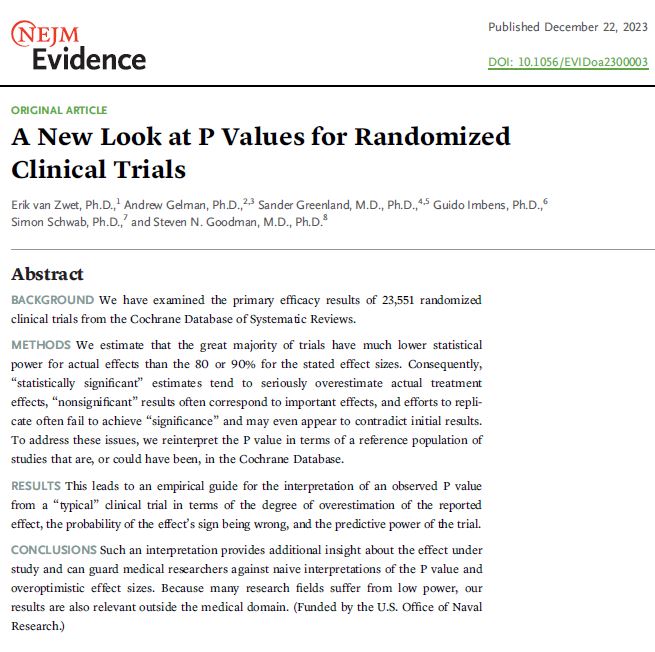
Don't like p-values? We're presenting a completely new interpretation in the context of clinical trials. With Andrew Gelman, Sander Greenland, @guido_imbens Simon Schwab and Steve Goodman. @Lester_Domes@goodmanmetrics@NEJMEvidence
https://t.co/iIu46aY3mZ
New paper by Cristian Mesquida @JennyMurphy2@JoeWarne1 and me in the Journal of Sport Sciences: “Publication bias, statistical power and reporting practices in the Journal of Sports Sciences: potential barriers to replicability” https://t.co/UgaaymaarK Some results: