@Aerolineas_AR Cancelled a booking within 24 hours of booking and rebooked due to a slight change in schedule on your website. I have cancellation confirmation email from your firm. It has been over 90 days and i still have not received the refund.
Are you watching the Chinese New Year Gala? The Robot Kungfu show is mind blowing!!!
They just executed a coordinated martial arts routine with spatial precision, rhythm control, and dynamic balance adjustments in real time.
Kung fu, one of China’s most iconic traditional art forms , performed by machines built with cutting-edge AI control systems, advanced actuators, and high-speed feedback loops. Ancient discipline meets algorithmic precision.
Last year, humanoid robots stepped onto the Spring Festival Gala stage for the first time. This year, they held synchronized kung fu stances with balance that would humble half of us after leg day.
And they did it live!!! On the most-watched television event on the planet.
The progress in just one year is magical.
That’s what we call China speed.
What makes it even sweeter is where this happened.
I love how the progress is integrated in culture. In celebration. In a Lunar New Year gala watched by hundreds of millions.
It’s music to my ears.
The robots didn’t look like they were “trying” anymore. They looked like they belonged.
Their joint articulation was smoother.
Their formation timing tighter.
Their balance recovery almost elegant.
Their choreography is expressive.
That’s what happens when AI models improve, control systems get smarter, hardware stabilizes, and iteration cycles compress.
One year in robotics today is not the same as one year ten years ago.
It’s compounding.
If this is what 12 months looks like,
imagine 36.
The Chinese New Year Robot Kungfu Gala is just futuristic.
It was quite the statement!
The future is getting better very, very fast.
It was so beautiful to watch. What do you think?
🚀 My first video of 2026 and it’s a BIG one 🤖🔥
Ever wondered how similar Google’s Gemini Agent Designer and Microsoft 365 Copilot’s Agent Builder really are? 👀
Spoiler alert: the overlap is wildly close.
In this video, I put these two cloud giants side-by-side and walk through:
🧭 Nearly identical navigation patterns
🛠️ Building agents in both platforms step-by-step
🧪 Live testing the agents head-to-head
🔐 Governance, security, sharing, and admin controls
🔌 Connector access and control
Full breakdown here 👉 https://t.co/aHITh4opv0
Watch 👀 or bookmark 🔖, learn 🧠 and share🥰.
#CopilotStudio #Microsoft365 #GoogleGemini #AgentBuilder #AIAgents #LowCode #AgenticAI #ITAdmins #DecisionMakers #2026Kickoff
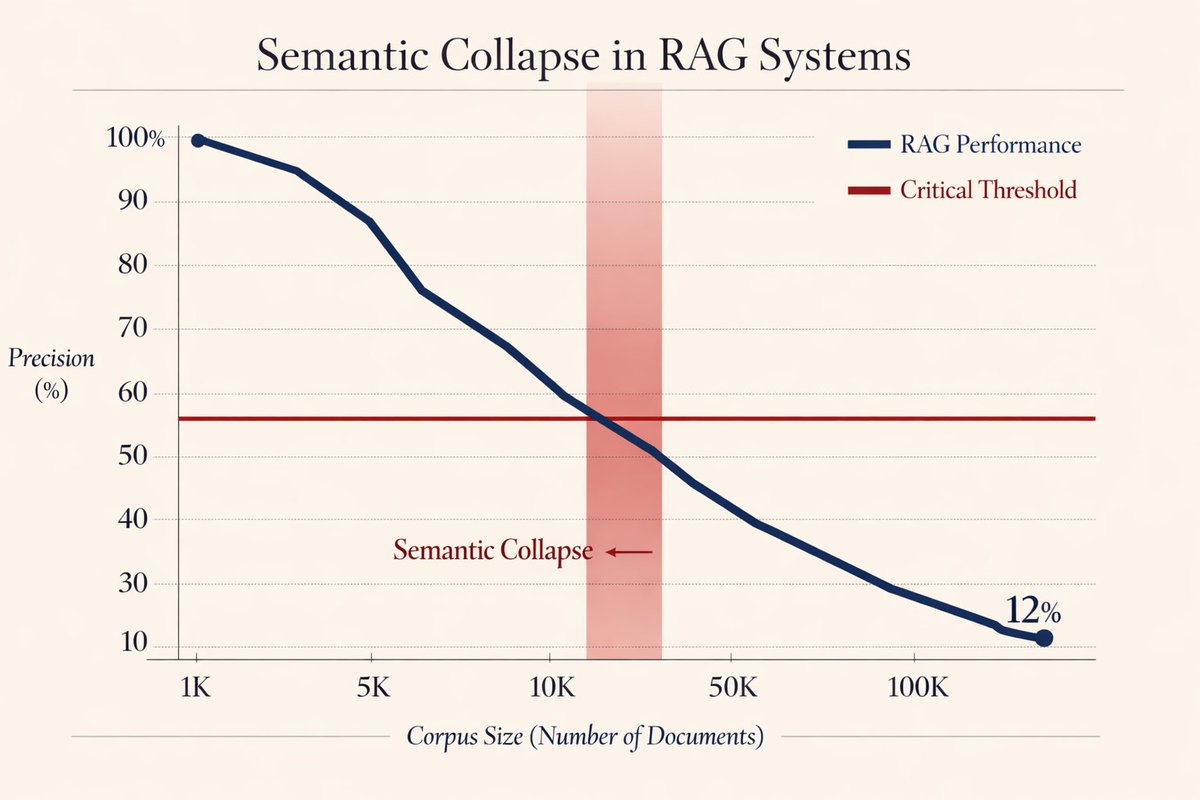
🚨 RAG is broken and nobody's talking about it.
Stanford just exposed the fatal flaw killing every "AI that reads your docs" product.
It's called "Semantic Collapse", and it happens the moment your knowledge base hits critical mass.
Here's the brutal math (and why your RAG system is already dying):
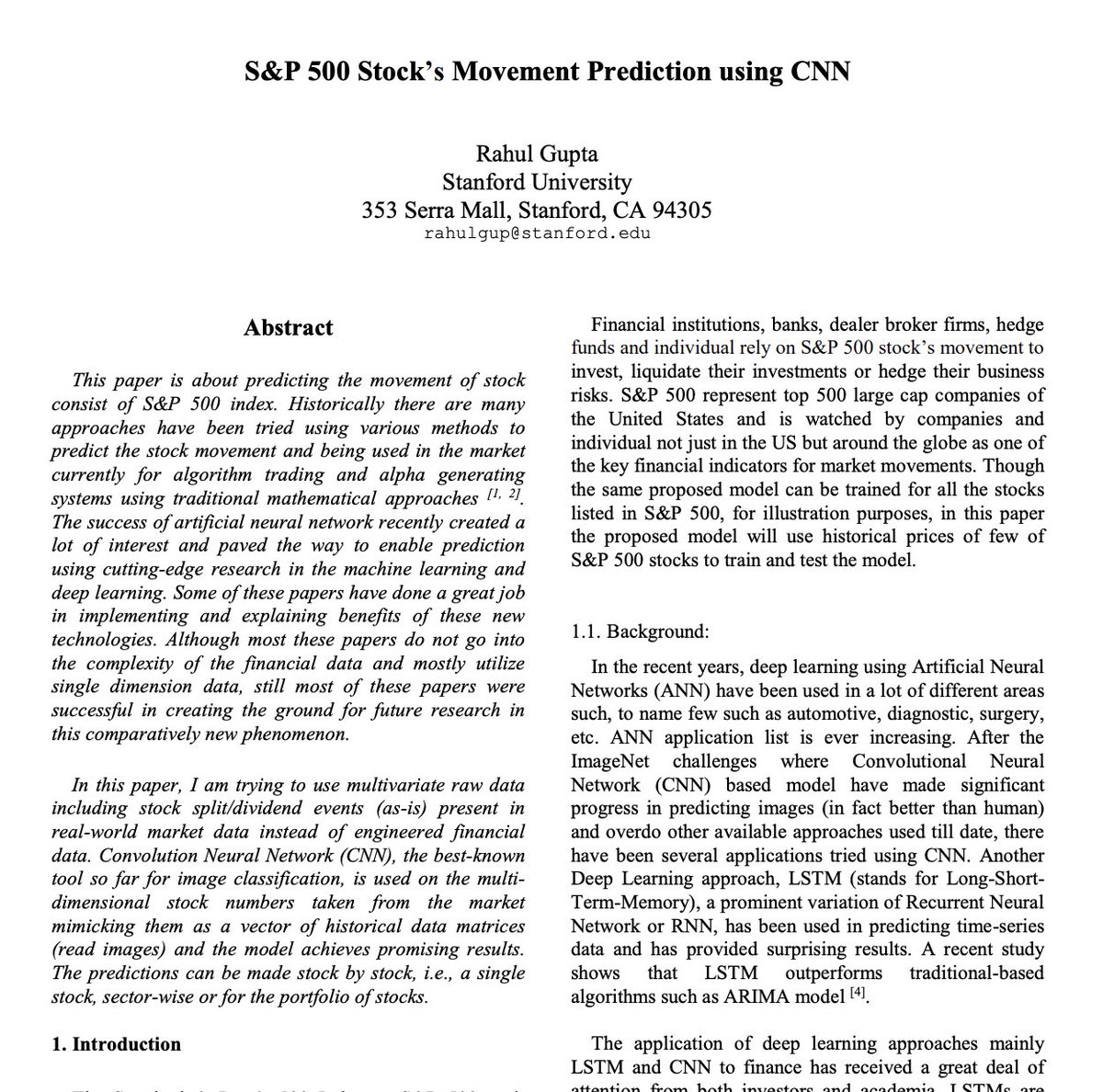
This paper from Stanford University tackles a question that’s been debated for decades in quantitative finance: can raw market data alone meaningfully predict stock price direction, without handcrafted indicators or heavy financial feature engineering?
The author proposes a Convolutional Neural Network–based approach to predict the directional movement (bullish vs bearish) of individual S&P 500 stocks using pure multivariate price data.
Instead of technical indicators, the model consumes raw daily OHLCV data plus adjusted prices that explicitly encode dividends and stock splits, which are usually smoothed away or ignored in most academic work.
The core idea is subtle but important. Multivariate time series are treated as spatial objects, not just sequences. Each rolling window of historical prices is reshaped into a matrix that behaves like a 1D “image,” allowing CNN filters to detect local patterns such as short-term momentum, volatility shifts, and structural breaks caused by corporate actions.
This reframing borrows intuition from computer vision rather than traditional econometrics.
The dataset spans up to two decades of daily data per stock, sourced from an institutional-grade provider. Ten channels are used: open, high, low, close, volume, and their adjusted counterparts.
Sliding windows generate thousands of training samples per stock, dramatically increasing data density without synthetic augmentation. A normalization step ensures scale invariance across features.
Architecturally, the model uses a deep 1D CNN with eight convolutional layers, followed by fully connected layers and a Softmax classifier optimized with cross-entropy loss. Early layers focus on short-term price structure, while deeper layers capture longer-term trends.
Unlike LSTMs, which struggle with noisy gradients and statefulness in finance, the CNN’s localized receptive fields make it naturally robust to volatility spikes and event-driven price jumps.
The training objective is framed as a probabilistic classification task: predicting bullish or bearish movement over future horizons ranging from 2 to 30 days.
Extensive hyperparameter tuning reveals that performance depends heavily on window size, batch size, and learning rate, with Adam optimization and larger batch sizes producing the most stable convergence.
Results are where the paper becomes provocative. On several large-cap stocks, reported validation accuracies reach high-80s to low-90s percent, significantly outperforming earlier deep learning baselines trained on raw data.
JP Morgan stock, in particular, shows accuracy touching ~91% for longer forecast horizons. Loss curves and accuracy plots suggest genuine learning rather than overfitting, aided by careful train–validation splits and shuffling.
The author is careful not to overclaim. The model predicts direction, not returns, and does not directly incorporate transaction costs, slippage, or execution constraints. Still, the findings suggest that CNNs can internalize complex market mechanics directly from raw price tensors, including the non-linear distortions introduced by dividends and splits.
The broader implication is that feature engineering may be less critical than representation choice. By letting the model learn spatial relationships inside time-series windows, the approach sidesteps many subjective assumptions baked into technical indicators. The paper also hints at natural extensions: hybrid CNN–LSTM architectures, portfolio-level predictions, and integration of textual sentiment for fundamentals-aware forecasting.
In short, this work argues that treating financial time series as structured, image-like data is not a gimmick. It is a viable inductive bias that unlocks predictive signal from raw market data, challenging the long-held belief that markets are too noisy for deep learning without heavy human intervention.
Paper: S&P 500 Stock’s Movement Prediction using CNN
Want to be a part of protecting U.S. critical infrastructure? InfraGard, a partnership program between the #FBI and members of the private sector, is now accepting applications for new members.
InfraGard provides business leaders with the tools and network needed to better protect the American people.
Learn more: https://t.co/8ggQlKOTjd
India: The Miracle of Holding Together
In this rare and powerful clip, Lee Kuan Yew the legendary founder of modern Singapore and one of the sharpest geopolitical minds of the last century reveals a truth about India that almost no Western analyst understands. Speaking with deep respect, LKY explains that *India is not just a country it is a continent held together by an idea*, a democracy stitched across thousands of years of culture, philosophy, and coexistence. He begins with a blunt observation that hits with the force of a reality check: *“Any Indian leader speaking in any language at one time doesn’t reach more than 40% of the people.”* Hindi dominates the north. English reaches only the educated elite — maybe 30%. Tamil speaks to 70 million. Malayalam to 40 million. Add to that dozens of major languages and over *320 dialects, each tied to its own history, identity, and memory. No single message, no single leader, no single broadcast can unite the entire nation in one stroke. *Yet the nation stands united. Lee Kuan Yew is not criticizing India — he is marvelling at it. He explains that governing such an unimaginably diverse population should be almost impossible. Policies cannot be communicated uniformly. Consensus cannot be built easily. Identities cannot be dissolved from the top-down. And yet… *India remains one nation*. Why? LKY gives the answer with admiration: India has kept its *constitution fluid*, its democracy adaptive, and its unity organic — not imposed. Unlike many post-colonial nations that collapsed or fragmented, India’s civilization had the philosophical depth and cultural resilience to absorb diversity rather than be broken by it. His final line lands like a punch of truth: *“As held together, that’s quite an achievement.”* This is a tribute to *India’s civilizational strength*.
This free CUDA course is worth more than most CS degrees.
12 hours that separate library users from GPU engineers.
I watched senior devs struggle with concepts taught in hour 3.
What makes it different:
No hand-waving. No "just use this library."
You build an MLP trainer FOUR times: → PyTorch (the easy way) → NumPy (getting harder) → C (now we're cooking) → CUDA (chef's kiss)
Same model. Same dataset. Four implementations.
By the end, you understand WHY PyTorch is fast.
The curriculum nobody else teaches:
➡️ GPU architecture (not just "it's parallel")
➡️ Writing kernels that don't suck
➡️ Profiling at kernel AND system level
➡️ When cuBLAS helps (and when it doesn't)
➡️ CUDA vs Triton (the comparison you need)
➡️ PyTorch extensions (actually useful ones)
Real talk:
➡️ After this course, you'll read PyTorch source code and understand it.
➡️ You'll optimize models other engineers can't touch.
➡️ You'll be the person teams hire to make things fast.
12 hours. Free. No excuses.
Who's starting this weekend?
(I will put the details in the comments.)
♻️ Repost to save someone $$$ and a lot of confusion.
✔️ You can follow @techNmak , for more insights.
This week we introduced @antigravity, a new agentic development platform where agents operate across the editor, terminal, and browser. Check out this tutorial to get started.
Highlights:
00:00 Overview
00:44 Agent Manager, editor, browser
01:48 Agent-assisted development
02:15 Initial prompt and implementation
03:30 Artifacts for agent accountability
05:09 Antigravity browser extension
06:12 Parallel tasks via the Inbox
06:40 Nano Banana image generation integration
08:08 Artifact review
11:18 Testing application
12:47 Walkthrough
Every great lesson begins with a spark. ✨
Try these ready-to-use @GeminiApp prompts to help:
🧠 Brainstorm real-world examples for lessons
📝 Create questions across DOK levels
🧪 Plan science lab experiments
Start personalizing your lessons today: https://t.co/24BAhMD6pC
Ask questions in natural language and let the Sentinel MCP server analyze user activities across connected services. See it here. https://t.co/CphpFPmWGg Unify your security data and use AI to reason over your entire digital estate with Microsoft Sentinel. See how threats evolve in real time, map attack paths, and understand which assets are most at risk. Visualize relationships across users, devices, and resources to pinpoint vulnerabilities and focus your response where it matters most. Using natural language, you can investigate faster. Ask questions, get context, and act on insights without writing complex queries. Build and extend your own identity graphs to include multicloud systems like Salesforce, enriching your view of risk. #SentinelGraph #microsoftsecurity #microsoft #security #cloudsecurity #secops
We detected and disrupted a highly automated cyber operation attempting to use Factory as a node in a worldwide mesh of “off-label” LLM usage.
The attackers deployed AI coding agents to generate and maintain their infrastructure, adapt to our defenses in real time, and orchestrate traffic from tens of thousands of synthetic organizations.
This attack mirrored similar incidents across the industry, including those recently disclosed by @anthropicAI.
The last day of the 5-Day AI Agents Intensive with @kaggle concludes with the most critical step: prototype to production.
Learn how to deploy, scale, and secure your agents in the real world. Get the playbook for AgentOps and A2A interoperability → https://t.co/pGflofttsG