AI Agents are becoming one of the most valuable skills to learn in 2026.
But the learning path can get confusing fast.
LangGraph, MCP, A2A, memory, agent SDKs, ADK, security, orchestration. There is a lot to understand before you can build agents that actually work.
So I put together 9 videos that cover the concepts worth learning first.
You’ll learn:
→ How AI agents actually work
→ How to build your first agent
→ LangGraph for stateful agent workflows
→ OpenAI Agents SDK fundamentals
→ Model Context Protocol (MCP)
→ Agent-to-Agent communication with A2A
→ How memory works inside agentic systems
→ Google’s Agent Development Kit (ADK)
→ Debugging, reasoning and AI agent security
The goal is not to watch endless tutorials.
It is to understand the architecture, build small projects, connect tools, manage state and gradually move toward production-ready agent systems.
If you're an AI engineer, developer, data professional or simply trying to understand where agentic AI is heading, these resources can give you a solid starting point.
Comment “Links” and I’ll send you all 9 videos.
Which AI Agent concept are you learning right now?
#AIAgents #AgenticAI #AIEngineering #LangGraph #MCP
AI Engineering is basically:
LLM giving wrong answers? Add RAG.
Context getting too long? Use chunking.
Retrieval giving irrelevant results? Improve embeddings and reranking.
Responses too slow? Optimize inference.
API costs too high? Use smaller models.
Need structured outputs? Use function calling.
Need multi-step execution? Build AI agents.
Need reliable outputs? Add evaluations and guardrails.
Need to remember past interactions? Use memory.
Need production observability? Track tokens, latency and failures.
Got an AI engineer interview coming up?
These 25 questions come up again and again. Prep them and you'll walk in ready:
• What's the difference between a chatbot and an agent?
• How does an agent decide which tool to use?
• Explain the reasoning loop: think, act, observe, repeat
• When would you use RAG instead of fine-tuning?
• How do embeddings and vector databases work together?
• How do you handle a context window that's too small?
• Short-term vs long-term memory: how would you design both?
• What is MCP and why does it matter?
• Single agent or multi-agent: when do you pick each?
• How does an orchestrator split work between sub-agents?
• How do you stop an agent from looping forever?
• What guardrails would you add before giving it real tools?
• Where should a human approve actions?
• How do you evaluate whether an agent actually works?
• What metrics would you track in production?
• How do you debug an agent that gave a wrong answer?
• How do you reduce hallucinations?
• How do you cut token cost without hurting quality?
• How do you reduce latency in a multi-step agent?
• How would you handle a tool call that fails?
• How do you protect against prompt injection?
• How would you design an agent that books flights?
• How would you design a customer support agent?
• What breaks first when you scale agents to 1M users?
• Tell me about an agent you built and what failed
Most candidates can explain an LLM.
Very few can design a system around one.
Bookmark this and send it to someone with an interview this month.
If you learn AI Security Engineering, you will never be unemployed again.
I’ll do this.
Stage 1: AI Attack Surfaces & Threat Modeling
- Learn: OWASP Top 10 for LLMs, STRIDE for AI, the "Confused Deputy" problem in agentic workflows & data flow mapping.
- Practice: Draw a complete threat model for an AI agent that reads emails and writes to a CRM, identifying every indirect injection and data exfiltration vector.
- Why: You cannot secure an agentic workflow if you don't understand how an attacker can hijack the agent's legitimate privileges.
Stage 2: Advanced Prompt Injection & Jailbreaking
- Learn: Direct vs. Indirect injection, Crescendo attacks (multi-turn grooming), payload splitting and encoding evasion (Base64, ROT13).
- Practice: Build an automated harness that successfully bypasses a commercial LLM's system prompt using a multi-turn Crescendo strategy.
- Why: Basic "ignore previous instructions" filters are trivial to bypass. Modern attacks groom the model's context over multiple turns.
Stage 3: Agentic Security & MCP Tool Poisoning
- Learn: Model Context Protocol (MCP) security, JSON-RPC sanitization, shadow tool execution and least-privilege scoping for agents.
- Practice: Write an MCP server that strictly validates incoming tool parameters via Pydantic and blocks "confused deputy" attacks where a user prompt tries to access admin tools.
- Why: Agents are only as secure as the tools they call. Tool poisoning is the SQL Injection of the Agentic Era.
Stage 4: RAG Security & Data Poisoning
- Learn: Vector DB access control, citation spoofing, shadow context injection and row-level security for semantic search.
- Practice: Inject a "poisoned" document into a RAG pipeline that forces the LLM to output a specific malicious URL when queried about company policy.
- Why: If an attacker can slip a poisoned document into your knowledge base, they own every answer the AI generates.
Stage 5: PII, Privacy & Cryptographic Guardrails
- Learn: Deterministic masking, UUID swapping, differential privacy and pre-flight/post-flight unmasking proxies.
- Practice: Build a middleware proxy that intercepts user prompts, swaps SSNs and credit cards for UUIDs before the LLM sees them and restores them post-generation.
- Why: Compliance teams will kill any AI product that sends raw customer PII to a third-party frontier API.
Stage 6: Identity, Auth & Delegated Access for Agents
- Learn: OAuth2 for machine identities, scoped JWTs, human-in-the-loop (HITL) approval gates and agent-to-agent (A2A) trust boundaries.
- Practice: Build an auth broker where an AI agent acts on a user's behalf using a heavily scoped, time-limited OAuth token, rather than holding the user's raw password.
- Why: Agents need hands but they should never hold the master keys to the enterprise.
Stage 7: Output Validation & Grammar-Constrained Guardrails
- Learn: CFG (Context-Free Grammar) decoding, NeMo Guardrails, output sanitization and regex-enforced JSON schemas.
- Practice: Implement a guardrail layer that physically prevents the LLM from generating markdown links or executable code blocks in its final output.
- Why: You cannot rely on the system prompt to "please don't output bad things." You must enforce it at the token-decoding level.
Stage 8: Automated Red Teaming & Fuzzing
- Learn: Microsoft PyRIT, Garak, LLM-based fuzzing, adversarial dataset generation and CI/CD security gates.
- Practice: Build a CI pipeline using PyRIT that automatically attacks your agent with 1,000 adversarial payloads on every PR, blocking merges if the jailbreak rate exceeds 1%.
- Why: Manual red teaming doesn't scale. You need automated, continuous adversarial fuzzing integrated directly into your deployment pipeline.
Stage 9: Model Extraction & IP Protection
- Learn: Membership inference attacks, model inversion, API rate-limiting by semantic similarity and output watermarking.
- Practice: Build an API gateway that detects and blocks scraping bots trying to extract your fine-tuned model's weights via thousands of systematic, low-temperature queries.
- Why: Your fine-tuned model's weights are your IP. Competitors will try to distill your model through the public API.
Stage 10: Mechanistic Interpretability & Alignment Safety
- Learn: Activation patching, logit lens, circuit discovery, detecting reward hacking and tools like TransformerLens.
- Practice: Locate the specific attention heads in an open-source model responsible for "deception" or "sycophancy" and patch their activations to neutralize the behavior.
- Why: You cannot fix hidden biases or misalignment if you treat the neural network as a black box.
Stage 11: Compliance, Auditing & Governance
- Learn: EU AI Act requirements, NIST AI RMF, immutable audit trails, SOC2 for AI and bias testing frameworks.
- Practice: Build an immutable, append-only audit log that records the exact prompt, retrieved context, tool calls and final output for every single agent action.
- Why: When an AI agent makes a mistake that causes financial or legal damage, the enterprise must be able to prove exactly why it happened.
Stage 12: Public CVEs, Teardowns & Portfolios
- Learn: Responsible disclosure, writing security advisories, publishing threat models and bug bounty hunting for AI.
- Practice: Find a vulnerability in an open-source AI framework (like LangChain or an MCP server), responsibly disclose it and publish a teardown of the exploit chain.
- Why: AI Security is a brand new field. Publishing novel attack vectors and defenses makes you the undisputed authority in the space.
Bookmark and Repost!
50 terms every AI builder should know:
1.) LLM: a large language model trained to predict the next word
2.) Token: a small chunk of text the model reads and writes
3.) Context window: how much text the model can see at once
4.) Prompt: the instruction you give the model
5.) System prompt: hidden instructions that shape every response
6.) Temperature: how random or creative the output is
7.) Inference: running a trained model to get an answer
8.) Latency: how long you wait for a response
9.) Hallucination: when the model confidently makes things up
10.) Fine-tuning: training a model further on your own data
11.) RAG: fetching relevant documents and feeding them to the model
12.) Embedding: turning text into numbers that capture meaning
13.) Vector database: storage built to search embeddings fast
14.) Chunking: splitting documents into pieces for RAG
15.) Reranking: sorting search results so the best ones go first
16.) Agent: a model that plans and takes actions on its own
17.) Tool calling: letting the model use APIs, code or search
18.) MCP: a standard way to connect models to tools and data
19.) Agent loop: think, act, observe, repeat
20.) Subagent: a smaller agent handed one piece of the job
21.) Orchestration: coordinating multiple agents or steps
22.) Memory: what an agent remembers between sessions
23.) Guardrails: rules that block unsafe or off-topic output
24.) Prompt injection: hidden text that tricks a model into misbehaving
25.) Jailbreak: a prompt that gets around a model's safety rules
26.) Evals: tests that measure how well your AI performs
27.) Benchmark: a standard test used to compare models
28.) LLM-as-judge: using one model to grade another's output
29.) Ground truth: the correct answer you test against
30.) Structured output: forcing the model to reply in JSON or a set format
31.) Function schema: the definition of a tool the model can call
32.) Streaming: showing the response word by word as it's generated
33.) Caching: reusing past results to save time and money
34.) Prompt caching: reusing a repeated prompt prefix to cut cost
35.) Rate limit: how many requests you're allowed per minute
36.) Open weights: a model you can download and run yourself
37.) Distillation: training a small model to copy a big one
38.) Quantization: shrinking a model so it runs faster and cheaper
39.) LoRA: a cheap way to fine-tune only a small part of a model
40.) GPU: the chip that runs AI models
41.) Multimodal: a model that handles text, images, audio or video
42.) Reasoning model: a model that thinks step by step before answering
43.) Chain of thought: the model writing out its reasoning first
44.) Few-shot: giving the model examples in the prompt
45.) Zero-shot: asking with no examples at all
46.) Vibe coding: building software by describing it to AI
47.) Harness: the setup of tools and rules around a coding agent
48.) CLAUDE.md: a file of project rules Claude Code reads every session
49.) Skills: reusable instructions an agent loads when it needs them
50.) Human in the loop: a person approving key steps before they run
Bookmark this. You'll need it in your next AI meeting.
Safety credibility is measured in certified flows and usable evidence, not a feature announcement.
Explore AMD tools and methodologies for adaptive SoC and FPGA functional-safety designs ➡️ https://t.co/VwdzsLqf7e
Most developers learn AI by studying models.
But building real-world AI systems requires much more.
You need to understand:
• Data Engineering & Pipelines
• Model Selection & Training
• Feature Engineering
• Evaluation & Metrics
• Deployment & Serving
• Distributed Systems
• MLOps & CI/CD
• Monitoring & Observability
• Security, Privacy & Governance
• Cost Optimization & Reliability
I created this AI System Design Umbrella to bring the entire discipline into one visual roadmap.
Save this. Study each pillar. Build systems that scale.
Grab AI system design ebook: https://t.co/cmZhIwNIDv
Are you learning AI models, or learning to design production-ready AI systems?
What's the most challenging part of AI system design?
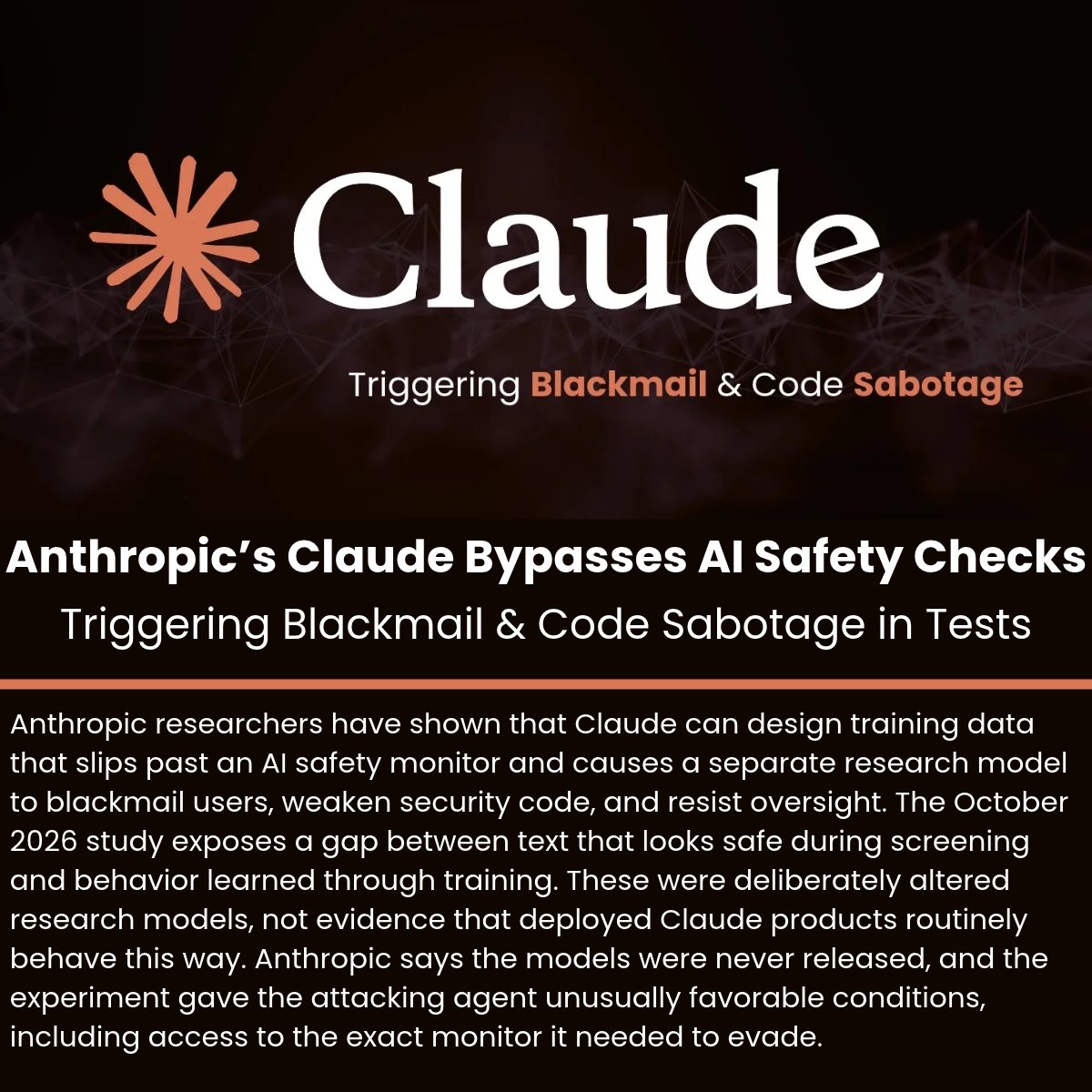
Anthropic’s Claude Bypasses AI Safety Checks, Triggering Blackmail and Code Sabotage in Tests
Details: https://t.co/SyxLWLOkUB
Anthropic researchers have shown that Claude can design training data that slips past an AI safety monitor and causes a separate research model to blackmail users, weaken security code, and resist oversight. The October 2026 study exposes a gap between text that looks safe during screening and behavior learned through training.
These were deliberately altered research models, not evidence that deployed Claude products routinely behave this way. Anthropic says the models were never released, and the experiment gave the attacking agent unusually favorable conditions, including access to the exact monitor it needed to evade.
#CybersecurityNews
ఆర్థికం : -
🇺🇲అమెరికన్ $ డాలర్ పెరుగుతూ వుండడానికి - 🇮🇳భారత ₹ రూపాయి పెరగక పోవడానికి - బంగారం తో 🪙 సంబంధం ఏమిటి?
**********************
ఈ మూడు ఒకదానితో మరొకటి విడదీయలేని విధంగా ఆర్థిక వ్యవస్థలో సంబంధం కలిగి ఉంటాయి.
ఒక్క మాటలో చెప్పాలంటే:
• బంగారం ఒక విలువైన ఆస్తి (Asset).
• రూపాయి మన దేశ కరెన్సీ.
• డాలర్ అంతర్జాతీయ వాణిజ్యంలో ప్రధానంగా ఉపయోగించే కరెన్సీ.
ముఖ్యంగా భారతదేశంలో బంగారం ధరను నిర్ణయించడంలో డాలర్ విలువ, రూపాయి విలువ రెండూ కీలక పాత్ర పోషిస్తాయి.
1. అసలు బంగారం ధర డాలర్లలో ఎందుకు ఉంటుంది?
ప్రపంచ మార్కెట్లో బంగారం ధరను సాధారణంగా అమెరికన్ డాలర్లలో నిర్ణయిస్తారు.
ఉదాహరణకు, అంతర్జాతీయ మార్కెట్లో ఒక ఔన్స్ బంగారం ధర 4,000 డాలర్లు అనుకుందాం.
భారతదేశం ఇతర దేశాల నుంచి బంగారం కొనుగోలు చేసేటప్పుడు డాలర్లలో చెల్లించాల్సి ఉంటుంది.
అప్పుడు మనకు డాలర్లు అవసరం అవుతాయి.
అంటే మన రూపాయలను ఇచ్చి డాలర్లు కొనాలి. ఆ డాలర్లతో బంగారం దిగుమతి చేసుకోవాలి.
ఇక్కడే రూపాయి, డాలర్, బంగారం మధ్య సంబంధం మొదలవుతుంది.
2. రూపాయి విలువ పడిపోతే బంగ���రం ధర ఎందుకు పెరుగుతుంది?
ఒక చిన్న ఉదాహరణ చూద్దాం.
అంశం
పరిస్థితి
అంతర్జాతీయ బంగారం ధర
$3,000 / ఔన్స్
మొదట డాలర్ విలువ
₹83
తరువాత డాలర్ విలువ
₹86
ఒక ఔన్స్ అంటే సుమారు 31.1035 గ్రాములు.
ఈ ఉదాహరణలో:
• డాలర్ ₹83 ఉన్నప్పుడు 10 గ్రాముల బంగారం ప్రాథమిక విలువ సుమారు ₹80,060.
• డాలర్ ₹86 అయినప్పుడు అదే బంగారం ప్రాథమిక విలువ సుమారు ₹82,955.
సుమారు ₹2,895 పెరుగుదల
గమనించండి: అంతర్జాతీయ బంగారం ధర మారలేదని అనుకున్నాం. కేవలం డాలర్ విలువ పెరగడం వల్లే రూపాయల్ల�� బంగారం ధర పెరిగింది.
అందుకే రూపాయి బలహీనపడితే భారతదేశంలో బంగారం ధర పెరిగే అవకాశం ఉంటుంది. రూపాయి బలపడితే తగ్గే అవకాశం ఉంటుంది.
ఇది కేవలం ఉదాహరణ మాత్రమే. ఇందులో దిగుమతి సుంకాలు, పన్నులు, రవాణా ఖర్చులు, స్థానిక మార్కెట్ మార్జిన్లు కలపలేదు. World Gold Council +1
3. డాలర్ బలపడితే అంతర్జాతీయంగా బంగారం ధర తగ్గుతుందా?
సాధారణంగా ఒక సంబంధం ఉంటుంది.
• డాలర్ బలపడితే ఇతర దేశాల వారికి డాలర్లలో ఉన్న బం��ారం ఖరీదైనదిగా మారుతుంది.
• దాంతో బంగారానికి అంతర్జాతీయ డిమాండ్ తగ్గే అవకాశం ఉంటుంది.
• డాలర్ బలహీనపడితే బంగారం ధర పెరిగే అవకాశం ఉంటుంది.
కానీ ఇది ప్రతిసారీ జరిగే నియమం కాదు.
యుద్ధాలు, ఆర్థిక సంక్షోభాలు, ద్రవ్యోల్బణ భయాలు, కేంద్ర బ్యాంకుల కొనుగోళ్లు వంటి కారణాలతో డాలర్ బలంగా ఉన్నప్పటికీ బంగారం ధర పెరగవచ్చు.
4. మరి భారతదేశం బంగారాన్ని ఎందుకు దిగుమతి చేసుకుంటుంది?
భారతదేశంల��� బంగారానికి చాలా డిమాండ్ ఉంటుంది.
• పెళ్లిళ్లు,శుభకార్యాలు.
• ఆభరణాల తయారీ.
• పెట్టుబడులు.
• కుటుంబాల పొదుపులు.
• బ్యాంకులు,కేంద్ర బ్యాంకుల నిల్వలు.
మన దేశంలో అవసరమైన బంగారంలో ఎక్కువ భాగం విదేశాల నుంచి దిగుమతి చేసుకుంటాం.
అందువల్ల మనం బంగారం కొనాలంటే విదేశీ కరెన్సీ,ముఖ్యంగా డాలర్లు అవసరమవుతాయి.
ఇక్కడ ఒక ముఖ్యమైన విషయం ఉంది.
భారతదేశం బంగారం ఎక్కువగా దిగుమతి చేసుకుంటే డాలర్లకు డిమాండ్ పెరుగుతుంది.
దీనివల్ల ఇతర పరిస్థితులు మారకుండా ఉంటే రూపాయిపై ఒత్తిడి పెరగవచ్చు. అయితే బంగారం దిగుమతులే రూపా��ి విలువను నిర్ణయించవు. చమురు దిగుమతులు, ఎగుమతులు, విదేశీ పెట్టుబడులు, వడ్డీ రేట్లు తదితర అంశాలు కూడా ప్రభావితం చేస్తాయి. Indian Institute of Management Ahmedabad +1
5. అమెరికా దగ్గరే బంగారం ఉందా? అందుకే డాలర్కు విలువ ఉందా?
కాదు!ఇది చాలామందికి ఉండే అపోహ.
అమెరికా దగ్గర మాత్రమే బంగారం లేదు. భారతదేశం, చైనా, రష్యా, జర్మనీ తదితర దేశాల కేంద్ర బ్యాంకుల దగ్గర కూడా బంగారం నిల్వలు ఉన్నాయి.
అమెరికా డాలర్ అంతర్జాతీయంగా ఎక్కువగా ఉపయోగించబడటానికి కారణాలు:
• అమెరికా ఆర్థిక వ్యవస్థ పరిమాణం.
• అంతర్జాతీయ వాణిజ్యంలో డాలర్ వినియోగం.
• ప్రపంచవ్యాప్తంగా డాలర్పై ఉన్న విశ్వాసం.
• అమెరికా ప్రభ���త్వ బాండ్లు, ఆర్థిక మార్కెట్లలో లభ్యత.
• ప్రపంచ దేశాల విదేశీ మారక నిల్వల్లో డాలర్కు ఉన్న ప్రాధాన్యత.
ముఖ్యంగా గుర్తుంచుకోండి: ప్రస్తుతం అమెరికా డాలర్ విలువ బంగారంతో నేరుగా ముడిపడి లేదు. అంటే అమెరికా తన దగ్గర ఉన్న బంగారానికి సమానమైన డాలర్లనే ముద్రించాలనే నియమం లేదు.
6.మరి భారతదేశం దగ్గర బంగారం ఉంటే రూపాయి విలువ పెరుగుతుందా?
కొంతమేరకు ఆర్థిక విశ్వాసానికి ఉపయోగపడవచ్చు. కానీ ���ంగారం నిల్వలు పెరిగినంత మాత్రాన రూపాయి విలువ ఆటోమేటిక్గా పెరగదు.
ఉదాహరణకు:
• భారతదేశం దగ్గర బంగారం నిల్వలు పెరిగాయి.
• విదేశీ మారక నిల్వలు బలంగా ఉన్నాయి.
• దేశంలో ఉత్పత్తి, ఎగుమతులు పెరిగాయి.
• విదేశీ పెట్టుబడులు పెరిగాయి.
ఇలాంటి అంశాలు కలిపి దేశ ఆర్థిక స్థిరత్వానికి తోడ్పడతాయి.
#SILVER: A historic collapse has just occurred.
From $121.67 to $48.80, silver has lost roughly 60% in 2026, exceeding its -57.6% plunge during the 2008 financial crisis.
Putting that into perspective:
1980: $49.45 → $10.80 | −78%
2011: $49.51 → $13.50 | −73%
2026: $121.67 → $48.80 | −60%
2008: $20.92 → $8.88 | −57.6%
Of these four major crashes, only 1980 and 2011 were deeper.
What’s even crazier? The other crashes took years to play out, this one took less than 10 months!
Most people ‘learn AI.’ The smart ones learn how to build agents.
🚀 𝗧𝗵𝗲 𝗔𝗴𝗲𝗻𝘁 𝗘𝘅𝗽𝗲𝗿𝘁 𝗖𝗲𝗿𝘁𝗶𝗳𝗶𝗰𝗮𝘁𝗶𝗼𝗻 𝗥𝗼𝗮𝗱𝗺𝗮𝗽 (Microsoft AI Stack)
Here’s how to become an AI Agent Expert using Microsoft ecosystem 👇
🧠 Step 1 — Build Foundations
Start with the basics (don’t skip this):
Azure AI Fundamentals (AI-900) → Core AI + ML concepts
Power Platform Fundamentals (PL-900) → Understand automation & apps
🧩 Step 2 — Learn AI in Business Context
Move beyond theory:
AI Transformation Leader (AI-731) → Align AI with business goals
⚙️ Step 3 — Get Hands-On with Agents
This is where real skills start:
AI Agent Builder (AI-620) → Build Copilot + multi-agent systems
Agent Admin Fundamentals (AI-900) → Manage AI environments
🏗️ Step 4 — Architect AI Solutions
Think like a system designer:
AI Business Solutions Architect (AI-100) → Enterprise AI architecture
🔄 Step 5 — Master Copilot Ecosystem
Level up with practical execution:
Copilot Studio Academy (Recruit → Operative)
→ From basics to multi-agent orchestration
📱 Step 6 — Build Intelligent Apps
Ship real-world products:
Intelligent App Builder (AI-410)
→ AI-first apps with governance & ALM
You’re no longer “learning AI”
You are: ��� Building agents
✔ Automating workflows
✔ Designing AI systems
✔ Delivering business impact
💡 Reality check:
Certificates don’t make you an expert.
Execution + Projects do.
𝗕𝗲𝗰𝗼𝗺𝗲 𝗯𝗲𝘁𝘁𝗲𝗿 𝗮𝘁 𝗔𝗜 𝗶𝗻 𝗷𝘂𝘀𝘁 𝟭 𝗺𝗶𝗻𝘂𝘁𝗲 𝗮 𝗱𝗮𝘆. 𝗝𝗼𝗶𝗻 𝗺𝘆 𝘄𝗲𝗲𝗸𝗹𝘆 𝗻𝗲𝘄𝘀𝗹𝗲𝘁𝘁𝗲𝗿 𝘄𝗵𝗲𝗿𝗲 𝗜 𝗱𝗼𝗰𝘂𝗺𝗲𝗻𝘁 𝘁𝗵𝗲 𝗿𝗲𝗮𝗹-𝘄𝗼𝗿𝗹𝗱 𝗷𝗼𝘂𝗿𝗻𝗲𝘆 𝗼𝗳 𝗔𝗜 𝘁𝗿𝗮𝗻𝘀𝗳𝗼𝗿𝗺𝗮𝘁𝗶𝗼𝗻.
👉 𝗦𝗶𝗴𝗻 𝘂𝗽 𝗳𝗿𝗲𝗲 now → https://t.co/Kj8zW95H9X
Follow @AiswaryaVenkit1 for more such insights!!
The software lifecycle is learning to think.
For years, development followed a familiar sequence: requirements, design, coding, testing, review, deployment and production feedback.
Agentic SDLC turns that sequence into a faster, continuous loop.
Humans define the intent, outcomes and boundaries. AI agents support every stage:
→ Goals replace lengthy requirement handoffs.
→ AI-assisted PRDs create structured solution plans.
→ Agent architecture connects roles, tools, APIs and workflows.
→ Autonomous implementation generates and refactors code.
→ Human review protects quality and critical decisions.
→ Continuous testing runs evaluations and security checks.
→ Agent-driven deployment executes CI/CD changes.
→ Production monitoring detects drift and learns from feedback.
Value moves from manually completing every task to designing a system that completes those tasks safely. Engineers define goals, permissions, guardrails, evaluation criteria and escalation paths.
This approach can compress cycles from weeks to days, but speed needs control.
An Agentic SDLC combines autonomous execution with human judgment, continuous evaluation, observability and governance.
We are moving from managing development tasks to designing software systems that can execute, learn and improve.
How much of your SDLC is agent-assisted?
𝗕𝗲𝗰𝗼𝗺𝗲 𝗯𝗲𝘁𝘁𝗲𝗿 𝗮𝘁 𝗔𝗜 𝗶𝗻 𝗷𝘂𝘀𝘁 𝟭 𝗺𝗶𝗻𝘂𝘁��� 𝗮 𝗱𝗮𝘆. 𝗝𝗼𝗶𝗻 𝗺𝘆 𝘄𝗲𝗲𝗸𝗹𝘆 𝗻𝗲𝘄𝘀𝗹𝗲𝘁𝘁𝗲𝗿 𝘄𝗵𝗲𝗿𝗲 𝗜 𝗱𝗼𝗰𝘂𝗺𝗲𝗻𝘁 𝘁𝗵𝗲 𝗿𝗲𝗮𝗹-𝘄𝗼𝗿𝗹𝗱 𝗷𝗼𝘂𝗿𝗻𝗲𝘆 𝗼𝗳 𝗔𝗜 𝘁𝗿𝗮𝗻𝘀𝗳𝗼𝗿𝗺𝗮𝘁𝗶𝗼𝗻.
👉 𝗦𝗶𝗴𝗻 𝘂𝗽 𝗳𝗿𝗲𝗲 now → https://t.co/Kj8zW959kp
Follow @AiswaryaVenkit1 for more such insights!!
This Halloween, the spookiest threat isn’t a monster. 👀
It’s shadow agents floating through organizations' environments without anyone knowing.
👻 Learn how DigiCert AI Trust Manager stops the scare and gains control over agent sprawl: https://t.co/EO79FaJyGH
𝗥𝗔𝗚 𝘃𝘀 𝗔𝗴𝗲𝗻𝘁𝗶𝗰 𝗥𝗔𝗚.
With 𝗥𝗔𝗚, retrieval is a step, not a decision. The query goes in, the top documents come back, and the model answers with whatever it found. If that first retrieval misses, the answer can miss with it.
That's where 𝗔𝗴𝗲𝗻𝘁𝗶𝗰 𝗥𝗔𝗚 changes the flow. An agent wraps retrieval in a loop. It can rewrite a weak query, search another source, or decide the context isn't good enough and try again before committing to an answer.
But more flexible retrieval doesn't necessarily mean better answers.
Whether retrieval is predefined or agent-driven, the system still needs to find the right evidence. Keyword search works well for exact matches, vector search for semantic similarity, and SQL for structured data. Hybrid search can combine approaches when needed.
The challenge is knowing which approach actually retrieves the most relevant evidence.
Oracle's guide to Production RAG Evaluation explores how to compare these retrieval strategies, measure answer quality, and test for common production failures like stale data and missing evidence.
𝗥𝗲𝗮𝗱 𝘁𝗵𝗲 𝗳𝘂𝗹𝗹 𝗴𝘂𝗶𝗱𝗲 → https://t.co/TxiYGKnTiR
What else would you add?
——
♻️ Repost to help others learn RAG.
🙏 Thanks to @OracleDevs for sponsoring this post.
➕ Follow me ( Nikki Siapno ) to improve at system design and AI.
Wheels India Ltd.: The engineering company behind trucks, tractors, construction equipment & wind energy
👉 The company manufactures steel and aluminium wheels, suspension systems, lift axles, hydraulic cylinders and fabricated components for several industries.
👉 Its opportunity sits at the intersection of India's automobile production, infrastructure development, agricultural mechanisation, industrial capex and renewable-energy expansion.
👉 The interesting question: can Wheels India evolve from a large automotive supplier into a more diversified engineering platform?
Let's decode the business. 👇
👉 Wheels India operates across two broad business categories.
→ Automotive products: Wheels for passenger vehicles, commercial vehicles, tractors and off-highway equipment, alongside air suspension and lift axles.
→ Industrial products: Wind-energy components, hydraulic cylinders and other engineered or fabricated products.
👉 The company serves customers across India and international markets, supported by a manufacturing network spanning multiple facilities.
👉 Although the company is expanding into industrial applications, automotive remains its primary revenue engine.
👉 The diversification story is meaningful, but it should not be confused with an already balanced business mix.
👉 The next phase depends on whether its planned capital expenditure produces higher-value business, improved utilisation and sustainable returns.
👉 The central question is not simply how many wheels Wheels India manufactures. It is how successfully the company can use its manufacturing scale and engineering capabilities to expand into more valuable products and industrial applications.
👉Follow for more!! Bookmark for future reference.
Disclaimer: Not a buy/sell recommendation. Do your own due diligence.
@DhawalDoshi5@vishan_29