SF AI Research Hackathon 🧠
50 teams, hand-picked from 1,200+ applications, spent the weekend building AI researchers. It ended with mariachis :))
🥇 HoldFast 🥈 The Revolutionaries 🥉 Crux
All the projects: https://t.co/oiXAeLCk8L
Battery manufacturers have lost more than $10B over the last 10 years due to product recalls. Meanwhile, 60% of gas turbine blades are discarded due to failed QA while the world grapples with 7 year waitlists to buy gas turbines to power data centers.
A flaw that reaches the customer costs up to 100x what it costs to catch at inspection.
@SirenOpt catches defects that are otherwise undetectable on the production line, in real time, without destroying the part. The PlasmaSens platform fires cold atmospheric plasma at a material, reads over 200,000 data points in a fraction of a second, and turns these data points into an accurate material fingerprint. Thickness, porosity, strength, and composition are all measured at once from a single instrument.
SirenOpt is already deployed across Asia, Europe, and the US in aerospace, defense, semiconductors, and energy. We’re proud to have doubled down in the company’s $25M Series A. Congratulations to Jared O'Leary, Ali Mesbah, and the whole SirenOpt team.
I'm absolutely thrilled that we're leading @FoundationAlloy's Series A!
As a materials scientist, I'll admit I'm a little biased, but this is the kind of company that makes you genuinely excited about what's possible in metals. Their technology unlocks solid-state processing without melting which lets them engineer microstructures that are simply inaccessible through conventional melt processing. We're talking unrestricted composition space, atomically controlled grain structures, and better performing materials (e.g. Mo alloys lasting 4x longer than incumbents in customer testing). The integrated platform also enables a 500x faster design-test-analyze loop to bring new alloys to market.
This is the future of materials innovation, treating alloy development like software.
Congrats to Jake Guglin and the Foundation Alloy team. Excited to join the journey!
Manufacturing alloys now run 900-day lead times. That's because we're still making metal by melting it, which humans have done since the Bronze Age.
Engineering alloys are inside everything advanced: jet engines, rockets, energy infrastructure, precision tools. The traditional melt-based process is energy-hungry, slow, and pressed against a performance ceiling it can't push through. Aircraft sit on the ground, manufacturing lines slow down, and supply gaps show up across aerospace, energy, and materials production.
@FoundationAlloy skips melting entirely. MetalsFIRST is a solid-state process that produces engineering alloys legacy methods can't make: specialty steels with 80-90% fewer processing steps, and alloys at 3x the strength of standard commercial alternatives. A new 36,000 sqft Massachusetts facility and a modular production cell in New Hampshire put the company on a path from pilot output to tons per week by 2027 -- all made in America.
We're excited to lead @FoundationAlloy's $22M Series A and back Jake Guglin's all-star team.
Under the Pacific seafloor sits enough clean, constant power to carry baseload across entire coastal regions. Nobody has figured out how to plug into it.
AI infrastructure is being built at over $1.3 billion of CapEx a day, and the US is on track for an 85-gigawatt power shortfall by 2030. Pacific island nations already pay almost 7x what Americans do for electricity, and everything they burn arrives by ship. Offshore geothermal could fill much of that gap: gigawatts of zero-emission baseload, right where the demand is.
No new physics required. Drilling, turbines, and subsea hardware all exist in adjacent industries. Endurance Energy is integrating them into a single unit you can lower onto the seafloor, hold at 300°C+ for years, and recover for service. In the past year, the team has completed four prototype deployments at depths up to 3,300 meters and is on track to deploy their first 100kW generator to the Juan de Fuca ridge this fall. That unit will generate power on the seabed and run a co-located compute module -- a complete end-to-end demo, with line of sight to grid power within two years.
We're excited to invest in Endurance's $54M Series A.
Endurance is proud to announce our $54M Series A, led by @foundersfund, to develop subsea geothermal energy. We're building mass-manufacturable and mass-deployable generators to access terawatts of low cost, clean, baseload power.
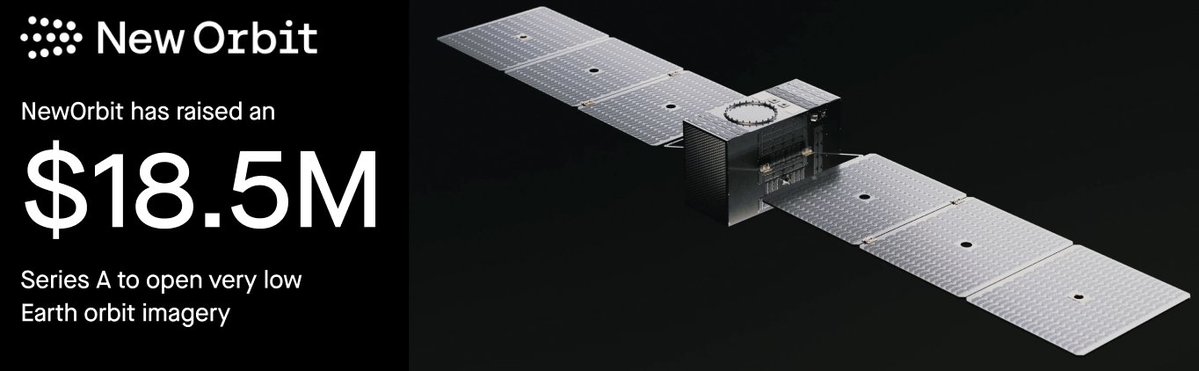
There's a sliver of space -- 200 to 300 km up -- that's been empty for sixty years. Not because nobody wanted it, but because nothing could survive there.
The closer a satellite flies to Earth, the more it can do and the less it costs. The catch is atmospheric drag: strong enough at this altitude to pull satellites back to Earth within weeks, and corrode them on the way down.
@NewOrbitSpace is building a satellite that handles both. NEO-1 has its own engine to fight the drag, materials that survive the chemistry, and a design built to stay up for five years. That unlocks high-resolution images from space at roughly 20x lower cost, 5G straight to a phone without rooftop antennas, and live HD video from orbit -- things that simply aren't possible from where satellites fly today.
We're proud to lead NewOrbit's $18.5M Series A and back the UK-based team.