Today's 'Kamaladhara Vajragopala' Alankara of Bhagwan Udupi Shri Krishna 🪷
Significance of clapping hands during Aarathi of Bhagwan
According to our Shastras, we must clap our hands while the Aarati of Bhagwan is being done in the Devasthanam or any other Devasthala, or while doing the bhajan or Keertanam of Bhagwan. The reason behind this ritual is, that with every clap our bad karmās get destroyed. We are getting purified and blessed with every clap done in Bhakti for Bhagwan.
Also, while entering any Devasthanam, we must never step on the platform of the entrance of the Devasthanam. Instead, we must touch every step on the stairs of the Devasthanam with our right hand and do a namaskaram including the platform, then cross over the platform and enter the Devasthanam.
Rukmini jeevana smarana Govinda Govinda 🙏
#Udupi #UdupiKrishna #ShiroorParyayaNammaParyaya
Indian Cattle tells an unspoken story of Out of India migration🔥
Why? Because cattle cannot just walk outside of India and go all over these places!
It needs Indian cattle herders, real people to move out of India with these cattle!
This is creating nightmare in the Aryan Invasion Theory camp!
Indian humped cattle – the indicine lineage (Bos indicus) – were domesticated in the Indus–Sarasvati region around 8000–7000 BCE, with early evidence from Neolithic Mehrgarh.
From this core zone, they spread steadily across the subcontinent between 7000–4000 BCE, becoming integral to early agro-pastoral economies.
By 3000–2000 BCE, indicine cattle moved eastward into Southeast Asia, contributing to the formation of regional zebu populations, and by 2000–1500 BCE they had entered parts of China, where they interacted with local taurine lineages.
A further major expansion carried Indian indicine cattle westward into Africa beginning around 2000 BCE, with multiple waves continuing into the first millennium CE; this movement profoundly reshaped East African cattle genetics, producing the taurine–indicine admixture visible today.
Thus, over several millennia, cattle domesticated in northwest India radiated outward across Asia and Africa, leaving a durable genetic and economic footprint that still defines tropical cattle populations.
Taurine cattle – the humpless lineage (Bos taurus) – were first domesticated in the Near East around 10,500–10,000 BCE from local aurochs populations in the Fertile Crescent.
They expanded with Neolithic farming communities into southeastern Europe by 7000–6000 BCE, and across most of Europe over the next millennium.
A southern dispersal carried taurine cattle into North Africa by 6000–5000 BCE, and progressively into Sub-Saharan Africa between 4000–2000 BCE, where they later encountered and hybridised with incoming indicine cattle.
Eastward movements brought taurine herds into Central Asia by 5000–3000 BCE, contributing to later Eurasian pastoral systems.
No evidence of any of them entering India! This agains weakens Aryan Invasion Theory or it's weakened version Aryan Migration Theory!
All silly political games played with human genetics in scholarship arena now checkmated by cow genetics!
Here’s a story. Uttarakhand cricket team used to sing GuruGobindSingh’s beautiful hymn “Deh Siva Bar Mohe” before entering the pitch. Nobody had a problem forever until @WasimJaffer14 was made the coach. He served less than a year but made sure the “religious” prayer was removed.
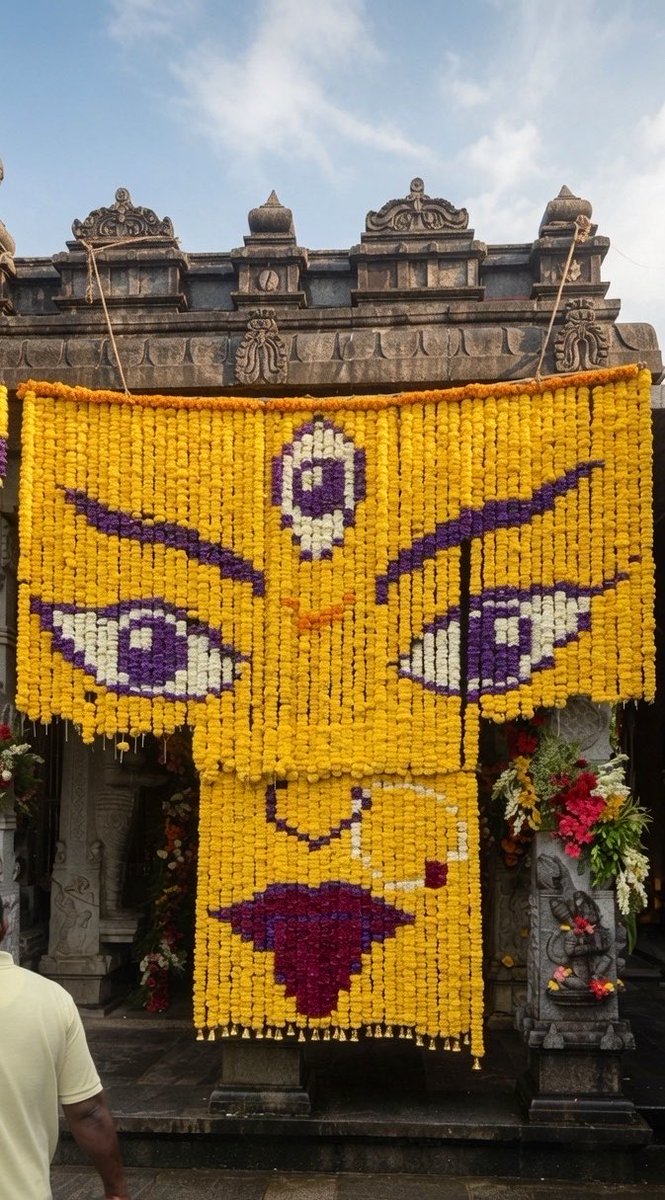
Ambalpady Shree Mahakali Devi Mukham today's stunningly beautiful artistic decoration with colourful flower Haaras at Ambalpady Devi Mahakali Devasthanam in Udupi 🪷
3rd day of Gupta Navaratri today
ಮಹಾಕಾಳಿ ಅಮ್ಮ ನಮ್ಮನ್ನು ಕಾಪಾಡಿ 🙏
#Ambalpady#Udupi
Let me explain what this whole fight is about, because it is very different from what the tweet by the Japanese official makes it sound like.
Back in 2015, India and Japan signed the Mumbai to Ahmedabad bullet train deal. 508 km.
India would use Japan's Shinkansen trains and Shinkansen technology. Japan put up a massive soft loan, covering most of the cost, at almost no interest, 0.1 percent, to be repaid over 50 years.
On paper it sounded amazing. Cheap money, world class trains.
But every such loan has a catch. Cheap Japanese money came tied to buying Japanese things.
Their trains. Their coaches. Their signal system. Their price, largely on their terms. That is normal. No country lends billions out of pure love. They lend to sell their own industry.
Then two things went wrong, and this is where his anger comes from.
One, the price.
The Japanese Shinkansen trainsets turned out to be extremely expensive. India felt it was being overcharged for the rolling stock. So, talks hit a wall.
Two, the timeline.
The newest Japanese trains, the E10 series, would reportedly only be ready for India around 2032. India did not want to sit on a finished 1.08 lakh crore track with no trains to run on it.
So India made a call. And this is the part I am proud of.
Instead of waiting and overpaying, India decided to run its own trains first. BEML in Bengaluru got an order to build indigenous high speed trainsets at about 866 crore each, designed to run at 280 kmph.
India will open the line with Indian made trains on the Surat to Vapi stretch around 2027, and bring in the Japanese Shinkansen later.
And the signal system, the thing he is bitter about, India switched from Japan's DS-ATC to the European ETCS Level 2 system.
The same family already used on the Delhi Meerut rapid rail. That is what he means by Japan being excluded from the signal system. India looked at the Japanese option, found it too costly and too slow, and picked a different one.
Now let me be fair, because I cannot be blind just because I am pro India.
He is not lying about everything.
India is genuinely a tough, frustrating negotiator. We change our mind. We push for our own interest till the last minute. We renegotiate things others thought were settled.
To a Japanese official raised on politeness and fixed agreements, this feels like betrayal.
But flip it around and look at it from our seat.
Our job is not to protect Japanese honour. Our job is to get India a bullet train at a fair price, that runs soon, and that builds Indian factories in the process.
On all three, changing course was the right call. Waiting till 2032 and overpaying for imported trains would have been the polite choice. It would also have been the stupid choice.
There is a bigger thing hiding under his frustration, and I think it is the real reason for the anger.
For decades, the deal was simple. Rich countries gave loans and technology, and poorer countries said thank you and bought whatever came bundled with it.
You took the money, you took their trains, you did not argue.
India argued. India took the loan, then insisted on its own trains, its own signal system, its own factories getting the work. We used their money to build our capability instead of just renting theirs.
That is what stings them. Not that we were reckless. That we refused to stay the junior partner in our own project.
I will give the Japanese side genuine credit.
Their engineering is world class. In 60 years, the Shinkansen has never had a passenger death from a derailment or collision.
That safety record is worth respecting. Their frustration with our chaos is also probably fair on a human level. Working with India can be maddening. Anyone who has managed an Indian project knows this.
For me, the real issue is what’s in it for our country.
India has the track. India is building its own trains for it. India picked its own signal system.
India got a 50 year loan at almost zero interest. And India will still get the Shinkansen later, on better terms than the original bundle.
If that is what Indian recklessness produces, I will take it every single time.
Be tough. Be a nightmare to negotiate with. Just make sure the country wins at the end of it. :)
Christian yoga is not yoga.
"And I don't say that because I'm against Christianity. I say it because I respect all religions. One of the biggest misconceptions today is that yoga is just a neutral set of postures that you can fill with anything you like. It is not.
"Yoga comes from the Hindu tradition and developed as part of a very specific understanding of reality and consciousness. Christianity has a fundamentally different understanding of God, the self, and humanity's relationship with the divine.
"Whether or not you believe in Hinduism, if you borrow from it, you have to do it right. If you change Om to Amen, rename the poses to biblical symbols, and just reinterpret everything through a Christian lens, then that's not yoga anymore, and neither is it a Christian movement practice or a non-Hindu flow.
"If you're teaching the same asana sequences but remove Hinduism from the equation, you haven't created something new. You've taken yoga, stripped away its roots, and given it a different name. Taking Hinduism out of yoga is like removing Christ from Holy Communion. At some point, you have to be honest and say you can't call it the same thing anymore.
"So don't take the old and present it as something new. Create something new and call it something new."
According to Tamil tradition, Murugan taught Tamil grammar to Agastya, who then composed the grammatical treatise Agathiyam, regarded as the earliest Tamil grammar.
A similar tradition exists in Sanskrit. When a Satavahana king asked his minister Śarvavarman to simplify Sanskrit grammar and produce a concise grammatical text within a short period, Śarvavarman worshipped Lord Murugan. Pleased with his devotion, the Lord appeared before him and revealed a simplified system of grammatical sūtras. Thus was born the celebrated Sanskrit grammatical work Kātantra Vyākaraṇa (कातन्त्रव्याकरणम्).
Since the opening sūtra revealed by the deity began with the words “Siddho varṇasamāmnāyaḥ”, the grammatical tradition also came to be known as Kaumāra Vyākaraṇa (derived from Kumāra) and Kalāpa Vyākaraṇa, the latter traditionally associated with the plumage (kalāpa) of Kārttikeya’s peacock mount.
Interestingly, several scholars have noted striking similarities between the Tamil grammar Tolkāppiyam and the Kātantra system. They begin with the classification of sounds (letters), proceed systematically to word formation and morphology, and present grammatical rules in a manner intended for learners.
They concluded that both belong to the ancient Aindiram grammatical tradition. Significantly, the Pāyiram of Tolkāppiyam itself describes its author as “ஐந்திரம் நிறைந்த தொல்காப்பியன்” (Tolkāppiyar, who was well versed in Aindiram).
Hence it is clear that Murugan is celebrated as the guardian of both Tamil and Sanskrit. This shared legacy is a powerful reminder that India’s languages are threads of a single civilizational fabric, woven together by a common spiritual and intellectual heritage.
If Parsi Dairy Farm can be shut down for food safety violations, just imagine the hundreds of sweet shops lined outside the temples of Mumbai
Don't buy sweets from them & protect your own health.
Remember Krishna's hunger was satiated with a mere fistful of the humble puffed rice
A must watch
“There is an attempt to make Tipu Sultan a national hero, I don’t know why”
Tipu Sultan unleashed destruction in the Malabar region & wanted higher-caste women to be converted or killed
Atrocities of Tipu Sultan by HH Aswathy Thirunal Gowri Lakshmi Bayi of Travancore
Credits to Culture calls YT channel