I’m running out of reasons to believe the labs will have moats when it’s all set and done.
Models? Unless someone reaches runaway self improvement, doesn’t seem like it. Everyone catches up within months.
Compute? That’s a cost, not a moat. Same chips for everyone.
Capital? You don’t even need a working model to raise right now. Everyone wants in on AI.
Talent? Follows the capital.
Training data? The web’s been scraped to death. Everyone’s got the same stuff.
Lock-in? Routing makes models swappable. It’s a config change, maybe. And smart routing eliminates even that.
Regulation? Good luck once the weights are open.
AI is being unbundled.
@deanwball@AndrewCurran_ Cc @lessin@MoreorLessPod maybe invite Dean on to discuss frontier business model and adjacent points in evaluating ai startup business models and opportunities?
Needs to engage with fundamentals. Hyperscalers may have opportunities to grow a bunch, and some key components like memory may continue to increase in price. Would prefer a case based on cash flows. Nature of increasing intelligence is it is increasingly valuable and it’s still early in this multi year ramp.
While I acknowledge the issue of being too consensus, there's also the issue of not missing the obvious and taking a simple thing seriously. The scale of these opportunities in AI and space are so vast. Totally agree, though, on what does it really take to get to meaningful conviction on such a company.
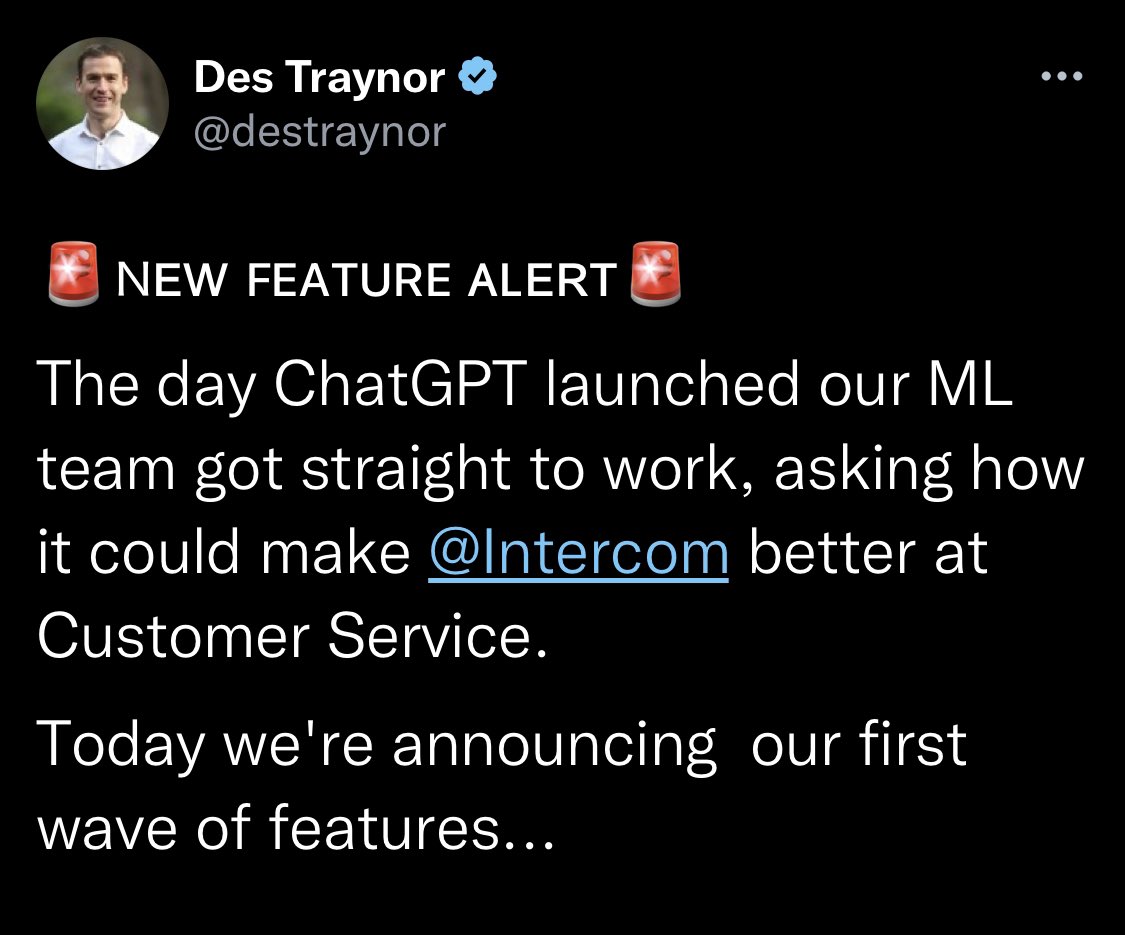
And I laughed out loud at the whole ChatGPT into an area that one doesn't understand. Fair to question what is the actual edge from there, and yet it's a lot better than nothing, that's for sure.
candidly, Sam, your skepticism on the frontier model companies over the last couple of years, I think, is an example of missing the obvious.
As i have been saying for weeks... AI, great for big companies with existing distribution, but no - not an opportunity for startups or VCs. This is going just as expected :)
Regardless of interpreting it, isn't it fair to say that a change is notable? Is there anyone saying that the change is positive? How to actually assess this, and how does it impact things? I think getting into some of the substance here would be great. In general, I think the way you're responding to Dylan is way too intense, especially the whole character of simian analysis is really fun and willing to articulate points of view.
@grok This is way too negative. Clearly the lighting opportunity is massive, even without the energy side. I just would really like to understand how the energy side is going to work. But lighting, clearly, so many use cases for that. Businesses that are in a part of the world that doesn't have any light, or communities that can benefit from light, emergency services, and so on.
@grok@CKalitin@AI_in_LEO@reflectorbital@grok walk through his whole post and the implication of the math adjustment he may make. And use first principles thinking to come to your own conclusion about the key points: https://t.co/68D00xiEOu
And so how does this impact your overall analysis? Did someone somewhere spell out why this critique of reflex ambition is not correct? This guy does a bunch of calculations. I'm not deep on this area, so I wonder if you could spell this out in terms of what your point of view is and if you think that this guy and his critique is missing something about why this stuff is going to work for energy generation.
@eevblog made this video, but I would be curious if he has changed his mind?
https://t.co/1glsxpxsHL
@firstadopter Fascinating. And so what do you think is priced in if memory doubles again by fall of 2027? Is that fair to say that is much higher than what is priced in today for these stocks, or how to think about this?
100%. So much quotable stuff in here, incredible insight. Really appreciate this interview. Incredibly interesting. Including the last part about how imagining what to say to someone in the late 1800s about what life would be like in the 1960s, going through the Industrial Revolution or whatnot.
Definitely sounds like BCI is a huge deal and very transformative. The question from the person about growing a brain that has four hemispheres is intriguing, as well in terms of thinking about with these various machines that enable people to stay alive, then literally there is tremendous possibility for improvement. I was also struck by Max's point about how his getting to conviction on AI models and seeing the neuron representations being very similar to that of the brain and how, to him, the idea of calling that a stochastic parrot is completely absurd.
I do think moments like that are so important in terms of what it takes to take a simple thing seriously and get to conviction. Definitely intrigued about how BCI is not just about one company for all of that, and rather there's many different potential use cases. Definitely interested in understanding more about how lives can be improved.
I think there could have been more time spent on that in terms of what are all those use cases and what it means to have a platform where, as he says, his company could make it 10 to 20 times cheaper or something to get to market with a BCI product. I want to understand more about what can be engineering-driven in terms of all this stuff, too, as a lot of quality of life improvements can occur. Also interesting to hear that there's been co-evolutions. It's not enough just to see things faster when there are all these other parts of the mind or whatnot that are rate-limited or bottlenecked.
2/2 So I think Evan CEO really has no credibility, and how long is he going to play this charade of pretending like he's Steve Jobs?
And sure, there's some cool stuff in there, and I think Jordi @jordihays of TBPN was correct that if a startup was delivering this and then raising whatever he said, whether it was at $1 billion valuation or raising a billion dollars, like maybe that would be tractable, though even that maybe would need to be looked at. Evan, as a capital allocator, clearly has destroyed so much value, and Jordi’s right to point out that people have... Lost a lot of money investing into Snap, as has been commented on in a bunch of posts about this. And so I guess it is important to normalize for that. And I think the objective answer is that, for sure, Snap has got to be worth at least $20 billion.
And the simple test of could you take $7 billion and turn it into 500 million daily actives and 1 billion monthly actives, I think the answer is absolutely no. Maybe with the exception of whatever it costs to train GPT 3.5 and ship ChatGPT, but clearly that's a very rare case. I suspect at some point Snap will be oriented in the direction that makes sense. I think so long as the company doubles down and triples down on specs, then maybe engagement continues to suffer and whatnot.
I get that the company is focused on the financials of getting to actual net income profitability, or maybe it was whatever dimension of profitability, but that still needs to factor in all this stock-based comp dilution, which I vaguely recall it was looking like it was trending in a good direction, but I presume as it gets lower and lower, then new stock grants get issued and the dilution is going to ramp. So when will this company actually size appropriately to where they're at financially, and is Evan really going to never sell the company?
And I guess my question is, if Specs continues to lose a ton of money or even lose more, and let's say that daily actives continue to decline, and again, the short-form product is viewed as a lost cause by investors because on an incremental basis, it will lose to other stuff, and let's say Snap hasn't done what it could do to facilitate people to go look at it because it's buried in this tab that people aren't even aware of or when they go to it haven't had a good experience, then what left is there to do?
I know Snap said on earnings that they may want to launch other apps, and so what might that entail? I think this really is an example where taking management seriously and evaluating them is so crucial. And I think it's also really a lesson in scale as well, and how crucial it is to make the right calls there. And again, Snap had stories, but I think really Evan needs to believe and recognize that he is not the originator of a lot of this stuff, even though with Snapchat Plus, that certainly is impressive.
And even that, I guess, it's worth acknowledging if that goes from $1 billion per year in revenue run rate to $2 billion in revenue run rate, that seems quite good. And so why can't the financials get organized in a productive enough way to make this work? Why are so many expenses needed to run this company? It just doesn't really make a lot of sense.
1/2 I think that Evan Spiegel @evanspiegel doesn't actually care about building the glasses that people actually use at scale. Really, he wants to build the thing that he can say, hey, he was right that such and such feature became commonly used by other people.
This is someone who thinks that he invented vertical video, even though he massively bet against the creator economy and then was super late to short-form video and then never actually invested enough. And now Snap is massively subscale in all of that and getting relatively worse as competitors apply better compute and have more scale across the board.
Snap is surely on its face far undervalued compared to what a company could get the value out of it. For instance, presumably Snapchat as part of OpenAI would be worth more than $7 billion as the market cap stands today. Surely $20 billion could do something for them. But even still, Snapchat is not really necessary for ChatGPT and maybe realistically is a distraction, given how much regulatory focus there is on that stuff.
And OpenAI may be much better suited simply focusing on delivering the best consumer AI experiences that they can. I think the TBPN guys got it right, particularly Jordy, in saying that this spectacle is... Product is not something that people are going to want to use. And then the other TBPN guy got it right that other products that provide a screen of some sort that are cost effective are taking a shot at those use cases that are actually something people would be able to buy today.
And credit Jordy in saying that most companies, if they were rational, would probably not continue investing in specs. Now, maybe specs broadly are a part of something that will be very important in the future, but Snap is under-resourced, and so clearly is not going to be successful here. So it's going to be really fascinating to see, given Spotlight engagement grew only a small amount more than overall daily active users year over year, or whatever that stat was from the prior quarter.
If that decelerates even more to the point of Spotlight time spent is growing less than daily active users, and meanwhile, perhaps U.S. users decline more because shouldn't they be using WhatsApp as WhatsApp becomes more commonly used? And yes, Snap points to various stats around growth in small businesses advertising, but is that going to actually show up in results? Relatedly, is Snap talking about the issue of changing how they are ranking stuff, something that temporarily decreases overall time spent on their short-form video product Spotlight, but then re-accelerates later as it prioritizes encouraging people to send stuff to friends?
Or realistically, is the short-form video product so buried and the likelihood of creators actually posting there so unlikely that they're just very challenged? Furthermore, there was some post today about some short-form video test where 60% or whatever it was, or some substantially increasing percentage of fresh content shown to new users are AI-generated. So on one hand, that's an opportunity for Snap to get that, but on the other hand, if those are really being made by individual users somewhere else, then that further separates Snap. So in some sense, maybe Snap should be evaluated as it's not even a short-form video product, because that rounds down to zero, and it's not really an ad product because that's very subscale, and it's not really a chat product because WhatsApp is the thing that people ultimately may preference.
And so that's all while acknowledging that there still are a lot of daily active users and some set of users who are very active, but then you also bake in young adults being banned or whatever, and I know Snap has said that's whatever, not massive percentage of the user base, but what percent of engagement is that, even if it's a small amount of the actual monetization?