Lies
My keenest attention
goes to the Mountains
Rivers, Wind, Forest and the Ocean
As they have never lied to me.
I have heard people, scriptures,
philosophies, ideologies and social media
All I see is narratives of self-interest
Narratives and narratives of me vs you
Against Nations, of Race and Religion
Of Caste, Creed and Colour – Narratives.
Lies going out as liberal thought
Lies being paraded as the way to heaven
Lies masquerading as well-being for all
Lies and Lies
Did a Mountain, River, Wind, Forest
or an Ocean ever lie to you…
The real water reserve is beneath our feet. Soil has the capacity to hold 800% more water than all the rivers put together. But that potential can be realized only when the land has substantial native vegetation in the form of trees, bushes, summer crops, or ground cover that enriches the soil organic content. It is not just about building more dams to store more water. The biggest dam on the planet is the Soil. –Sg #SaveSoil
You cannot be receptive when you are too full of yourself. The less you are, the more you receive. The more you are, the less you receive. #SadhguruQuotes
Once your relationships are about sharing your Joy, rather than extracting Joy out of someone else, you will have wonderful relationships with anyone. #SadhguruQuotes
There are legitimate questions one can ask about any large yogic organisation, including Isha. But this thread is a good example of how a collection of facts can be arranged to imply something much more sinister than the evidence actually establishes.
Yes, Isha owns a very large property in Tennessee. Yes, it is developing residential accommodation. Yes, some residences involve 99-year ground leases, and yes, certain types of residence have prerequisites connected with Isha’s spiritual practices and culture. None of this is hidden: Isha publishes the arrangements itself, and the residential development and its utilities appear openly in Tennessee regulatory filings.
But what exactly is the allegation?
The repeated emphasis on “17,000 acres” needs context. That number describes the broader landholding, not 17,000 acres being turned into houses and apartments. Isha has publicly stated that roughly 70% of the land is intended to remain under conservation. Much of it is forest, bluffs, waterways and wildlife habitat rather than a giant residential development.
Having spent time there myself, one of the most striking things is actually how much wildlife thrives on the property. Nature has been left largely undisturbed, and you see animals flourishing everywhere.
What is actually being taught and practiced there? Primarily yoga, meditation and a way of living centered on the science of well-being. Isha does not require residents to convert, adopt a religious or political identity, or renounce their existing faith.
It is not particularly unusual that some people who value this way of life would choose to live near others who share those interests. People everywhere choose residential environments that reflect how they want to live: around nature, wellness, sustainability, retirement, or simply shared interests. For example in Georgia, Deerlick Astronomy Village was created specifically for people who share a passion for astronomy and want to live under genuinely dark skies. The development has no streetlights and imposes strict limits on outdoor lighting, building and land use specifically to protect the night sky for everyone who chooses to live there. These shared expectations are not sinister or separatist.
Living in a setting conducive to yoga and meditation is no more a withdrawal from wider American society than choosing to live in an astronomy village or an eco-community. People there still live under the same laws, pay taxes and participate in the world like everyone else. Wanting to live around people who share some of your values is hardly separatism.
And what’s actually expected of people living there is pretty ordinary: avoiding drugs and alcohol, and maintaining a peaceful atmosphere conducive to yoga and meditation. They are not aggressively policed rules, but part of the basic ethos people are expected to respect when choosing to live there.
The practice requirements make more sense in that context. Yoga and meditation have well-documented scientific evidences for physical and psychological benefits, and at Isha they are part of a broader way of life centered on health, awareness and inner well-being. It is not a requirement to adopt a particular religious identity. Asking prospective residents to have actually experienced these practices simply ensures they understand what they are choosing to be part of. Before labeling it “religious,” “separatist” or something more sinister, it might be worth first understanding what is actually practiced there and why.
Isha’s programs are open to people across religious backgrounds and do not demand exclusive religious allegiance; someone can remain Christian, Muslim, Jewish, Hindu, atheist or anything else while practicing yoga and meditation. For more than 30 years, these practices have been taught globally to people of different cultures and faiths, by teachers who themselves come from diverse backgrounds.
The Tennessee center is also open to visitors and hosts events intended for the wider public, from Christmas lights and celebrations to Earth Day and World Peace Day. That hardly fits the picture of a closed religious enclave separating itself from the outside world.
So the relevant question is not, “Why are they building a separate society?” They aren’t. A more meaningful question is: what is inherently sinister about people who value yoga, meditation, nature and a quieter way of life choosing to live near one another in an environment designed to support those interests, while remaining part of the wider society around them?
The same problem appears in the attempt to draw ideological conclusions from the organisations Isha has interacted with. Cooperation or engagement with groups, such as Sewa, ITServe, HSS or RSS, does not, by itself, establish ideological alignment. Isha has engaged with an extraordinarily diverse range of institutions and leaders globally, particularly through its ecological and humanitarian initiatives, including Muslim leaders, Jewish rabbis, Vatican representatives, Buddhist monks, various governments, NGOs and people from widely differing cultural, religious and political backgrounds.
That breadth of engagement is exactly what one would expect when addressing issues such as soil degradation, rivers and ecological restoration, which transcend religion, nationality and politics. Cooperation with one organisation on a particular project no more implies endorsement of that organisation’s wider affiliations than cooperation with the Vatican makes Isha Catholic. Collaboration on a shared objective establishes common ground on that objective. Nothing more.
What concerns me more in many of the comments on this thread is the amount of misinformation, half-truths and unsupported allegations being repeated as established fact. I have seen this pattern before: legitimate questions become mixed with ideological hostility, selective facts and guilt by association until a predetermined narrative begins to masquerade as evidence.
Given the complex political and religious dynamics surrounding these issues in India, there are groups with sharply competing interests and interpretations. That does not make every criticism malicious, nor should Isha or any large organisation be beyond scrutiny. But scrutiny should make us more rigorous about evidence, not less. Accusations should not become facts simply through repetition, and associations should not become conspiracies through insinuation.
If the concern is genuinely accountability, then the standard should remain the same for everyone: evidence, context and intellectual honesty. Not selective facts, guilt by association or hostility dressed up as investigation.
I resigned from Anthropic today. I spent the last three years doing pretraining research at both OpenAI and Anthropic. Neither company is acting responsibly. They are racing straight to self-improving superintelligence and gambling with our lives. More thoughts below.
Happy Birthday Sadhguru.
You have said birthdays come and go and remind us that time is slipping by and it's a very brief life.
Praying for your long, healthy and impactful life ahead.
@SadhguruJV
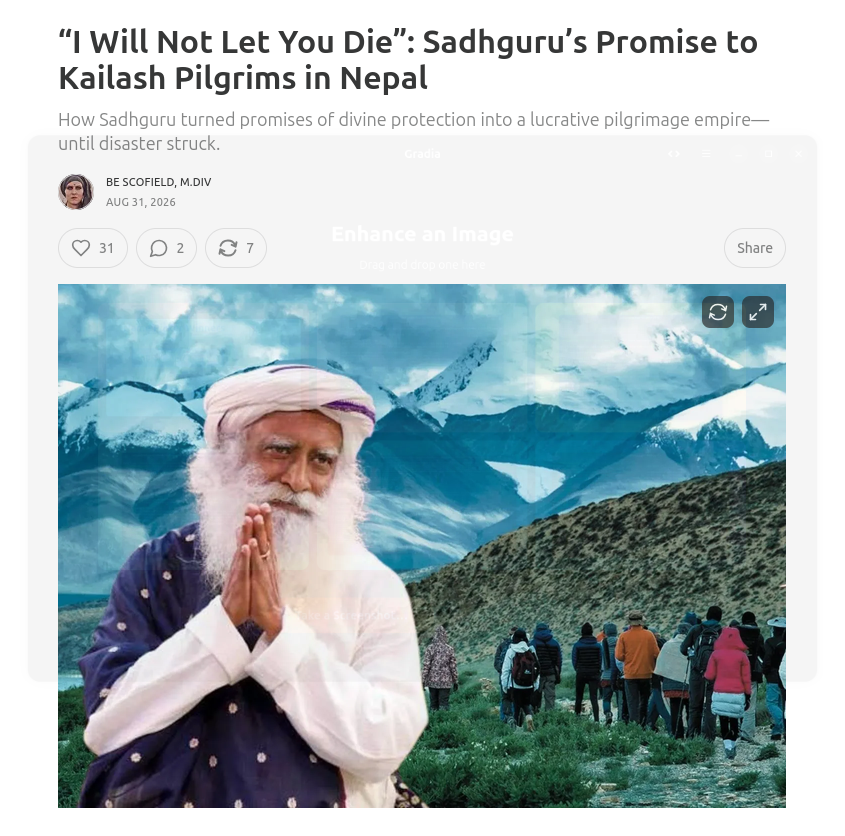
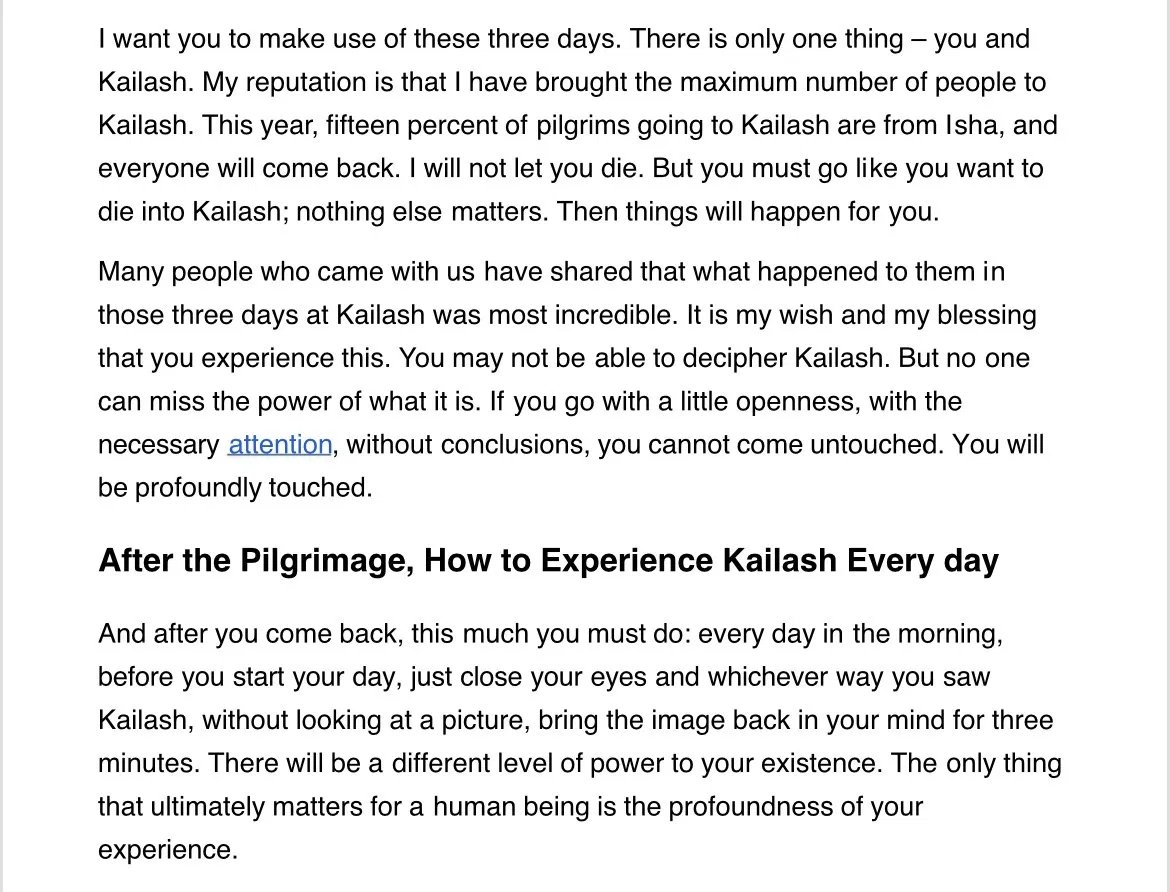
The line everyone is passing around as having said by Sadhguru is "I will not let you die."
Four words, ripped clean out of the paragraph they live in, and held up as proof that a man sold pilgrims a guarantee against death, and therefore owns their deaths when a glacier came down.
So read the paragraph. It's public - Isha has published it. The link is below.
https://t.co/z0xYiuo5xy
It's from a talk at the foot of Kailash in 2017. The entire address is about one thing: surrender.
He tells the pilgrims this is not a tour or a trek, and that a pilgrim doesn't go to conquer the mountain. He goes to wear himself down, to become less than he imagines himself to be.
And in the very same breath as "I will not let you die," he tells them to enter Kailash as though they came to die into it, to lose the self completely, to hold nothing back.
You cannot honestly read one half of that sentence as a literal promise about the body while ignoring that its other half begs you toward a death of the ego. The two only make sense together, and together they say something every mystical tradition has said for millennia: do not be afraid of dissolving here and so let go entirely.
That is not an insurance clause. It is the oldest instruction a spiritual teacher gives.
"You are safe, so surrender" is the language of a guru speaking to a disciple's fear. It is not the language of a brochure warranting your safe return, and judging it by that standard is a crooked rewrite and not a reading.
Just step back and look at what Sadhguru is being blamed for. A section of glacier broke off a Himalayan peak and hit the valley with enough force to register as an earthquake. Witnesses thought it was a bomb. More than nine hundred people are dead, of every faith and none. No sentence spoken in 2017 turns that back.
Taking a teaching about surrendering the ego, recasting it as the cause of false hope, and then presenting the bill to one man in the middle of a natural catastrophe is not honesty about the dead. It is using them to settle a score.
Read the whole passage. Then decide who did the twisting.