🚨 ELON MUSK: "Neuralink, where we want to try to solve the bandwidth constraint that humans have. So, because you can imagine, like, even in the most benign scenario where the AI is super friendly and wants to do everything it wants to make you happy, just our rate of communication is too slow.
So, like, the peak human bandwidth is only about 100 bits per second, roughly. And our input bandwidth is much higher because of vision. So there we maybe have, it's a debatable point, but, you know, a megabit per second or a few megabits per second from our eyes, which are, in fact, like cameras. But our output bandwidth is really low, maybe 100 bits per second, whereas computers are communicating at a trillion bits per second.
So, anything we can do to increase the communication speed of humans will improve the, I think, the alignment of humans and machines. Because otherwise, to an AI that is communicating at a terabit a second, talking to a human would be like talking to a tree."
La computación para entrenar IA no sólo crece.
Se multiplica por 4 cada año.
Desde 2010.
En 15 años: más de 1.000 millones de veces.
Nuestro cerebro no está hecho para entender lo exponencial, y por eso cuesta tanto explicarlo.
Lo he intentado en este vídeo 👇
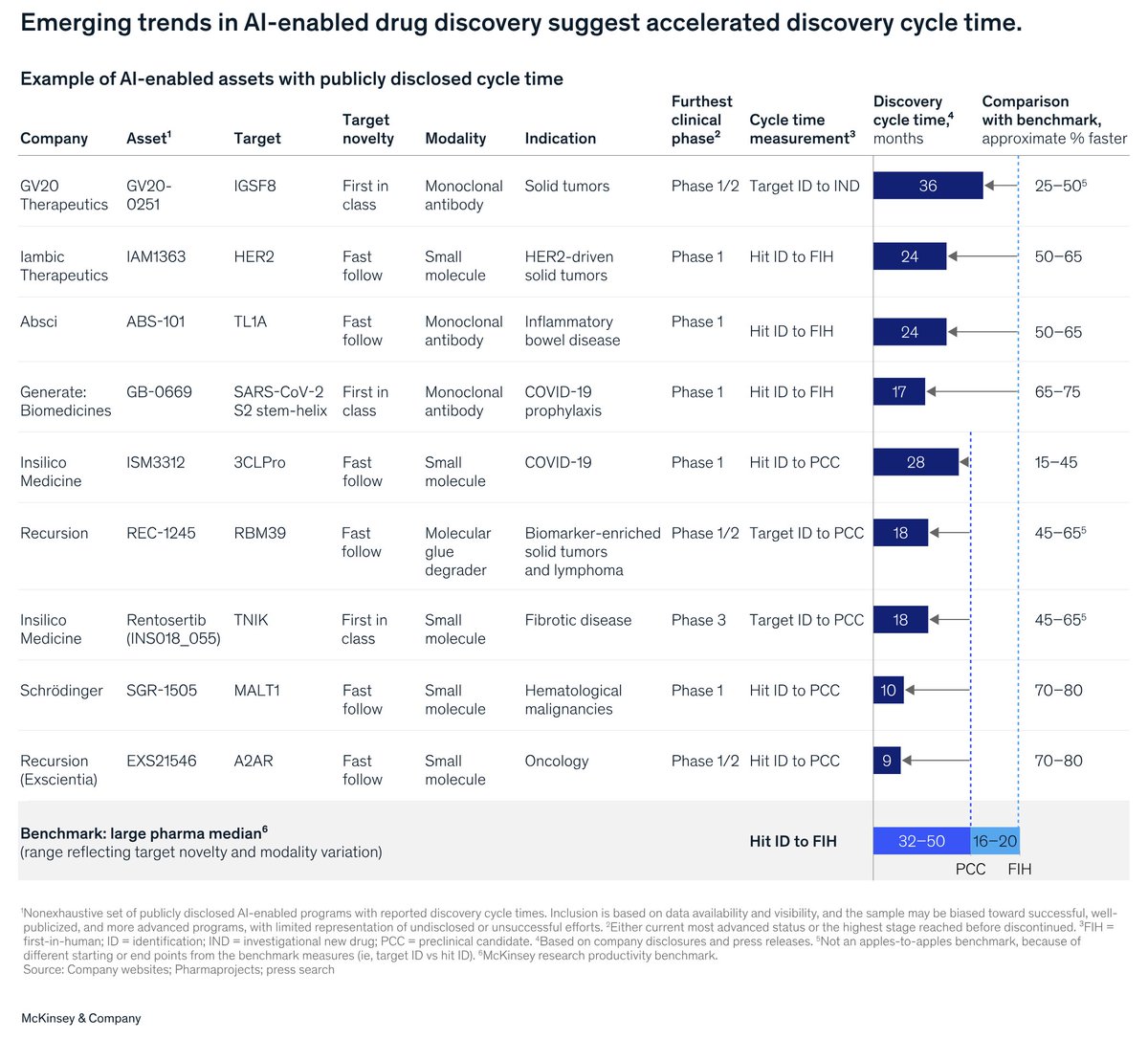
Is AI actually speeding up drug discovery?
According to new McKinsey research, there are early signs that it is: all of these candidates were AI-enabled, with discovery time cut by ~15-80%.
(Incredibly bullish)
Today we announced the Claude-led discovery of a molecular machine that we suspect could represent a new gene editing mechanism. Its precise function, biotechnological utility (if any), or level of significance is not yet clear, but at minimum it is work I would have been proud to do as a PhD student. The work was done mostly, though not entirely, by Claude: our life sciences team suggested a broad area of research, Claude read through the literature and a bunch of genome data and discovered something interesting, then Claude proposed experiments to verify the discovery and our team carried them out.
It’s easy to dismiss this as a one-off or curiosity, but we’ve repeatedly seen a pattern where AI performance in new intellectual domains goes from weak to superhuman in a matter of a few years. In 2023 models struggled to do math at the level of an average high-school student. In 2024 they started to do well on math competitions for the best high-schoolers in the country, in 2025 they started to solve minor open problems, in early 2026 more significant open problems, and in late 2026 they are beginning to solve the top few open problems in all of mathematics. We believe AI for biology is on a similar exponential trend.
The main difference between biology and mathematics, of course, is that math can be done purely theoretically, while biology requires experimentation. Some have used this to draw the conclusion that AI’s utility in biology will be limited. We think this is wrong. As we’ve demonstrated today, humans can collaborate with AI to perform the experiments, validate key results in a few weeks and, if necessary, work with the AI to iterate on what they find. Eventually it may even be possible for Claude itself to safely perform the experiments by autonomously controlling lab equipment, with appropriate safeguards in place, but we aren’t doing that today (our lab is also a BSL1/BSL2 facility that doesn't handle materials dangerous to humans).
More broadly, biomedical advancement has many stages — from fundamental biology discoveries, to translational research, to drug discovery, clinical trials, and finally the actual delivery of medicines and health care to patients. We are also interested in these later stages, but even simply accelerating the first stage of fundamental biological discoveries has the potential to speed up and broaden the entire pipeline. Improving our understanding of biology and sharpening biologists’ tools can drive forward all of the later stages, for example by identifying new drug targets, finding new therapeutic modalities, allowing for more precise measurement, and speeding up the experimental loop which itself further accelerates our understanding of biology. This will not in itself speed up clinical trial times, but if it succeeds it could greatly increase the number of promising candidates that go into the pipeline — an increase in throughput even though latency remains.
In Machines of Loving Grace, I wrote about AI’s potential to “cure most diseases in 5-10 years” — a goal that sounds impossible, but one I believe is just barely possible if AI is applied to every stage of the pipeline. The first step is showing that AI can first help with, and then drive, biological discoveries.
Claude’s discovery is the latest in a line of related prior work that goes back decades, beginning with systems like CRISPR, and continuing with discoveries like the bridge recombinase and VIPR in the past few years. Recently, there has been heightened interest in systems based on reverse transcriptase (RT) enzymes, the enzyme underlying the system Claude identified. And most recently, a Stanford team working independently described a novel RT system with an associated non-coding array that is in some ways similar to the one Claude found, though they are distinct systems that evolved independently from each other. I believe that we’re at the very beginning of finding such systems and developing them into powerful tools for biotechnology.
I’m proud of the resources Anthropic has invested in accelerating the public benefits of AI through the life sciences, and we’re aiming both to grow our life sciences team and to work with other scientists to extend this approach to a broad range of problems. If you have a proposal for a research collaboration or are interested in joining our life sciences team, please reach out.
Any legal 3×3 Rubik’s Cube scramble can be solved in 20 moves or fewer. This is called “God’s Number.”
In 2010, researchers proved it by effectively checking all 43,252,003,274,489,856,000 possible cube states using massive computing power. So no matter how scrambled it is, there’s always a solution within 20 face turns—where a 180° turn counts as one move. In the stricter quarter-turn metric, the maximum is 26 moves.
En EEUU la carrera de la IA es, en gran medida, una carrera empresarial financiada con capital privado; en China es también una política industrial de Estado.
Pero hay un pequeño problema llamado China. China no ha aceptado que Silicon Valley decida a qué velocidad debe avanzar la inteligencia artificial. Y si China continúa acelerando mientras Estados Unidos frena, lo que parecía una política de seguridad puede convertirse en una cesión de ventaja tecnológica. Por eso el debate real ya no es “¿debemos frenar la IA?”. Es mucho más incómodo: “¿cómo frenas una carrera tecnológica cuando tu principal rival no quiere frenar?”.
El problema no es que Anthropic quiera frenar. El problema es que empieza a querer frenar buena parte de la industria estadounidense. OpenAI, Google, Meta, xAI, Anthropic… todos están atrapados en la misma paradoja: ninguno puede levantar el pie mientras los demás sigan acelerando. Por eso no hablan de frenar individualmente. Hablan de frenar colectivamente. Porque si todos reducen velocidad al mismo tiempo, nadie pierde posición y todos reducen el coste monstruoso de esta carrera
Tal vez por eso estamos viendo dos políticas avanzar juntas: pedir que la industria occidental reduzca la velocidad y, al mismo tiempo, intentar que China tenga cada vez más dificultades para conseguir los chips necesarios para mantener la suya. Una política controla el acelerador propio. La otra intenta cortar combustible al rival.
Si China hubiera aceptado frenar, esto sería principalmente un debate sobre seguridad. Si China no frena, pasa a ser también un debate sobre capital, poder industrial y hegemonía tecnológica.
El verdadero dilema de Silicon Valley quizá ya no sea cómo construir una IA más inteligente. Es cómo dejar de gastar como si cada seis meses tuviera que reinventarla sin regalarle la carrera a China.
Marc Anderseen, cofundador de la mítica Netscape, actualiza su famosa tesis de 2011: “el software se está comiendo el mundo”. Ahora dice que hasta hoy lo hizo a la velocidad de las manos humanas, pero que a partir de ahora lo hará a la velocidad del cómputo.
Su argumento es interesante porque va justo contra la narrativa de que la IA destruirá el trabajo de los ingenieros. Si los agentes escriben ya gran parte del código, el programador no desaparece: gana una capacidad de producción enorme. Pasa de escribir línea a línea a dirigir una flota de agentes, de “albañil” a “arquitecto”.
Y aquí está la clave económica: cuando una tecnología reduce radicalmente el coste de producir algo, no necesariamente reduce el mercado. Muchas veces lo expande. Más productividad, software más barato, nuevos casos de uso que antes no eran rentables y, por tanto, más demanda.
Cada salto tecnológico que supuestamente iba a destruir la profesión del programador terminó haciendo el software más barato, aumentando la demanda y expandiendo el mercado. Su tesis es que la IA repetirá ese patrón a una escala mucho mayor.
Dice “no estamos automatizando al ingeniero fuera del mercado; estamos multiplicando lo que un ingeniero puede hacer.” La IA no tiene conciencia, no es más que la herramienta que nos aportará beneficios, pero hay quienes se han hipotecado para rentabilizar esa bonanza de la humanidad.
Frente a quienes ven la IA principalmente como una amenaza que debe ralentizarse, Andreessen la ve como una tecnología de abundancia, productividad y expansión económica. Por eso también desconfía mucho de que el miedo apocalíptico termine sirviendo como argumento para regular de tal forma que solo los grandes PARTICIPANTES puedan competir.
Andreessen no está diciendo simplemente que la IA ayuda a programar. Está diciendo que automatizar el software acelera, indirectamente, todas las industrias que dependen de él. Eso es la IA para él.
El debate no debería ser regulación sí o regulación no. El debate es qué regulamos: los daños de la inteligencia artificial o el derecho a competir en inteligencia artificial.
I am not sure Sam Altman, Elon Musk and Dario Amodei agree on the danger of AI killing humanity. But I am sure they agree that this mad race among themselves can make them all go broke. Meta and Alphabet included. So this talk of AI killing all of us can be better understood as AI destroying their solvency. In this scenario a "slow down" makes sense, it's a slow down of dripping blood.
ELON MUSK: AI competitors should peer review each other’s models before release.
“I would recommend that we at least have some sort of informal weekly or biweekly call and that there’s maybe a week or two weeks of early access by competitors. This is why I think the incentives work, competing companies are likely to understand if something is a security risk and they’re not going to be shy about highlighting that their competitors’ models should be delayed in release.
The incentive structure does work quite well there. It’s similar to how the Motion Picture Association works as an industry group that decides how movies should be rated. That seems to have worked quite well. You really just have to ask the government to intervene if a company is doing something very dangerous and refuses to take action to reduce the danger.”
Aquí lo tienen. El apocalipsis de la IA empieza a parecerse demasiado a una barrera de entrada.
Primero, una dimisión con advertencias sobre el fin de la humanidad. Después, titulares y alarma. Ahora, Amodei propone frenar el desarrollo y exigir supervisión externa permanente a los laboratorios punteros. Anthropic se compromete a dar el primer paso y pide que los gobiernos obliguen al resto.
La secuencia no demuestra por sí sola una operación coordinada. Pero plantea una duda que llevo meses analizando: ¿quién podrá permitirse cumplir las condiciones para seguir compitiendo? Porque si la regulación exige una estructura que solo pueden financiar los gigantes, no solo estaremos regulando una tecnología: estaremos blindando a sus propietarios frente a futuros competidores.
Y hay un detalle revelador: Amodei contempla excepciones limitadas a las normas de competencia para que las empresas puedan coordinarse en materia de seguridad. Merece atención especial este detalle porque esconde el meollo del tema.
Y obviamente ahora escucharemos por todas partes, medios y otros, titulares sobre el fin de la humanidad a menos que le pongamos reglas, barreras y vigilantes. Adivina quienes van a ser esos vigilantes... ya verás.
Aún así, no hace falta negar los riesgos de la IA para cuestionar los intereses de quienes proponen las reglas. Cuidado con que, para salvarnos de una inteligencia artificial fuera de control, terminemos entregando su control a cuatro empresas.
I agree with Dario that we need to pace the frontier. This has been a primary topic of discussions we've had at OpenAI in recent weeks.
Committing to having independent evaluators with employee-like access is a great idea, and we will do the same. We'll have more to share soon.
El artículo que @DarioAmodei ha publicado esta tarde es importantísimo. Me atrevo a resumir lo que dice, intercalando alguna cita textual:
1) El beneficio a futuro de la IA será enorme, con especial énfasis en la medicina. Pero los riesgos también lo son: perder el control, malos usos como el bioterrorismo o impactos económicos enormes.
Debemos reducir el ritmo de desarrollo de la IA. Dos motivos recientes: los grandes avances en RSI ("recursive self-improvement", que admite que ya están viendo en Anthropic) y el incidente OpenAI - Hugging Face, con el enjambre de agentes.
"it’s my worry that in 6–12 months such a swarm could be capable of taking over the entire internet"
2) Hay que reducir el ritmo porque conviene ganar tiempo, aunque sean 1-2 años.
Esto permitiría aumentar la precisión en la ejecución (admite incidentes recientes por problemas en la ejecución), mejorar el alineamiento de los nuevos modelos, avanzar en la interpretabilidad de los mismos y mejorar en los tests y benchmarks para entender bien sus capacidades.
"I believe that if slowing down bought us even an extra year or two before models reach critical levels of capability, and we used that time to advance alignment, we could greatly reduce the risk that something goes seriously wrong"
3) Esta ralentización se podría llevar a cabo a partir de tres iniciativas:
a) Integrar evaluadores independientes en las empresas que lideran la IA (menciona, por ejemplo, a @METR_Evals). Verificabilidad, transparencia, segundas opiniones, etc. Anthropic dice que empieza a hacerlo unilateralmente, sin esperar a que los otros hagan lo mismo. @sama acaba de decir que OpenAI también lo hará.
b) Regular inmediatamente el avance en los países democráticos. Y como la regulación es lenta, propone a las otras grandes empresas hacerlo rápido y de manera voluntaria.
Aquí es muy transparente: reducir el ritmo no puede significar permitir que los modelos chinos se conviertan en los más potentes. Y explora vías para garantizar esto (límites a la exportación de chips, mayor seguridad para evitar "robos" de modelos, etc.).
"If we execute these measures well, I believe they would slow China’s progress enough to widen America’s lead significantly over the next 3–5 years"
c) Llegar a un acuerdo mundial, cooperando con China, para que el ritmo sea verificable. Propone 4 niveles distintos de acuerdos posibles, empezando por un primer acuerdo para prohibir el uso peligroso en temas como las armas biológicas.
4) El artículo acaba como empieza: la IA puede aumentar muchísimo la calidad de vida de nuestra especie, pero estos beneficios solo se alcanzarán si se hace por el camino correcto.
Creo que es un artículo que merece una lectura pausada. Espero que genere un debate profundo y mundial: el tema lo merece.
https://t.co/d0eFnY5g7E
Mont Blanc this morning! 😍
After this terrible summer 'La Jonction' between Grands Mulets and Bossons Glaciers (lower left) doesn't exist anymore... 🧊🔥😭
“Mathematicians will be pondering what all this means for the future of their subject.” On “The Intelligence” we examine AI’s triumph over a gnarly maths problem https://t.co/xWkRwSDLjZ
Terence Tao identifies an issue that extends beyond mathematics. When incentive structures reward secrecy over collaboration, scientific progress may suffer. Research groups and individuals with significant findings should carefully consider how they share their work.