🗣️wahoo!!! my doctoral work is out online in @CellCellPress: https://t.co/OBbpudQRvq!! couldn't have done it without my two wonderful labs and co-advisors @stanleyqilab & @MackallLab
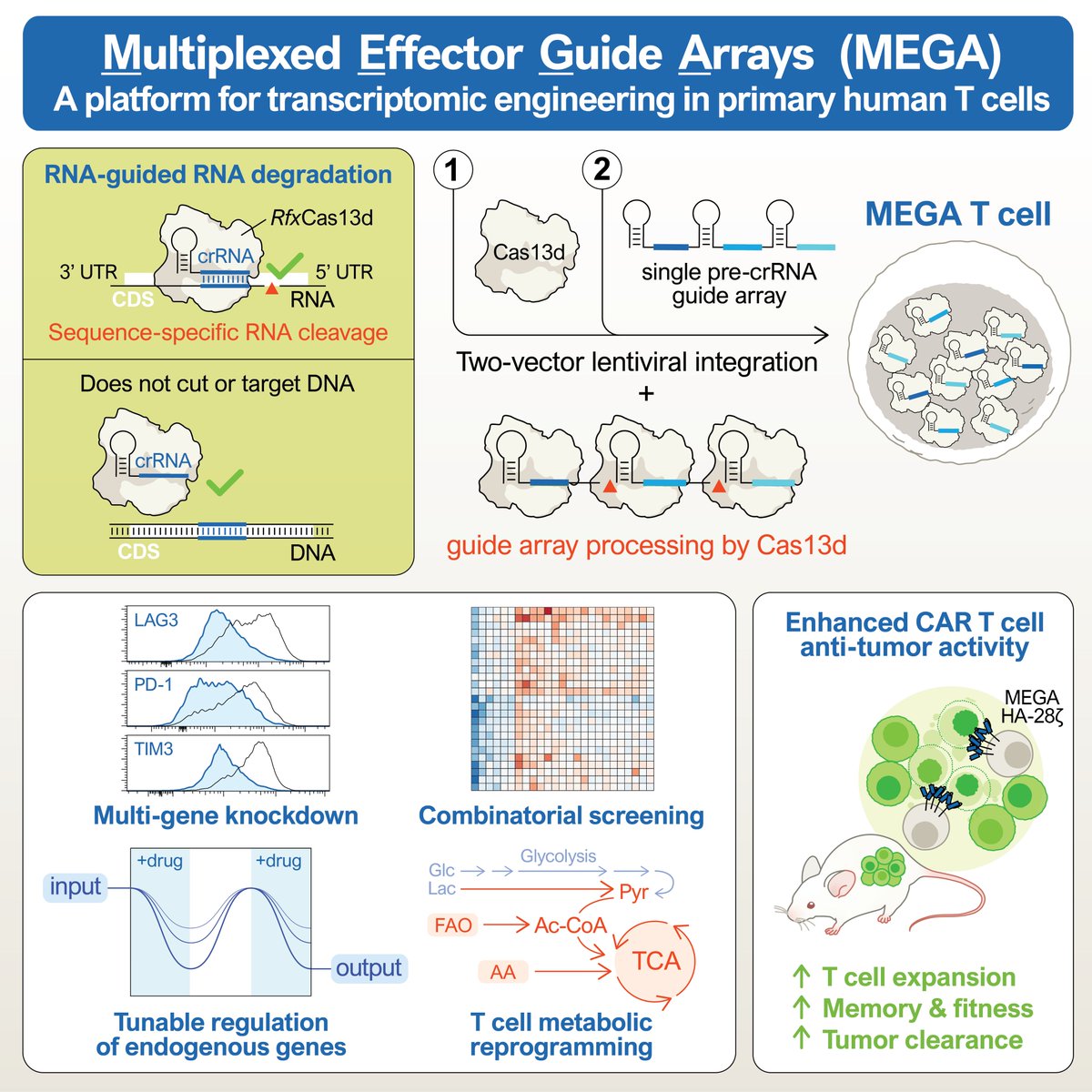
we developed a new RNA-targeting CRISPR platform (MEGA) to engineer better T cell therapies...🧵
so grateful for the opportunity to highlight our work on multiplexed transcriptome engineering & combinatorial screening for better CAR T cell therapies in the latest issue of @NatureRevCancer!!
📄: https://t.co/hVsAsKzAMI
We’re still in our BRAT summer by sharing our new RNA resources! Improved understanding of RNA over the years has led to huge developments, such as creating a COVID vaccine that saved millions of lives. Learn more in our new fact sheet! https://t.co/f0bpvxV1ov
yes!! i've long suspected that this was the case since essentially all prior cas13d collateral cleavage studies were done in transfected cell lines. it's so great to see this important & rigorous study out – congrats to the team!!
🚨New lab preprint! 🚨
A deep dive to shed light on a long-standing controversy with RNA-targeting CRISPRs: Do they have high levels of collateral (trans) cleavage of other RNAs in the cell ✂️✂️✂️ — or not?
New work from talented PhD student #SydneyHart & others in our lab. 📰
thanks @GenomeSeminars@harvardmed for inviting me to give a talk on MEGA recently!! really great opportunity for young scientists/first authors to present & discuss their work. seminars are weekly, totally free to attend (zoom), and recorded/posted here: https://t.co/EHNlUWRQJz
In summary, memory programming (but not TOO much memory) is a great thing for CAR T! FOXO1 is critical for mediating CAR T function and FOXO1 overexpression represents a broadly-applicable approach to enhance CAR T antitumor activity. The jury is still out on TCF1/TCF7. 13/
Check out the latest findings from PICI Center Director at @StanfordMed Crystal Mackall, MD, @MackallLab. The PICI-funded research suggests cell therapies for #cancer could see improvements with use of a new CRISPR RNA-editing platform called MEGA. Learn more in @CellCellPress
MEGA is a CRISPR-Cas13d system that allows for knockdown of gene expression at the genetic level, offering several unique advantages over CRISPR-Cas9 👉 https://t.co/MHHo6wAVTs @StanfordMed
Lead author Victor Tieu, @stanleyqilab, Crystal Mackall @MackallLab & team discovered a way to potentially improve CAR T therapies using a CRISPR RNA-editing platform—Multiplexed Effector Guide Arrays (MEGA)—that boosts the cells’ ability to target tumors https://t.co/PUP4Mld2gs
🗣️wahoo!!! my doctoral work is out online in @CellCellPress: https://t.co/OBbpudQRvq!! couldn't have done it without my two wonderful labs and co-advisors @stanleyqilab & @MackallLab
we developed a new RNA-targeting CRISPR platform (MEGA) to engineer better T cell therapies...🧵
A CRISPR-Cas13d based platform MEGA enables safer, more controllable editing of T cells to enhance CAR T therapy via reversible, multiplexed gene knockdown without cutting genomic DNA. #NBThighlight
https://t.co/DQ75g9Ygb4
SCI members Stanley Qi, Crystal Mackall & team pioneered MEGA, a #CRISPR RNA-editing tool enhancing #CARTcells precision against tumors. https://t.co/T7iW3wZOuY @stanleyqilab @MackallLab