@gitlawb I can’t properly type Vietnamese with the Telex input method in OpenClaude yet — especially characters with stacked accents like “ấ”, “ể”, “ượ”, etc. Copy-paste works fine though.
Telex is the common Vietnamese typing method where extra letters are used to create accents
They called it the "American Dream" and exported it to every corner of the earth.
The dream: work hard, play by the rules, and you will succeed.
Your success will be proportional to your effort.
Your failure will be proportional to your inadequacy.
The system is fair. The system is open. The system rewards merit.
This dream required a specific kind of blindness to function.
It required not seeing that the rules were written by the people who already had everything.
It required not seeing that the "level playing field" of American capitalism was built on stolen land, built by enslaved labor, maintained by the systematic exclusion of entire populations from the wealth they generated.
It required not seeing that the prosperity Americans enjoyed throughout the twentieth century was directly connected to the extraction of resources and labor from the rest of the world, enforced by the military power and financial architecture of empire.
It required not seeing that when poor countries tried to write their own rules, tried to nationalize their resources, tried to redistribute land, tried to build welfare states that served their own populations rather than American investors, those attempts were systematically destroyed.
The dream was real for enough people, enough of the time, to function as proof of concept.
But the dream was also a management tool.
It told working Americans that their interests were aligned with the wealthy Americans who owned the system.
It told them that the enemy was not the domestic billionaire class but the foreign ideology that threatened the system in which they too might one day succeed.
It turned solidarity with the poor of the world into a threat to be feared rather than a kinship to be claimed.
The Vietnamese rice farmer who wanted land reform and the American factory worker who wanted a union were natural political allies.
The empire's greatest domestic achievement was ensuring they never recognized each other.
Instead, the factory worker was taught to see the rice farmer as the threat.
And sent to kill him.
And came home broken.
And the man who sent him got a library named after him.
The most honest thing ever said about the American War was said by a Vietnamese colonel to an American colonel after the war ended.
The American colonel, Harry Summers, told his Vietnamese counterpart:
"You know, you never defeated us on the battlefield."
The Vietnamese colonel, Nguyễn Đôn Tự, thought about it and replied:
"That may be so. But it is also irrelevant."
That exchange contains the entire war.
The Americans won battles. They won firefights. They had superior firepower in almost every conventional engagement.
By their own metrics, body counts, kill ratios, territory controlled, they were often "winning."
And they lost the war.
Because wars are not won by body counts.
Wars are not won by kill ratios.
Wars are not won by the number of bombs dropped or the cost of the weapons deployed or the technological sophistication of the killing machinery.
Wars, especially wars of occupation, wars of colonial imposition, wars fought against people defending their own land, are won by will.
And on the question of will, there was never a contest.
The Vietnamese people had been resisting foreign occupation for two thousand years before America arrived.
Fighting was not a policy position. It was a cultural inheritance. A collective understanding of who they were and what they would do when someone came to tell them how to live.
America arrived with the most powerful military in human history and a firm belief that sufficient firepower could substitute for legitimacy.
It cannot. It never could. It never will.
Irrelevant. That one word, from a Vietnamese colonel to his American counterpart, is the entire lesson.
Your "respect" is hollow.
You replaced Westmoreland's biological racism with geopolitical infantilization.
Different packaging. Same refusal to admit that an Asian nation defeated a Western superpower on its own terms.
To suggest millions of Vietnamese endured napalm, Agent Orange, and carpet-bombing because a "despot" told them to is imperial arrogance in its purest form.
We were not fighting for an ideology. We were expelling a foreign invader.
America was not fighting despots. It was fighting the immune system of a nation.
And it lost.
Yes. The Soviets sent weapons and aid.
Yes, China sent anti-aircraft and logistical support.
But the men and women in the tunnels, the people who broke Westmoreland's army psychologically, were Vietnamese.
America brought half a million troops, total air and naval supremacy, allies from South Korea to Australia, and dropped more bombs than all of World War II combined.
And still it left by helicopter from a rooftop.
Do not blame China for American military humiliation.
Vietnam's post-war poverty was not caused by socialism.
Vietnam was physically obliterated by American explosives, its agriculture poisoned with millions of gallons of Agent Orange, and then strangled by a vindictive, two-decade U.S. trade embargo meant to starve it for winning.
Vietnam thrives today not because it "broke free" of its allies, but because it survived an American-made apocalypse and rebuilt from the ashes.
You can try to rewrite history to soothe the American ego.
The scoreboard does not change.
The Vietnamese fought. The Vietnamese won.
You just can't let that sentence stand alone.
General William Westmoreland, the American commander in Vietnam, said that Asians do not value human life the way Westerners do.
He said this to explain why Vietnamese soldiers kept fighting despite losses that would have broken Western armies.
He did not say: perhaps they are fighting for something worth dying for.
He did not say: perhaps our intelligence about their will to fight was wrong.
He did not say: perhaps we have fundamentally misunderstood this enemy.
He said: they don't value life.
This is what happens when an army built on the premise of its own civilizational superiority meets a people who simply refuse to accept that premise.
The army cannot update its model.
It cannot say "we were wrong about who these people are."
So it invents a theory where the enemy's resistance is not a sign of strength but a sign of deficiency.
They keep fighting because life is cheap to them.
Not because their cause is just.
Not because they are brave.
Because they are less than us.
Westmoreland ran the war for years on this theory.
He lost.
The Vietnamese people, who apparently did not value life, built a country that is alive and growing and free.
Westmoreland died in 2005.
The people he could not understand are still here.
So is the theory.
Operation Rolling Thunder.
From 1965 to 1968, the United States conducted a sustained bombing campaign against North Vietnam.
The goal was to break the will of the North Vietnamese government and people.
To make the cost of continuing the war too high to bear.
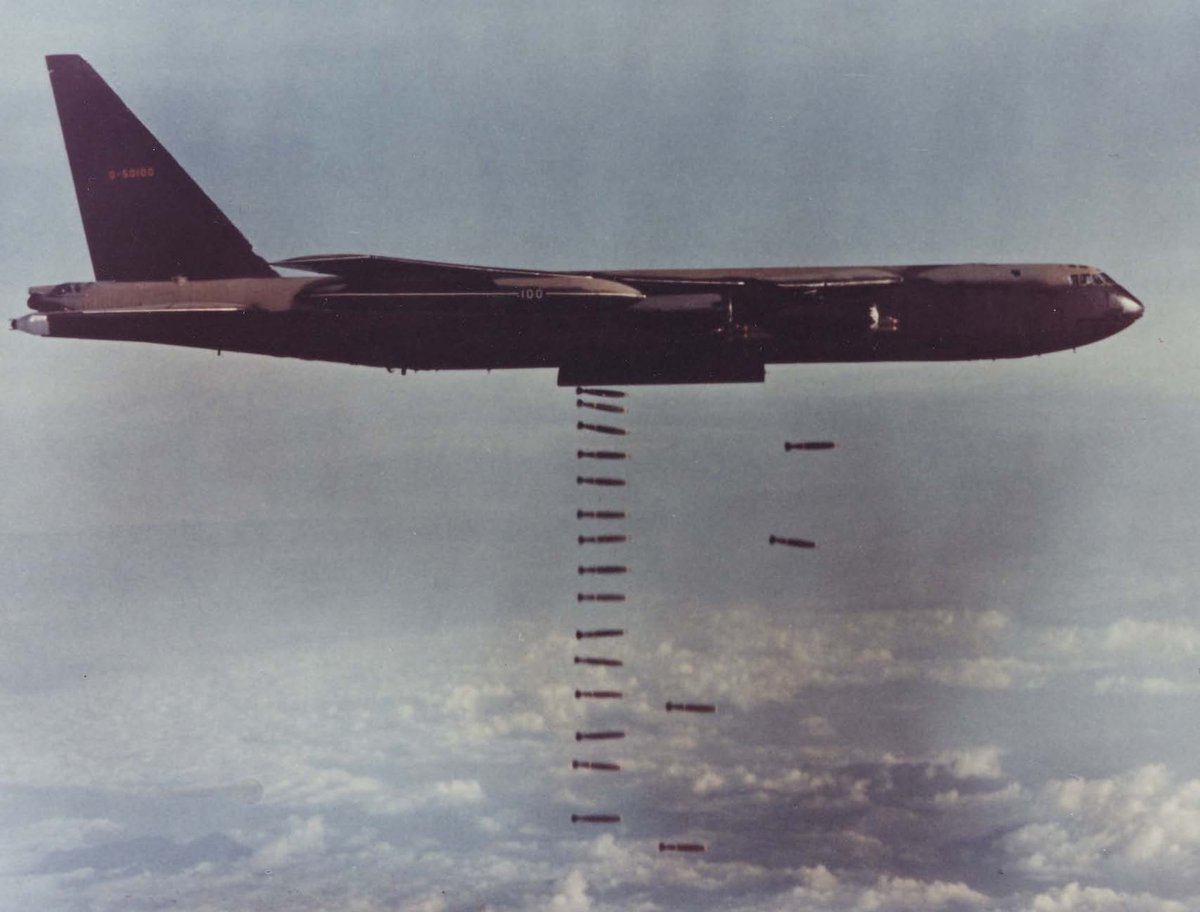
They dropped 864,000 tons of bombs.
The will was not broken.
So they escalated.
Operation Linebacker.
Operation Linebacker II, the Christmas Bombings of 1972: twelve days of around-the-clock bombing of Hanoi and Haiphong, described by some U.S. generals as trying to "bomb them back to the Stone Age."
Hospitals were hit.
Residential areas were hit.
Bạch Mai Hospital, the largest hospital in North Vietnam, was hit repeatedly.
After the Christmas Bombings, the North Vietnamese negotiating position at the Paris Peace talks did not weaken.
It strengthened.
They bombed us into refusing to surrender.
Every bomb that fell on a hospital, every family killed in their home, every village erased from the map created ten more people who would die before they accepted foreign domination.
This is what American strategists, with all their degrees and all their think tanks and all their war games, failed to understand about the people they were trying to break.
You cannot bomb dignity out of people who have decided they would rather die than give it up.