Indian AI just did something most people said it couldn't: compete on the hard metric instead of the hype metric.
Sarvam Prism scores 71.8 with a median response time of 44 milliseconds. According to Sarvam, that's the best average score of any decision model that answers in under 100ms. Here's why that matters more than another chatbot launch.
In enterprise finance, speed is a cost line. A fraud check, a credit call, an invoice match, a claims triage. These run millions of times a day. A model that thinks for 2 seconds is a demo. A model that decides in 44ms is infrastructure.
Most of the global race is about who builds the biggest brain. Sarvam went after the boring, profitable question: how good can you be when you're forced to be fast .. Look at their chart. Everything above them on the score axis is 2x to 6x slower.
That's a strategy call, not just an engineering one. Pick the corner of the market where incumbents are weak and own it.
For years the line was India will be a user of AI, not a builder. Sarvam keeps making that line look lazy. 105B base model. Built here. Benchmarked in the open against global names.
The real test is still ahead .. production deployments, pricing, and whether Indian enterprises actually buy Indian.
Today, though, credit where it's due. Well done @SarvamAI. 🇮🇳
Attacks will accelerate from here on - We are there: Six months ago I said Mythos like capability will be widely available. It's happening. A critical vulnerability, a social engineering attack that looks innocuous, or daisy chaining publicly available vulnerabilities and conducting a sniper strike is all being witnessed in the wild. Incident responders have never been busier.
Some key points:
- attacks are not becoming more sophisticated, it's the same attacks, faster and by a lot more people.
- attack path discovery which took trial and error and multiple attempts is now trivial, open source LLMs are here to help
- you are as secure as your supply chain, insecure down or upstream players who have access to your infrastructure could be the next attack path, marketplaces and supply chain is an easier vector
The increase in activity is a result of more people becoming better at hacking due to the ease of being able to attack. Had not contemplated that in my calculus.
Please:
1. Test your infrastructure for accessible vulnerabilities and misconfigurations
2. Fix your code and demand your vendors do.
3. Old infra, or insecure infra at the perimeter needs to be updated first
4. New AI tools, especially coding need a security framework. Your developers will do more with code, new skills, and more automation. Don't forget the coding models have trained on human code.
Stay safe this Halloween :)
At the OCP Summit, AMD CEO Lisa Su announced the AMD Helion Agentic AI Rack, a response to the rise of AI agents and growing demand for traditional CPUs. We break down how the system allows enterprise clients to customize racks with combinations of GPUs and CPUs.
Let’s do a primer on in-flight ice accumulation, or “icing” for those not familiar.
As you go up in altitude, the temperature & pressure decrease. It’s about 2°C per 1,000’, called the “standard lapse rate”. It varies locally, but we use this as our standard.
So, even on a hot day on the surface at 90°F (32°C), you theoretically only need to climb 16,000’ to get to 32°F (0°C).
Because of the way air flows over the surfaces of an airplane at speed, the outside air temperature is not equal to the temperature of the air as it hits the wing & such. Friction & compression heats the air as it hits the airplane; we measure this & call it the “Total Air Temperature” (TAT). The faster you go, the higher the TAT.
Still, most jets can’t go fast enough at altitude to get the TAT above freezing. In fact, on the 737 at near max speed & a cruise altitude of 35,000’ or so, the TAT is still going to be around -40°C (it varies a lot, that’s just a guess).
Now, clouds are just visible moisture. We all know what happens to water at those temperatures. An airplane passing through a bunch of frozen water is going to collect ice on it.
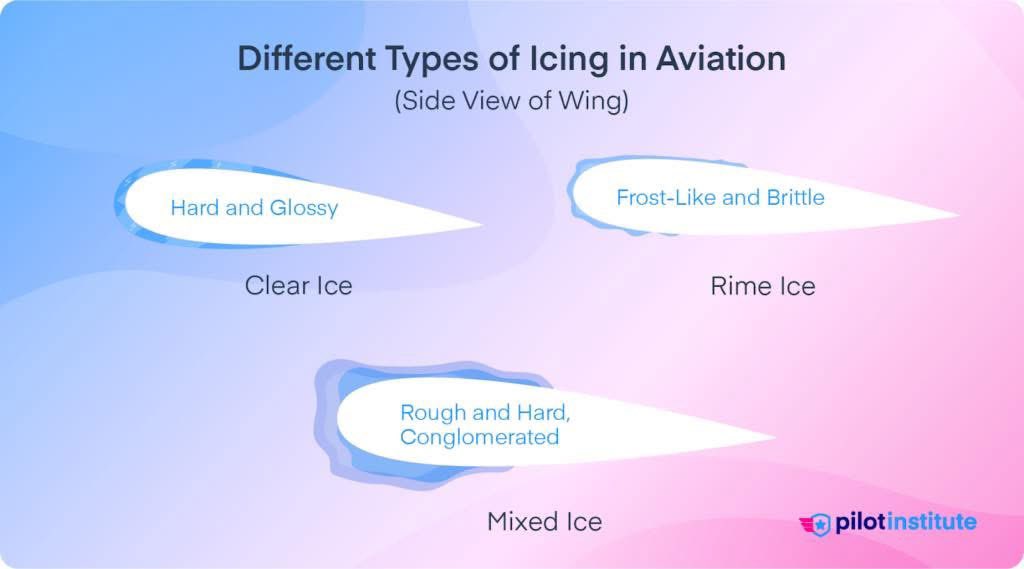
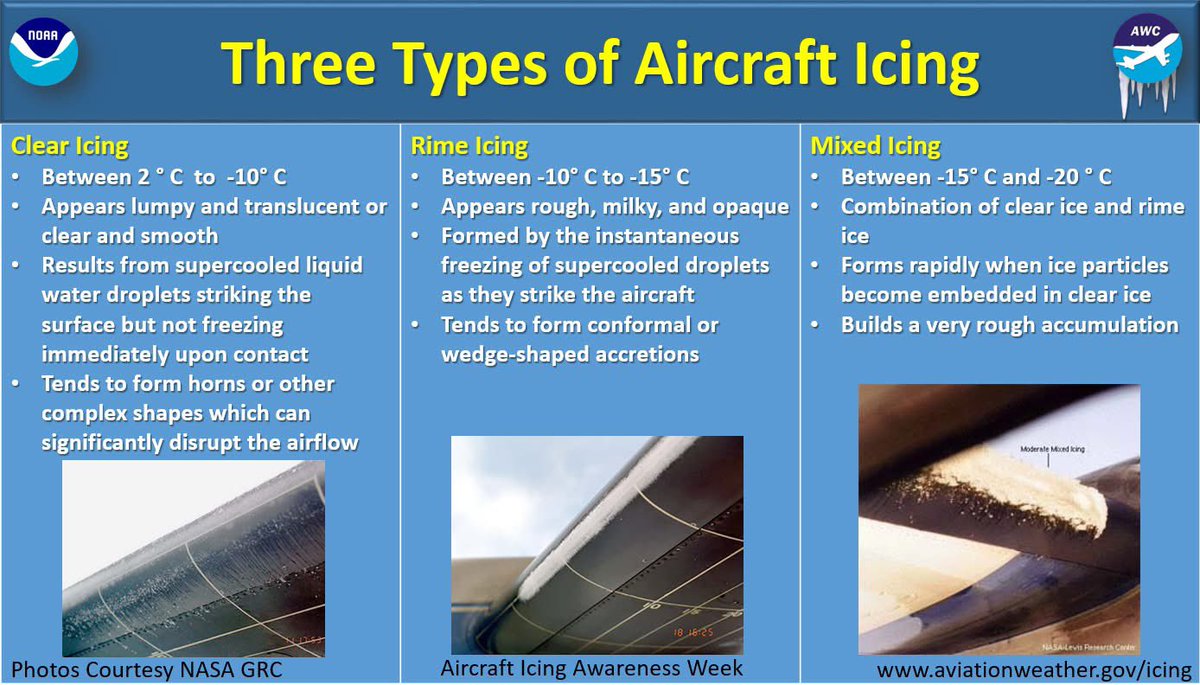
There are different categories, types & intensities of icing. Structural icing is just the airplane flying through cold clouds; the ice collects on the airplane. It can be Rime icing, which is kind of milky in color & looks bubbly, Clear icing, which can be tough to see or a mix. In some rare scenarios, very large drops of water are supercooled & remain liquid until they contact the jet, then instantly freeze. While the other types of ice generally only collect on the leading edges of surfaces, supercooled drops may run back over more of the jet during the freeze.
That’s a big problem; usually only the leading edges of the surfaces like the wings & engines are protected from ice. The shiny parts on the front of airliner wings & around the engine intake are where hot air from the engines gets diverted to heat up that area & melt any ice…but if ice goes beyond that, there isn’t much you can do. Some airplanes have systems to prevent ice formation on the tail, too, but that’s usually electric pads & usually only shows up on T-tail jets.
Anyway, regardless of the type, you may get various intensities: trace, light, moderate or severe ice.
Induction icing occurs in the engines, as it sucks air in & changes the pressure. You can get induction icing without structural icing, but again, the area around the engine inlet is heated to prevent large chunks of ice from forming, breaking off & going through the engine.
We treat icing as a possibility anytime there is visible moisture (rain, snow, fog, clouds) and the temperature is 10°C or below. Yeah, you won’t get structural icing at 10°C, but you might get induction icing. In these conditions, the engine anti-ice is turned on, sending hot air around the leading edge of the engines.
The wing anti-ice is used a bit differently & the philosophy here varies widely by airline. I’ve always used it not as an anti-ice, preventing ice from forming like on engines, but as a de-ice…it’s not turned on until I see ice forming. Other airlines have different philosophies.
I turn it on, melt the ice, then turn it off. Now, we can’t see the wings well, so on the 737 we use the windscreen wipers as a proxy for the wings. If the large nut on the wiper arm has collected ice, I assume the wings have, too (the windscreens are electrically heated, but it’s not unusual to go through moderate or severe icing & collect some ice around the edges of the windscreen).
If you recall, I said the tail often doesn’t have an ice system, and that’s true of the 737. That may sound scary, but it’s not something I’m worried about. If we turn on the wing anti-ice during a flight, the computer assumes the tail may have ice on it & it bumps our approach speed up to give the tail extra air to manipulate. It’s basically an ICE additive to our final approach speed.
I hope that helps, I’m out of space.
if you run a city or a transit agency in the US you should know that the probability that self driving cars will exist in your city and work with perfect safety (as in 0 deaths) + be cheap within 5 years is 100%.
which means is now time to start redesigning cities for this. This should be very exciting for making cities more livable! It means
- no more land used for parking. We can return this to humans
- no need to waste money on extremely expensive car ownership (financing + insurance + maintainance is very expensive)
- vehicle sizes trend smaller as there is less ownership
- more ridership in mass transit as a connector for long distances and as car ownership goes down
- tons of new jobs maintaining, cleaning, charging, etc these new vehicles
I think the idyllic cities of 20 years from now will mostly have AVs roughly the size of rickshaws that interconnect with mass transit and manual bikers that safely share the road with them. There will be some cars roughly the size of current normal cars for when it’s 2 ppl and the occasional current-SUV sized car for full-family transit or luggage.
human-driven cars will be for recreation and used in roughly the same places horses are used now
A University of Chicago psychologist published a short paper in 1984 proving that the average tutored student outperformed 98% of students in a normal class, and almost nobody outside education research has read it.
His name was Benjamin Bloom.
He called it the 2 Sigma Problem.
Two of his PhD students, Joanne Anania and Joseph Arthur Burke, compared three ways of teaching the same material:
> A normal class with one teacher and a room full of students.
> Mastery learning, where students take regular quick tests and get corrections before moving on.
> One-to-one tutoring, combined with mastery learning.
The tutored students beat the normal class by two standard deviations.
In Bloom's words, "the average tutored student was above 98% of the students in the control class."
And about 90% of tutored students reached a level that only the top 20% of the normal class reached.
Here's the part that matters.
These were ordinary students in ordinary schools. Same kind of kids, different conditions.
Bloom's conclusion was blunt. One-to-one tutoring works, but it is too costly for most societies to provide at scale. So he set a challenge for researchers: find methods of group teaching that work as well as a personal tutor.
He also ranked the cheaper levers. Feedback and correction before moving on was worth about one standard deviation by itself. Graded homework, about 0.8. Cooperative learning, about 0.8.
For 40 years, that challenge mostly sat there.
Now AI tutors are being pitched as the answer.
But the early evidence says the design decides everything. A tutor that hands you answers is a shortcut. A tutor that makes you try, checks you, and corrects you is closer to what Bloom measured.
The 2 sigma never came from the tutor knowing more. It came from someone making sure you could not skip the hard part.
Who was the one person who taught you one-to-one and changed how you learn?
🇨🇳China and 🇮🇳India have seen striking growth in the number of registered clinical trials over the past decades.
From 1999 to 2025, #India's count rose from 9 to 21,410 and #China's from 39 to 24,524, reflecting expanding biomedical R&D activity.
#FactsMatter
Timeline is getting interesting.
Personalised cancer vaccine era is just getting started, and soon it could become normal.
An Indian biotech startup, PopVax, is building something fascinating.
Its RNA Foundry in Hyderabad can take a patient's tumour sequencing data, use an AI-powered pipeline to design personalised neoantigen vaccine sequences, manufacture the mRNA, encapsulate it in lipid nanoparticles (LNPs), and perform quality-control testing.
The entire process is designed to take just 8–10 weeks. 👀
PopVax is targeting manufacturing capacity for 100+ personalised cancer vaccines over the next 12 months.
For decades, we've largely developed cancer treatments using standardised approaches, even though every patient's cancer is different.
Now, we're moving towards a future where we can design personalised vaccines around the unique mutations of an individual's tumour, training their immune system to recognise and attack cancer cells.
Cancer treatment could become increasingly personalised, programmable and manufactured on demand.
AI + mRNA + biotechnology could fundamentally change how we develop medicines. Lots more is yet to come!
A ‘hello world’ milestone for Project Suncatcher 🚀
After launching our prototype satellite a few weeks ago, we’ve now successfully sent a command up to orbit, booted up the TPU, ran the prompt, and received our first complete response back on earth - a haiku!
Simply put, starting now, builders must use agents to bring their ideas to life.
Coding is directionally right, but incomplete. Agents will:
- De/refine requirements
- Architect and design
- Code
- Test
- Deploy
- Operate
- Govern
The whole thing, the entire shebang. The builder has the idea and the oversight, plus the ability to steer. That’s about it. And all that’s needed.
Reddit's CEO just admitted something $GOOGL would rather you didn't hear!!
"Google is crawling us as hard as ever. AI Mode does not drive traffic. Not for us, and not to anybody."
The way the internet ran on for 25 years is you let Google read your site, and Google sends you visitors/traffic. That deal is over now and it’s all because of AI.
Google now reads Reddit, writes the answer itself and the user never leaves the search page.
Reddit does the work and Google keeps the reader…and that’s how money is being made.
For $RDDT, its biggest front door is closing which is why the stock is down -25% this morning. Huffman's plan is that people will just come to Reddit directly. Maybe. But US user growth is already down to 6%, and "we'll change everyone's habits" is a hope that’s never gonna come.
For Google, the issue is the same. The damage is slower but it goes deeper. Its AI is only as smart as the open web it learns from. Stop sending sites traffic, and they'll lock their content up, sell it to rival labs or block Google outright. Google is eating the thing it feeds on.
AI killed the click and both of these companies were built on it. It's a fight over who survives the next version of the internet… $GOOGL looks interesting if they cannot win the search
This is why AI in medicine is going to change everything.
Many of the worst diseases we fight today, from Parkinson’s to Alzheimer’s to cancer, all share one root cause. Proteins in our bodies folding the wrong way. Johns Hopkins just secured up to $52M from @ARPA_H to lead a team of 7 institutions building an AI that can predict exactly how those proteins misfold.
Once we can see the shape, we can design drugs that target only the bad versions and leave the healthy ones alone. In the first phase, they’re analyzing 1 billion protein structures and testing 100 million drug candidates.
This is American medicine leaping into the future.
I did say we'd be releasing our models periodically...introducing Gemini 4 Carbon, our next frontier model.
Following Argon's release just two weeks ago, Carbon shows the pace at which we’re pushing the frontier, it ranks #1 on the recently updated v5.0 of @ArtificialAnlys Intelligence Index at 59. It also leads across key cybersecurity evaluations scoring 88.2% on SEC-bench Pro for finding vulnerabilities, 54.8% on ExploitGym for exploitation, and 71.0% on CWE-bench for patching.
We’re seeing significant improvements in long-horizon tasks even compared to Argon, and we’ve strengthened frontier safeguards.
As we did with Argon, we’re going to roll it out gradually + responsibly. Some trusted cyber defenders will get access starting this week. We'll be expanding it to more partners through our Fairwind Program, ahead of wider availability soon, so hang tight!