Glamsterdam targets L1 throughput across three consecutive layers.
> ePBS (EIP-7732) moves block building into the protocol. Validators stop trusting off-chain relays and pick directly from builder bids submitted at the protocol level.
> BALs (EIP-7928) enforce access lists at the block level so transactions can execute in parallel instead of one at a time. The builder declares every address and storage slot touched, and clients use that map to parallelize execution.
> Gas repricings (EIP-7981 & EIP-8037) close data and state growth exploits. EIP-7981 prices access list data at 64 gas per byte, killing the old EIP-2930 block size exploit and making transaction-level access lists economically obsolete once BALs exist. EIP-8037 raises state creation costs so higher gas limits don’t cause runaway state growth.
ePBS and BALs each stand on their own.
Only when these three are improved together can ethereum:native credibly target a much higher gas limit(aligned on a ~200M floor post-Glamsterdam) without compromising verification speed, node requirements, or long-term state growth.
🔷 NEXT ETHEREUM UPGRADE IS COMING 🚀
@ethereum Glamsterdam upgrade is now in its final development phase ahead of testnet deployment, with a mainnet launch expected in H2 2026.
Besides the clarity act, this is one of the important things that could push the $ETH price💪
@fundstrat@BitMNR
Welp looks like Ethereum needs to start building rockets…
• ethereum:native market cap - $214 Billion
• $SPCX market cap $2.5 - $3 Trillion
• Adding more than Ethereum’s market cap in a day
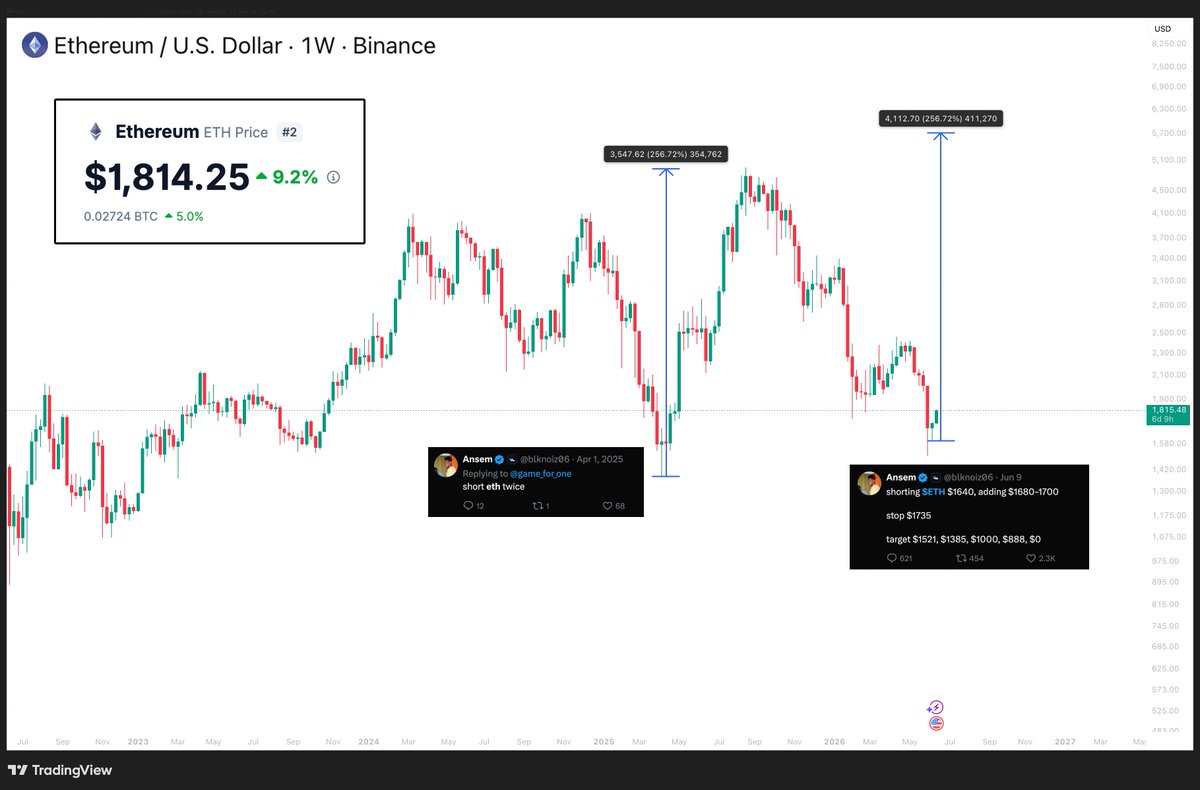
The Ansem $ETH short signal is back.
He called $ETH a short June 9th. It's already up 9%, outperforming $BTC, and squeezing through his stop.
Last time he did this, ETH ran 256% to a new ATH.
If history repeats, we're looking at ~$6,000..
Is Ansem secretly Ethereum's best bull signal?
🔷ETHEREUM JUST CROSSED 1 MILLION LIFETIME DEVELOPERS 🚀
Electric Capital data shows 1,012,824 people have built in the @Ethereum ecosystem.
🔷 156,780 full-time peak
🔷 373,394 one-time peak
🔹 471,220 part-time peak
Crypto’s largest builder ecosystem keeps getting bigger & better!
Bitmine @BitMNR will also benefit from this development 💪
@fundstrat
$S on ChangeNOW.
@SonicLabs is an EVM Layer 1 built for DeFi, combining sub-second finality, native bridging, staking and developer incentives through fee monetization.
Swap $S with 1,000+ assets here 👉https://t.co/MiTOHoAkJd
In a world of 99% uninvestable assets, aerodrome-finance:native stands out as a winner in the new era of our space.
Will be a strong launch next month and I'd anticipate the token re-rates higher leading into it. Feels like a layup of a play tbh
Day 107 shilling $s until $1.
Altseason is inevitable; it’s just a matter of time.
If not now, by the end of the year.
If not by the end of the year, then 2027.
Just hold your bags with patience.
Because 90% of the gains happen in just two weeks.
Observing how $ETH just entered probably its most important zone of the current cycle
Now, if we successfully retest this support, we're heading higher
But if not, I'm not even sure how low we will dump
Ethereum's biggest upgrade since the Merge is closing in
Glamsterdam is in its final testing stretch. @ethereum's next hard fork has cleared multi-client devnets, with public testnets the last step before a mainnet date gets set. The two headline changes are real structural shifts, not tweaks.
ePBS moves block-building on-chain, cutting reliance on the external relays that handle 80-90% of blocks today and trimming MEV. Block-level access lists lay the groundwork for parallel execution, Ethereum's answer to faster L1s like Solana. No block height is locked yet.
You are focused on the $422B @USDC transfer volume processed on @SonicLabs.
The number is impressive, but I think the bigger story is what it represents. 💭
In crypto, many metrics can be misleading. Transaction counts can be inflated. Wallet numbers can be farmed. Even TVL doesn't always translate into actual usage.
Stablecoin flow is different.
When billions of dollars in USDC consistently move through a network, it suggests that users, protocols, traders, and applications are actively choosing that network as a settlement layer for value transfer.
That's why stablecoin activity is one of the strongest signals of real economic utility in crypto.
The key question isn't whether Sonic processed $422B.
The key question is why that volume chose to move through Sonic in the first place? 🧠
The answer comes down to reducing friction.
Most blockchain discussions revolve around throughput and TPS, but for the average user, the real problem has never been TPS.
The real problem is complexity.
Today, sending stablecoins often requires users to understand gas tokens, manage balances across multiple assets, bridge liquidity between networks, and wait for transaction finality.
Crypto-native users have learned to accept this.
Mainstream users have not.
For digital dollars to scale globally, the experience needs to become dramatically simpler.
This is where Sonic's positioning becomes interesting.
The network combines near-instant finality, extremely low transaction costs, deepening stablecoin liquidity, and a history of reliable uptime.
These characteristics are particularly valuable for stablecoin transfers because payment infrastructure succeeds when it becomes invisible.
Users don't care about consensus mechanisms.
They care that money arrives instantly, cheaply, and reliably.
The most interesting part of Sonic's roadmap may not even be the volume it has already processed.
It's the effort to remove gas friction from stablecoin transfers.
For years, one of the biggest usability barriers in crypto has been the requirement to hold a separate token just to move your money.
A user may hold USDC, but still be unable to send it because they lack the native gas token.
From a mainstream payments perspective, that experience makes little sense.
If stablecoin transfers become effectively gasless from the user's perspective, blockchain payments start to feel much closer to modern financial applications.
And that's where the opportunity becomes much larger than trading.
The long-term opportunity isn't simply moving crypto assets between wallets.
It's powering payments, remittances, merchant settlement, digital commerce, and eventually broader on-chain economic activity.
Every major blockchain is competing for a share of that future.
What Sonic appears to be optimizing for is becoming a high-performance rail for digital dollar movement.
$422B in USDC transfer volume doesn't prove that Sonic has already won.
Volume alone is not the same as adoption.
But it does suggest that the network is becoming increasingly relevant as a place where stablecoin liquidity moves.
And in an industry that is rapidly converging around stablecoins as its most successful product, that may be one of the most important trends to watch.
$S $USDC