I write:
Quest for Gorkhaland: A century-long struggle for identity and autonomy
The Gorkhaland demand in Darjeeling has persisted for over 100 years, driven by the Gorkha community's quest for statehood. Despite partial administrative measures, the issue remains unresolved, impacting regional politics
https://t.co/JWvkkwKsmE via @IndiaTodayNE
We come from the same CD Block and belong to adjacent villages. Such a proud moment for all of us in the region. He is our first generation educationist. There were no roads and electricity across our villages when he was studying. He is a true pioneer. He was possibly the first academic to represent our voices in the Rio summit in 1992 from the entire eastern Himalayas. Koti koti naman to Prof GS Yonzon.
हाम्रो दार्जिलिङ-���ालेबुङ क्षेत्रका प्रख्यात वनस्पति वैज्ञानिक, शिक्षाविद् �� पर्यावरणविद् प्रो. गम्भीर सिंह योन्जोनज्युलाई राष्ट्र निर्माण तथा पर्यावरण संरक्षणमा उहाँको उत्कृष्ट योगदानको लागि पद्मश्री सम्मानबाट सम्मानित गरिनेछ।
उहाँको कार्य प्रकृति संरक्षण र आउँदो पुस्ताहरूका लागि प्रेरणाको स्रोत हो।
We are so grateful to Hon'ble Prime Minister Sh. @narendramodi ji for democratizing Padma awards, and making it truly people's Padma, where the people from across the country who have made true contribution to our nation are honoured and recognized.
Once again congratulations to Dr. GS Yonzon Sir
Is this sustainable tourism that we have been talking about in the Himalayas? Where is the coordination and monitoring of tourists inflow in the region?
Natural springs have been the traditional sources of drinking and domestic water across both urban and rural Himalaya. Even today over 50% households largely depend on springs. Municipality water supply is inadequate and unreliable. We need to map these springs systematically.
Last winter, Gangtok faced a crisis it could not ignore. With rainfall stopping by September, the city’s main water source, the Ratey Chu River, saw its discharge drop by nearly 50%.
However, emerging from underground aquifer networks beneath the town, Gangtok's freshwater springs have been silently sustaining residents long before and long after crises.
The commentary draws from fieldwork in Gangtok by Sailendra Dewan, Fellow at ATREE, and Niharika Bindal, who worked as an intern in ATREE and its The Himalaya Initiative.
Read the full article here: https://t.co/EmJVNjT90q
They ruined the reputation of entire academic community. We require integrity to handle such an important project. 22 lac students are now suffering because of them. I hope this event will herald paradigm shift in the way we conduct examinations in India.
BREAKING | NEET 2026 Paper Leak: CBI Arrests Kingpin PV Kulkarni, Chemistry Lecturer From Pune https://t.co/ieo4Bm2mfD
7 months after angioplasty, I walk around 8 to 10 k steps daily (Abt 1 hr 30 mins), do indoor exercises (Abt 40 mins) which also includes around 90 pushups and 10 to 15 pull ups, among others. I hve lost about 6 kgs and I feel hungry all the time. My left shoulder still pains mildly.
I survived a similar situation last September. I was also in the later part of my 47. I used to exercise about 40 minutes daily for many years and was absolutely fine. There were no clear symptoms. However, I used to experience slight/mild pain on the left shoulder after my first COVID vaccination. Had a massive attack while I was delivering Key Note address at Gorubathan College on September 2023. Survived by the grace of god and with the help of friends and colleagues.
Dileep Raj passes away at 47 after heart attack; Known for Puneeth Rajkumar's 'Milana' https://t.co/wdkGRw0I0S via @timesofindia
"Nobody trips over mountains. It is the small pebble that causes you to stumble. Pass all the pebbles in your path and you will find you have crossed the mountain". -Unknown
I survived a similar situation last September. I was also in the later part of my 47. I used to exercise about 40 minutes daily for many years and was absolutely fine. There were no clear symptoms. However, I used to experience slight/mild pain on the left shoulder after my first COVID vaccination. Had a massive attack while I was delivering Key Note address at Gorubathan College on September 2023. Survived by the grace of god and with the help of friends and colleagues.
Dileep Raj passes away at 47 after heart attack; Known for Puneeth Rajkumar's 'Milana' https://t.co/wdkGRw0I0S via @timesofindia
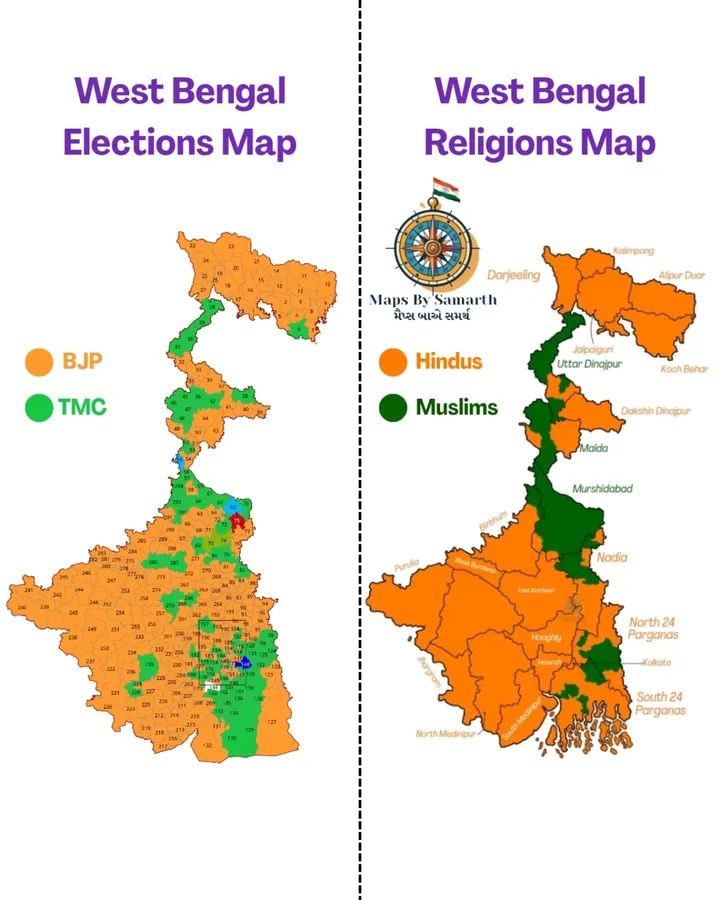
The recently released maps of 2026 West Bengal Assembly election results and the religious demographic distribution present a striking picture. In the election map, BJP (orange) has dominated large parts of North Bengal, Jangalmahal, and several other districts, while TMC (green) retained strongholds primarily in South Bengal and certain pockets. When placed next to the religious map, a visible pattern emerges: BJP’s victories largely align with Hindu-majority areas, whereas TMC’s support base strongly corresponds with Muslim-majority districts (such as Murshidabad, Malda, parts of North 24 Parganas, and Kolkata-adjacent areas).
This correlation highlights the increasing communal polarisation in West Bengal politics. While development, governance, and anti-incumbency played important roles, the near-perfect overlap between religious demographics and voting preference suggests that identity politics has become a dominant factor in the state’s electoral landscape.
Whether this reflects genuine aspiration for change in Hindu-majority regions or consolidated minority voting in TMC strongholds, one thing is clear — West Bengal’s politics is now deeply divided along religious lines. The new government will need to rise above this polarisation and deliver inclusive development for all communities if it wants to heal these fault lines.
With the BJP’s historic victory in the 2026 West Bengal Assembly elections — securing a decisive mandate with over 200 seats and ending TMC’s 15-year rule — the state stands at a historic crossroads.
The people have voted overwhelmingly for change, good governance, transparency, and equitable development. This mandate must now translate into a bold paradigm shift: dismantling the decades-old Kolkata-centric model and placing North Bengal at the centre of the state’s development agenda.
https://t.co/jdvuOEpnBS
Happy to share a piece I wrote with my colleague @GAmarjit at the Special Centre for the Study of North East India, Jawaharlal Nehru University, New Delhi for the India Today NE. The piece is written as a part of the Centre’s initiatives beginning in 2025 to study and make meaningful intervention on the issues of ecology, sustainability and community practices in North East India. @NEC_GoI
https://t.co/PlmopxlIcu via @IndiaTodayNE
In a recent viral video from February 2026, a woman and her husband in Malviya Nagar, Delhi, were recorded using several racial slurs against three women from Arunachal Pradesh, including the statement that "northeast people are shit".
Let me present 10 points of NE India that are way better than mainstream India, particularly northern India.
Northeast India is often considered superior in quality of life and environment due to its pristine nature, high literacy rates, and unique cultural practices. Key advantages include unmatched biodiversity, clean villages, vibrant indigenous cultures, and a generally progressive, equitable, and peaceful society that thrives on sustainability and close-knit community values.
1. World's Cleanest Villages: Meghalaya’s Mawlynnong is hailed as Asia's cleanest village, setting a high standard for environmental sanitation and eco-friendly practices.
2. High Literacy Rates: States like Mizoram and Tripura have some of India's highest literacy rates, with Tripura often rivaling or exceeding Kerala's high standards.
3. Untouched Natural Biodiversity: The region is a global biodiversity hotspot, hosting the unique one-horned rhinoceros, rare red pandas, and the only floating national park (Keibul Lamjao) in the world.
4. Progressive Societal Norms: The region is generally free from the severe dowry issues rampant in other parts of India, boasting a more equitable, community-driven social structure.
5. Unique Cultural Heritage: It has a distinct ethnic and cultural identity, featuring over 135 tribes with unique traditions, languages, and, in some cases, matrilineal systems.
6. Less Pollution and Congestion: Cities like Aizawl are known for being virtually honking-free, offering a much more peaceful and less chaotic urban experience than mainland cities.
7. Distinct Culinary Traditions: The cuisine is highly organic and flavorful, relying on fresh bamboo shoots, fermented foods, and unique, indigenous ingredients not found elsewhere.
8. Vibrant Festivals and Music: Known as the "Land of Festivals," it hosts unique, lively celebrations like the Hornbill Festival (Nagaland) and Ziro Music Festival (Arunachal Pradesh).
9. Sustainable Living Practices: The culture emphasizes sustainable, simple living in harmony with nature, illustrated by the eco-friendly "living root bridges" in Meghalaya.
10. Exceptional Women Empowerment: Many tribes in the Northeast are matrilineal or, at minimum, offer women a higher status and more autonomy compared to many other parts of India.
Thats a good initiative! Academia-policy makers should closely work on relevant policy/development issues and interact as much as possible on critical development themes. Thank you @MDoNER_India for inviting her. We look forward for more such interactions. We are all committed for sustainable growth and development of NE India.
A senior IES officer, currently advisor in the Ministry of Women and Child Welfare, GoI, asked me to list three priority areas for the rapid growth and development of NE India. I listed the following: 👇
The three most crucial, immediate, and practically implementable policy interventions for NE India that can deliver transformative economic impact within 3–7 years are:
1.Creating a time-bound “NER Multi-Modal Connectivity Mission 2030- 35” with dedicated funding and single-point accountability. I think we should make connectivity the absolute top priority. Despite progress, logistics costs in NER are still 1.5–2× higher than the national average, choking industry, tourism, and agriculture.
2.Launching a tourism project “Destination North East 2030” – public-private partnership mission to make NER one of Asia’s top 10 eco-adventure-cultural tourism destinations by 2030. Tourism is the lowest-hanging fruit in the region- the region already has world-class assets (living root bridges, Kaziranga, Tawang, Majuli, Hornbill, Sangai, Dzukou Valley, Loktak, etc.) but receives only ~1.2 crore tourists annually versus Thailand’s 4 crore or Vietnam’s 1.8 crore. Conservative estimates (NITI Aayog & FICCI studies) indicate tourism can create 6–8 lakh direct jobs and 15–20 lakh indirect jobs by 2030 and add ₹80,000–1,00,000 crore annually to the regional economy by 2032–33.
3.Transforming NER into India’s certified organic & high-value agri-horti-food processing hub. NER already grows 25% of India’s organic produce and has natural advantage in kiwi, pineapple, passion fruit, large cardamom, ginger, turmeric, lakadong turmeric, King chilli, Joha rice, etc.
These three interventions are deliberately chosen because they are (a) mutually reinforcing (connectivity enables tourism and agro-industry), (b) largely within central government powers or require only cooperative federalism, (c) build on existing schemes (PM-DevINE, Gati Shakti, NEIDS, PM-FME, UDAN, etc.) rather than starting from scratch, and (d) can show visible results before the end of this decade.
If the Government of India executes these three with the same intensity it showed in J&K post-2019 or in building national highways over the last ten years, the North Eastern Region will cease to be seen as a “remote periphery” and will become one of India’s fastest-growing economic corridors by 2032–35.
@NEC_GoI@MDoNER_India