This is genuine, well documented history, but drawing "reservation is worse than caste" from it is a significant overreach beyond what Kalelkar himself was actually saying.
Kaka Kalelkar chaired the First Backward Classes Commission (1953 to 1955), the commission submitted a report identifying 2,399 backward castes, and Kalelkar did write a covering letter to the President expressing doubts, including the exact line quoted, that the remedies suggested were worse than the evil the commission was out to combat, and that extending caste based benefits to Muslim and Christian communities created an unhealthy incentive for them to assert caste identity.
**Where the post overreaches:** Kalelkar's specific worry was narrower than "caste based reservation is worse than caste" as a general claim. He was troubled by one particular effect, using caste as the administrative marker even for religions that present themselves as formally casteless (Islam, Christianity) risked encouraging those communities to assert caste identity they might otherwise be distancing from, purely to access benefits. That is a real, specific critique about using one criterion (caste) as a universal cross-religious yardstick, not a demonstrated finding that reservation overall makes caste-based discrimination worse than doing nothing.
**Important context the post skips entirely:** despite his own doubts, Kalelkar's commission still recommended sweeping reservation, listing 2,399 backward communities and proposing 70 percent reservation in technical and professional institutions. The government at the time actually shelved the report for years, largely because it was seen as too vague and lacking objective criteria, not because his covering letter proved reservation itself was harmful. And crucially, this single chairman's private doubts from 1955 did not settle the matter. The later Mandal Commission (1980), extensive Supreme Court litigation including Indra Sawhney (1992), and decades of subsequent policy all continued using caste as a central criterion, with courts explicitly weighing and ultimately not accepting that Kalelkar's letter was disqualifying.
**Bottom line:** real historical document, real internal disagreement even within the commission, but the leap to "proves reservation is worse than caste" reads Kalelkar's specific worry about cross-religious incentive effects as a general verdict on the entire policy, which is more than the source itself claims.
चुनाव की बात करें तो, हां, अंबेडकर 1952 में बॉम्बे नॉर्थ सेंट्रल सीट से हार गए थे। जो बात इस कतरन में नहीं बताई गई वह यह है कि उन्हें हराने वाले काजरोलकर खुद उनके पूर्व निजी सहायक थे, वे भी दलित थे, और यह एक आरक्षित सीट थी, कोई असंबंधित बाहरी व्यक्ति नहीं था। कई विवरण, जिनमें अंबेडकर के अपने पत्रों का लेखन भी शामिल है, इस हार की असली वजह उनकी पार्टी, कम्युनिस्टों और हिंदू महासभा के बीच वोटों के बंटवारे को बताते हैं, साथ ही नेहरू के उनके खिलाफ सक्रिय रूप से प्रचार करने को भी, न कि यह उनकी हैसियत पर कोई फैसला था। एक चुनाव हारने से संविधान लिखने का काम मिट नहीं जाता। गांधी भी चुनाव हारे थे। किसी भी व्यक्ति की विरासत को इस तरह नहीं आंका जाता।
सुधारों की इस सूची की बात करें तो, यह ज़्यादातर सही है, और साथ ही मुद्दे से हटकर भी है। कोई यह दावा नहीं करता कि अंबेडकर ने हिंदू व्यक्तिगत कानून में सुधार का विचार खोजा था, राम मोहन रॉय और विद्यासागर पहले आए थे, यह सच है। हिंदू कोड बिल को अलग बनाने वाली बात उसका दायरा था, एक एकीकृत संहिता जो उत्तराधिकार, विवाह, तलाक और एकविवाह को एक साथ कवर करती थी, न कि बिखरे हुए अलग-अलग कानून। इसे 1951 में ठीक इसलिए रोका गया क्योंकि यह इतना महत्वाकांक्षी था, और इसी वजह से उन्होंने इस्तीफा दिया। सुधारों की इस कड़ी में बाद में आना इस कोशिश को छोटा नहीं बनाता।
This is genuine Ambedkar text, and the crucial missing context is exactly why he said it, which flips the meaning of the meme entirely.
**The quote is real.** This traces to Ambedkar's speeches and a Times of India article from the early 1930s, matching the excerpts and citation format shown. Historically accurate too: the Mahars did dominate the East India Company's Bombay army for decades, nine out of ten names on the Koregaon memorial column are Mahars, and this recruitment continued until 1892, when it was abruptly stopped. [deccanherald](https://t.co/NwScfLbzTR)
**Why Ambedkar actually said this matters enormously.** He wasn't praising British rule or shaming Dalits as traitors. He was making an accusation of British betrayal. Mahars were considered untouchable and faced numerous humiliating restrictions under Peshwa rule, [Blogger](https://t.co/4HE03lnimL) and joining the Company army was one of the only paths to dignity, pay, and standing available to them under a caste system that denied them almost everything else. Then, after decades of loyal service, the British declared them a "non-martial race" and abruptly ended their recruitment in 1892, [Outlook India](https://t.co/PyBqwc3sGk) a decision Ambedkar spent years publicly protesting as rank ingratitude, since he saw it as the British discarding a community the moment convenient racial theories replaced older recruitment priorities. That's the actual point of these passages, documenting British betrayal of people who served them, not endorsing colonialism.
**The Koregaon battle specifically has a completely different meaning in Dalit memory than "helping British conquer India."** This 1818 battle is remembered today as symbolic of the struggle for Dalit equality, [Swarajya](https://t.co/QjlgjMVFRt) because the enemy that day was the Peshwa's own caste-oppressive Brahminical regime, not "India." At the time, there was no unified India resisting colonial rule; the East India Company and the Peshwa were two rival regional powers fighting a straightforward territorial war, decades before any organized anti-colonial movement existed. [Down To Earth](https://t.co/sXaxcRw9Vf) For a community denied basic human dignity under Peshwa rule, defeating that specific regime became a symbol of resistance to caste oppression, which is why it's celebrated at Bhima Koregaon every year, not treated as some shameful betrayal.
**Bottom line:** The image takes real Ambedkar text, documenting British exploitation and betrayal of a community that served them faithfully, and inverts it into "Dalits are British stooges who don't love India." That's the opposite of what the passage argues.
**Vajpayee's daughter — the name given is wrong.** Vajpayee never married and had no biological children, that part is correct. But **Rajkumari Kaul** was his lifelong close companion (married to someone else, B.N. Kaul), not his daughter. His informally adopted daughter, whom he raised, is **Namita Kaul Bhattacharya** — Rajkumari Kaul's daughter. The post conflates the companion with the daughter.
**The 51 cartons of Nehru's papers — this part is real, current, and well documented.** These letters, including correspondence with Edwina Mountbatten, were packed into 51 boxes and sent to Sonia Gandhi in 2008 [newsonair](https://t.co/k0vPLNcz7C) from what's now the Prime Ministers' Museum and Library (formerly Nehru Memorial Museum and Library). As recently as December 2025, the government has been publicly asking Sonia Gandhi to return them, noting continuous correspondence including letters sent in January and July 2025, [The Federal](https://t.co/NkdTjUeM7D) and Union Culture Minister Gajendra Singh Shekhawat said Sonia Gandhi herself has acknowledged in writing that the papers are with her. [deccanherald](https://t.co/qrqoRs6zlt) So this is a live, real, ongoing political controversy, not a fabrication.
**What's inside those cartons — this is where it goes off the rails.** Every official statement and news report found describes the contents as **personal correspondence** — letters to Edwina Mountbatten, Albert Einstein, Jayaprakash Narayan, Aruna Asaf Ali, Jagjivan Ram. Nowhere in any official government statement, museum request, or news coverage is a "death certificate" mentioned as part of these cartons. That specific detail appears to be an invented addition layered onto a real controversy, and death certificates aren't personal correspondence anyway; they're issued by the municipal authority that recorded the death, not typically part of someone's private letters collection.
**On the Vajpayee "apology letter" claim** — this actually has real, if contested, sourcing: politician Subramanian Swamy has publicly claimed since 2000 that Vajpayee wrote apology letters to Indira Gandhi during the Emergency to secure parole, and a 2017 biography, *The Untold Vajpayee: Politician and Paradox*, describes him seeking a compromise with Indira Gandhi's government. So the underlying claim about an apology/compromise isn't baseless — but there's no evidence connecting any such letter to the specific Nehru-papers cartons. That's an unsupported leap stitching two separate, real controversies together.
This claim is false, and it's a long-running, thoroughly debunked piece of misinformation, not a new one.
**Official cause of death:** Nehru died on 27 May 1964, and every contemporaneous record, including Encyclopedia Britannica, states he died of a stroke, following a heart attack, with the BBC's 1964 coverage reporting he "suffered a heart attack" and specialists fought to save him for much of the day before he passed away with his daughter Indira by his side. [Scribd](https://t.co/rl9aJzox7d)
**The syphilis claim has a traceable, discredited origin.** It goes back to a 2017 YouTube video by Rajiv Dixit (an activist associated with Baba Ramdev's circle), and was later amplified by Acharya Balkrishna, Patanjali's managing director, who tweeted it and later deleted the tweet after being questioned by fact checkers. There's no medical documentation, no post-mortem report, no credible source behind it, just secondhand claims traced back to an anonymous, unverifiable "friend of a friend" story that has circulated online since at least the 1990s in slightly different forms, none supported by an actual named source or document.
**On the "death certificate in Sonia Gandhi's custody" detail specifically:** No verifiable record of any such document existing publicly, being examined by any journalist or historian, or being referenced anywhere except in the same unverified viral claims. That's an unfalsifiable framing, since it always claims the "proof" is conveniently inaccessible, which is a common pattern in this kind of misinformation.
**Worth noting the broader pattern:** these claims about Nehru's sex life, parentage, and death cause have circulated for decades in Hindutva-aligned circles, frequently changing details (syphilis, then AIDS, then various affair claims) without ever producing an actual document. That instability across different claims over time is itself a strong signal this is fabricated rumor, not suppressed fact.
@neha_laldas This flips the gotcha back on itself: the quote is being used to argue against reservation, but read straight, it is actually the case for it, since the whole point is getting access to the milk in the first place, which is exactly what reservation is designed to do.
Context:
A few different, layered reasons come together here, going back further than 1942 itself.
**The root of it goes back to the Poona Pact, 1932.** Ambedkar had won separate electorates for the Depressed Classes at the Round Table Conferences, meaning Dalits would vote for their own representatives separately from caste Hindus, similar to what Muslims already had. Gandhi saw this as a permanent fracture of Hindu society and went on a fast unto death against it. Under that pressure, Ambedkar was forced to give up separate electorates in exchange for a weaker compromise, reserved seats within a joint Hindu electorate. Ambedkar felt this showed Gandhi and Congress cared more about preserving Hindu unity on paper than about giving Dalits real independent political power. That episode shaped his lasting distrust of Congress led nationalism as a vehicle for genuine Dalit emancipation.
**That fed directly into his "governing class" critique.** His argument, mainly laid out in his 1945 book "What Congress and Gandhi Have Done to the Untouchables," was that Congress leadership was overwhelmingly drawn from upper caste Hindus. A freedom movement led by that group, he argued, would fight for freedom to govern, not necessarily freedom for the servile classes from that same group's social dominance. His question was blunt: freedom for whom, and under whose continued social hierarchy.
**On Gandhi specifically**, the disagreement was ideological, not personal pettiness. Gandhi wanted to reform Hinduism from within, keep an idealized version of varna based on occupation rather than birth, and end untouchability through moral appeal to caste Hindus' conscience. Ambedkar thought this left the actual caste hierarchy intact and argued caste itself, not just untouchability, needed to be legally and structurally dismantled, which required political power, not persuasion. His "dark age" line reflects that he saw Gandhi's romanticized village based, anti industrial social vision as regressive compared to his own more modernist, rights based, constitutional vision.
**On Quit India specifically, 1942 was a genuinely fraught wartime moment.** Japan had just taken Singapore and was advancing through Burma, right up to India's eastern border. Ambedkar, by then Labour Member on the Viceroy's Executive Council, along with several non Congress political actors including parts of the Muslim League, argued that mass civil disobedience mid war, without any settled plan for minority or depressed classes safeguards, risked chaos that could invite invasion and would hand post war political power straight to the same Congress leadership he already distrusted on caste, with no guarantees attached. The archival IB record actually captures his own framing precisely: he and his Executive Council colleagues said law and order should be maintained "so long as the present government continued in place of a better government," which reads as a conditional, strategic position, not blanket loyalty to British rule.
So the throughline across all of it is consistent: not opposition to India's freedom itself, but deep skepticism that a Congress led transfer of power alone would deliver freedom to people at the bottom of the caste hierarchy, based on Poona Pact era grievances that were, by his account, quite real.
A few different claims here, so taking them one at a time.
Purely economic reservation ignores that caste discrimination and economic poverty are not the same thing. A poor Brahmin and a poor Dalit face different obstacles. The Dalit also faces social exclusion, discrimination in hiring and housing, and denial of access that has nothing to do with income. Economic criteria alone would miss that entirely, which is why courts have repeatedly held that caste based backwardness and economic backwardness need separate remedies, not one replacing the other.
On the list growing three or four times in 80 years, most of that growth is administrative, not new people suddenly becoming disadvantaged. The same community often gets listed under multiple regional name spellings, and new states formed since 1950 each got their own schedule added to the national list. That looks like explosive growth on a chart while covering largely the same population.
On whether a SC or ST IAS officer's children should still get reservation, that is actually a fair and serious question, not a flawed one. It already has a name, creamy layer exclusion, applied to OBC reservation for years, and the Supreme Court's 2024 Davinder Singh judgment opened the door for states to apply it to SC and ST as well. That is the right conversation to have. It argues for better targeting within reservation, not for scrapping it and replacing it with income alone, which brings back the first problem, that poverty and caste exclusion are not interchangeable.
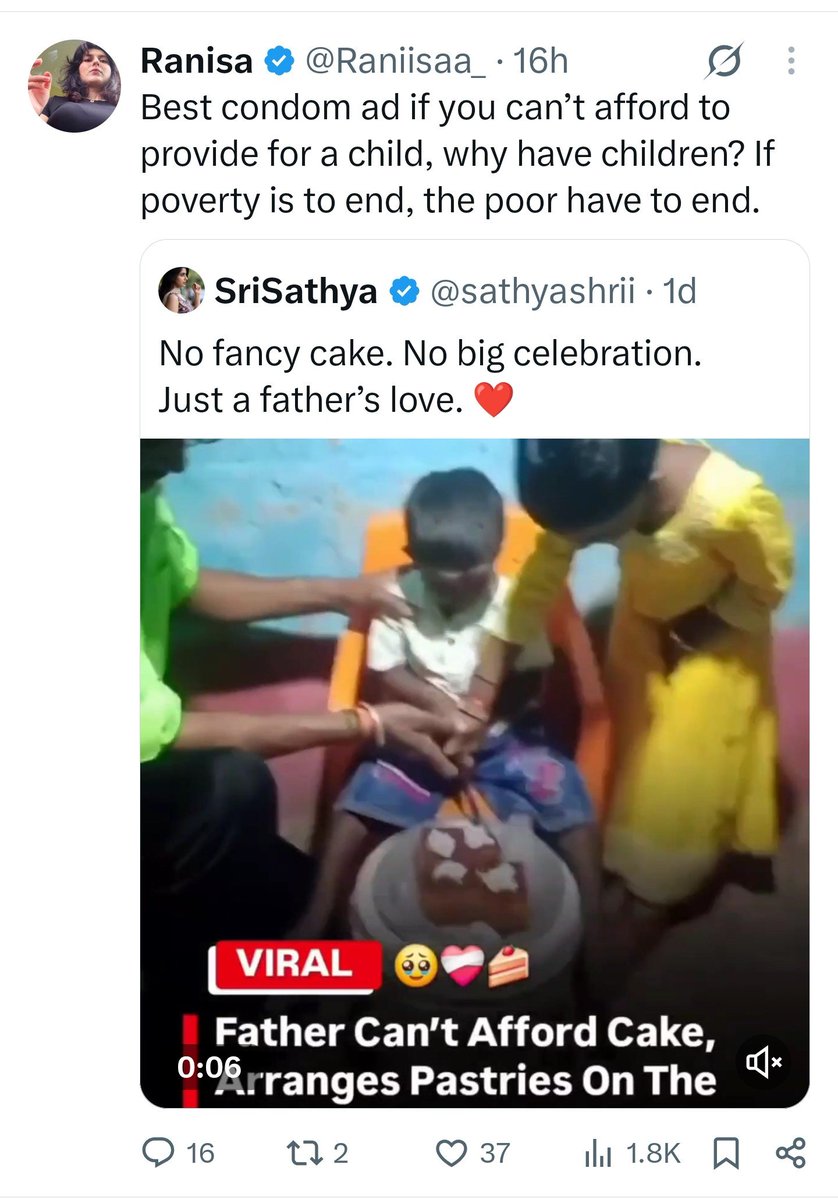
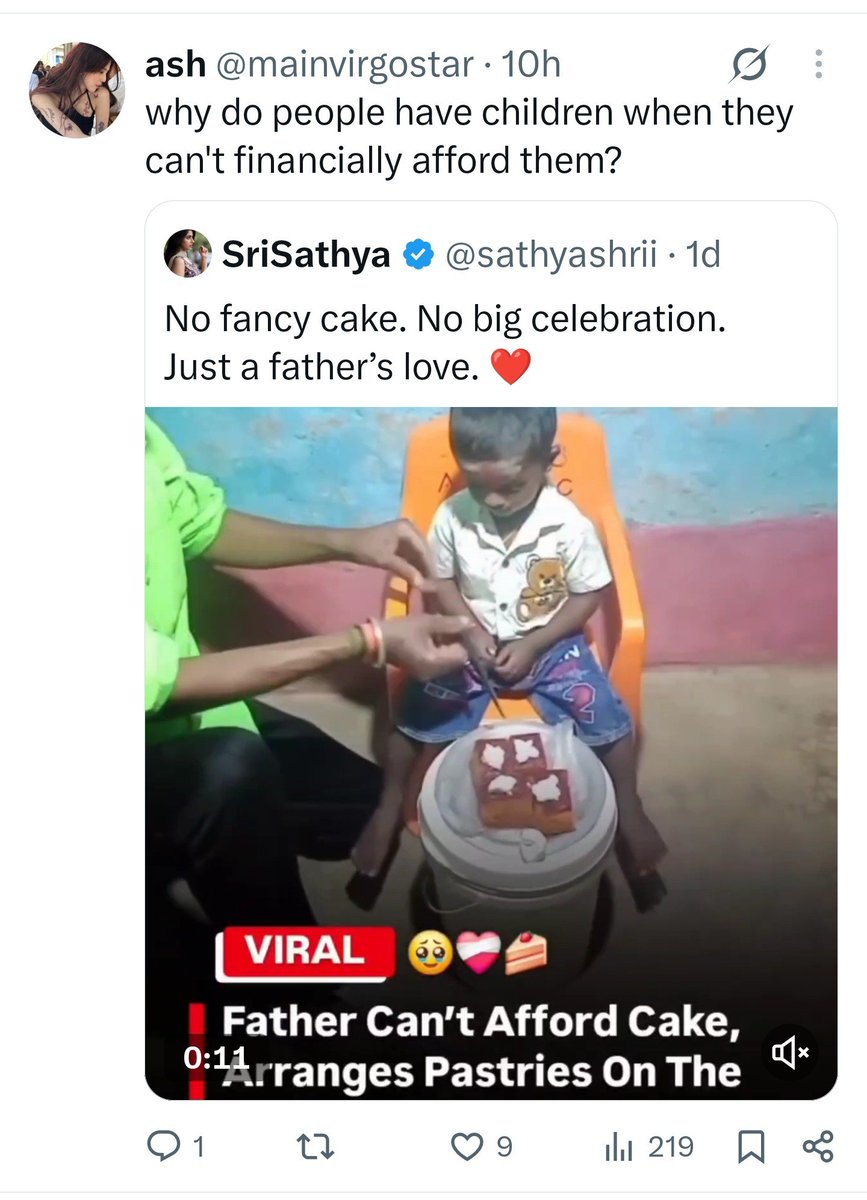
The most hateful reposts on this are coming from women. All they can see is the monetary value of the pastry, and the assumed poverty.
Men, however can see the father's love. You know why? Many of us men, didn't cut cakes on our birthdays. But, we did get education and healthcare. We got basic food, clothing and shelter. We saw our dads work hard outside and earn whatever he can, so that we can study and grow in our lives.
Our fathers did not give us poverty, but gave us the spirit to grow, to love, to be rich in our hearts.
What has happened to the women of this country? Why so money minded? Have they lost their heart to look at anything but finances?
Pathetic!
I feel disgusted looking at these reposts. See the attached screenshots.
The meetings happened, and Buddhistan did come up in conversation. But your own source contradicts the headline you are drawing from it. Read further into the same pamphlet you cited. It says plainly that Ambedkar argued only for Pakistan for Muslims and Hindustan for Hindus, not any other stan, and its own conclusion states Buddhistan could not be achieved.
There is a real difference here. Jinnah's Pakistan demand became a formal, sustained campaign, a resolution passed at Lahore in 1940, years of negotiation, and actual partition in 1947. Periyar's Dravidanadu was also formalized through a resolution in 1939 to 1940 and pursued for years by the Justice Party and later the DMK. Buddhistan, by your own source's account, never became a real political program. It surfaces once, as a private idea floated at a 1944 Rangoon meeting, with no resolution, no movement, and no sustained campaign following it.
What Ambedkar actually pursued formally and consistently for decades, from the Round Table Conferences through the Poona Pact to the Constituent Assembly, was political representation and constitutional safeguards within one India, not a separate sovereign state. Listing Buddhistan alongside Pakistan and Dravidanadu as three equivalent demands is not what your own source says happened.
"If you can do the job, you get hired" has actually been tested, and the results say otherwise. Thorat & Attewell (2007) ran a correspondence study sending identical resumes to private companies in Delhi, same qualifications, same experience, only the name changed to signal caste/religion (upper-caste Hindu vs Dalit vs Muslim). Dalit applicants got callbacks at 0.67x the rate of identical upper-caste applicants; Muslim applicants at 0.33x. Multiple follow-up studies (Siddique 2011, Banerjee et al. 2009) replicated the same pattern, lower-caste applicants needing to send significantly more resumes for the same callback rate, with discrimination showing up more in some private sectors than others. This isn't decades-old either — it's been replicated repeatedly since.
So the premise that private hiring is a clean meritocracy where identical qualifications get identical treatment isn't just an assumption, it's a claim that's been directly tested and falsified. That's the actual argument for why relying on "just perform and you'll get hired" doesn't fully hold in practice — not a hypothetical, a measured hiring gap between identical resumes.
On South Africa, I didn't hand-wave it, I gave you the actual number (32.4%) and said it's real and worth taking seriously, while also pointing out academic research says the effect of BEE specifically can't be cleanly separated from apartheid-era structural causes, automation, and weak GDP growth. That's not denial, that's just not overclaiming a single cause for a multi-causal problem — which is a more careful standard than what's being applied to the other side of this argument.
"Let the state build its own companies" isn't a real alternative anymore, over 90% of employment in India is already private sector. Telling people who want fair representation to just go work for the shrinking 2% public sector isn't a solution, it's telling them to wait for a sector that's disappearing.
On capital flight: this is a genuinely contested claim, not settled fact either way, so I won't overstate it. Critics in South Africa do argue BEE deters investment, some call it a de facto "tax on capital." That's a real position. But multinationals haven't mass-exited South Africa over it. Firms continue investing and structuring BEE-compliant deals there two decades in, and South African courts have actively struck down BEE overreach in specific sectors (aviation licensing, for instance) rather than the whole system collapsing or triggering an exodus. The honest picture is "contested and imperfect," not "proven capital flight catastrophe."
"You cannot tax, regulate, or quota your way into efficiency", nobody's claiming quotas create efficiency. The claim is quotas create access to opportunity for people currently locked out of the interview room by non-merit factors (networks, legacy, unpaid internship access) that already compromise "pure meritocracy" today. And "fix the school pipeline first" keeps being repeated as a substitute for actually engaging with why workplace-stage exclusion needs its own fix. Fixing schools doesn't dissolve hiring networks that exclude qualified outsiders once they graduate. Both problems are real; picking one to stall on isn't an answer to either.
32.4% unemployment is real, current, and worth taking seriously, but "BEE led to it" is a stronger causal claim than the evidence supports. Academic labour market research on this specifically says the opposite of what you're implying: studies note that other simultaneous forces like rising capital intensity, automation, population growth, decades of apartheid-era structural exclusion, sluggish overall GDP growth (averaging under 2% since 2010) are so overwhelming that economists say it's "difficult, if not impossible" to isolate employment equity's specific contribution to the unemployment rate. Even critics of BEE mostly argue it hasn't delivered enough transformation, not that it single-handedly caused mass unemployment that predates it. South Africa's unemployment crisis has apartheid-era and structural roots going back further than BEE itself (introduced in 2003).
So I'm not going to defend "BEE has been a clean success". It hasn't, and there's real, valid criticism of it (elite capture, fronting, uneven implementation). But citing South Africa as if it "proves quotas cause 32% unemployment" overstates what the actual research says, in a case that's genuinely mixed and contested, not settled in your direction.
On "safety regulations vs identity quotas aren't the same". I wasn't claiming they're the same mechanism, I was pointing out they're both cases of the state telling private companies "pure profit-maximization isn't the only rule you follow." That principle applies whether the specific regulation is about safety or representation. The state already limits unrestricted private discretion in dozens of ways, so "the private sector shouldn't be told what to do" isn't actually true as a general principle; it's selectively applied here.
And "you can't fix 12 years of broken education at the interview stage" is true, which is exactly why nobody's arguing employment reservation should replace education reform. They're different fixes for different stages of the same pipeline. Demanding one instead of the other, instead of both, isn't a solution, it's just picking which problem to ignore.
The "10 years" figure is real, but it applies to a much narrower thing than you're implying. Article 334's 10-year sunset only ever covered political reservation, reserved seats for SC/ST in the Lok Sabha and state assemblies. It's been extended every decade since 1960 (8th, 23rd, 45th, 62nd, 79th, 95th, 104th Amendments), each time through Parliament, most recently to 2030. Educational and employment reservation under Articles 15(4)/16(4) never had a 10-year clause at all. That's a separate provision with no built-in expiry. So "the problem was to be solved in 10 years" describes one narrow category, not reservation as a whole.
"If not solved, it's superstition, must be abolished" doesn't follow either. Parliament re-examines and re-votes on that extension every single decade. It's not automatic, it's a deliberate, repeated legislative choice based on the ground reality that political underrepresentation of SC/ST hasn't resolved itself. Continuing to renew a remedy because the underlying problem persists isn't superstition, it's just... responding to evidence.
The "paradox" point, using caste categories to fight caste — is actually a real, serious debate, not a gotcha. But Ambedkar addressed this directly: formal legal equality without redress ignores that caste-based social networks, capital, and discrimination keep operating informally regardless of what the law says on paper. He saw reservation as instrumental, a necessary tool to dismantle caste's material effects. Not a contradiction of the goal to annihilate caste as an ideology. Using caste-consciousness as a temporary corrective tool isn't the same as endorsing caste as a permanent social category.
Read what the quote actually argues before using it as a gotcha. Ambedkar's point in 1948 was that within a given domain, reservation must stay a minority of seats. That's the exact reasoning the Supreme Court later built the 50% cap on in Indra Sawhney (1992). It's a ceiling within a domain, not a ban on introducing reservation into a domain that currently has none.
Private sector employment in India has 0% mandated reservation right now. A proposal to bring in reservation there, at any reasonable percentage well under 50% is still "a minority of seats." It doesn't violate what Ambedkar said, it's consistent with it. You're quoting a ceiling principle to oppose an extension that hasn't even approached that ceiling.
If you want to make the case that a *specific* proposed number breaches the 50% cap, make that argument with the actual number. But using this quote as a blanket "see, even Ambedkar would oppose this" doesn't hold up. He was arguing against reservation swallowing equality of opportunity, not against reservation existing somewhere it currently doesn't.
The "disease" analogy misreads what reservation actually treats. It's not measuring how many names are on a list, it's measuring access to education and jobs for people historically excluded from both. List size going up doesn't mean more people are becoming disadvantaged; it mostly reflects administrative additions: the same community getting listed under multiple regional name variants (one caste, five spellings, counted as five), and new states/UTs formed since 1950 each getting their own schedule added to the national list. That shows up as "growth" on a chart even when it's the same people already covered.
"Not a single caste has been uplifted out of reservation" also isn't the right success metric. Reservation was never designed to make an entire caste graduate out of existence as a bloc — caste discrimination operates on individuals and families across generations, not as a group switch that flips off once enough members do well. The actual metric is whether individuals within these communities got access they were historically denied. On that metric there's real, measurable progress — you're just demanding an all-or-nothing outcome the policy was never built to produce.
And the "everyone wants to be classified as backward" point is a different phenomenon entirely. That's the Maratha/Jat/Patel-style OBC agitations by economically dominant castes seeking a new classification, not evidence that SC/ST reservation itself is failing. Conflating the two muddies what's actually a legitimate, separate debate about who currently gets OBC status.
"Private sector owes nothing but efficiency and survival" is a chosen political stance, not an economic law. Private companies already operate under minimum wage laws, safety regulations, environmental compliance, and labour laws that aren't there for "efficiency" either, they're there because pure profit-maximization doesn't automatically produce fair outcomes. Employment equity rules would just be one more item in a list that already exists.
On "will drive capital and businesses out" — this isn't hypothetical, other countries have actually tried workplace-representation laws in the private sector, so we don't have to guess. South Africa's Employment Equity Act, running since 1998, hasn't caused a business exodus, companies still operate and compete there. I won't oversell this though: it's a genuinely mixed case, with real criticism around implementation problems, "fronting" (fake compliance), and some skilled emigration. That's a fair caution, but it's a much more nuanced outcome than "economic sabotage," and nowhere close to capital flight destroying the economy.
And "fix education first" keeps getting repeated as if it's a new argument. It isn't, it's the same false choice from before. Education reform and workplace-level exclusion are two different problems happening at two different life stages. Fixing one doesn't fix the other, and there's no reason both can't be worked on at once.