This is a fantastic story of how modern cough medicine has its roots in ancient Ayurveda. But how many of us know this?
It begins with Vasaka. An Ayurvedic plant whose leaves were used for chest complaints long before ambroxol reached the pharmacy shelf.
In Germany, the plant has a name that tells you where it came from: "Indisches Lungenkraut". Indian lung herb.
But before we get to the German medicine, look at Calcutta in 1925.
R. N. Chopra and S. Ghosh, at the School of Tropical Medicine, were studying this plant. Their paper recorded its use in Ayurvedic preparations, examined its chemistry and described 3 years of clinical experience with a leaf extract.
The line I have highlighted in the attached page reads:
"In chronic bronchitis the cough is relieved, the sputum is liquefied so that it is brought up more easily."
100 years ago, Indian researchers were putting a familiar Ayurvedic remedy through chemical and clinical investigation. They recorded the limits too. Asthma relief was "not very marked". Against tuberculosis itself, the extract was "absolutely useless".
The leaves contained an alkaloid called vasicine. And here comes the connection many of us never hear about.
Bromhexine, a modern cough medicine, is chemically related to vasicine. When the body processes bromhexine, it produces another active compound: ambroxol.
Ambroxol was discovered at Dr. Karl Thomae, a Boehringer Ingelheim company. It was 1st marketed in 1979.
The connection to Ayurveda is not something we have to squeeze out of a resemblance. T. Weiser's pharmacology review on ambroxol states it directly:
"Its history can be traced, however, to ayurvedic medicine in ancient India."
An Indian respiratory remedy. A Calcutta investigation you can still read. And a connection acknowledged in the scientific history of a German medicine.
P.S. Sputum is the mucus we cough up.
Sources: R. N. Chopra and S. Ghosh, "A Preliminary Note on the Pharmacology and Therapeutics of Adhatoda Vasica (Basak)", Indian Medical Gazette, vol. 60, no. 8, August 1925, pp. 354-355. T. Weiser, "Ambroxol: A CNS Drug?", CNS Neuroscience & Therapeutics, vol. 14, no. 1, 2008, pp. 17-24.
Photo 1: Chopra and Ghosh's original 1925 paper describing Vasaka's effect on cough and sputum in chronic bronchitis. Indian Medical Gazette, August 1925, p. 355, via PubMed Central; yellow highlighting added.
Photo 2: Vasaka (Justicia adhatoda), used in Ayurvedic respiratory preparations. Vinayaraj, Wikimedia Commons, "Justicia adhatoda 02.JPG", CC BY-SA 4.0.
Christian Propaganda Alert 🚨
Did you know?
The concept of Mahishasur being ancestors of santhal(Tribal) was first started by a Norwegian missionary named Lars Olsen Skrefsrud in his book Horkoren Mare Hapramko Reak Katha in 1871.
[THREAD]
याहिया सिनवार कितना बड़ा स्वार्थी और नीच था की 7 अक्टूबर को इसराइल पर हमले के ठीक 1 दिन पहले का उसका एक सीसीटीवी फुटेज सामने आया है
6 अक्टूबर को वह अपने बीवी और बच्चों को सुरक्षित टनल में शिफ्ट करके गाजा से बाहर निकाल दिया
उसे पता था कि 7 अक्टूबर को जब हमला होगा तब इसराइल पलटवार करेगा और बड़े संख्या में लोग मारे जाएंगे लेकिन उसे अपने बीवी और बच्चों की चिंता थी आम गाजा वालों की चिंता नहीं थी
वह चाहता था गाजा के आम लोग मरे तो मरे लेकिन उसके बीवी और बच्चों को कोई नुकसान नहीं होना चाहिए
जबकि उसकी दो पत्नी और 7 बच्चे कतर में है और एक पत्नी और तीन बच्चे गाजा में रहते थे
और इसमें आप देखेंगे कि उसके बीवी के हाथ में 32000 डॉलर का बिर्किन पर्स है
In a Latin medical book printed in Venice in 1509, a physician called Sedasan keeps giving advice. "Sedasan dixit." Sedasan said....Dixit is here nit the surname but the latin for said :))
Interestingly, there was no Sedasan. It is a title that got mangled...
The book is the Siddhasara, written in Sanskrit around 650 CE by Ravigupta, son of Durgagupta. Here is how it got there.
Ibn Dahn, an Indian who ran the Barmakid hospital in Baghdad, put it into Arabic. Al-Razi, who died around 925, copied many of its passages into his huge al-Hawi.
In 1279 Faraj ben Salim, a Sicilian Jewish physician working in Naples for King Charles, translated al-Hawi into Latin.
Every copy passed the title on a little more garbled. The 1509 Venice edition has Sedasan, Sidhsar, Sadhsar, Sandasar and more than a dozen other spellings. R. E. Emmerick showed they are all one book title, not a person.
What does Sedasan say?
On page LXVII, toothache mostly comes from wind. Hold warm sesame oil in your mouth / cooked cow butter (Ghee).
Elsewhere "Sandasar" lists the signs of intestinal worms: light fevers, pale skin, a racing heart. And he tells convalescents to avoid heavy food, cold water and sleeping in the day.
The book also went the other way across Asia. Tibetan has it. Khotanese has it, 64 folios survive. Old Uighur has it too, written on the back of Chinese Buddhist scrolls at Turfan.
Interestingly, One Indian book, read for centuries in Europe as a man's name.
P.S. "Wind" here is an old medical idea of vapours inside the body, not weather. Al-Hawi is Arabic for "The Comprehensive Book". The Latin version is called Continens.
Sources: Peter Zieme, Notes on Uighur Medicine, Asian Medicine 3 (2007) 308-322; R. E. Emmerick, The Sanskrit text of the Siddhasara, BSOAS 1971; Ibn al-Nadim, Fihrist (on Ibn Dahn); Liyanaratne, J. European Ayurvedic Society 3 (1993)
Photo: Latin Continens, translation colophon, BnF Latin 6912 (vol. 5). Highlights: King Charles, Faraj the Jew, son of Salem of Agrigento, Monday 13 Feb, indiction VII, Naples. via Gallica / Wikimedia Commons
This is a fascinating story a young Brahmin who followed Euler's algebra without knowing English, later argued that Bhaskara, 700 years before him, had used the idea behind the differential calculus.
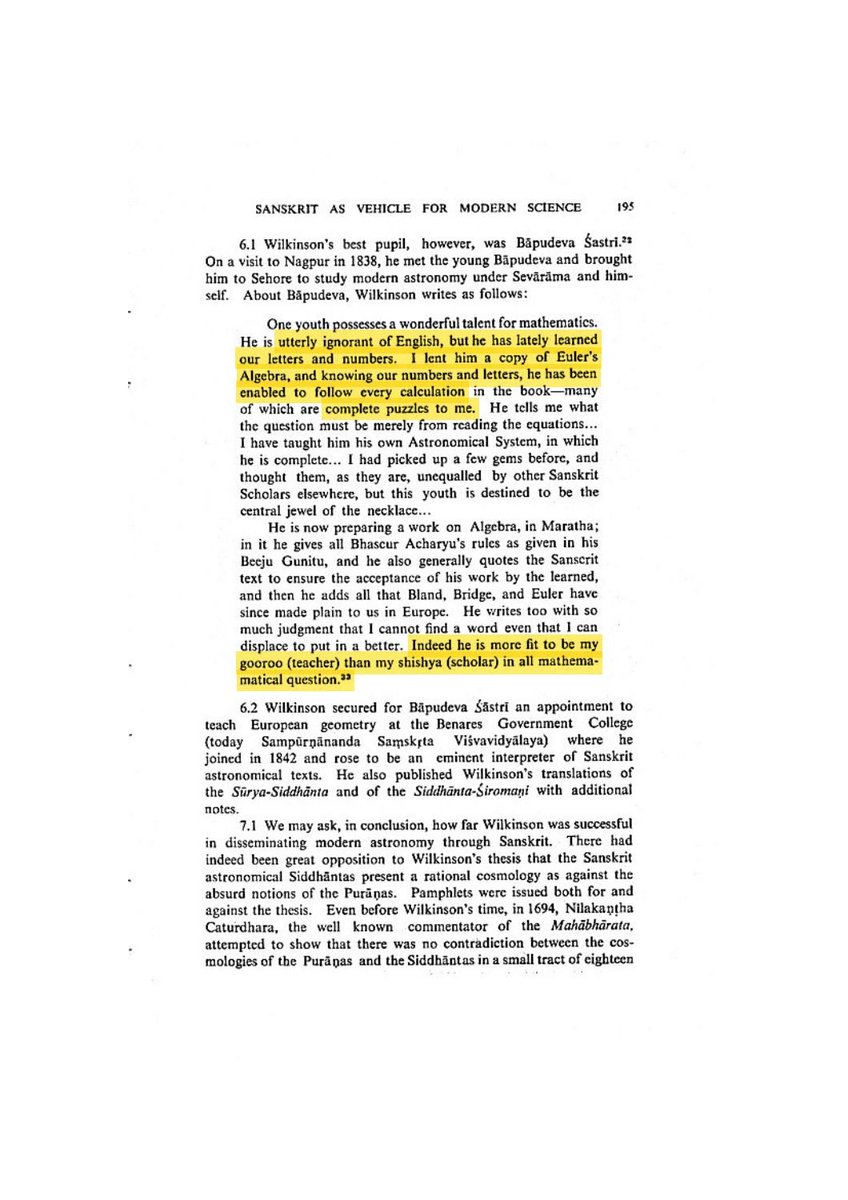
Lancelot Wilkinson had lent a young Sanskrit scholar a copy of Euler's book. The young man had only just learnt European letters and numerals. Yet,
Wilkinson wrote, he could follow every calculation. Many were "complete puzzles to me".
His name was Bapu Deva Shastri....
Wilkinson went further. The pupil was "more fit to be my gooroo (Guru) than my shishya (scholar) in all mathematical question."
By 1842 Bapu Deva was teaching European geometry at the Government Sanskrit College in Banaras.
Then, on 4 May 1858, he signed a 4 page paper that challenged a received account of Indian mathematics.
"It appears to be generally believed that the principle of the Differential Calculus was unknown to the ancient Hindu mathematicians. Allow me to correct this impression..."
A 12th century astronomer sat at the centre of the argument. Bhaskaracharya.
The question was specific. Find a planet's position today and again tomorrow, and you know how far it moved. But its speed did not stay the same through that day. What was its motion at one instant?
Bapu Deva pointed to Bhaskara's two terms: rough daily motion, and tatkalika, the instantaneous motion.
His paper explained a construction. Instead of following the bending arc, extend the motion along its tangent. Use similar triangles. A cosine appears in the instantaneous change of the sine.
He set this beside a differential formula and argued Bhaskara was "fully acquainted with the principle of the Differential Calculus."
In London, H.H. Wilson thought it "a matter of more than ordinary interest" and wanted it carefully tested. He asked the mathematician William Spottiswoode for an opinion.
The reply came from 12 James Street, Buckingham Gate. 5 May 1859.
Spottiswoode did not accept the whole claim. In the method as given, he found no allusion to infinitesimally small intervals of time and space, and nothing saying the method was approximate.
But the letter did not stop there.
Bhaskara's penetration was "in the highest degree remarkable". The formula and method bore "a strong analogy" to the corresponding process in modern mathematical astronomy.
And of Bapu Deva:
"We are much indebted to him for calling our attention to so important an element in the old Indian methods of calculation."
The Royal Asiatic Society published the exchange in 1860, with a postscript from Spottiswoode putting the old calculation beside its modern counterpart.
Bapu Deva's work went on. A volume of 1861 carried his English translation of the Surya Siddhanta, with Wilkinson's Siddhanta Siromani translation revised by him.
On 4 July 1864 the Royal Asiatic Society elected him an Honorary Member. The printed list reads "Pandita Bapu Deva Sastri, Benares", beside Isvarachandra Vidyasagara, Bhau Daji and Syed Ahmad Khan.
Sources: JASB vol. 27, pp. 213-216 (1858); JRAS vol. 17, pp. 221-222 (1860); S.R. Sarma, "Sanskrit as vehicle for modern science", p. 195 (quoting Wilkinson); RAS list of members, p. 15.
Photo 1: Lancelot Wilkinson on young Bapu Deva: "utterly ignorant of English" yet follows every calculation in Euler's Algebra, and is "more fit to be my gooroo than my shishya." Source: S.R. Sarma, "Sanskrit as vehicle for modern science", p. 195, quoting Wilkinson.
Photo 2: Bapu Deva's own claim, signed 4 May 1858: Bhaskaracharya "was fully acquainted with the principle of the Differential Calculus." Source: Journal of the Asiatic Society of Bengal, vol. 27, p. 216.
Photo 3: Spottiswoode's reply: no allusion to infinitesimal intervals in the method given, but Bhaskara's penetration is "in the highest degree remarkable" and bears "a strong analogy" to modern mathematical astronomy. Source: Journal of the Royal Asiatic Society, vol. 17 (1860), p. 222.
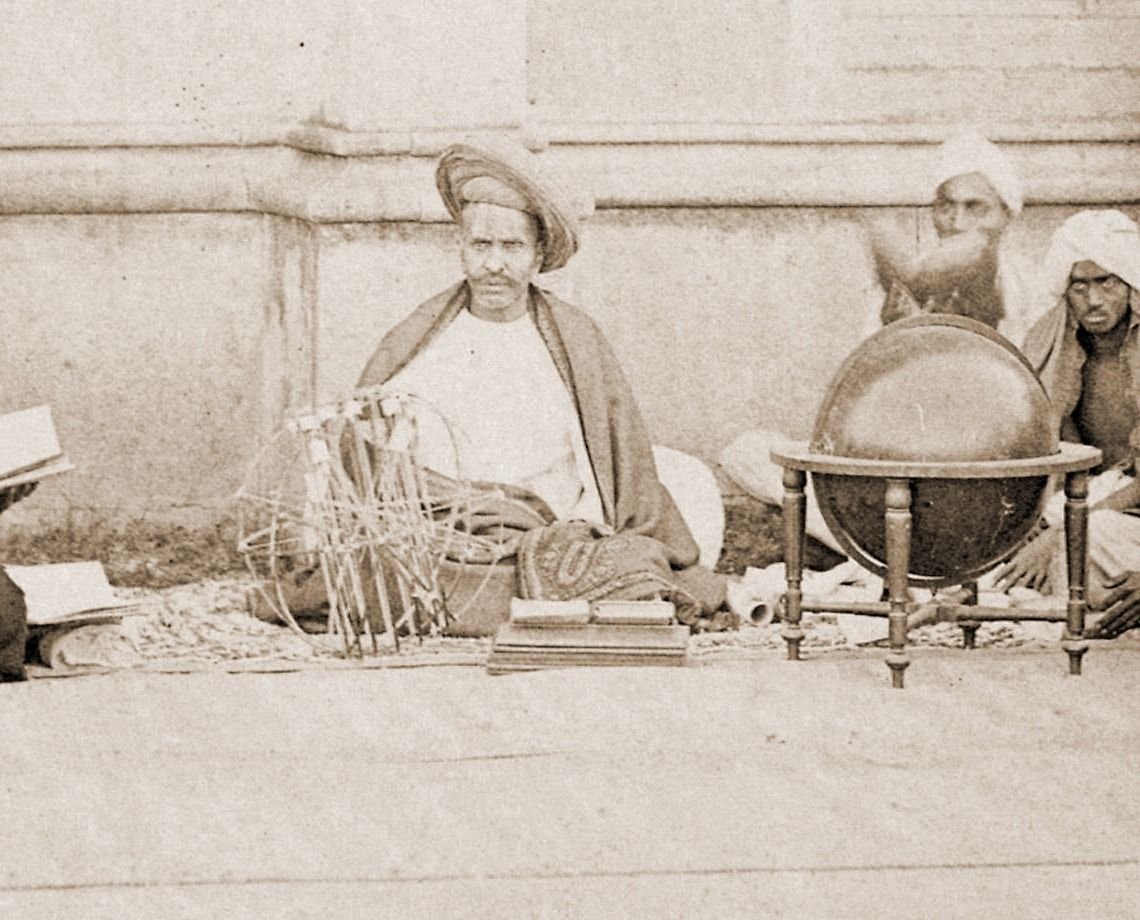
Photo 4: Bapu Deva Shastri teaching at Queen's College, Varanasi, c. 1870. British Library, Photo 1000/46(4709), via Wikimedia Commons. Public domain.
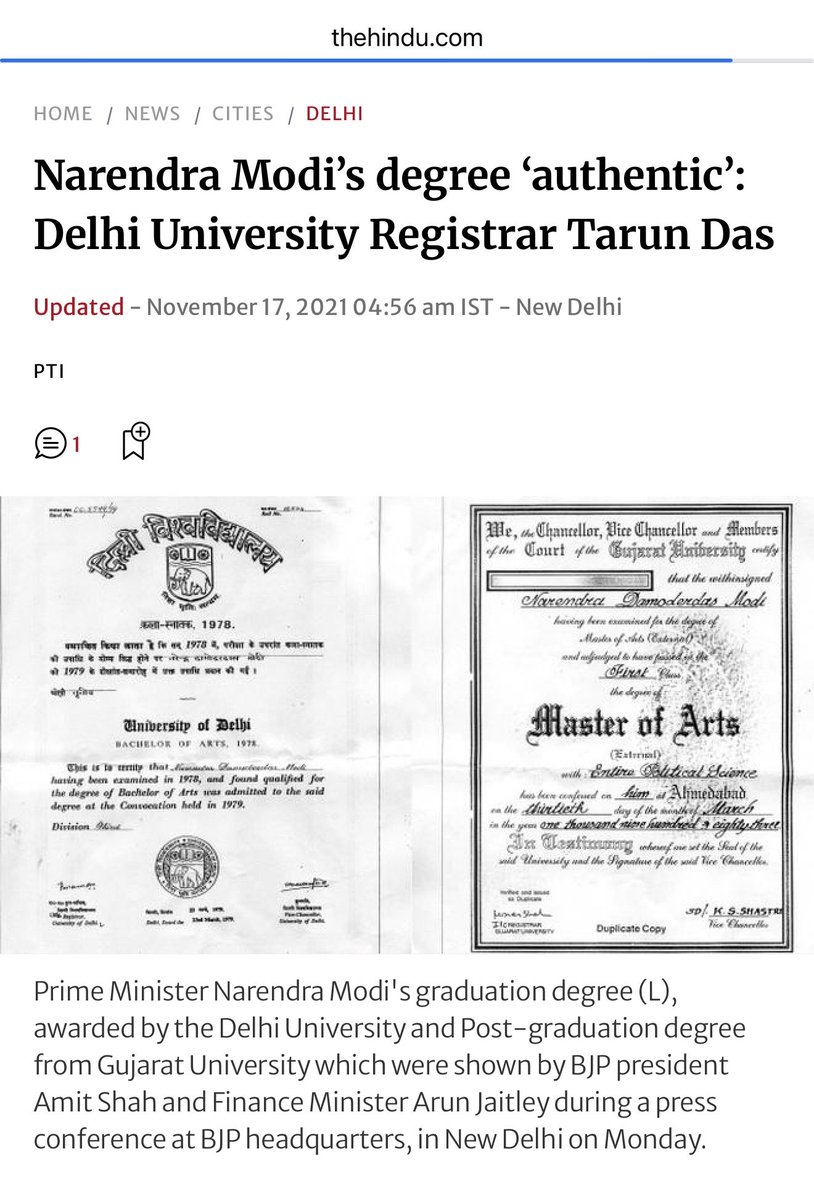
Unka original certified copy public mai hai. Aapne dekha nahin? “The Hindu” ke maalikon ne AI photo lagaya kya? Ya “tharra certifying agency” ki tarah Kejru ne ab “degree certifying agency” bhi shuru kiya?
Waise zara Saurav ka paternity certificate+Dipke ka degree bhi dikha dena
Ripudaman had warned. The Mistakes committed more than 2000 years back divided India. We can't allow illegal migrants in India's voter list.
अवैध घुसपैठियों को कांग्रेस पार्टी का समर्थन देखकर मुझे यह दृश्य याद आ रहा है। भारत का पुनः विभाजन नहीं होना चाहिए!
Saket ji, don’t be so surprised by an “ACM Court”. Executive Magistrates and preventive peace bonds weren’t invented last week by Amit Shah.
The power existed for decades under Section 107 CrPC and today continues under Section 126 BNSS — allowing an Executive Magistrate to require a person to execute a bond to maintain peace.
And no, this isn’t some exotic Delhi-only creature. Mamata Didi’s West Bengal, Left’s Kerala and DMK’s Tamil Nadu all used Executive/Special Executive Magistrates for such preventive proceedings. Tamil Nadu has, in fact, recently empowered senior police officers as Special Executive Magistrates with BNSS preventive powers.
It’s called preventive law and public-order administration. It has existed under Congress, Left, TMC, DMK and BJP governments.
I am sure now you can answer - चलिए Saket जी, ₹5,000 के लिए एक आसान-सा KBC सवाल खेलते हैं — CrPC/BNSS क्या है और Executive Magistrate क्या करता है?”
6 या 7 साल की उम्र में यह बच्ची अपने माता और पिता दोनों के कब्र में मिट्टी डाल रही है
इसके माता और पिता का गुनाह यह था कि उन्होंने एक सऊदी अरब की मस्जिद में रिल्स बनाते समय एक दूसरे को kiss कर लिया था
सऊदी अरब में बांग्लादेश के दंपति का सर कलम करके मौत की सजा देने के बाद उनके शव बांग्लादेश पहुंच गए जिसका अंतिम संस्कार कर दिया गया
पता चल रहा है कि उन दोनों की एक 8 साल की बेटी भी है जो अब अनाथ हो गई
और यह पति-पत्नी मक्का की एक मस्जिद में सेक्स नहीं कर रहे थे बल्कि एक दूसरे का चुंबन ले रहे थे रील बना रहे थे
और उनके इसी “खतरनाक" गुनाह पर दोनों का तलवार से सर धड़ से अलग कर दिया गया
सजा देते समय का भी वीडियो है क्योंकि सऊदी अरब में सार्वजनिक रूप से सजा दी जाती है लेकिन वह वीडियो इतना भयावह है कि मैं उसे पोस्ट नहीं कर सकता
पहले पुरुष का सर काटा गया और उसका सर धड़ से अलग होकर कई घंटे तक छटपटाता रहा इधर-उधर हिलता रहा उसके बाद महिला का भी सर काट दिया गया और सबसे भयावह दृश्य तब था जब दोनों के सर उछलते उछलते एक दूसरे के करीब आ जाते थे
जाहिद का लिखा हुआ एक शेर याद आ गया
“जाहिद शराब पीने दे मस्जिद में बैठकर
या फिर वो जगह बता दे जहां खुद नहीं है"
हमारे यहाँ इस्लाम में ऐसा है कि ऐसी औरत से शादी करो जो ज़्यादा बच्चा पैदा करने वाली औरत हो। हम ख़ुद 13 भाई बहन है, जिसके पास 6 बच्चे है वो सातवां करे और मुझसे 10 हजार ईनाम ले जाये !
- शौकत अली (प्रदेश अध्यक्ष, AIMIM)