An Argentinian car mechanic was messing around with his employees. He came up with an idea, and ended up creating a device to help women during childbirth. It's the biggest advancement in the field since 1950.
Aguante Avenida Warnes
@RPMComo@RogerPielkeJr@AndrewJWHaynes In Dutch we say "de kruik gaat zo lang te water tot hij breekt". There surely is a way cooler sounding Italian version of this :) You can get away with it for a long time, until you can't. Or as in finance "gradually, then suddenly". The reputation will be impossible to fix.
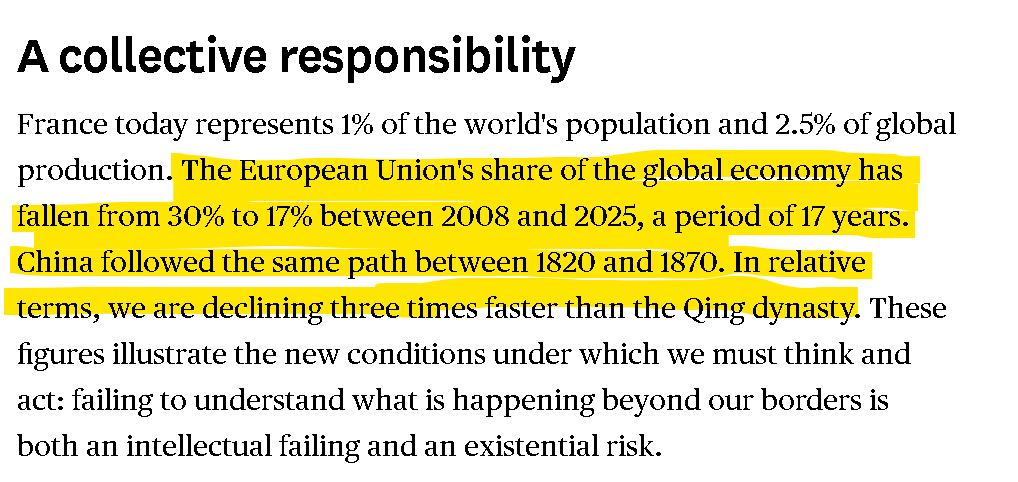
People don't grasp the sheer speed and scale of Europe's decline.
This 👇 is an extraordinary number shared by Luis Vassy, director of Sciences Po (one of France's most famous schools) in this article: https://t.co/BQbkXb2kPl
He calculated that the EU is declining 3 times faster than the Qing dynasty at the height of China's century of humiliation.
Back then, it took China 50 years to drop from 30% of world GDP to 17%, whereas it took the EU just 17 years (from 2008 to 2025).
Insane 😢 And, sadly, given the current direction and the EU's systematically suicidal policy choices (latest example: https://t.co/6EYJgdXVVo), it's just the beginning...
This is cool--Karpathy's autoresearch idea applied to a real load-bearing problem: minimizing the size of a quantum circuit breaking DL over secp256k1.
Recall that the smallest quantum circuit currently known (from a group of researchers from Google and more) was not released publicly, and the authors only proved knowledge of a quantum circuit via zk.
This is basically completely the opposite: the smallest quantum circuit will be publicly available, and anyone or any agent/AI in the world can contribute to it!
How the lower bound develops for the next few weeks will be very interesting to watch. My bet is on the move to post-quantum cryptography moving to an even more accelerated timeline due to this project.
🛑 Rhine Water Levels Fall, Oil Barges Forced To Reduce Cargo
🛑 The Rhine, one of Europe’s most important rivers, has seen water levels continue to fall, restricting barge carrying capacity and, together with the ongoing protracted Iran conflict, adding further pressure to regional fuel supply chains. Spotbarge data showed that earlier on Wednesday water at Germany’s key navigation point Kaub had dropped to extremely low levels, with a 110‑metre barge able to carry just over 1,000 tonnes of diesel — roughly 40% of its total rated capacity. The Rhine is a critical European transport artery: over 280 million tonnes of cargo moved via the waterway in 2024, with petroleum products accounting for more than 20% of that volume.
Many define AI as compute, data, and algorithms. The three pillars. I am not sure.
Compute is a commodity. Nvidia sells it to anyone with capital. Data is increasingly licensed, scraped, or synthetic. Algorithms are published on arXiv within weeks of being invented. The transformer paper is open source. So is most of what came after.
What isn’t a commodity is uniquely talented humans who know how to actually train a frontier model. The knowledge of what learning rate to use, which data to throw away, when a loss curve means something is wrong. That lives in heads, not papers.
Artificial Intelligence is actually quite human so far.
Europe loves what hurts it and hates what helps it.
Mass migration destroys the welfare state it claims to defend. Net zero accelerates the deindustrialization of a continent that once led the world in manufacturing. China beats Europe at every level but European leaders prefer Xi to Trump.
Europe finances Russia by paying for its gas while sanctioning it, sustaining the very war machine it claims to oppose. Europe regulates AI before building it, guaranteeing that American and Chinese companies dominate, while European founders relocate to Austin or SF. Europe punishes Israel while depending on Israeli technology for cybersecurity, defense systems, and medical innovation. Europe taxes productive citizens and successful companies until they leave then wonders why growth stagnates and the tax base shrinks every year.
A continent that punishes what sustains it and rewards what destroys it is not in decline by accident. It is in decline by choice.