Watching Gen Z men veer right hits different for Millennials. We lived through Columbine, 9/11, the Iraq War, 2008 crash, 2016 election, covid, abortion bans, & now this. We watched institutions repeatedly fail us while older generations selfishly protected the status quo. 🧵1/
Most medical students at Johns Hopkins University will no longer pay tuition thanks to a $1 billion gift from Bloomberg Philanthropies. https://t.co/e9jOJ3WhU6
Thanks Peter for the kind words. In that session Peter and @RWalensky gave amazing talks and I had the opportunity to present to the AAP how the deployment of convalescent plasma for COVID-19 in the USA had saved tens of thousands of lives in the the first year of the pandemic.
We've lost a treasured friend and colleague with the passing of Dr. Worta McCaskill-Stevens last week. She transformed #ClinicalOncology research and was a tireless champion to reduce disparities and improve cancer care for underserved communities. She will be greatly missed.
@emmettdoog I loved the banter between you two. This is a loss that really hurts. I hope that he is playing with our Corgi, Captain now. He loved treats as much as Emmett.
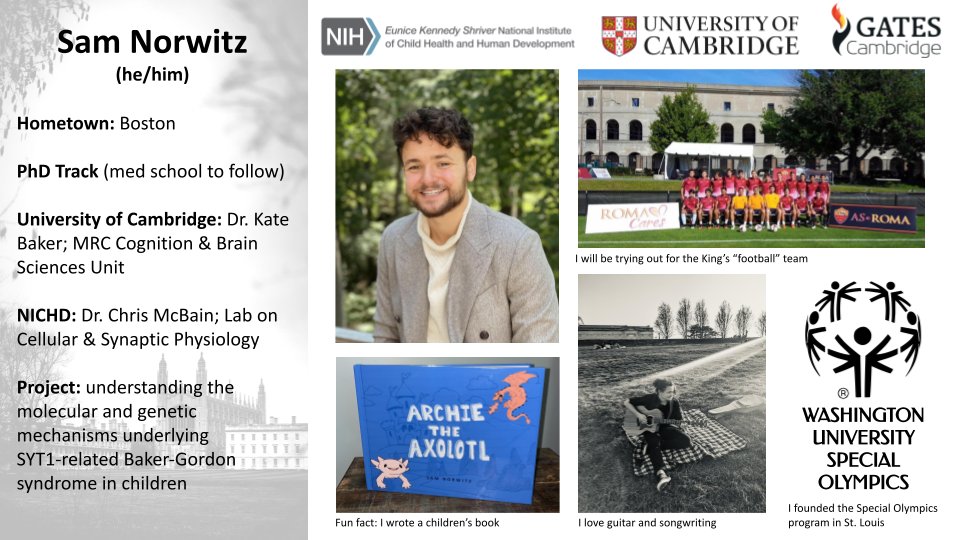
Let's welcome Sam Norwitz to the NIH OxCam Scholars Program! Sam is a @Gates_Cambridge scholar who recently graduated from @WUSTL ! #WelcomeClassof2023
Following the shooting at UNC the school paper made this the front page- it’s texts from students on campus during the shooting. It doesn’t have to be this way but Republicans in North Carolina have loosened gun laws.
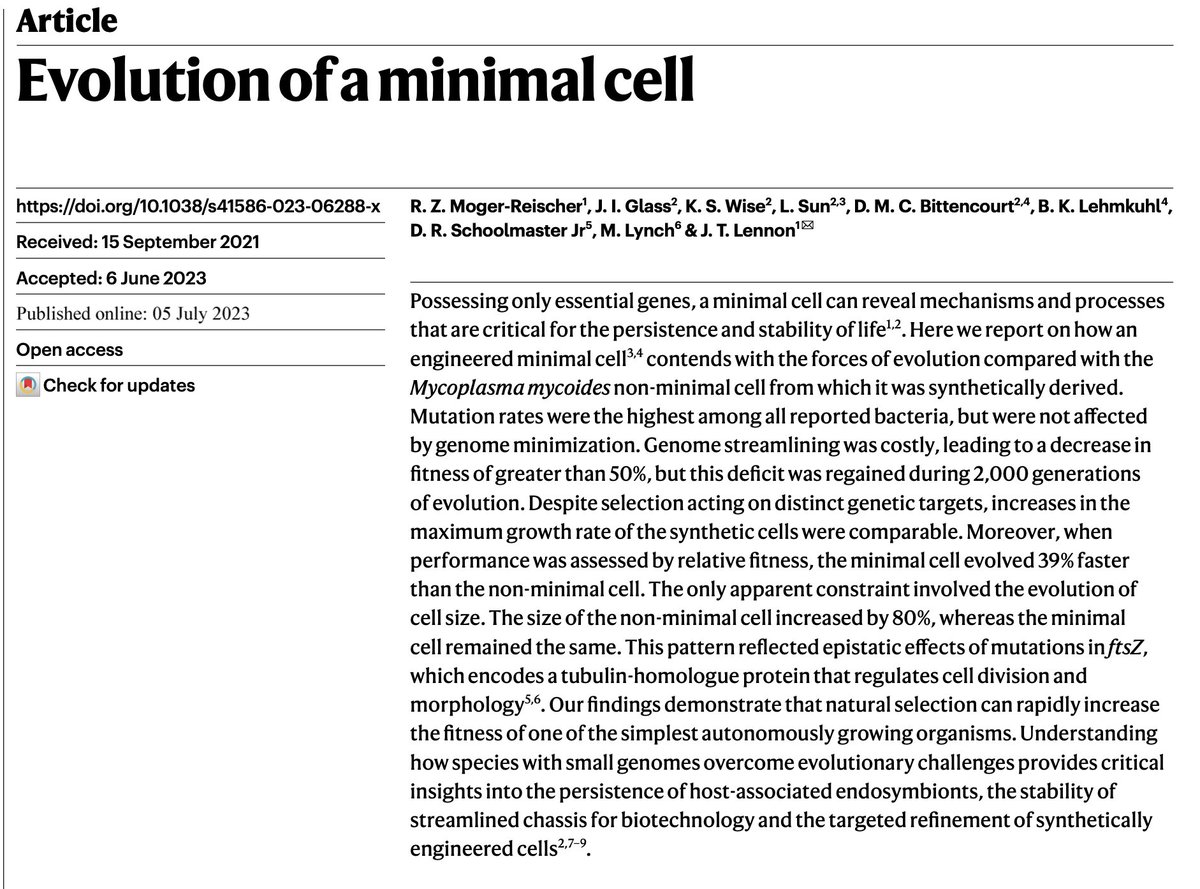
A mind-blowing paper has come out today in @Nature
In 2016, JC Venter Institute scientists trimmed a bacterial genome to its barest minimum required for life to synthesize what they called a "minimal genome" (https://t.co/Rk8oZJ0bUj).
Today, a group of scientists from Indiana University reports how that minimal genome evolved over 2000 generations in comparison to the non-minimal genome.
The authors found that even when you reduce a bacterial genome to its absolute minimum where every nucleotide matters, the genome undergoes mutational events generation after generation as much as the non-minimal genome. One simply cannot stop the evolution.
Just over 300 days of evolution (equivalent to 40,000 years in humans) the minimal cell has gained everything it lacked in fitness on day one in comparison to the non-minimal cell.
When comparing the evolved traits between the minimal and non-minimal cells, the scientists found something striking. The evolutionary process increased the cell size of non-minimal cells but not that of the minimal cell. But that is not the striking part.
The scientists were able to identify the key mutation that resulted in cell size evolution. And it turned out that the mutation that helped the non-minimal cells to grow bigger is the same that helped the minimal cells to stay smaller. Growing bigger had a survival advantage for non-minimal cells and not growing bigger had a survival advantage for minimal cells. So, the mutation had a context-dependent effect. This just demonstrates that the evolutionary effects on traits have no absolute direction. All that matter is what is beneficial for the organism's survival.
The conclusion of the paper is metaphorically a quote from the Jurassic Park movie:
“Listen, if there’s one thing the history of evolution has taught us is that life will not be contained. Life breaks free. It expands to new territories, and it crashes through barriers painfully, maybe even dangerously, but . . . life finds a way". (https://t.co/UlxRlb86CT)
https://t.co/zA9OAqSoAu
Just published and #ASV2023 attendees can see part 2 of this work at P22-75 @CEIRRNetwork ; sometimes antigenic drift comes with a fitness cost... https://t.co/OU6c7UVjpp