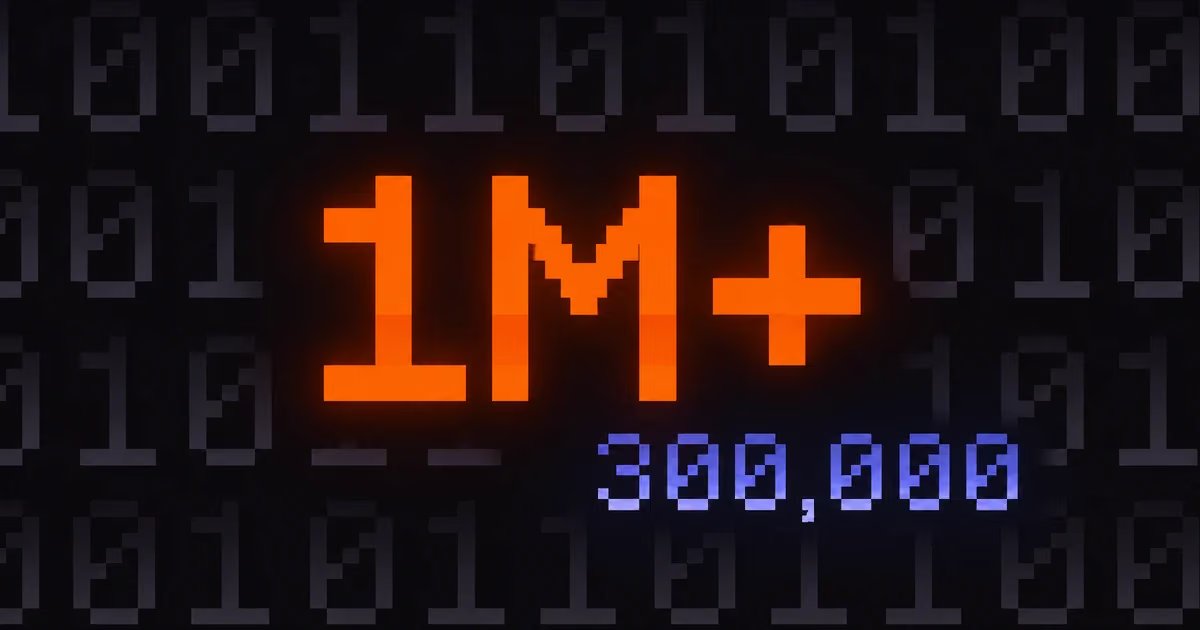
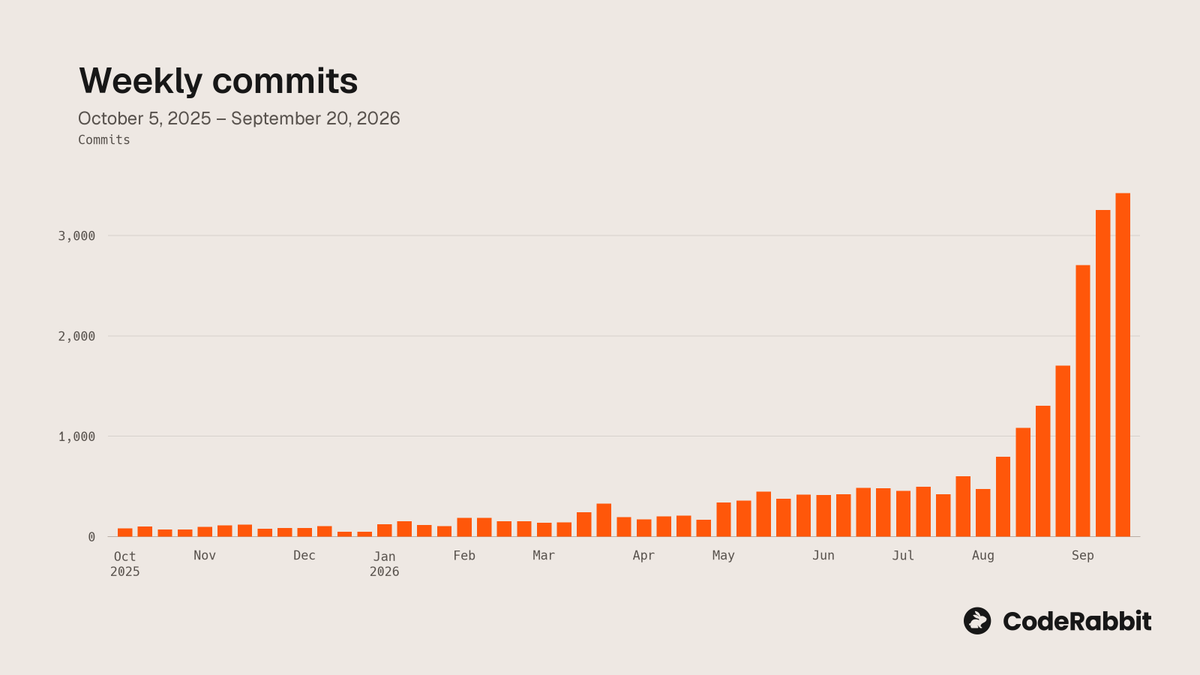
1,049,817 open-source code reviews in September, a new monthly record!
That's 2.49x April's volume and up 14.4% from August.
"Not using it today would be like racing Formula One without a seatbelt or helmet." – @tannerlinsley, creator of TanStack
I shipped roughly 3000 PRs in a month (similar ballpark as @poteto) and my spend is roughly ~$200K a month in tokens. The value created by all that code is in millions, if not in billions!
My SF Tech Week calendar got a little out of hand... 😁
I’m co-hosting and speaking at six events across SF and Mountain View next week.
Here’s where you’ll find me:
🏃 Monday, Oct 5 · 8 AM - Rabbits on the Run
An all-paces run, then breakfast and a little rave at @coderabbitai HQ. Warm-up at 8, run at 8:15, breakfast beats at 9 on our rooftop.
🏭 Wednesday, Oct 7 · 5 PM - Factory Reset w/ @mastra
Short, opinionated talks about the agentic software development lifecycle: AI code review, open source, autonomous engineering, SW Factories, and what’s actually working w/ @abhiaiyer
⚙️ Thursday, Oct 8 · 4:30–8 PM - AI & Platform Engineering Developer Meetup with @Intuit OSS
I’m in Mountain View talking about scaling engineering judgment when code is basically free, alongside Intuit engineers and @arizeai’s @aparnadhinak Dhinakaran exploring agents that improve through feedback and evals.
🌊 Friday, Oct 9 · 8 AM - Waves & Breakfast with CodeRabbit
Surf, a cold plunge, coffee, and breakfast at Ocean Beach. Beach people welcome, even if you’re skipping the surf.
🌇 Friday, Oct 9 · 6–9 PM - October Tech Rooftop Mixer
Closing out my week with Founders & Friends and Founder Social Club: founders, builders, investors, and sunset conversations in SF.
Join us
🔥 Saturday, Oct 10 · 4 PM · Menlo Park - Nar Nights
A fireside chat with an actual fire, under the redwoods. A small circle of founders, investors, and researchers sharing stories, with pillows and carpets on the ground.
If you're in the city and any of that sounds interesting to you, I'd love to meet you!
See ya there! 👋
P.S. Links below
Your agent doesn't know Jev.
Most code calls LLMs the long way:
state → prompt → text → parse → if statement
Decision models like Jev skip the text and plug into your logic.
Here's 30 minutes with @typesafeai's @allietheicon on building with it.
What is happening inside @coderabbitai's engineering team feels unprecedented and is hard to explain to anyone on the outside. We have hardly grown as an engineering team, but we are shipping software 5–6x faster than we were six months ago. The world may not have seen productivity gains like this since the Industrial Revolution.
We’ve had to rewire how we ship software as we speedrun through one bottleneck after another: agentic reviews, agentic validation, local resource constraints, collaboration bottlenecks, CI/CD pipelines, release processes, and so on. Every bottleneck we solve exposes the next. Processes that worked just a few months ago are already struggling to keep up.
We are looking for passionate builders who want to help define how the industry ships software at scale. It’s a once-in-a-lifetime opportunity to be part of a team on a parabolic learning curve, encountering and solving problems that most other startups haven’t reached yet.
If that excites you, I would love to hear from you. DMs are open!
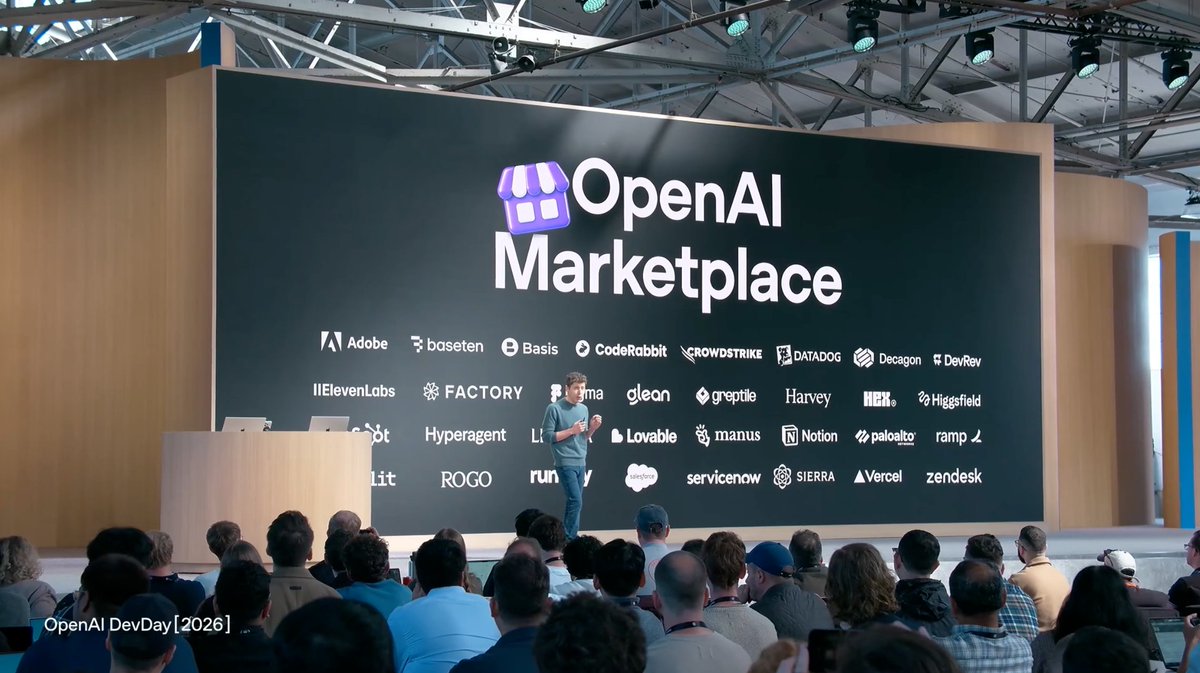
CodeRabbit went live yesterday as a featured launch partner on the new @OpenAI Marketplace.
Coding agents are writing more of the code that ships, and someone still has to know what changed and whether it's safe to merge.
That's the job of our Agentic Change Management platform. It catches bugs and digs into security issues in code from developers and agents alike. And it maps everything a change touches.
It flags which changes actually need a human look, so reviewers spend their time there. People still decide what gets approved and shipped.
For enterprise teams there's a procurement upside too. Existing OpenAI spend commitments can now go toward CodeRabbit through the Marketplace.
Your coding agent opened five more PRs while you were reviewing the first one.
CodeRabbit is joining the OpenAI Marketplace, which means your existing OpenAI spend commitment can now cover independent AI code review.
Let the agents keep shipping. We'll read the diffs.
https://t.co/h8Dw4PT3j8
Writing code is turning into the cheap part. Knowing which code should exist, which shouldn't, and why is where the value's heading, and Jev is the latest case of AI making those decisions instead of just producing output.
You still have to think like a programmer.
Just a few layers above the code!
Your agent worked all night. Do you merge what it wrote?
Francesco Bonacci (@francedot) of Cua (@trycua) wants his agents shipping while he sleeps, without waking up to a mess he has to clean up. The hard part is staying close enough to steer them.
On this episode of The Merge we get into how he closes the loop on agent tasks, what to do with low-quality AI-generated PRs, and why a proposed patch isn't a merge.
His take: more autonomy means review matters more, not less. You still need to be able to inspect the result and push back on it.
This week in the CodeRabbit changelog 🐰
→ Share TypeScript review configs across repos
→ Handle metrics API retries with clearer retry guidance
Define review standards once. Reuse them across your team’s repositories.
See the full changelog: https://t.co/uiL1uuhoyF
CodeRabbit is available in Claude Marketplace!
Apply a portion of your committed Anthropic spend to CodeRabbit, the same route we used for Vercel Sandbox and Workflows!
Read Anthropic's announcement:
https://t.co/P7dBBmeuz4
Agents can create PRs in minutes, but understanding them still takes work.
CodeRabbit Change Stack connects a PR's purpose, behavior, dependencies, and code so reviewers can really verify it before approving.
Do you understand what you're about to merge?
We ran Opus 5.5 through CodeRabbit's review pipeline.
> On 80 known bug patterns it caught 51 vs 49 for our production mix.
> On 13 harder cases, 10 vs 5.
> It found a retry-count race in Cal.com that production missed.
The catch is ~50% more tokens, and 9 bugs our baseline caught that Opus 5.5 didn't.
Read our full Opus 5.5 model evaluation here: https://t.co/8GRec6koER