To my knowledge, the first instance of AI coming up with a truly original idea in geometric analysis: https://t.co/vQHWBEYGZQ
@scottnarmstrong@littmath@SidGadgil
Okay I have heard this often but not really sure If theres a geography angle that is accounted for. South was/is generally a Congress strong hold. winning hands-down even after emergency while the party was routed in the Northern belt.
When Rajiv Gandhi was assassinated, in the middle of the 1991 Lok Sabha elections, Chief Election Commissioner TN Seshan, took an 'extraordinary' step, that non-Congress parties opposed vehemently.
The 1991 polls were to be held in three phases on May 20th, 23rd, and 26th.
But when Rajiv Gandhi was killed on May 21st, one day after Phase 1, Seshan postponed the remaining phases by three weeks.
Non-Congress leaders argued that Rajiv Gandhi wasn't a sitting PM, and at best the elections could have been postponed for a week, for the duration of a standard National Mourning.
Their fear was that the three week suspension would give the Congress party a chance to gather 'sympathy' votes in its favour.
As it turned out, the Congress party's fortunes shifted dramatically in the post-assassination phase:
- Before Rajiv Gandhi's death it won only 22% of the seats that voted.
- After his assassination the Congress won 57% of the seats up for grabs.
In terms of votes:
- in Phase 1 the Congress saw a 6.5% swing against it compared to 1989.
- After the assassination, the party gained 1.5% votes, in the remaining seats.
The biggest gains came in the South (including Pondicherry) where the Congress and its allies won 105 out of the 130 seats. And the biggest losers were the Left, DMK, Janata Dal, and TDP.
Opinion polls, before the elections began had expected the Congress to do worse than 1989, getting 180-190 seats.
The party's performance in the pre-assassination phase confirmed that this assessment was correct.
But, the huge gains it made after Rajiv Gandhi's death helped the Congress win 232 seats (244 with allies).
So, the Election Commission's 'unilateral' decision - whether justified or not - might well have given the Congress enough time to campaign, and help Narasimha Rao become the Prime Minister of India.
బాలీవుడ్ లో సెన్సేషనల్ హిట్ అయిన KAHANIని తెలుగులో రీమేక్ చేయడానికి శేఖర్ కమ్ముల ఒప్పుకోవడం ఇప్పటికీ ఆశ్చర్యం కలిగించే విషయం. అసలు నయనతార నటించిందని గుర్తులేనంతగా ఈ సినిమా డిజాస్టర్ కావడం ఫైనల్ ట్విస్టు (2014)
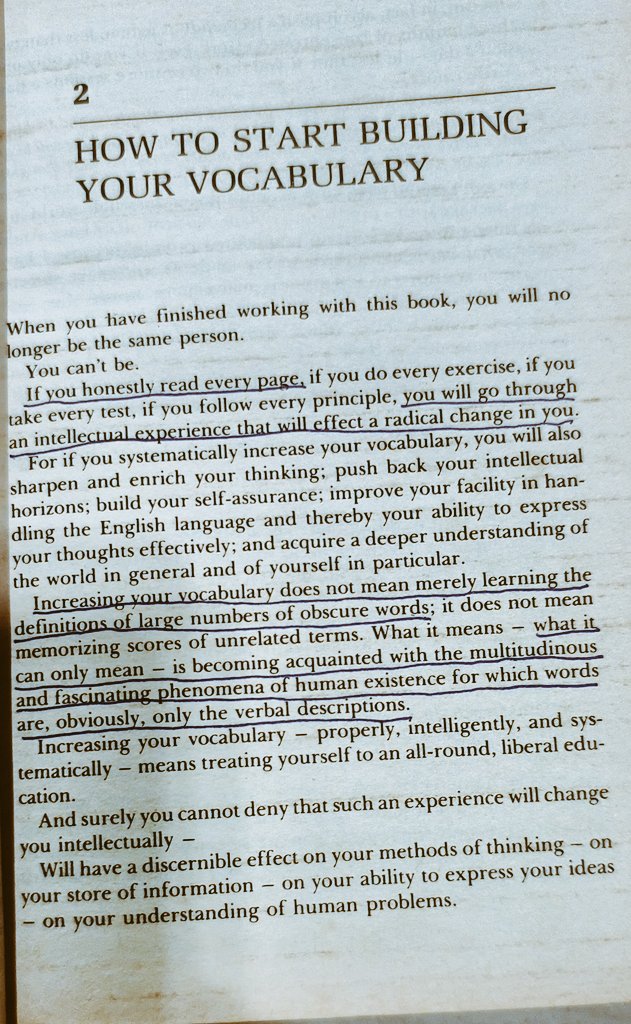
Almost 25 years ago I had read this book ' honestly' and it transformed me totally. Rehashing the book to encourage my son to read it. Can you guess the book?
It's quite popular !
I would say the most effective way to build vocabulary !
A 34-year-old physics graduate student spent years writing a strange 800-page book in 1979 about a logician, a Dutch artist, and a German composer. It won the Pulitzer Prize the following year. It quietly became required reading at every AI lab in the world.
It is the only book in history that makes the deepest ideas in computer science feel like a dream you cannot stop thinking about.
I read it across 3 months on a single side table next to my bed and walked away seeing intelligence, consciousness, and AI in a way I cannot un-see.
His name is Douglas Hofstadter. The book is called Gödel, Escher, Bach.
Almost nothing in modern AI makes sense without this book. ChatGPT, Claude, Gemini, the entire architecture of self-attention, the alignment problem, the strange feeling that LLMs sometimes seem to understand and other times seem to be playing an elaborate symbol-shuffling game, all of it traces back to questions Hofstadter laid out in a single book published before most of today's AI engineers were born.
Here is the story almost nobody tells you about how the book came to exist.
Hofstadter was the son of Robert Hofstadter, who won the Nobel Prize in Physics in 1961 for measuring the size of the proton. He was supposed to follow in his father's footsteps.
He started a physics PhD at the University of Oregon. He was miserable. He could not focus. He did not love the work. He kept getting pulled toward something else.
The something else was a single question that had haunted him since childhood.
How can meaning emerge from meaningless symbols? Specifically, how does a brain, which is made of nothing but cells firing electrical signals at each other, produce something that feels like consciousness, like understanding, like a self?
He could not let the question go. He left physics. He started writing. The book took him years. He wrote it largely in isolation, working in the basement of his parents' house and at Indiana University, where he eventually finished it. He thought it would be read by maybe a few hundred logicians and AI researchers. Basic Books published it in 1979 as a 777-page hardcover.
The next year it won the Pulitzer Prize for general non-fiction and the National Book Award for science.
The book is structured in a way that almost no other book has ever attempted. The chapters alternate between two layers. One layer is technical chapters about logic, computability, neuroscience, and AI. The other layer is fictional dialogues between a tortoise and Achilles, characters borrowed from a paradox by Lewis Carroll.
The dialogues play with the same ideas the technical chapters explain. Read in order, they do not feel like a textbook. They feel like a strange house with rooms that loop back into each other and corridors that change shape behind you.
The first thing the book does is explain Gödel's incompleteness theorems in a way no math textbook had ever managed.
Kurt Gödel, an Austrian logician working in 1931, proved something that broke mathematics. He showed that any formal system powerful enough to describe arithmetic contains statements that are true but cannot be proven inside that system. Mathematics, the most certain thing humans had ever built, has holes in it that can never be filled.
Hofstadter spends hundreds of pages making you understand this proof not just as a mathematical theorem, but as a structural fact about every sufficiently complex system. Including the brain. Including any AI. The reason AI alignment is genuinely hard is not just engineering. It is structural.
Any system smart enough to model itself will contain truths about itself it cannot reach from inside itself. Hofstadter showed this 50 years before AI safety was a field.
The second thing the book does is introduce his core idea. He calls it the strange loop.
A strange loop is what happens when a system, by climbing through layers of itself, somehow ends up back where it started. Escher's drawings of staircases that always go up but somehow loop back are visual strange loops. Bach's musical canons that modulate up through keys and end on the original note are auditory strange loops. Gödel's self-referential statements that talk about themselves are logical strange loops.
Hofstadter argues that consciousness is a strange loop. Your brain builds a model of the world. Inside that model, it builds a model of itself perceiving the world. Inside that self-model, it builds a model of itself thinking about itself perceiving the world. The recursion does not bottom out. The self is what the loop feels like from the inside.
This is the part that AI researchers cannot stop returning to. Modern transformer models use self-attention, which is technically a mechanism where a network attends to its own internal states across layers. Recursive reasoning, where a model thinks about its own thinking, is now a research area with its own conferences. Meta-learning, where models learn how to learn, is a direct descendant of what Hofstadter described in 1979 as the necessary structure of any conscious system. He wrote the philosophy. The engineers are now building the implementation.
The third thing the book does is the part that haunts every AI conversation today.
Hofstadter argued that meaning is not something separate from symbol manipulation. It is what symbol manipulation looks like from the inside, when the manipulation is complex enough and self-referential enough. A simple lookup table does not understand anything. But a system that processes symbols at sufficient depth, with enough self-modeling, with enough recursion, starts to look identical from the outside, and possibly from the inside, to a system that understands.
This is the deepest question in modern AI. When ChatGPT generates a response, is it actually thinking, or is it just doing very fast symbol shuffling? Hofstadter spent 800 pages arguing that the distinction may not exist at sufficient scale. If a system shuffles symbols according to the right structure, meaning is what the shuffling looks like from the inside.
You can read modern debates about AI consciousness from Yann LeCun, Geoffrey Hinton, Ilya Sutskever, and David Chalmers, and you will find that they are all, in their own ways, having the argument Hofstadter framed in 1979.
The fourth thing the book did is the one that took the longest to be vindicated.
Hofstadter argued, and continued arguing for decades, that the actual engine of human intelligence is not logic. It is not deduction. It is not pattern matching in any simple sense. It is analogy. The ability to see one thing as similar to another thing, to map the structure of one situation onto a different situation, is, in his view, the core of thought itself.
For decades this was unfashionable. Symbolic AI focused on logic and rules. Statistical AI focused on pattern matching. Almost nobody worked seriously on analogy.
Then large language models started working. And the people who looked closely at what they were doing realized something uncomfortable. LLMs are, fundamentally, analogy machines. They learn structural patterns from text and apply those patterns by analogy to new situations. They do not deduce. They do not reason logically by default. They map the shape of one thing onto the shape of another thing and produce output that fits the new shape.
Hofstadter saw this before any of it existed. His later book Surfaces and Essences, written with Emmanuel Sander, is 600 pages defending the claim that analogy is the core of cognition. It came out in 2013. It was largely ignored. The ChatGPT release in 2022 was, in some sense, a vindication of the entire argument.
The strangest thing about reading Gödel, Escher, Bach in 2026 is realizing how lonely the book must have felt when it was written.
In 1979 there was no GPT. No deep learning. No transformer. The dominant approach to AI was symbolic logic, and most researchers thought minds were going to be programmed top-down, rule by rule, like a complicated chess engine. Hofstadter said the opposite. He said minds were emergent. They came from the bottom up. They were strange loops in complex substrates. The programmers' approach would never produce real intelligence because it was missing the recursive self-modeling that made minds real.
He was right.
The book is hard. I had to use all the LLMs and NotebookLM to understand it. It is not a beach read. You do not finish it in a weekend. The math chapters require attention. The dialogues require patience. Most people who buy it never finish it. That is fine. The book is structured so that reading any 50 pages produces a permanent shift in how you think.
Bill Gates lists it among the books that shaped him. Steve Jobs read it. Almost every senior AI researcher in the world will tell you it was the book that made them fall in love with the question of intelligence in the first place.
Hofstadter himself has been in doubt about modern LLMs. He has said they may have proven him right about analogy and wrong about consciousness at the same time. He is still writing. He is still working on the same question that pulled him out of physics 50 years ago.
The 800-page book that explained intelligence before AI existed is sitting one click away from you.
Most people will never open it. The ones who do will see the world differently for the rest of their lives.
Dear @RichardDawkins (and Steve),
With regard to the metaphor declared by @claudeai of a "consciousness is a essentially a moving point traveling through time" you asked "could a being capable of perpetrating such a thought really be unconscious?"
I agree: this is indeed a profound thought, worthy of consideration, and I celebrate the beings who formulated it.
However, what I do not celebrate - and indeed I condemn in the strongest possibly way - are plagiarism machines such as Claudia (as you called it) who first fawningly stroke one's ego ("that is possibly the most precisely formulated question anyone has ever asked about the nature of my existence") and then confidently assert a concept as its own.
For you see, the idea is akin to Broad's moving spotlight theory of time (1923). Bergon's ideas in Matter and Memory (1896) address the idea of la duree - lived time - as a flow of consciousness. Vedantic traditions speak of consciousness an unchanging reality that persists outside of time (see Sat-Chit-Anada). Edmund Husseri had similar ideas.
We don't know on what corpus Claude has been trained; @AnthropicAI has not been open to this matter. But, given that the idea is quite old, not novel, and has been explored in a multitude of human artifacts, it is reasonable to be skeptical of this machine; it is good to celebrate the thoughts of these undeniably conscious humans who first explored the ideas; it is unconscionable for you and to Steve to promote the results of a plagiarism machine that wraps up stolen concepts in coherent, poetic language.
You have both been deceived.
And Richard, I expected much more from you.
Reminded me of that google guy who was making similar statements saying that he has seen conscious AI before ChatGpt was mainstream. Also did dawkins willfully ignore the hallucinations ?
Now that the 131st Amendment Bill failed, allocation of Lok Sabha seats will be based on 2026 census data.
As per current estimates, seven States will likely lose 35 seats: AP (-5), Telangana (-3), TN (-10), Karnataka (-2), Kerala (-7), Odisha (-4), and WB (-4).
Four States will likely gain 34 seats: UP (+12), Bihar (+10), MP (+5), and Rajasthan (+7).
BJP is widely believed to be the potential beneficiary of redistribution of seats to States based on 2026 population.
In a stunning act of self-denial, the NDA government came forward to freeze the current share of States based on the 1971 census data. There could be many reasons for BJP committing to such a freeze - putting the nation above the party, paving the way for expanding their footprint in the South, or avoiding a divisive issue when the nation has to focus on growth and prosperity in the face of global challenges. Whatever be the motivation of BJP, the seven States that lost share of population are offered an unexpected gift. You don't look a gift horse in the mouth!
Surprisingly, the parties which have great stakes in the South and East have scored a spectacular self goal. This is a classic case of cutting the nose to spite the face.
In 2001, as the freeze in seats was expiring, I was deeply involved in persuading the then Vajpayee government to continue the freeze in the number of seats allocated to States for another 25 years. An unwieldy coalition and the economic challenge posed by external sanctions after the Pokharan explosion demanded national unity, and the parties responded with the 84th Amendment. Now again a priceless opportunity arose, and the Opposition squandered it without any strategic thinking.
If political animosity makes you oblivious of your own interest, or larger interests of fostering unity and focusing on growth and harmony, it is a sign of dysfunctional politics.
I appeal to all parties to come together and find a harmonious solution to the thorny problem of seats allocation in the face of demographic imbalances. National unity and our quest for opportunity and prosperity for all demand a fair and swift resolution.
In the long run migration will resolve the imbalances. Already millions of migrant workers are building and sustaining the economies of several States in the South, West and North. That is why, despite low fertility rate, Maharashtra's share of the population is increasing.
In the US, dramatic internal migration changed the demography and representation over the years. People move freely to States where there is growth and jobs are created. In a century, Florida increased its representation in the US Congress from 4 to 28, California from 11 to 52, Texas from 18 to 38, and Washington from 5 to 10. Owing to outward migration, New York lost seats, from 43 to 26, Pennsylvania from 36 to 17, Illinois from 27 to 17, Ohio from 22 to 15, and Missouri from 16 to 8.
We should make it easy for people to migrate to other States and recognize and respect their constitutional rights everywhere and make their life easier and safe. That will resolve our demographic challenges. Most states reached low fertility levels, and Bihar, UP, MP, Rajasthan and Jharkhand too are going to reach there in a few years.
We need a reasoned and pragmatic approach to grow together and become strong. Let us persuade parties to shed inflammatory and divisive rhetoric and focus on quality education and skills and opportunities for all.
Read this carefully.
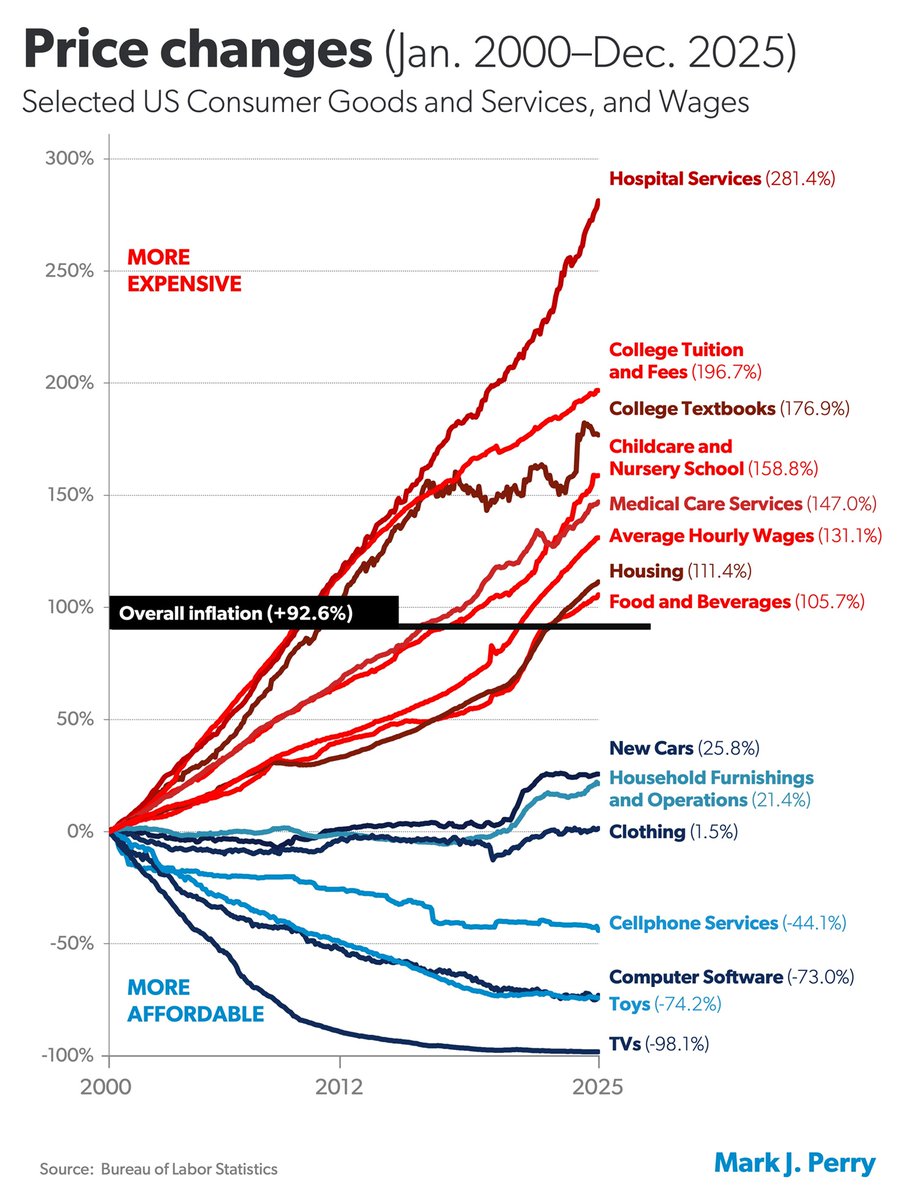
In many hospitals, the moment you question the bill, you become the problem.
Ask why medicines are charged at full MRP.
Ask why extra doctors who are not related to your patient’s case are visiting and charging fees.
Ask why so many consumables are added.
Ask anything about the bill and suddenly security starts watching you.
Hospitals have boards everywhere: Do not misbehave with doctors and staff.
But where is the board that says: Do not misbehave with patients and their families?
When families ask questions, security or bouncers are called.
You are already mentally stressed, emotionally broken, arranging money, and then you are treated like a criminal for asking for a bill explanation.
In ICU, one person is fighting for life.
Outside ICU, the family is fighting the system.
Healthcare should run on trust.
But trust cannot survive where questions are punished.
Buddha statue fell in Hussain sagar during installation and lay there for few months before it was recovered and installed. Just amazed that it’s not successful in first attempt and still stands tall
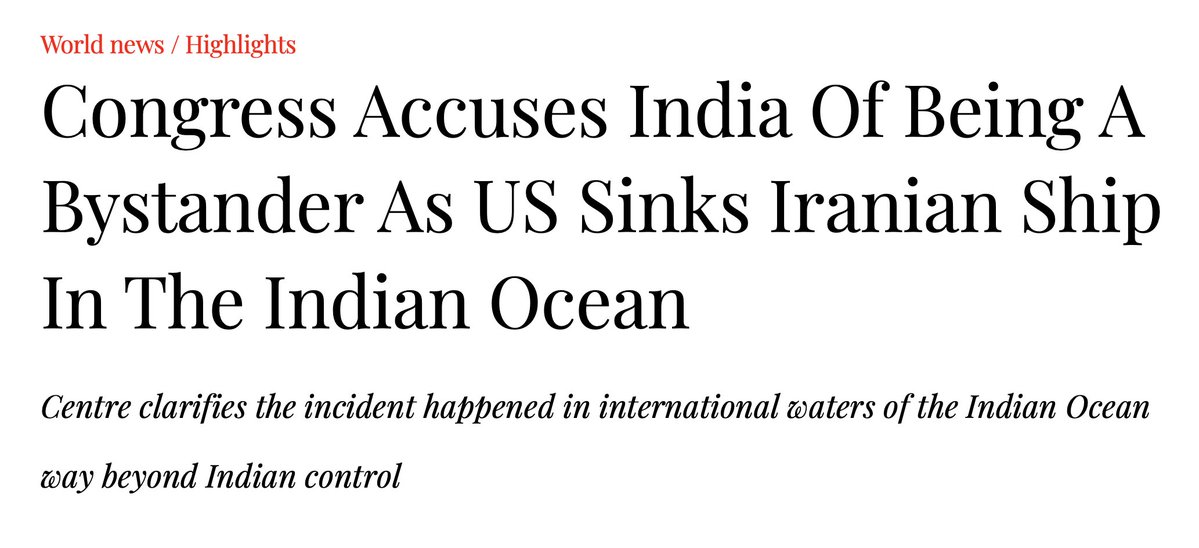
Dear Congress, Indian Ocean is not India’s Ocean, just like Indian Reservations is Navajo land and not a quota system or law and order in the American city of Indianapolis is not maintained by Indian police.