Theory theory
This week's installment from A Panorama of Logic, an introduction to all parts of logic for mathematicians, philosophers, and computer scientists.
https://t.co/d9F5CuDxih #InfinitelyMore#PanoramaOfLogic
«Chapter 6»
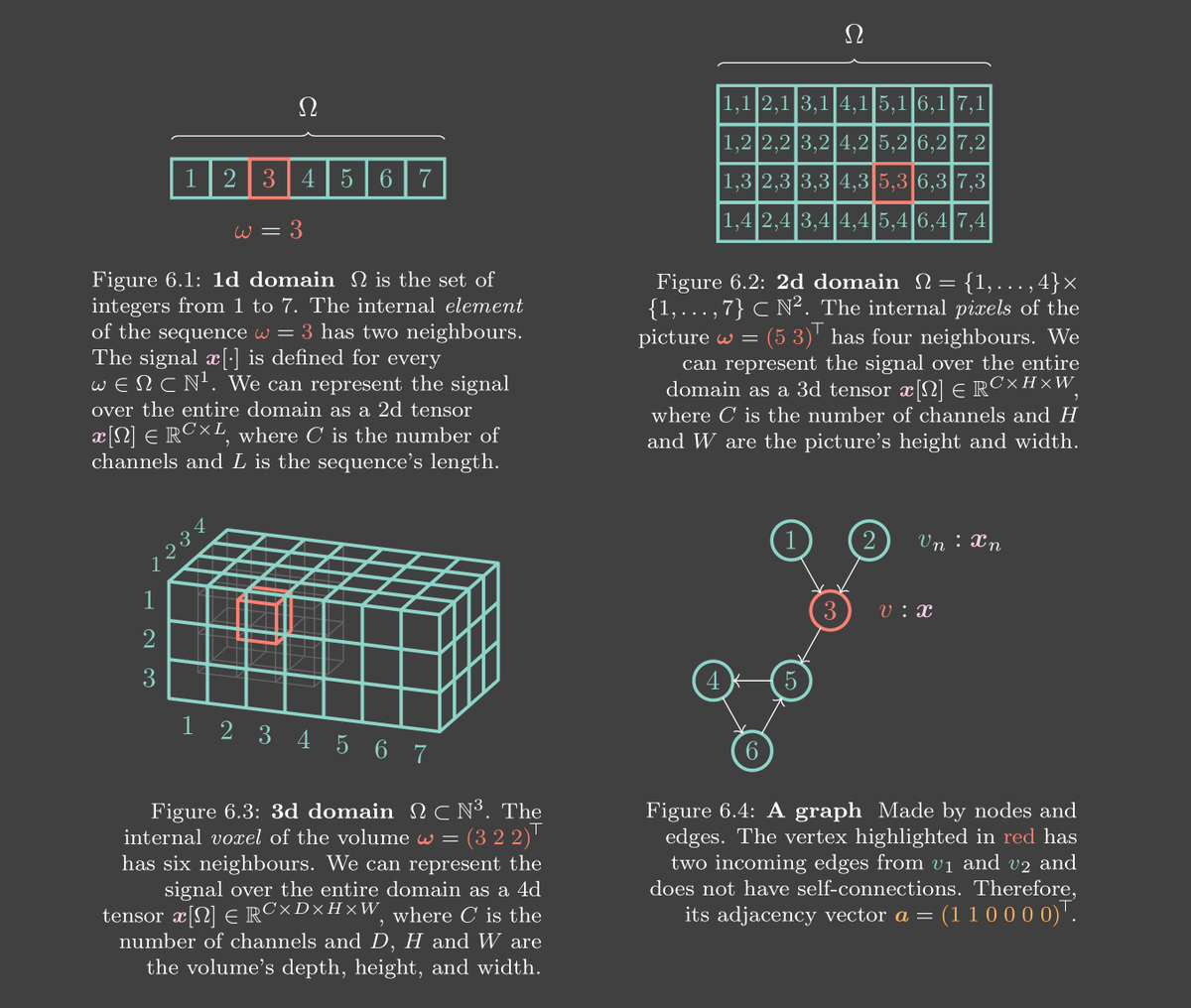
In this chapter, we'll introduce several geometric structures, over which functions are defined, and whose properties can be exploited to reduce computations and ease learning, giving rise to several architecture families we'll cover in this part of the book.
Explaining Probability Distributions in Plain English
🧵 Probability Distributions: A No-Nonsense Guide🎲
• Let's start simple. Ever wonder about the chances of something happening? Like, the odds of it raining tomorrow, or pulling the ace of spades from a deck? That's where probability distributions come into play.
• What are they?
•A probability distribution is a fancy way to describe how likely each outcome of an uncertain event is.
• Imagine rolling a dice.
•Each side (1 through 6) has an equal chance of 1/6.
•The probability distribution here is straightforward: each outcome's probability is 1/6.
• But not all scenarios are as simple as a dice roll.
• Types of Probability Distributions:
•Discrete: Specific, separate outcomes.
•Continuous: Any value within a range.
• Discrete Probability Distribution:
•Like flipping a coin: Heads or Tails.
•Each has a 50% chance.
• Continuous Probability Distribution:
•Think of measuring the time it takes to run a mile.
•You could get 6.5 minutes, 6.51 minutes, 6.512 minutes...
•Instead of exact probabilities for each time, we have a density over a range of times.
• A popular example of a continuous distribution is the "bell curve" or "normal distribution".
•Most outcomes cluster around the middle, with fewer as you move out to the extremes.
• Why care about probability distributions?
•They help us predict, prepare, and understand the randomness in life.
• To wrap up:
•Probability distributions tell us the likelihood of different outcomes.
•They range from simple (like dice) to complex (like predicting heights in a city).
•They're a key tool in stats for understanding and working with uncertainty.
• So, when pondering the odds or chances of something, remember you're stepping into the world of probability distributions. 🎲📊
#Statistics #DataScience
All theory is provisional and all application is a crisis discipline. Once you get past the need for the map to be the territory then you can work on making better maps, a whole diverse plurality of maps, maps that work for different purposes, and keep on questing after the imaginary perfect tools while resting easy in the knowledge that means even hammers must evolve and all the fun is in accepting this and striving anyway.
https://t.co/0d4Q1Mvfs1
Murray Gell-Mann once whispered (in a typically mischievous Murray way) to me during an @sfiscience seminar, "biology is not ready for maths."
I don't agree but I am sympathetic. Moving forward requires triangulating bw diff types of representations. Even as we approach the end of a problem I think what actually crystalizes is not just an equation but mappings + isomorphisms, with understanding residing inside the triangle—a position that is akin but not identical to one of Roger Penrose's, and captured in his three-world's diagram.
Lots of discussion lately about the value of math + formalization, particularly for problems at the boundary of science + philosophy. Formalization can help to clarify as long as we remain aware of its + our limits.
New video! It ties together three recent topics we've discussed:
- The central limit theorem
- Why π is in the formula for a Gaussian
- Convolutions.
We cover a very pleasing visual intuition for why a Gaussian is the "central limit"
https://t.co/p4oRcXjsXg
Suppose you're one of the 1% of calculus teachers who spend time on quadratic ε-δ proofs AND agree with me that the overuse of absolute value expressions impedes student understanding. Then you might be interested in this. I tried to actually explain what's going on.
Algorithmic trading is the domain of secretive hedge funds and banks.
Python unlocked these secrets for everyone (even Goldman Sachs has an open-source tool).
Use the same tools the professionals use.
Here are 17 Python libraries that open the black box:
In math books, the
Theorem:
Proof:
format should be replaced with
Theorem:
Proof idea:
Proof:
The proof idea is a short summary of the key idea behind the proof. Given the proof idea, you might be able to figure out the full proof.