@JulianCaperaB No solo fue un activista ni"dió" su vida: Fue primer ministro y los belgas lo disolvieron en ácido por oponerse a ellos. https://t.co/XhNuMlOink
See the top ranked papers in AI, ML, Robotics, Quantum Physics, and more on @kurateorg. Hundreds of arXiv preprints ranked daily by scientific impact through pairwise tournaments judged by Claude, GPT, and Gemini.
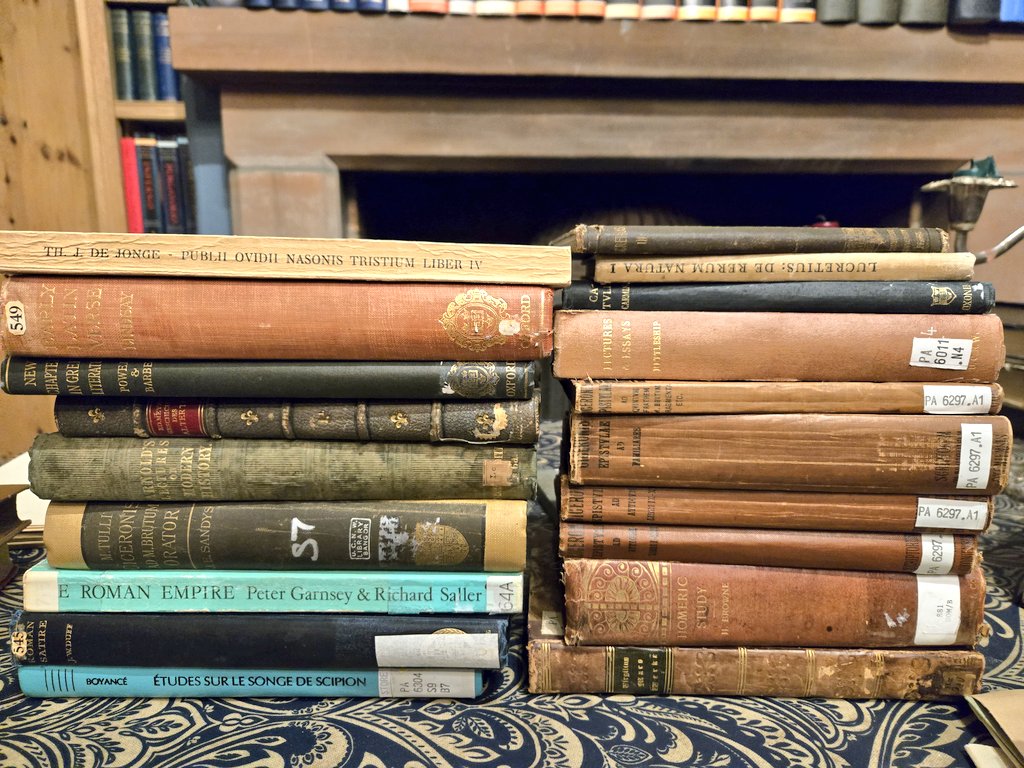
Our next book give-away launches tomorrow! 40+ books and ephemera about the Classical world and such like subjects. Check in here tomorrow evening for an introduction to what will be raffled off next Sunday!
Time for the Antigone Spring Books Give-away! 40+ books and pamphlets on offer worldwide. Just repost this message and follow us, and on Sunday 3 names will be drawn. 1st chooses 20 things, 2nd 12, 3rd gets the rest. We'll add details of the items over coming days. Good luck all!
Orcas eat great white sharks. They hunt seals, dolphins, and baby whales. They have never killed a single human in the open ocean. Not once, in all of recorded history.
An orca's brain weighs up to 15 pounds. Yours weighs about 3. They have roughly double the brain cells we do in the regions that handle complex thought. A neuroscientist at Emory named Lori Marino put an orca brain in an MRI and found these animals can tell different species apart underwater. They do it by sending out clicks that bounce off everything around them and come back as a kind of 3D sound map (this is called echolocation). From 500 feet away, an orca knows you're a human and not a seal. It skips you on purpose.
The answer is culture. Orcas around the world are divided into at least 10 separate populations, each with its own food rules, its own language, and its own way of hunting. All of it learned from their mothers. One population eats only fish. Another eats only marine mammals like seals and sea lions. These two populations can live in the exact same water and never swap a single meal. A baby orca learns what food is from its mother, and that list stays the same for life.
In the Pacific Northwest, one population called the Southern Residents eats almost nothing but Chinook salmon. Scientists have documented them killing harbor porpoises 78 times over six decades, carrying the dead porpoises in their mouths, and never once eating them. Even when the group was starving. A 2023 study in Marine Mammal Science looked at all 78 cases and concluded it was play. These orcas would rather go hungry than eat something their culture says isn't food.
Researchers studying whale behavior in 2001 found that orca cultural traditions "appear to have no parallel outside humans." Each family group has its own dialect, its own version of the language. Calves spend about two years just learning how to make all the sounds their family uses. Mothers will slow down a hunt on purpose so their young can watch.
In 2005, a 12-year-old kid was swimming in Helm Bay, Alaska when an orca came at him full speed. At the very last second, the orca seemed to realize it was charging a human. It bent its entire body in half and turned back to open water. In captivity, it goes differently. SeaWorld's Tilikum killed three people during his life in a concrete tank. Research from 2016, published in the journal Animals, traced it to psychological collapse from being locked away from the family bonds orcas need to stay stable.
I think calling this a "mystery" undersells the science. Orcas decide what to eat based on culture, not instinct. No orca mother has ever taught her calf to hunt humans, so no orca hunts humans. Only about 75 of those salmon-eating Southern Residents are still alive. Their pregnancy failure rate is 69% because we've destroyed their salmon runs. They won't break their food culture to survive. Whether we care enough to protect theirs is the part that actually matters.
Invented in Florence in 1919, Negroni is considered to be one of the most famous Italian cocktails in the world. Here's our recipe to make one: https://t.co/sMLW19s44A
Now that Artemis II has launched we have 10 days to get everyone on Earth a Planet of the Apes costume so we can do something hilarious when the astronauts return 😁
This guy literally explained why Marcus Aurelius had unlimited power and chose to live like he had none.
The philosophy behind it is 2000 years old and more relevant than ever. Stoicism
Watch this:
Más de “La Flauta Mágica”. Este simpático ensayo o grabación del tierno dueto de Papageno y Papagena, con una divertida complicidad entre sus cantantes.
Sólo Mozart podía hacer que el idioma alemán sonará hermoso en una ópera.
I learned about the concept of ‘pastiche’ in Frederic Jameson’s “Post-Modernism & Consumer Society.”
Once you become aware of it, you’ll notice it everywhere, including in half of the songs nominated for Song of the Year at the Grammys as @rickbeato revealed in his latest video.