Que reviravolta interessante nas #BIG7 nestas últimas duas semanas! Assumiram claramente o papel de impulsionadoras nos índices, beneficiando da rotação setorial que se afastou das empresas ligadas ao IA, nomeadamente nos segmentos de chips e memórias. Se este movimento de alta persistir, temos bastante margem para ver os índices a atingirem novos patamares. Vamos ver o que vai acontecer nestas próximas 2 semanas, os earnings estão aí à porta 😉Deixo o vídeo abaixo 👇
https://t.co/UBeeD865Eh
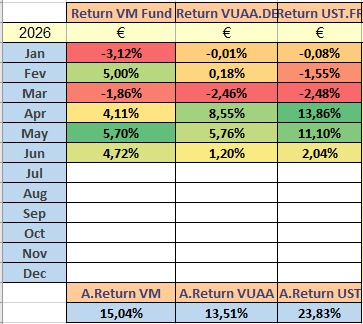
📊 Fecho do 1º Semestre de 2026: Análise de Performance, Disciplina e Gestão de Risco
Chegou ao fim a primeira metade do ano e é o momento obrigatório de fazer o recap do que é que andei a fazer nos mercados!
Arrancámos 2026 com uma tendência lateral e perda de tração nas empresas líderes, uma clara extensão do cenário que já vínhamos a observar desde outubro de 2025. O aumento das tensões geopolíticas entre o Irão, EUA e Israel trouxe volatilidade e correções visíveis nos principais índices, o que aumentou a dificuldade de execução.
Contudo, o segundo trimestre (abril, maio e junho) inverteu o sentido com uma força tremenda, abrindo janelas de oportunidade extraordinárias.
Mas o mercado é soberano e imprevisível. É nestes momentos de euforia que a gestão de risco tem de assumir o papel principal. Afinal, de que serve gerar retornos incríveis se depois os devolvemos ao mercado por falta de controlo?
Cometi muitos erros, falhei trades e tomei decisões menos certas. Faz parte do processo. No entanto, a disciplina blindou o portfólio. Mesmo que essa mesma disciplina tenha limitado a rentabilidade teórica máxima (apesar de ter identificado quase todas as cotadas que mais valorizaram nos últimos 3 meses), o balanço final é positivo e foi aquele que me fez dormir descansado!
📈 Os Resultados em Detalhe incluindo comissões e variação cambial:
Retorno (TMWR): 15.06% (VM) vs. S&P500 (13.51%) e Nasdaq100 (23.83%)
Sharpe Ratio: 1.53
Nº Total de Trades: 537
Wins: 166 | Losses: 128 | Break-even / Abort: 243
Maior Win (%): https://t.co/Weo8E2cvY5 (+30.01%)
Maior Win (€): https://t.co/FM6SVpR8IW (+5.18%)
Maior Loss (%): https://t.co/xNMEyjdEEB (-13.01%)
Maior Loss (€): https://t.co/96di9s202w (-7.39%)
Top Contribuidor: https://t.co/BxrwdOpKLK (+6.52%)
Pior Contribuidor: https://t.co/kcaqtGr9UB (-1.58%)
Trade mais longo: https://t.co/g6WfVPpubo (26 dias, +2.19%)
Max Drawdown: -8.67% (02/02/2026)
Superámos o S&P500, ficámos aquém do Nasdaq100, mas não posso estar triste com o resultado! O ano ainda só vai a meio e o verdadeiro teste de fogo será quando o mercado corrigir, aí veremos quem tem a disciplina necessária para proteger o capital e os lucros.
Como diz o @joaomvlcruz : “O que me interessa é fazer as coisas bem, os resultados irão aparecer inevitavelmente.”
Um obrigado genuíno a todos os que me acompanham nesta jornada! Seguimos juntos e focados na melhoria contínua! Juntos somos mais fortes cada dia, até porque ninguém sabe tudo! 💗
Como correu o vosso primeiro semestre? Quais foram as maiores dificuldades e lições aprendidas até agora? Deixa aí nos comentários 👇
#Investimentos #GestaoDeRisco #Trading #MercadosFinanceiros #Performance #SharpeRatio #Resultados
@longtermindex Gosto! Não conheço a empresa, mas tem muito bom aspeto sim, se baterem os earnings tem possibilidades de ultrapassar essa linha preta que tens no gráfico! Contudo, está num setor mais fraco e deverás ter sempre a noção do risco, neste caso do SL! Um abraço, bons negócios!
Stocks are not mutual funds with a manager.... you're the manage. Either you manage the risk, or you suffer a big drawdown (and quite possibly blow upyour account). It's that simple.
Bottom line: Those who don't use stops, eventually stop trading. At best, they get benchmark performance. If you don't agree, you simply haven't been trading long enough, and your catastrophic lesson will come in time. This I can guarantee 💯.
BREAKING: US job growth in February has been revised down from an initially reported -92,000 jobs to a total loss of -133,000 jobs.
This marks the biggest monthly US job loss since December 2020.
Today’s market strength was textbook. This is exactly what markets do during corrections when they get stretched to oversold levels. As I said just recently, "some of the biggest rallies occur during bear markets and corrections." Today was a perfect example.
Traders rushed in after headlines hit that Iran’s president signaled a willingness to end the conflict with the U.S. The Dow exploded higher by 1,125 points. But let’s not confuse cause and effect. The news may have been the trigger, but the market was already set up for a rally. It was oversold and primed. Now comes the part where discipline matters.
We ignore the first few days of a rally attempt. That’s potential noise. What matters is whether the market can follow through and whether leadership begins to emerge and proper setups develop.
Technically, this is a classic snapback: Indexes that broke below the 200-day are rallying back toward it, while Indexes that held the 200-day are bouncing off it. That’s typical countertrend behavior until proven otherwise.
Expect volatility to remain elevated. That’s not where low-risk money is made, but it's certainly where the risk is. Your job during corrections is simple: identify the stocks showing the best relative strength and the tightest price action. Those are your future leaders when the market finally turns.
On the macro side, nothing has been resolved. Higher crude prices are still a problem. Yesterday’s rally did nothing to materially bring down oil. The bigger issue is still in play and the jury still out. Oil at these levels feeds inflation, pressures growth, and gives the Fed a reason to stay on hold longer. Yields stay elevated in that environment.
To cut through all the noise, I look to the market itself, which has a much better track record of telling us the truth than the politicians, the analysts, the news, and the gurus.
The four steps of the bottoming process are:
1. Oversold – The difference between an ordinary pullback and an oversold condition starts with price, but it does not end there. Poor breadth and and a lack of volume confirmed follow through describe a one-sided market, and one not to trust.
2. Rally – Inevitably, the market bounces from its oversold condition. A high-quality rally is broad-based. A low-quality rally is defined by short covering and driven primarily by the stocks that have declined the most. Again, the character of the rally is important to distinguish. So far, we simply don't have enough data to make a confident determination, so patience is the watch word while we wait.
3. Retest – After the rally, there is almost always a retest. The popular averages approach, and in some cases breach, their oversold lows. The key to a successful retest is less selling pressure, such as fewer stocks below their moving averages, fewer stocks, sectors, and markets making new lows, less total volume, and less downside volume. If the retest fails, the process reverts and we generally start looking for divergences during lower lows. In the event of unexpected news, it is possible for the market to recover in a "V" fashion with no retest. In that case, we look at breadth confirmation and participation.
4. Breadth thrusts – In the final phase, not only do benchmark indices rally sharply with few pullbacks, but they do so with an extremely high percentage of stocks, sectors, and markets participating, or what technical analysts call breadth thrusts. In rare cases, the market has skipped step 3. With strong enough breadth, retests are not necessary. The Covid bottom is an example of a pretty powerful V-shaped recovery.
Bottom line:
This was an oversold rally, sparked by headlines—but not defined by them, and certainly not confirmation of a reliable bottom.
Now we watch:
--Quality of follow-through
--Emergence of leadership
--Market internals and model health
If the rally lacks quality, if economic pressure builds, or if leading stocks begin to deteriorate, then this remains what it likely is—a rally within a correction.
Stay objective. Let the market prove itself. If you are going to trade, do so incrementally.
https://t.co/JXzFFTmMtn
Hoje tivemos várias noticias que colocam em causa a duração da guerra no médio Oriente, os mercados já reagiram e estamos a ver subidas fortes nos índices acionistas!
Veio mesmo a calhar, pois hoje às 21:00h estaremos em direto no segundo episódio do Market Talk no Youtube com o grande mestre Eugênio Filho @CienciasDoInv que será a pessoa mais indicada para debater este tema.
Ate já! 😊
Link: https://t.co/R50EpqK36C
#mercadosfinanceiros #análisefundamental #ações #indices
BREAKING: President Trump threatens to revoke the EU's "favorable access" to US LNG shipments if they do not implement their trade deal with the US.
Details include:
1. The US-EU trade deal reached in 2025 lowered tariffs to 15% on most EU exports, but EU ratification has been delayed
2. The EU is set to vote on the pact on Thursday, which includes an agreement for the EU to buy $750B worth of US energy by 2028
3. Energy purchases include LNG, oil and civil nuclear technologies
4. The threat comes at a time where EU LNG prices have surged amid the Strait of Hormuz's closure
Trade tensions seem to be mounting in the background.
BREAKING: Iran responds to President Trump's threat to "obliterate" Iranian power plants if the Strait of Hormuz is not opened "within 48 hours."
Iran's response:
1. Iran will "completely close" the Strait of Hormuz
2. Iran will hit “vital” infrastructure in the Middle East
3. This includes energy, IT, and water desalination facilities
4. Iran’s senior military commander says the country’s military strategy has shifted from defensive to offensive
5. Iranian officials say the country has enough reserves of essential goods to last for up to one year
Trump's deadline has 33 hours remaining.