@reach_vb My remaining usage dropped to zero for no reason. Then, I used a banked reset, and my usage is now already at 45%, and I have not used Codex at all. Can you give my banked reset back?
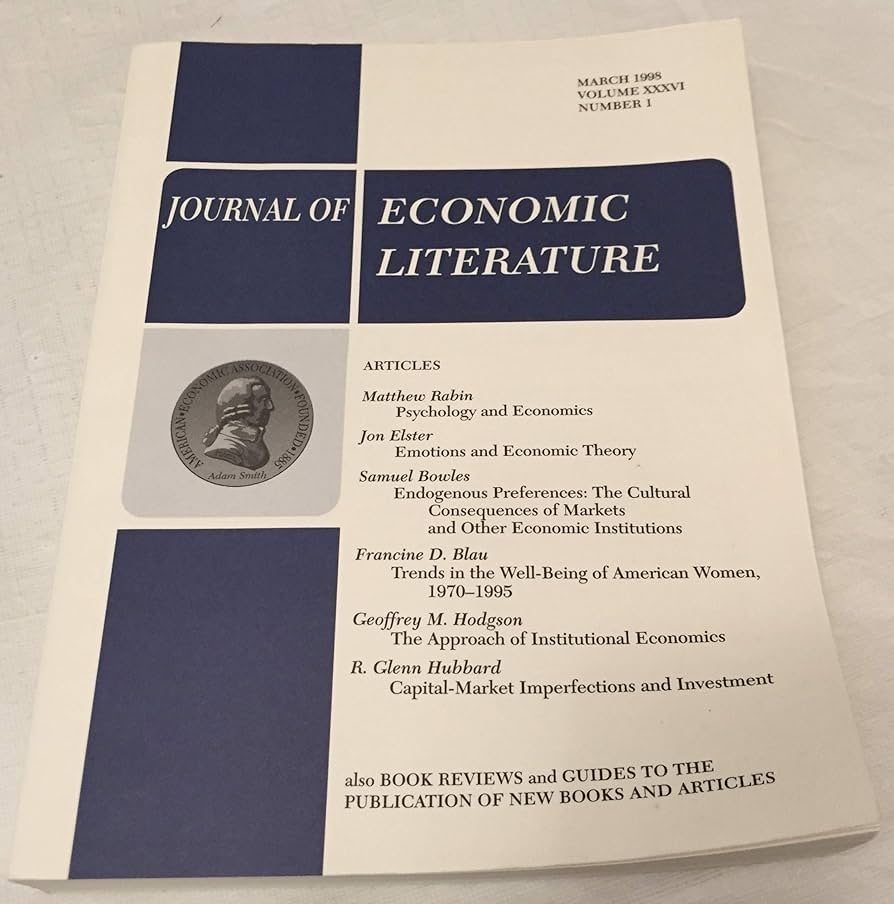
By now, I have published a fair number of papers, and one more acceptance would have close to zero marginal impact on anything that matters professionally. But getting my survey on “Deep Learning for Solving Models” accepted into the Journal of Economic Literature made me genuinely happy, for reasons that have nothing to do with my CV.
I had the misfortune of studying my undergraduate degree in economics at a quite awful institution. Two professors, David Taguas and Alfredo Arahuetes, were outstanding, and I owe them a great deal. The rest were well below any reasonable professional level, and some violated the basic standards of ethical conduct. They had no business teaching economics at any level, let alone at a university that charged tuition and claimed to prepare students for professional life.
I had to work out most of my education on my own. The surveys published in the Journal of Economic Literature were how I did it. I spent hours in the library’s reading room going through one survey after another on topics I had never been properly taught. Some helped more than others, but collectively they gave me a solid enough foundation that, when I arrived at Minnesota for my PhD, I discovered, to my considerable surprise, that I was ahead of nearly all the other first-year students, including some who held master’s degrees, despite the fact that I had finished my undergraduate degree just six weeks before. I owe the Journal of Economic Literature a debt I will never be able to repay. Publishing a survey there is the closest I can come to trying.
So, the thought that some student somewhere, working on her own in a library or on a laptop, might find my survey useful gives me tremendous satisfaction.
But there is a broader point worth making. Even in the world of AI, the profession has an important mission in making educational material widely available. Textbooks, surveys, teaching slides, these are public goods in the economist’s sense: high social value, insufficient private incentive to produce. This is also why I post all my slides and teaching material online:
https://t.co/jcFH9WK9Qu
We do not reward these activities nearly enough, and their supply is well below what any reasonable social planner would choose. I do not have a good proposal for changing this, and I would welcome suggestions.
What I do find heartbreaking is that many of the great economists of the past couple of generations never wrote textbooks on their areas of expertise. I do not mean this as criticism. All of them maximize, and perhaps they all suffer from the same bias I suffer from: the belief that one can always do it next year. But I often think about the hours of pure intellectual pleasure I would have had reading “Time Series Econometrics: An Advanced Textbook” by Chris Sims or “Methods in Structural Estimation” by Pat Bajari. Those books do not exist. They should.
não é só a extrema-direita que propaga fake news
“enquanto protege as despesas financeiras, especialmente o pagamento de juros que beneficiam os grandes rentistas”
Census tracts that received a Starbucks saw an increase in the number of startups of 9.1% to 18% (or 2.9 to 5.7 firms) per year over 7 years.
A @Starbucks and @MagicJohnson collaboration for underprivileged neighborhoods produced even larger effects.
https://t.co/fthI90rGkK
É isso mesmo que você está vendo. Guardando R$ 341,29 por mês, você terá uma aposentadoria de 20 anos, recebendo R$ 5.000 diretamente do Tesouro Nacional, corrigidos pela inflação.
Previdência privada? Não, Tesouro Renda+. Sem depender de banco algum pra fazer uma previdência.
A curious fact about how Claudia Goldin helped change taxation in Brazil
Between 2018 and 2019, my team and I delved into Professor Claudia Goldin's texts to understand how motherhood was related to the wage gap between men and women (the gender pay gap)
[1/4]
Historically, much of the gender gap in earnings could be explained by differences in education and occupational choices. However, this year’s economic sciences laureate Claudia Goldin has shown that the bulk of this earnings difference is now between men and women in the same occupation, and that it largely arises with the birth of the first child.
#NobelPrize
This morning, the Bureau of Economic Analysis (BEA) released its latest benchmark revisions for the national income and product accounts. 🧵on the work that goes into BEA's efforts to measure the economy: 1/14
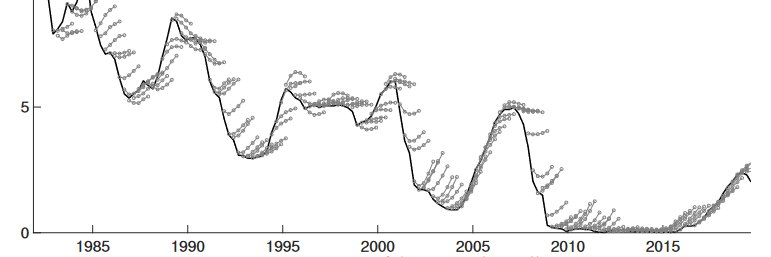
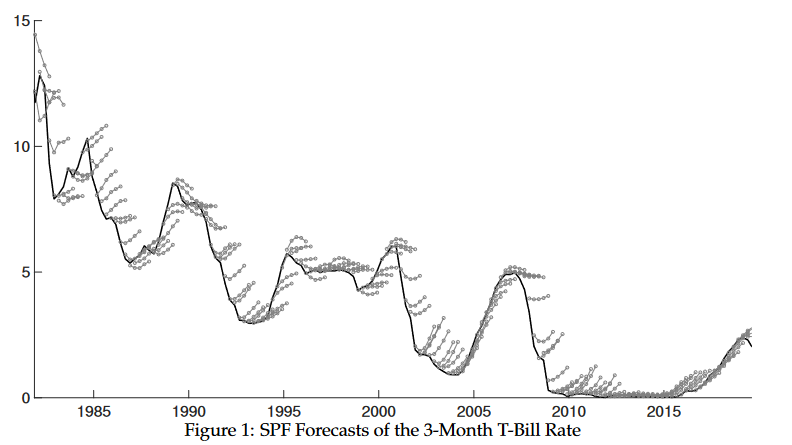
@BernardoGmrs Esse é um dos meus gráficos favoritos. Ele contrasta as previsões de mercados para a taxa de juros dos EUA (3-Month T-Bill Rate) e o valor de fato. 2/3
@BernardoGmrs Excelente artigo. O desafio de prever o PIB, a inflação e os juros é enorme. Economistas trabalham há décadas para aperfeiçoar as previsões, mas ainda tem muito para melhorar. 1/3
@BernardoGmrs Esse é um dos meus gráficos favoritos. Ele contrasta as previsões de mercados para a taxa de juros dos EUA (3-Month T-Bill Rate) e o valor de fato. 2/3
Primeiras impressões sobre a PLOA 2024:
- O crescimento estimado de receita administrada é de 19%, com inflação esperada de 3,3% e PIB +2,3%, algo nunca antes visto. A arrecadação cresceria 1,5 p.p. do PIB , um enorme desafio que pode ter impacto negativo na economia, principalmente investimento.
- Crescimento total das despesas de R$134 bilhões, +6,5% nominal, ou cerca de 3% real, já ficaria acima do limite do arcabouço de 2,5%.
- Reajuste do salário mínimo anunciado em 7,7% mas crescimento esperado da previdência é de apenas 5,3%. 🤔
-Orçamento do BF não será corrigido, mas o BPC terá alta de 11% e o abono +9%. Uma consolidação e otimização de programas sociais seria muito bem vinda (só esses programas somam 3,1% do PIB)
- Nesse cenário, o déficit zero é praticamente impossível e, com muito esforço, o mais provável é termos um déficit semelhante ao de 2023, próximo de R$100 bilhões com despesas se mantendo em torno de 19% do PIB.