A lone hindu doing tapasya on the banks of river kishenganga at LoC Teetwal Kashmir today 🍁
We have named this ghat as Swami Nand lal ghat as our ancestors pre partition would take a holy dip here and then proceed to sharda temple LoC Teetwal Kashmir. He is Mahaveer Thussu a kashmiri pandit.
Jai sharda 🙏
@t_mahaveer@ReclaimTemples@punarutthana@BattaKashmiri@AdityaRajKaul
@sanatan_kannada Hang that Bolero driver. I am sure the biker took a risk here- He might have thought that he may be safer with Elephant than going under that Bolero.
@navdeepdahiya55 Can you please let us know, if this is affecting South India to some extent? From past 2-3 days we are seeing some small spells of rain in Bangalore and little heavy rain in Western Ghats of Karnataka. Thanks
@Vikrchan Seriously... Can't eat these soft idlis - vaLLe akki hittu kalasi tinda hange ansatte. So called mallige idli becomes kallu idli of it is not hot.
Idli for me is with akki thari.
@ParveenKaswan @nirman_vihar When I was 8-12 year old, we used to see vultures near our house. It's sad that their numbers are reduced drastically that they are now in a protected area. Hope the numbers increase.
India pays a premium for the privilege of not learning anything :)
Every Indian car Tata, Mahindra, Maruti, all of them has a tiny computer inside called an ECU (Engine Control Unit)
This computer decides everything - how much fuel to inject, when to shift gears, how brakes work, how the battery behaves in an EV. Think of it as the car's brain.
India makes zero of these brains for passenger cars. All of them come from foreign companies, mainly Bosch (Germany).
If you don't control the brain, you don't really control the car. Indian OEMs can't even add a simple valve to their own engine without asking Bosch for permission.
They can't change a single line of code. They are selling cars with someone else engineering inside.
This isn't really about technology being too hard. It's a business model designed to keep you dependent.
Three layers lock you in :)
First, every new car programme needs Bosch to do setup work (Rs 10-30 crore). Second, you pay full price for software Bosch already developed for Volkswagen so Bosch gets paid twice for the same work.
Third and this is the killer every time you want to change anything in the software, even something tiny, it costs around $500,000. So Indian OEMs simply stop trying to innovate. They accept whatever Bosch gives them.
The calibration trap means tuning the car's brain for Indian conditions, how should the engine behave in Ladakh cold vs Chennai heat?
Indian OEMs outsource even this to AVL in Austria. AVL reuses work they already did for European cars, charges India full price, and transfers zero knowledge. So Indian engineers never even learn how their own cars work from the inside.
What Korea did is Hyundai faced the exact same situation in 1987. They set up Kefico as a joint venture with Bosch, learned everything from the inside, and by 2015 they owned the full technology themselves.
The sequence was simple - first learn calibration (tuning) → then write your own software → then build your own hardware. It's a ladder. India never climbed the first rung.
Why India didn't do this - It's not a talent problem Indian engineers design ECUs at Bosch offices worldwide.
It's a combination of things like Indian OEMs won't fund Indian startups to develop alternatives. They demand that Indian suppliers first prove themselves in Europe before getting a chance at home (while European companies protect their own).
Middle managers won't risk their careers backing a Pune startup when they can safely pick Bosch. India spends 0.64% of GDP on R&D vs Korea's 4.9%. Private sector funds only 36% of India's R&D, in Korea it's 79%.
SEDEMAC - the one exception - One Indian company (IIT Bombay founders, Pune-based) actually makes ECUs for two-wheelers and generators. They have real IP, real patents, millions of units shipped.
But even they couldn't break into passenger cars. Tata Motors is literally in the same city and doesn't use them.
EVs are simpler to control than petrol/diesel engines. This should have been India's fresh start. Instead, Mahindra's new EV platform has Bosch (Germany), Valeo (France), BYD (China), Mobileye (Israel), Continental (Germany) - zero Indian ECUs.
The dependency just migrated from ICE to EV with different foreign names.
https://t.co/WWAQF0P5uR
Hidden in Chikkapete, Bengaluru, lies a lodge and shopping complex built in 1909.
Very few know that this bustling spot was once Shahaji’s palace: Gauri Vilas, where young Shivaji spent his early childhood.
@Ayudhika1310 What a surprise, never knew this. I have visited this place many times, there's a cloth store called Kanakambal inside where we have been buying since 25-30 years.
Govt should do something to preserve such places.
@DriveSmart_IN@3rdEyeDude One of my relatives in car was hit by a 2 wheeler. The bike was gone completely. Biker tried to play local person victim card, but everybody around reminded him about his fault. Later my relative gave a written complaint at nearest station just to be safe.
@priyathedentico From when did Odisha move to Africa? Not sure why the map in this video shows Odisha in Africa. Can the content creator check for it? Check the screenshot from the video.
Why do atomic clocks fail in space? Let me tell you how an atomic clock works.
Very recently India lost IRNSS-1F's atomic clocks. Not 1 clock, all redundant clocks stopped working. Today India has only 3 active positioning satellites in space. In-sufficient to trilaterate position on ground.
Clocks are very important because, to put it simply, we use the speed of light to calculate our distance from multiple known satellites. Speed of light is 3*10^8 m/s , so if we need an accuracy of 1m we would need clocks of the accuracy 1/c seconds. Order of nano/pico seconds.
Atomic clocks are no different from ordinary clocks. Any ordinary digital clock has a quartz crystal ( or a turning fork ) which oscillates at a specific frequency. Most watches have it at 32768 times/second. 32khz. Why? It's a power of 2. 2^15 to be precise.
We use piezeo electric effect to turn this osscillation into a voltage signal and this signal of 2^15 hz when passed through a series of flip-flops can give us a 1hz signal. Very simple circut. This 1hz signal is used to drive the stepper motor and then gears and then hands. This is how a normal clock works.
But the problem here is the oscillation is damped. Friction stops the oscillator and so we need active resonant feedback to oscillator to keep it's motion. That is where we use electronic feedback to keep the osciallations going. This is like a drummer...doing a continuous note and when he sleeps we zap him with electricity.
Now in this process over time, the osciallator due to mechanical wear and tear, temperature, aging shows a drift. In general watches there is no absolute reference to correct this drift. Usually in hand held watches this may be 1sec a day. If we loose one second in GPS, it will put as 300,000 km way from where we are. This is where atomic clocks come into play.
Atomic clock Feedback mechanism
==================
=> We still have a local oscillator (quartz or microwave).
=>This oscillator drives atoms (e.g. cesium/rubidium
=>These atoms inherently have specific states, which can be achieved through a specific frequency radiation. We generate that radiation using the osciallator frequency.
=>You measure how well the oscillator frequency matches the atomic transition
=>A feedback loop continuously corrects the oscillator to maximize atomic resonance.
With drummer analogy, the drummer is now not alone. There is a specific metronome playing in the background and drummers beats are always synced to that.
Dealing with drastic thermal cycles, radiation and extreme aging. This is where most of the potential issues arise. The rubidum lamps are extremely precise machines working hard every second to maintain osciallation & excitation of the entire system. When these fail, an entire satellite fails.
India has been working on indegenious atomic clocks, that coupled with terrestrial /alternative PNT sources. A very focused effort is 100% needed in this area.
@RohitInExile@hamsanandi I do not know what else to say, but I pray to God that you get back your house. I wish to see your mother once again walking in the house.
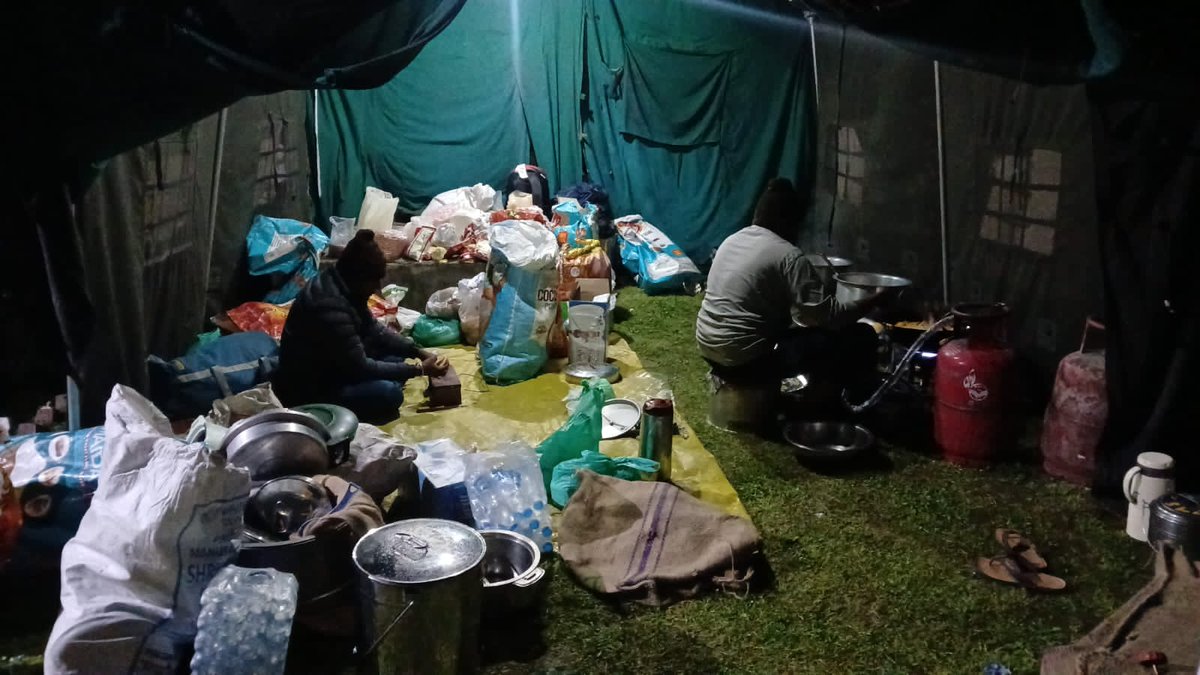
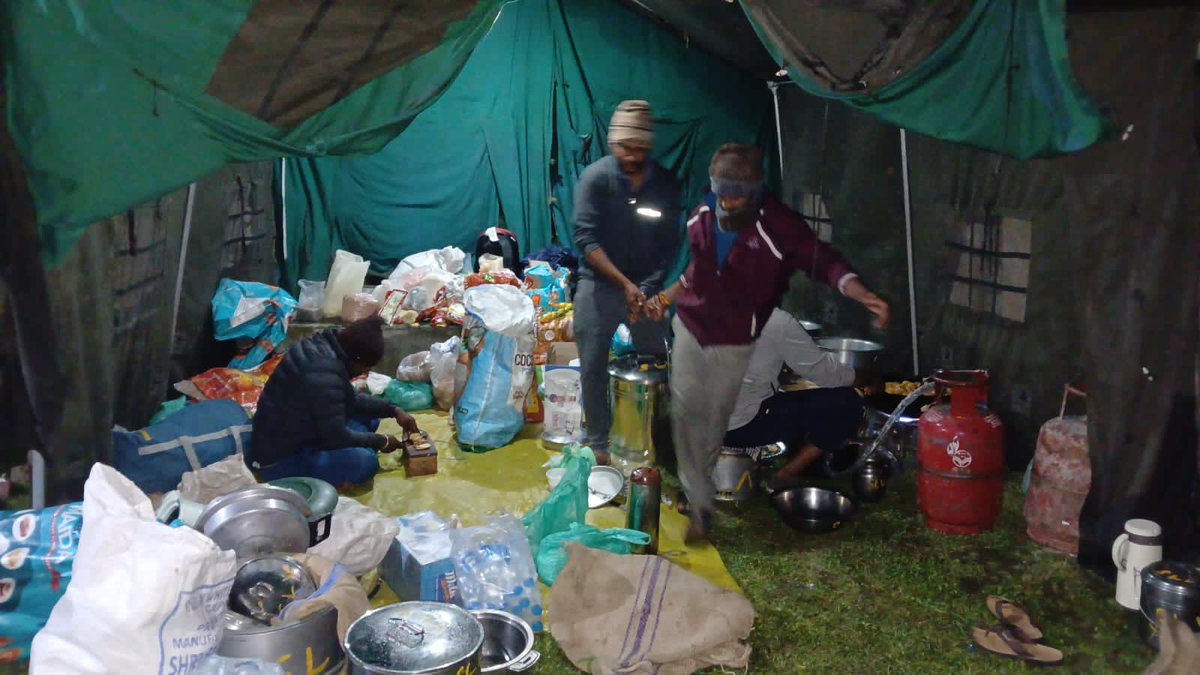
53 yatris of sharda temple LoC Teetwal Kashmir helped out after hectic efforts of 4 hours in fresh overnight snowfall at sadhna pass just now. All Bangalore yatris are through now.
Drivers are advised not to move without tyre chains and Teetwal drivers/ vehicles be preferred. Thanks to @adgpi , district administration and our coordinator Ajaz Khan. Jai sharda 🙏