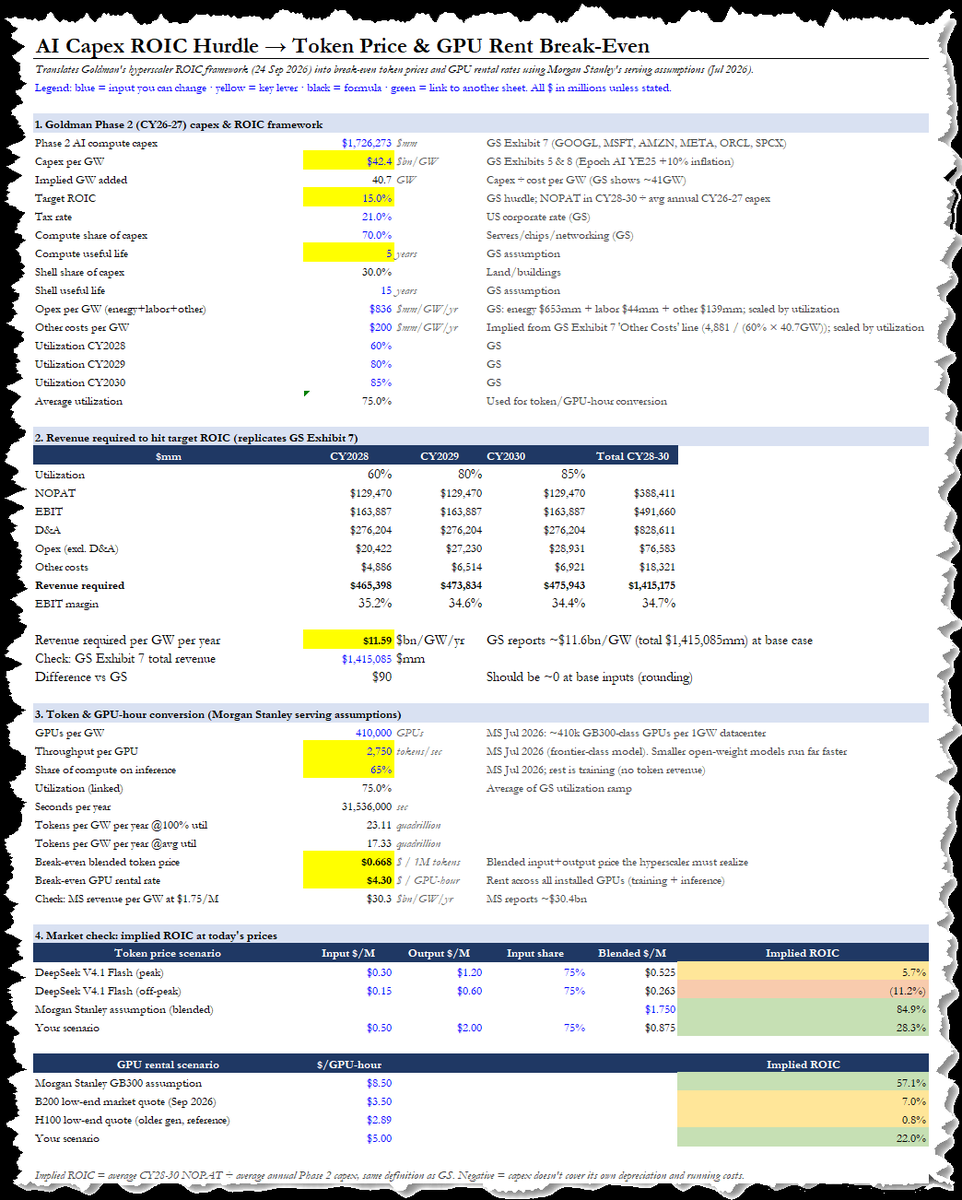
Spending on AI infrastructure is projected to average 3.6% of US GDP in the coming years.
That would represent a higher share of the economy than the investment in Canals (1836-41), Railroads (1870-90) and Electrification (1905-25) ... Combined.
Where does money invested into the AI buildout actually go?
For every $100 flowing into the supply chain:
- $50 to chips
- $20 to power
- $15 to networking
- $15 to cooling, buildings, and land
More charts in State of Markets II: https://t.co/MTaxKUxa2w
At 27, Stan Druckenmiller was running $6 billion for a Pittsburgh bank, earning $43,000 a year and worth about $4,000.
In 1981 he started his own fund. Two years later his backer was in jail and the firm was losing $90,000 a year.
"I wasn't a genius, I just didn't know any better."
At the bank he had no experience whatsoever, so he put everything into oil and defense stocks. Then the Shah of Iran fell, the bet took off, and everyone called him a genius.
"If I had been a little older, a little wiser, I would have diversified."
Then a dinner in New York. A man told him he didn't sound like a banker and should start a firm. "With what? I'm worth about four grand."
The man offered to pay him just to talk. It still took a year and a half to raise $900,000.
Then the man went to jail over a scheme that cost Chase Bank $256 million, and Druckenmiller was left with $7 million at a 1% fee.
"I had $70,000 a year in revenues and my overhead was $160,000."
"That's how it started."
By 2010: $12 billion under management. 30.4% a year for 30 years. Zero losing years.
What he says actually made the money: most managers earn 70 to 80% of a year's gains on two or three ideas, while holding 30 or 40.
"The present is already in the price." So he looks 18 to 24 months ahead.
"My first boss used to say the obvious is obviously wrong."
Save this and watch the clip tonight, when you have time to actually sit with it.
The red flags for risk are piling up:
- Weak NFP and yields reverse up
- Huge EU SPR release absorbed by oil price
- Increased awareness of labour and permit limitations to '27E DC buildout
- AI power users with sideways bills since August (cf Ramp) as possible harbinger for broader AI spend, at least next 1-2 quarters. Spend not token/adoption!
- No Iran resolution in sight
- Sept best month of the year for Momo = last pillar of market strength now very crowded
- EURUSD major breakdown
- CCC spreads blowing out
The ingredients for a major pre-Midterm sell are in place. As always, it is all about probabilities and something entire different may happen
Warren Buffett put five billion dollars into Bank of America after a call center refused to transfer him to the CEO.
Brian Moynihan tells it plainly: Buffett got into the phones first and asked to speak to him. They do not send everybody through. Berkshire's CFO found a banker who knew the right people inside BofA. That's how the line opened.
Buffett got Moynihan on the phone and said he wanted to invest. Moynihan told him the bank didn't need the capital. Buffett said that's exactly why he was calling.
They spoke for the first time in Moynihan's life on a Monday at eleven. The agreement was signed Tuesday by eight or nine in the morning. The money was in by Thursday.
That was August 2011. The U.S. had just lost its AAA rating. Mortgage lawsuits from Countrywide and Merrill were stacking up against the bank. The stock had been cut in half that year, down to $7. Regulators were watching capital levels closely.
Buffett got terms nobody else could get: preferred shares paying 6%, plus warrants to buy 700 million shares at $7.14. Berkshire exercised those warrants years later and turned the position into more than triple the initial stake.
Here is the part that matters more than the phone call. Moynihan said it himself: a common shareholder who bought Bank of America stock that same day would have done just as well as Buffett did. Same stock surge, same recovery. The only thing Buffett had that the shareholder didn't was the courage to write five billion dollars into a bank everyone else was fleeing, at the exact moment the headlines were worst.
The deal wasn't the edge. The willingness to act while afraid was.
The tape is free to bookmark and watch.
This is to my point about compression being inevitable as human knowledge is too small for what we are building. As well, humans are too redundant in their wants needs and questions.
AI-generated content will clearly contain propagation errors just like human history of knowledge does. Only LLMs will iterate those propagation errors infinitely faster with less ability to self- correct, for want of understanding.
This gets to Ballard’s test. LLMs cannot attain understanding (AGI) as understanding cannot exist unless reason first exists without language. A likely impossibility for a language model.
Research on this is already focused on getting around this in some way. Though many also have not yet conceded the point.
Warren Buffett's sister owned roughly $12M of Berkshire stock.
After Black Monday, she owed $2M.
Doris needed income. The shares paid no dividend.
A broker suggested uncovered put options. She collected premiums for promising to buy stocks if prices fell.
Then the Dow dropped 22.6% in one session.
The positions could not be closed fast enough.
Charlie Rose asked why she had not called the world's most famous investor before entering the trade.
"I thought he'd be so disapproving."
Do not create income by taking a risk that can wipe out the capital underneath it.
Charlie Munger spent decades studying exactly why smart people still make decisions like this.
The article below organizes Munger's 25 Rules for Avoiding Costly Decisions into a practical checklist.
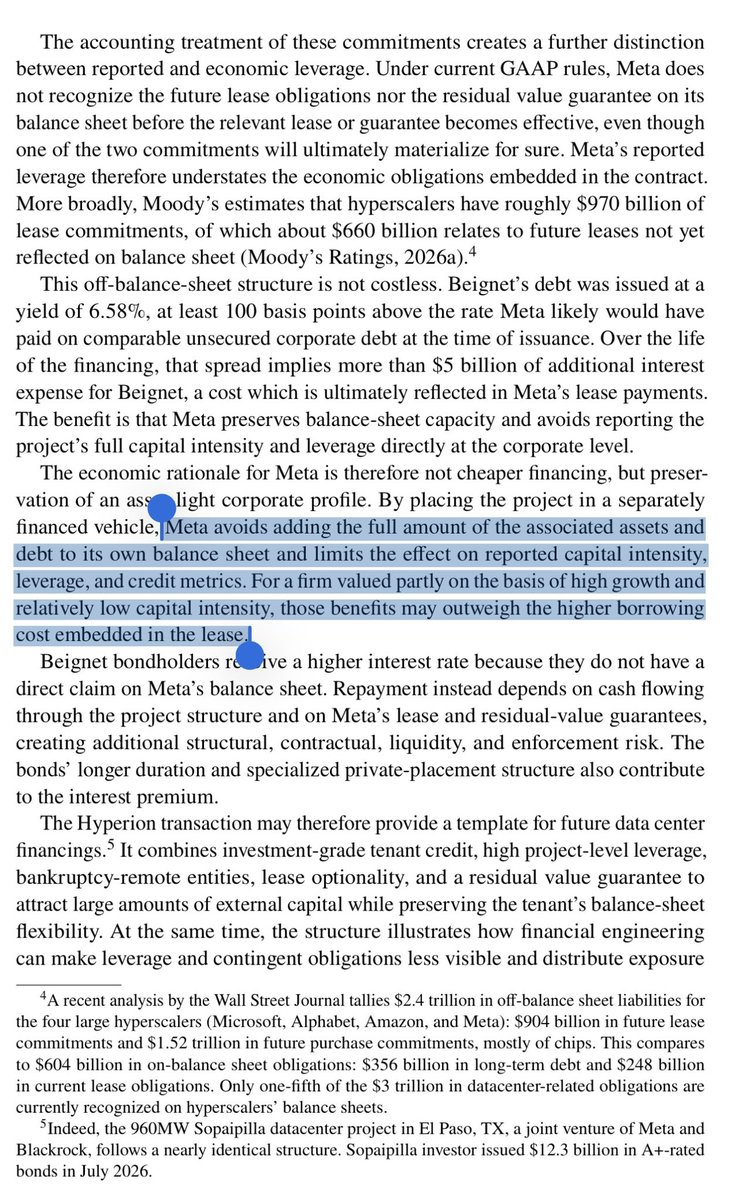
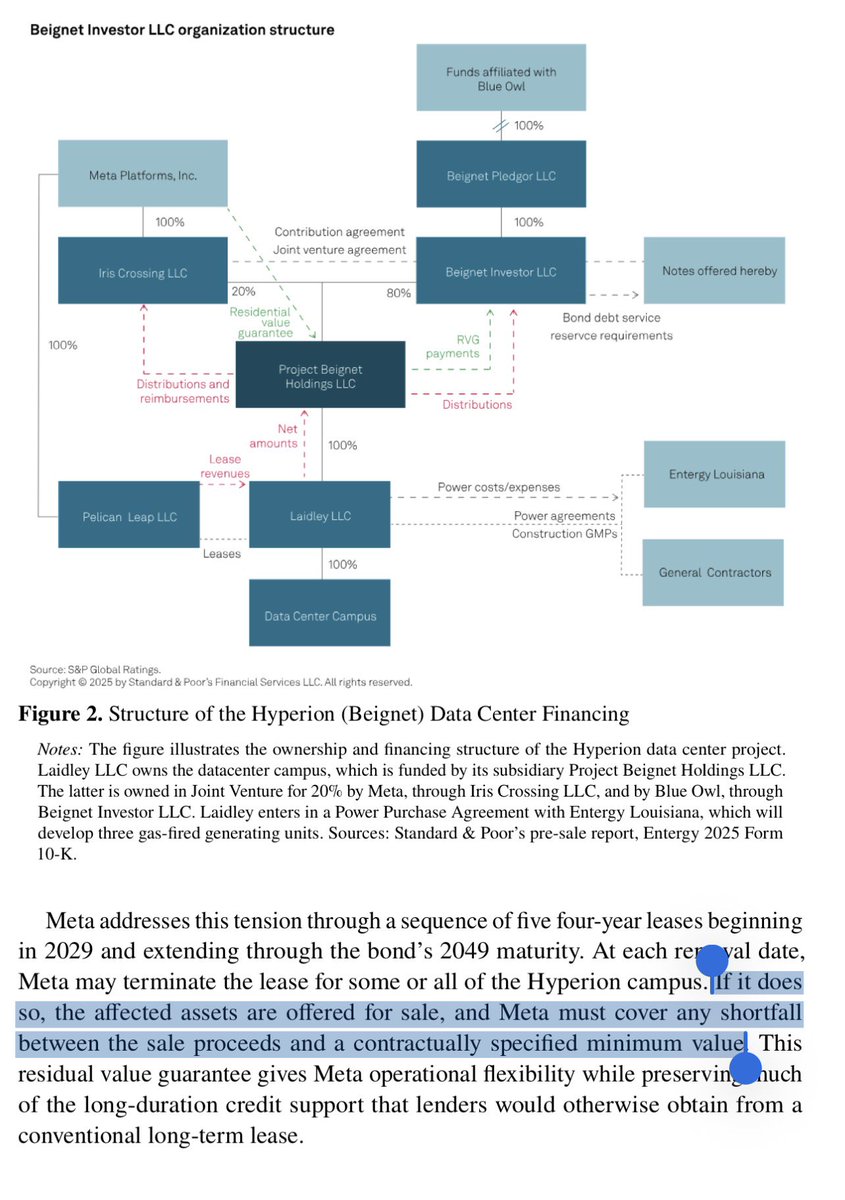
This is a very good and clear writeup on datacenter finance. Can someone explain to me in an EMH-compatible way why it’s worth $META paying *more* in interest just in order to nominally remain an “asset-light” business?
Warren Buffett told Jamie Dimon: "you can report any number you want in an insurance company for a while... if you tell me I'm gonna be shot unless I come up with earnings of X carried out to eight decimal places... believe me, I can come up with that"
this is him explaining the one phone call Dimon says can add $100 million of revenue, what happens to managements he'd trust with his own daughter once they start promising numbers, and which of the two hates Bitcoin more
"...making a phone call and do some swaps and add 100 million dollars of revenue"
" I'd be glad if they married my daughter... and when they find they can't make the numbers, sometimes they make up numbers"
bookmark & watch it – then read the article below ↓
The new Copilot is Microsoft’s bet that the AI race is moving from models to products.
It doesn’t need to own the best model if Copilot can choose among them and keep the customer inside Microsoft.
The potential secret weapon is Autopilot (what I’ve been calling Muse for Business). It knows your workflows, sits across the apps and data you already use, and keeps working even when you step away.
It’s a preview of the battle to come in enterprise AI. OpenAI and Anthropic are racing from models into products. Can they build their own version of this? And can they match Microsoft on the boring-but-critical stuff: permissions, identity, auditability and control, as agents become more autonomous?
My full conversation with @satyanadella. We also talk open vs. closed models, US-China Summit, regulation and the infrastructure buildout.
00:00 Microsoft’s new Copilot
02:02 Why not just give us Autopilot?
05:18 Who pays for always-on AI?
08:06 Copilot picks the model
10:27 Chinese models and OpenAI’s lead
12:04 Competing with OpenAI and Anthropic
13:17 US–China AI talks
16:11 Does AI need new rules?
18:05 The data center backlash
20:40 Is AI being overbuilt?
23:44 Keeping humans in control
We’re building Copilot as a new OS for work that spans every model, every form factor, and every task. Today, we’re announcing our biggest update to Copilot to date, bringing four things together:
· Autopilot: proactive and long-running agent built for the enterprise
· Code: build apps with Copilot, hosted inside your company’s tenant
· Home: Chat + Cowork together
· Office: now fully embedded in Copilot (and Copilot embedded in Office, of course!)
Plus, you can invoke Copilot in Teams, and we’re introducing Today, a proactive experience that surfaces the most important information from across M365 without needing to ask for it.
The way we work is changing and so are our workflows. This update brings AI into that flow, from answering a question, to building an app, to getting work done on your behalf.
How do companies act when they are being existentially threatened by new technology?
There’s a big difference between a stock worth buying and a stock worth owning, and we’re undoubtedly going to see a lot of the former in AI disrupted companies…but it’s more difficult to determine which names fall in the latter.
When we look at the recent past for example, we see something of a gradual cycle in which it “becomes obvious” a company has been disrupted, everyone sells. Then that overextends the stock to the downside relative to current fundamentals (or relative to headlines announcing the companies are taking measures to adapt), at which point dip buyers come in.
In the examples of real disruption, it corrects back to a trend, but the cycle restates itself and the trend proves to be a downward one on a long enough timeframe (downward can also simply be massively underperforming the index by going sideways for a decade).
The insidious nature of these names is that technological disruption manifests first as multiple compression, current earnings tend to look reassuring and near-term analyst expectations tend to overestimate the impact (and under-estimate in the long term). This results in better than expected results that can mask the competitive damage.
These rebounds don’t actually prove the preceding selloff overshot fair value, and the rally tends to be overly optimistic on what future life should be assigned to today’s profits.
Two classic and relatively recent examples.
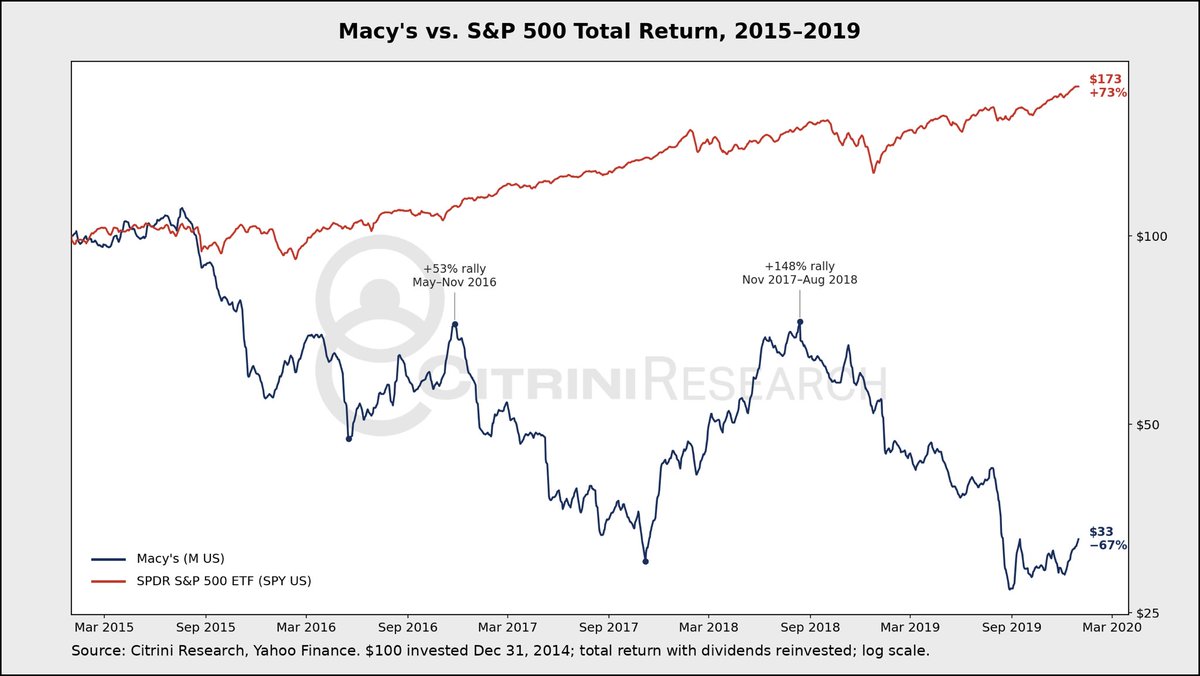
Macy’s had two of these moves. +58% in 2016 and +148% in 2018. But across 2015-2019 the shares still declined -67% compared to SPY’s +73% gain. In 2016, there were skeptics regarding the extent to which e-commerce’s growth sounded a death knell for brick and mortar - after all, malls had been a mainstay of the American town for decades. By 2019, it would be a difficult task to find an investor who owned Macy’s on the thesis that Amazon’s disruption to the company was overstated.
And it’s not like these rallies were on pure sentiment shifts. In 2018 same store sales rose 2% YoY.
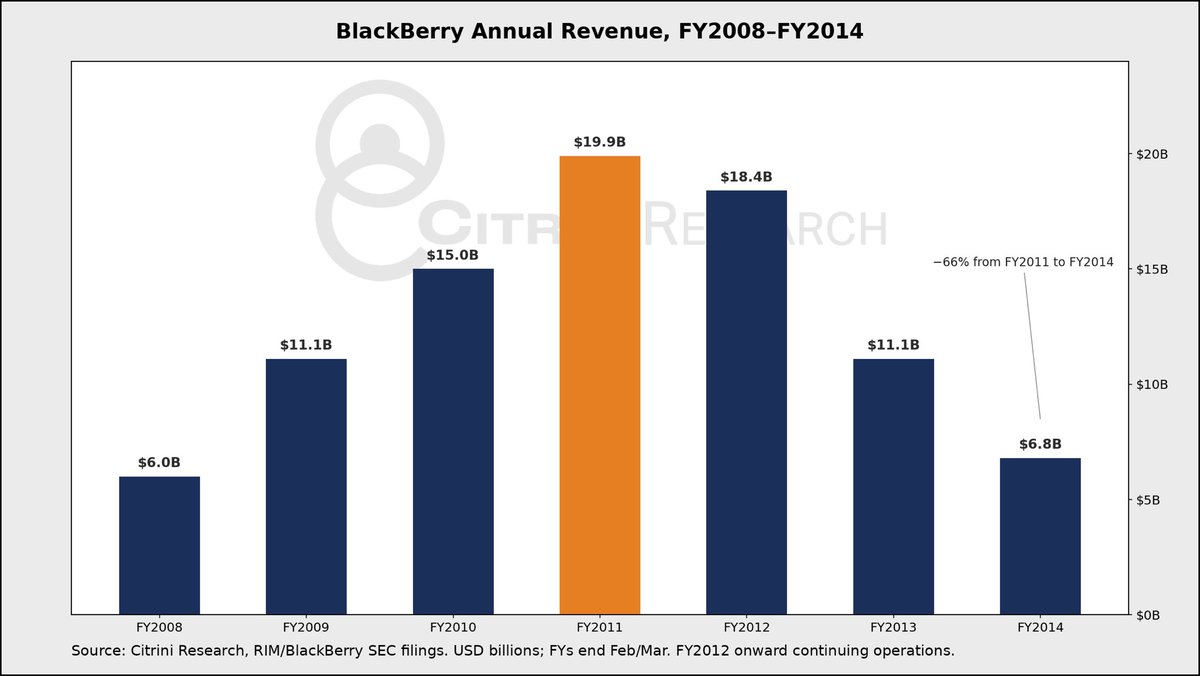
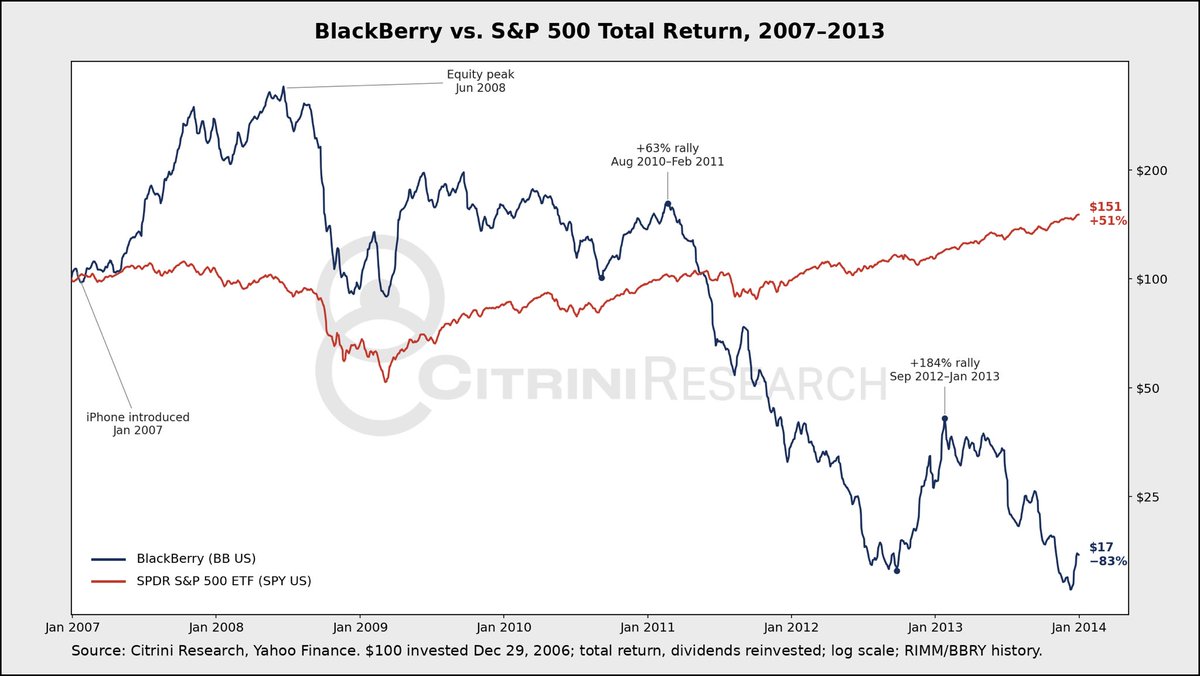
Apple unveiled the iPhone in Jan 2007, BlackBerry’s stock price peaked in 2008 but its revenue didn’t peak until 2011. And even if you shorted the revenue peak you still had to sit through a rally where it tripled on its way to declining 95% by 2013.
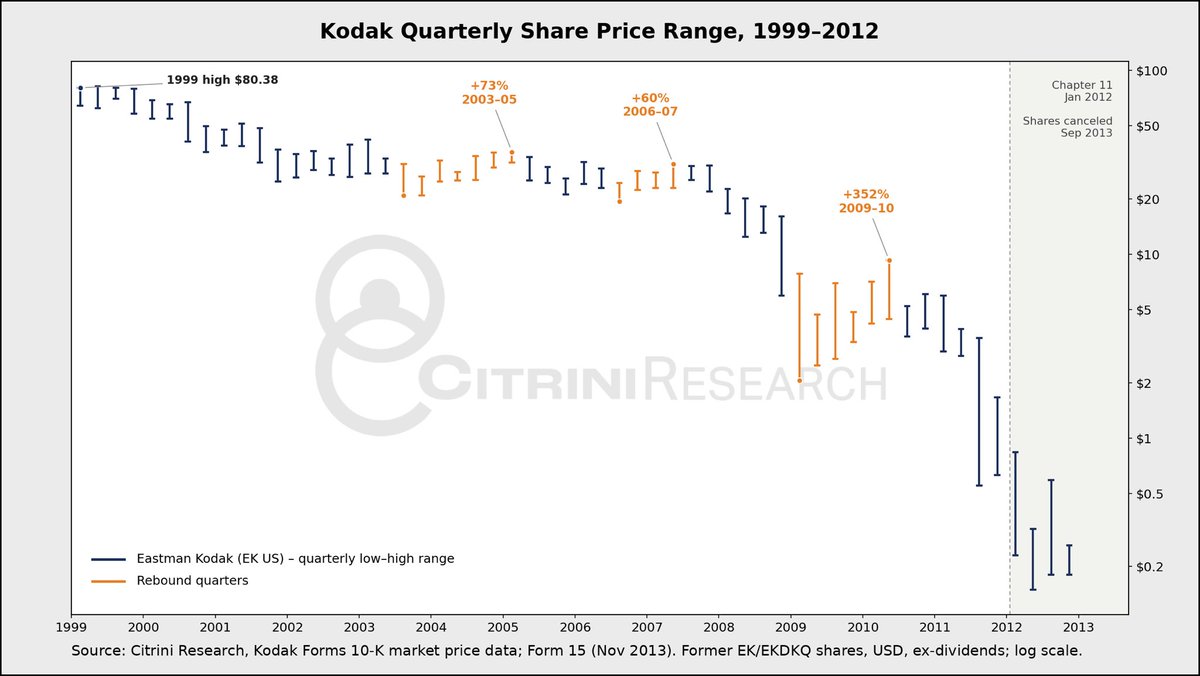
The most tricky aspect seems to be when companies present as having adapted but, for any number of reasons, can’t actually manage. Kodak, for example, had shifted mix to a majority digital (54%) by 2005. But that simply was no match for the hit to the amazing recurring revenue of the film/processing model.
Adding new technology doesn’t make up for losing the disrupted profit pool, especially when it transitions your business model to a less favorable or competitive one.
In 2010, Kodak jumped 30% on quarterly numbers signaling a turnaround on lower costs, printer sales and licensing income. They filed for Chapter 11 in 2012.
Ive been thinking about what we can we do to avoid falling into the same traps while also not being blind to the potential for real opportunities in poorly understood disruption. Hard to answer without sounding cliche or generic but…
At least for now, “having/using AI” is not a solution. That will be the default for every company on earth soon enough.
The questions that matter are more nuanced: Do customers still renew? Does pricing hold? Who owns the customer relationship? After the new costs and old cannibalization, does the new strategy/product even replace the old profits?
It’s going to be pretty difficult to differentiate the incumbents that deserve to rebound from the ones that don’t but at the very least I’m taking notes as things play out.
Ken Griffin just described the hardest part of building Citadel in 1990, and it was not capital. He was twenty one years old. Nobody with fifteen years of trading experience wanted to work for a twenty one year old kid, so he had no real choice but to build his entire firm out of college students who had never worked a desk in their life.
He says the whole focus in those early years was finding people straight off campuses who were unusually ambitious, unusually sharp, and genuinely hungry for a career in finance. Not people who already knew how to trade. People who wanted to learn it badly enough that he could teach them everything himself, from nothing, on his own terms.
I learned this same lesson the expensive way. In eighty four I paid a so called finished trader more than I paid myself that year, poached him off a bigger desk, and watched him lose more money in six months defending a position he refused to admit was wrong than the college kid I hired the same week made me in the next two years. The finished one had fifteen years of being right often enough to stop questioning himself. The kid had nothing to defend, so he just watched the tape and changed his mind the second it told him to.
Everyone wants to hire the finished product. The finished product is usually finished learning too, and by the time you find that out, you have already paid for the lesson twice, once in salary and once in the position he would not close.
So if you are hiring right now, stop reading the resume for what somebody already knows. Ask one question instead. Tell me about a time you were completely wrong, and how fast you admitted it. That answer tells you more than fifteen years on paper ever will.
susquehanna is one of the largest options market makers on earth, with $22 billion of revenue last year. in 2023 it became the first major quant firm to build a dedicated prediction markets desk. this is the trade they use to explain what it is actually for:
"tim is a rancher. he's run a goat operation out of california for a long time. tim's risk was that his wages were going to go up by 4x, which is not a sustainable thing for his business. it's either cutting some herders from your payroll, or shutting down your business."
"he chose to hedge whether or not the california state legislature was going to help him and other goat ranchers get this provision back in. if they do get it back in, then he loses the premium that he paid. but if they don't get it back in, then he gets a 10x payout on his premium, and he'll be paid half a million dollars."
"either outcome now is an outcome that is going to help him move forward with his business."
Market thoughts:
- With 10-year breaking out to new highs and its move intertwined with the Iran situation, game theory suggests that Iran now plays hardball. Every day it waits, the pressure increases on the capital-markets sensitive US
- Thus, I'd expect markets to weaken, potentially considerably, over the next few weeks towards a point of maximum pain where then some compromise is found
- I expect a compromise as Iran's advantage is only current, and increased market stress eventually also imperils its remaining trade partners (ie China)
- Once a compromise is found, a bullish period should follow as AI breakthroughs and continued deficit spend support the underlying economy
As always, keep in mind these views come with a high error rate, every day provides information that could change the outlook and something entirely different could happen
Major themes
1. SPX earnings expectations are in an epic bubble which won't deliver as there is not enough "GDP pie" and valuations are highish
2. In order to stand a chance of delivering these epic bubble like earnings massive issuance will be required to pay for capex while borrowing by the government remains high. That is a headwind on all assets and limits wealth effect consumption as well
3. Long term interest rates have V topped and fallen rapidly 6 times post COVID. This time despite suppression attempts by the administration a V top in yields is unlikely and higher for longer long term yields will over time tighten financial conditions and slow the economy
Positioning. In a bubble regime with larger tails in both directions and apparent low expected volatility supported by low realized volatility it's tempting to leverage up above your risk target in your long term long only portfolio. Do not do that. Maintain your risk target. That's my beta positioning today. At risk target in a long stocks, bonds, tips, commodities, and gold balance and diversified across dm
As for market timing alpha
I am currently running a small bet that the market climbs through 9/30 while opportunistically adding November equity puts. My delta is slightly long but will be max short by 9/30. Max short risks 4% of AUM on put premiums for a 20-25% payoff if market corrects 5-10%. I am not positioned for a crash and you shouldn't be either
STIR i am building a long in SFRH7 for two reasons. 1. A growth slowdown in Q4/Q1 for my big macro themes which may not pay as soon but is well priced if it doesnt and 2. A hedge for an equity short in case Warsh does what every central bank does which is pivot dovish on any weakness
Bonds
My central case is a drift higher in bond yields and i have a credit 1x2 in ZB which will make money in all scenarios besides a true bond puke. In such a puke my most 9/30 max short equity will work
Oil would short a rally but far away. Own a bunch in commodity beta but no alpha
Gold meh. No view here. Own 10% in beta but no alpha bet
I favor ROW equity's and bonds. I favor ROW currency markets
Always own beta but not above risk targets in this environment
There’s no way any of us can predict the impact that AI will have on companies, sectors or consumer behavior (which has been, for all of history until now, human behavior).
But to claim that it won’t have an impact and simply brush it off lacks both humility and creativity.
Tactics that worked when consumer behavior was dictated by human psychology will fall by the wayside, and those that fail to adapt will be left behind.
Every day from now on we will see new examples of areas where friction was profitable becoming cost centers for companies that don’t react in a timely enough manner.
Today you might realize just how many flight credits, loyalty points or promotional offers you’ve never used that will end up utilized by agents. What impact will that have?
Tomorrow, you might see something that makes you ask how much money health insurers make simply because people won’t sit on the phone for 5 hours trying to get coverage approved unless it’s a massive expense and/or life or death matter.
What about your savings account? That money could be in a money market fund, but you haven’t bothered to move it. How much in net interest income is made because of that friction?
The coming years will be some of the most interesting for investors who are intrigued by paradigm shifts and their ripple effects.
I, for one, could not be more excited to see how it all plays out and invest through the changes.
Consumer agent thoughts:
To start, it seems intuitive to me that Muse will be sticky for both explorative and unemotional tasks that everyone is glad to outsource
- The former include recommendations e.g. for hospitality, travel etc supported by Reels
- The latter includes price comparison and contract optimisation for utilities, insurance, telcos. Finding best offers for flights
All this likely comes at the expense of:
- Biz with high inertia margin
- Consumer discovery and comparison biz
- Frontier consumer traffic ("where is the best bakery in Memphis" moves from chatgpt to Muse)
- Consumer ad biz