Founder-engineer building companies, not just features. Health, AI, SaaS, Growth, IoT. From idea → product → scale. Building, launching, iterating. Ships daily
Thanks Google, Embedding Gemma 2 is a big deal 🫶
Multimodal embeddings (text, images, video, audio) can run on-device in the browser. No server, no API key, ~20–70 ms per query on WebGPU. Everything stays on your machine (ofc).
Now go build (new) things with it 🚀
"Most people aren't looking to save time, they're looking for ways to spend their time."
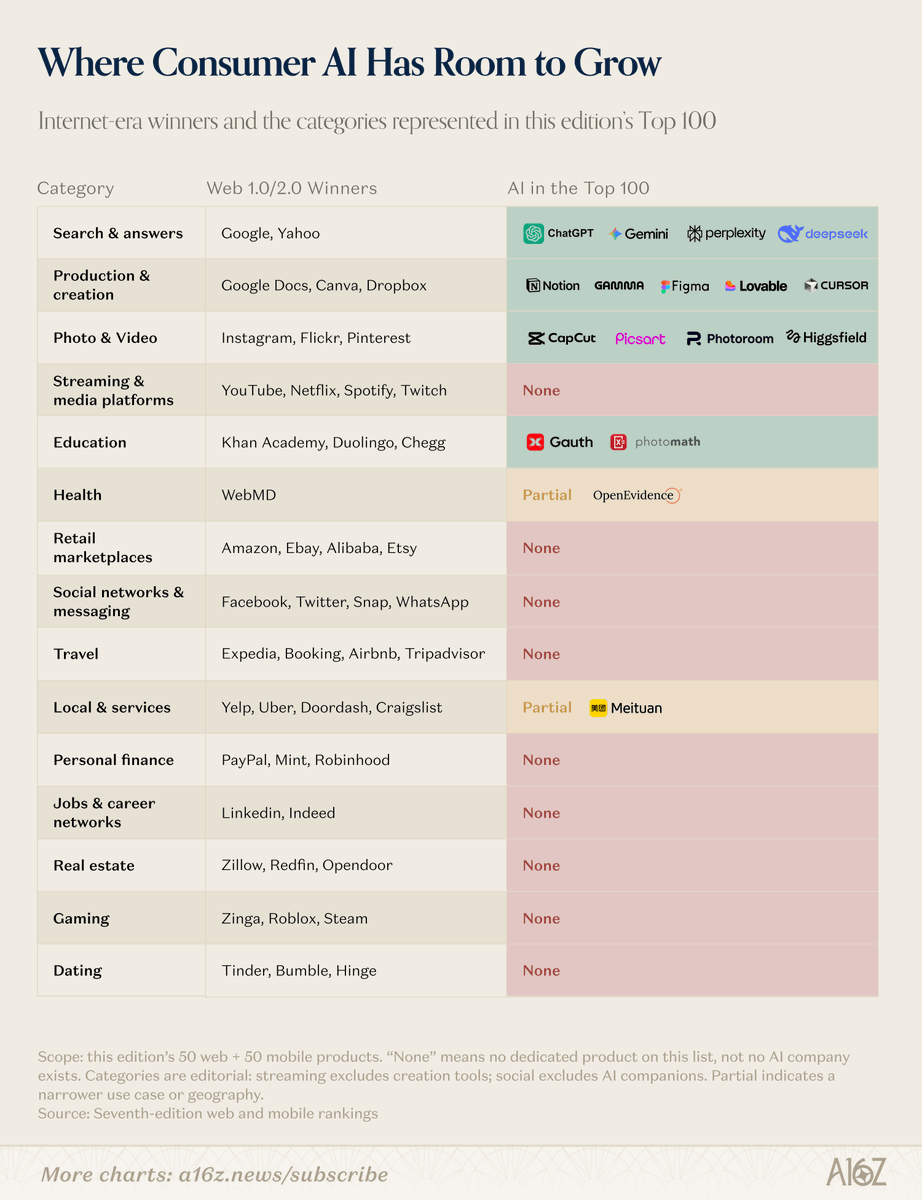
9 of 15 consumer internet categories have zero AI products in the Top 100. These built some of the biggest companies of the last two eras:
- Streaming
- Social
- Dating
- Gaming
- Travel
- Retail
- Finance
- Real estate
- Jobs
More charts in our Top 100 Consumer AI Apps breakdown: https://t.co/J9edFBQvCN
Big day 🔥
🚀 Introducing Dolphin AI - an agentic AI studio for complete video production.
The story of Dolphin is very interesting.
It didn’t start as a product. It started as an internal tool.
We started with one question:
Why does AI video still struggle the moment you ask it to remember what happened before?
The real problem was CONTEXT.
Characters change. Faces drift. Locations and props lose consistency.
So we started building video differently, around three ideas: better context, multi-shot generation and stitched workflows.
Before opening Dolphin AI to the world, 45k+ videos were created through it in our test phase
And we saw the impact firsthand:
→ Better CTR and CTI on ad creatives
→ Higher engagement and retention across micro-drama and micro-learning
→ Faster creative experimentation and iteration
We started operating at a very different scale:
Story TV : : 5,000+ dramas. From 100 dramas a month to 250+ now.
Master: 20,000+ micro learning series.
Ad creatives: From 15K to 100K+ every month.
That gave us conviction that the answer isn’t another model. It’s a better creative system.
For someone starting out, Dolphin has 120+ templates for UGC, social and other use cases.
For creative professionals, our Playground feature brings models, generation and editing into one workspace.
And for longer-form storytelling, World Lock carries characters, voices, wardrobes, props, locations and the visual world across shots.
The system remembers, so the creator can focus on creating.
But our ambition with Dolphin is much bigger than the product...
India is already one of the world’s largest consumers of content.
We believe AI can help us become one of its largest creators and exporters 🇮🇳
We have the storytellers. We have the ideas. AI can give that creativity production scale.
@trydolphinai is our bet on that future 🇮🇳🐬
We are live today at trydolphin(dot)ai for early access
Join the waitlist or DM me for an invite code.
Back to shipping 🚀
Introducing Griffin, the first model to pass the video Turing test.
48% of people who talked to it live thought it was a real human. Previous systems have had a pass rate <3%. It is #1 on NVIDIA's benchmark for full-duplex AI video.
It’s the first Human Interaction Model (HIM).
Monetization of software is dead now.
Anyone can clone your app in few hours, copy your ads, ditto your positioning.
I see a new opportunity now.
Monetization of SLMs (small language models)
You can fine-tune 0.5B to 12B models for specific use cases.
Then sell licenses to these models like you do for SaaS.
Models like Deepseek v4 pro, GLM 5.3, Kimi k3 or even GPT 6 Astra are really smart at understanding fine tuning jobs.
From preparing the dataset, LoRA adapter, to exporting the model as GGUF or MLX, these models can do end-to-end jobs for you.
I've fine-tuned 20+ models in last pne year and I'm surprised that not many people on X talk about this.
A fine-tuned SLM can beat a SoTA model on specific use cases.
That can drop API costs by 95%, make it 5x faster, and its your model, hosted privately.
Custom SLM > SaaS now. Dive into this space.
Recently watched this clip on India's medical tourism boom, and it got me thinking about what's still missing.
So I did some quick online research.
Our cost advantage over the West is enormous, on almost every procedure. Yet we rank only 10th globally. Behind Thailand, Turkey, Malaysia & Singapore.
Because this business isn't won on price alone. It's won on trust. And trust is built in small moments: the airport, the taxi, the ward, the food, the speed of service, the warmth of the welcome & the goodbye.
One bad link & the price advantage stops mattering.
Hotels worked this out long ago. They map the whole journey & find the 'moments of truth' that make or break confidence.
And to help manage those moments, in medical tourism we will have to create a concierge layer that turns a hospital visit into a seamless journey, from arrival to departure.
As for expanding locations, Goa & Vizag have the flights & the hospitality infrastructure. Bring in the hospitals & specialists & they could be next.
The emerging super-cities like Amravati & GIFT City should plan for health districts now. But frankly, doctors don't follow master plans, they follow medical colleges. That takes 15 years, not 5.
India's medical tourism market is set to nearly double by 2030. I think that is inevitable. This is going to be a significant growth opportunity for our economy.
However, I believe the real question is simpler: do we just want to be the world's cheapest, or the place people trust to deliver an overall seamless experience?
That's going to be hard work to accomplish.
It's going to be absolutely essential to do that work, because what we're actually selling is not only procedures, but peace of mind while fixing the body.
Anthropic’s Economics team is sharing a new model of how AI might affect economic growth, jobs, wages, and more by 2030.
Explore the scenarios, tell us what you think will happen, and see how your answers compare to more than 10,000 Americans. https://t.co/AvQlEZNxR0
Every Indian should know this one, and here is why.
Five students from IIT Madras just got a patent granted by the toughest patent office in the world. :)
Now here is what they actually invented.
See, satellites look at Earth two ways.
The first is a normal camera, just a very good one.
Sharp, full colour, easy to read. The catch is it needs sunlight and clear sky. Clouds block it. Night blocks it. Smoke blocks it.
Over India during the monsoon, it is basically blind for months.
The second is radar.
It fires radio waves at the ground and reads the echo. Radio waves pass straight through cloud, smoke and darkness, so radar works at 3 am in heavy rain.
But the picture it gives you is grey and strange. It shows shape and texture, not colour. Reading it takes a lot of training.
So one gives you a beautiful image you often cannot capture. The other gives you an image you can always capture but struggle to understand.
The fix obviously is to combine them.
People tried for years and it did not work well, for a simple reason.
The two images came from different satellites. The camera photographed a field at 10 in the morning from one angle. The radar satellite scanned it at 4 in the afternoon from a different angle. Lay one over the other and nothing lines up.
Different time, different position, different view. You are not looking at the same moment.
GalaxEye's patent covers a way to put both sensors on one satellite and make them fire together. Same instant, same patch of ground, same angle.
The invention is the architecture that keeps the two locked in.
The same technology was already patented in India. Now the US has recognised it too. The company says this makes it the first Indian startup to hold a US patent for satellite imaging technology.
Obviously there are plenty of applications for that technology like defence radars to see through camouflage and tree cover.
In farming, the technology will allow us to watch crops during monsoon, exactly when normal satellites cannot see.
Interestingly, the idea came from a real problem. Suyash Singh was assessing wildfire damage in California using satellite data.
The camera images were useless because of the smoke. The radar images were available but were hard to interpret.
Now you understand why the solution is simply genius. :)
GalaxEye was founded in 2021 by five IIT Madras alumni. Suyash Singh, Denil Chawda, Kishan Thakkar, Pranit Mehta and Rakshit Bhatt.
They met while building Team Avishkar Hyperloop.
In 2019 that team was the only Asian entry to reach the finals of SpaceX's global hyperloop competition. They built India's first self propelled hyperloop pod.
Then they decided to build satellites instead. Incubated at IIT Madras, based in Bengaluru, backed by Mela Ventures, Speciale Invest, ideaForge and Rainmatter.
On 3 May this year they launched Mission Drishti on a Falcon 9. The world's first OptoSAR satellite. At around 190 kg it was India's largest privately built Earth observation satellite at the time.
So, five people who were students seven years ago had an original idea, patented it in India, built the hardware, flew it on a Falcon 9 and then got the invention recognised by the US patent office.
Amazing! 🇮🇳
I wrote about the state of AI, why I’m concerned about the next few years, and the choices we need to make to keep the future in humanity’s hands.
An Alien Mind: https://t.co/FeIfWNe0UE
The window to patch software bugs is collapsing
Of the bugs hackers actually exploit, ~87% are now being attacked on or before the day the bug is public knowledge
That share was 23% in 2020
Charts of the Week: https://t.co/RfYfzHpbLI
A random VC office:
Founder: Hi, I have a startup idea.
VC: Take a number. You're 435th in line.
Founder: How long is the wait?
VC: Five hours, maybe six.
Founder: Oh. It's an AI security startup.
VC: Why didn't you say so?? Come in, come in.
Founder: I don't feel great skipping all these people...
VC: They're building agents for dentists. Sit. $20M?
Founder: You don't want to hear the idea first?
VC: Fair point. $50M.
Founder: I was thinking, AI models... for cyber?
VC: $100M. No, $200M.
Founder: Honestly I'm not sure what we'd actually do in the field. I might not need that much.
VC: Love the discipline. $500M.
Founder: I think I'll go.
VC: Wait! $1B!
Founder: Bye.
VC: $2B! Final offer! Okay, you got me. $5B. Do you have a deck? Doesn't matter. Do you have a name? Doesn't matter.
General rumors in high DATA circles in SF that:
- Labs are hiring exceptional domain experts to build domain specific RL data and Evals in-house.
- There has been no better time to work on more strong Evals (and better teams doing this will get acquired)
Don't sleep on Tesla in humanoids just because they've gone quiet.
Tesla bet on solving driving intelligence from vision alone, put a powerful inference computer in every car long before FSD was solved or profitable, and built the biggest robotics data flywheel.
General-purpose humanoid needs the same systems, but on steroids. Debate the AI model architectures and actuator designs all you want. They definitely matter for setting the right direction. But what ultimately decides the outcome is the organizational strength that powers every decision.
The trifecta:
• Engineering: fast iteration, bringing new work in-house, pivoting quickly
• Physical ops: manufacturing, data collection, supply chain, repairs, fleet management
• Inference and training compute infra at massive scale
Few companies can bring all three together at scale as well as Tesla.
The Modern Data Stack is over, long live the Post-AI Data Stack🫡🤖
I wrote about how technological shifts change what a data team can build, the features of post-AI data stacks, what we've built at @tryramp, and what data teams can learn from @nbcsnl.
https://t.co/W3GEXDLdjY