Dr. @FryRsquared (@GoogleDeepMind's Podcast) and @mariogabriele (@thegeneralistco) host two of the best podcasts out there. Every episode reflects the depth of their knowledge and preparation.
You should listen to the following episodes of the Google DeepMind Podcast:
1. "The Future of Intelligence" with @demishassabis
👉🏼https://t.co/JrUpr42XuM
2. "When Millions of AI Agents meet" with @weballergy
👉🏼https://t.co/RXSQTpVm69
3. "Is Human Data Enough?" with David Silver
👉🏼https://t.co/9zuuad4tpE
You should listen to the following episodes of the Generalist:
1. "Investing Like a Mystic: How Cyan Banister Finds Outliers" with @cyantist
👉🏼https://t.co/sBPUG7TsaE
2. "Our Goal is to Build an Electrical Engineer" with @davideasnaghi
👉🏼https://t.co/FLU4H0iETN
3. "How Anduril is Reimagining the Defense Industry" with @traestephens
👉🏼https://t.co/z3icP5e3IL
Just deleted my @Replit Core subscription. I’m a bit sad about it.
With it, I built the first version of our website and the first mockup of our product. Both were instrumental in convincing the CTO and team to jump on board and understand the vision behind One Ring Labs.
Since then, an engineer rebuilt the website in his spare time and made it far better than my original version, while the product has also moved much closer to MVP.
So I’m cancelling it because things are progressing. That’s probably the best reason to delete a tool.
I’m fairly sure we’ll use it again soon.
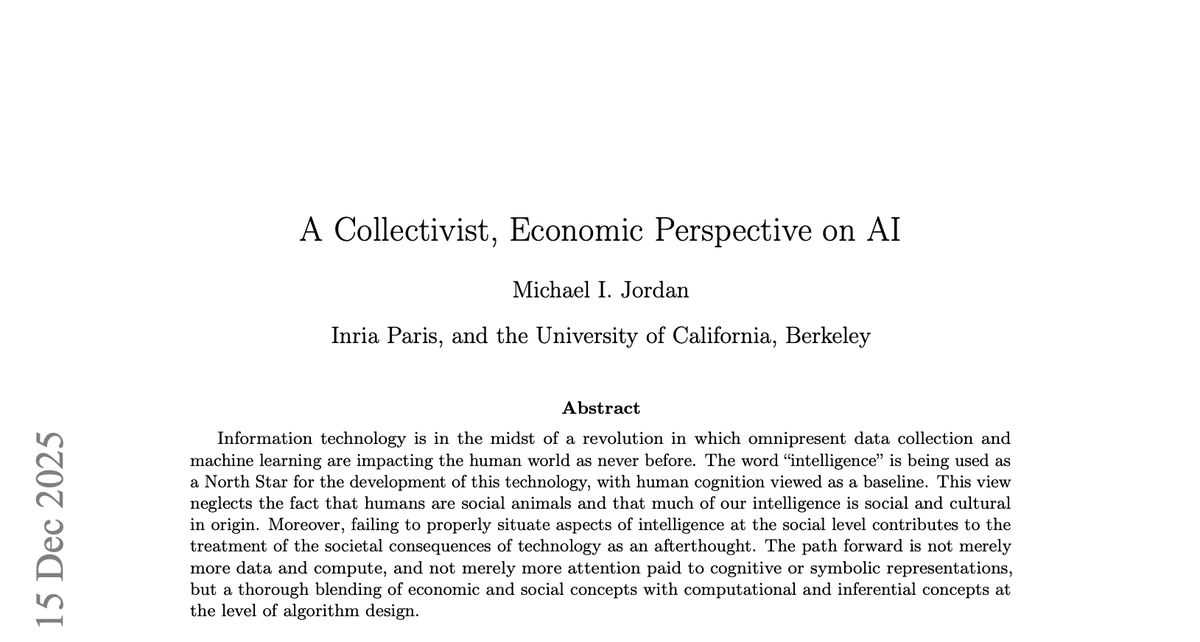
Behind “A Collectivist, Economic Perspective on AI” by Michael I. Jordan lies a beautiful vision of what this technology can become.
Rather than treating intelligence as a property of increasingly capable individual systems, Jordan shifts the focus toward collective intelligence: how humans, institutions, and machines coordinate to make better decisions together.
This perspective feels especially important as AI becomes cheaper, more capable, and more embedded in organizations. The next bottleneck may not be cognition, but coordination.
The paper challenges the dominant narrative that progress comes primarily from scaling models. Instead, it argues that real impact emerges when information, incentives, and actions are aligned across large groups of actors.
For anyone interested in AI-native organizations, markets, or multi-agent systems, this is a valuable framework. It asks a deeper question: not how to build smarter agents, but how to build systems that help society think and act more effectively as a whole.
Increasingly, I believe companies may need to be rebuilt from the ground up, where you have a single timeline of all observability + product metrics + file changes laid out in a retrievable system, like Datadog + Posthog + Google Drive + Slack (really unified filesystem of Claude Code chats + Codex chats). This might be the new data foundation for any and all companies to maximize AI. Needs to be rebuilt because keeping track of diffs on existing system basically impossible to produce longitudinal information on decisions and rollbacks, something coding agent storage companies are actively trying to figure out, but this should extend to businesses as a whole.
Highly skeptical existing businesses will adopt this though because it means overhauling everything about their instrumentation and business data, but I think businesses built on this foundation probably can execute 100x better and faster
Claude Fable 5 and Claude Mythos 5 are out!
Woke up this morning to the news, and I asked myself the question I ask every day: Is my startup dead?
Happy to announce that it is not. In fact, I’m even more excited.
One of our core theses is that artificial cognitive capacity is improving and becoming cheaper.
This is creating the conditions for greater autonomy inside enterprises and a growing need for an architecture that can coordinate not only humans, but also a human-machine work environment that is moving faster every day.
At the same time, this increasing speed creates new risks. One of them is the possibility that a company diverges from market reality faster than ever before.
The question is no longer how to make AI agents smarter.
The question is how to keep increasingly autonomous companies connected to reality.
#fable
Most people worry about AI making bad decisions.
We’re studying a different risk: what happens when AI keeps making good decisions for a reality that no longer exists?
Imagine a grocery chain loses customers to a new competitor. The AI app responds by increasing spending from the shoppers who remain. Average order value rises, dashboards stay green, and every local metric looks healthy.
The company is still losing the market.
That’s the core idea behind the Hyper-Drift hypothesis: the next generation of business failures may not come from AI making mistakes, but from AI executing the wrong assumptions exceptionally well.
Everyone assumes AI agents will make companies more efficient.
Maybe.
But they may also become the fastest strategic drift engine ever created.
Kodak and Blockbuster took years to lose touch with reality. Agentic organizations could do it in months while reporting record productivity.
Hyper-Drift is now live.