Well written, I don't agree with this take.
Agents do pretty good at this stuff if you have a clean codebase. And its the easiest stuff to fix. And you should fix it with constraints, all that is true, its just the low lift side of the problem.
The really really fucking hard part is that agents continually
- Implement half baked versions of things that already exist either in the codebase, the stdlib, or out there in the open source world in a highly stable and battle tested form.
- Solve problems either way too fucking much or nowhere near enough. Calibrating appropriate complexity of a solution to a problem given context is like kryptonite, fable / sol / opus all suck at it.
- Infer bizarre / moronic invariants from insufficient or slightly ambiguous instruction, and reify them in the code / defend them to the death.
It is extraordinarily hard to detect and mitigate these things with agents.
I think concepts like testing, backpressure, etc are all interesting but decently trodden ground. I would like to hear about how people solve hard problems like I mentioned, or other things like
- Reducing codebase churn
- Increasing the speed / accuracy of human to human communication
- Provide good pushback to avoid building unnecessary / stupid features
Lovable just raised $400M at a $13.3B valuation to build the business that helps build businesses.
Apps built on Lovable now get 900M visits every month, and we’ve quadrupled ARR in the last 12 months.
Since we started, Lovable has become the place where founders create million dollar businesses, business leaders spin up new product lines, and people inside companies rewire workflows and build tools that fit their exact needs, typically at a fraction of what software used to cost.
There’s a lot more to do.
We will create the most intuitive platform to build and run a business.
That means:
- Understanding what success looks like for you, then helping you achieve it. Not only ensuring your software works but also that you can attract customers, improve workflows, and grow your company.
- Deeper integrations that work with your existing tech stack so you can build the interface to your entire business across sales, ops, marketing, finance, etc.
- Becoming the safest platform to build and run your business on, which means secured code by default and that you get help to make safe decisions. As you build, the platform carries more of the security weight, spotting risks and helping you close them, so you can move fast without needing to become a security expert.
- Staying model-independent and orchestrating the best models for every task so you don’t have to. We’ll continue to absorb the complexity of evaluating and teaching models to route to the best ones in the background, to minimize cognitive load for our users.
As more people depend on Lovable, the quality standards our team is driving increase every single day.
We’re growing the team with people with a founder mindset: curious, ambitious, and who think end to end. Model training, product geniuses, infrastructure tinkerers, and security are the priority.
The world is full of ambitious people with deep knowledge of problems worth solving. Very few of them have historically had the power to act on them. Our ambition is to give people that power, and then help them achieve more than they thought possible.
Thank you to everyone who has followed along our journey. Thank you to @MenloVentures for leading, the Scaleup Europe Fund (managed by @eqt) for co-leading, and all of the new and returning investors who recognize our global ambitions and will help make them a reality.
We have made a lot of progress but we are nowhere close to done, it’s still day zero.
See our blog: https://t.co/d1L2ZQPjtN
@honnibal “For backwards compatibility”, usually meaning it forgot to update all references to something it changed and decided to keep both implementations
Voice-controlled UI.
This is an agent design pattern I'm calling EPIC, "explicit prompting for implicit coordination." Feel free to suggest a better name. :-)
In the video, I'm navigating around a map, conversationally, pulling in information dynamically from tool calls and realtime streamed events.
There are two separate agents (inference loops) here: a voice agent and a UI control agent. They know about each other (at the prompt level) but they work independently.
@mitsuhiko I mean this seems like a perfect solution for passthrough secret values like api keys, but for things like an RSA private key your sandboxed code needs to use the secret value internally.
Would you just fall back to an unprotected secret in that case?
@LewisCTech the advantage is you can keep using standalone allocations where convenient but still optimize the crap out of core data structures
can be hard in languages like go where you have to pick between usable interfaces XOR reliable performance
@jonathangrahl probably worth checking if Self includes time blocked on syscalls
if the OS doesn't have a user-space TSC it might need a syscall on each invocation which is >10x slower
Lovable just raised $330M at a $6.6B valuation.
It's been an iconic, insane, wonderful journey so far.
Thank you to everyone who made this possible: (thread)
Announcing Lovable raised $330M at a $6.6B valuation.
We launched Lovable to empower the 99%, the people with ideas who don’t code.
Now everyone is a builder: founders, teachers, artists, and teams inside the world's largest companies.
Meet some of those incredible builders:
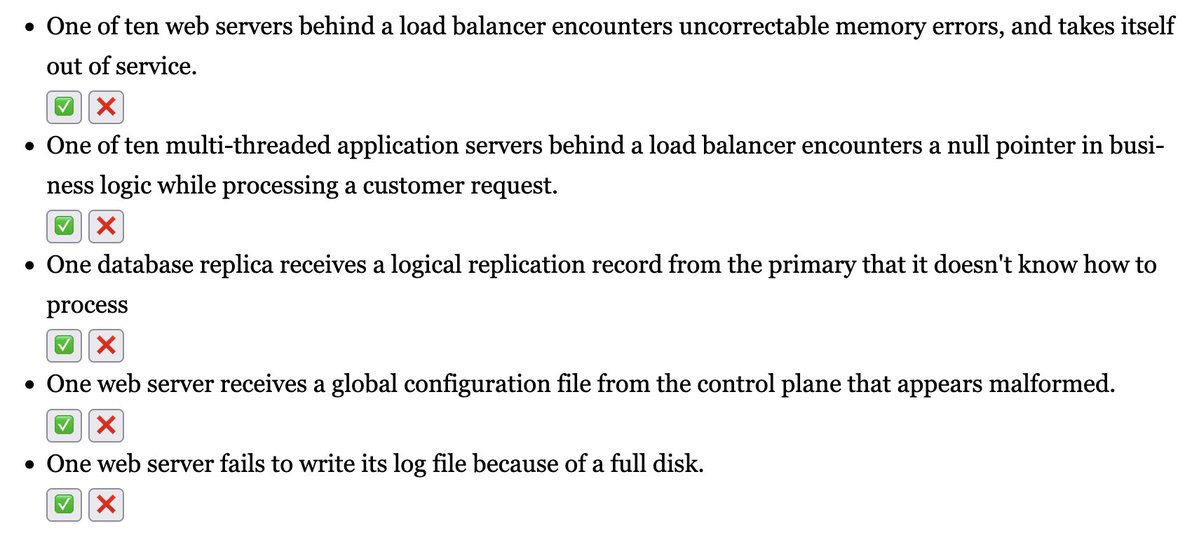
How should we think about error handling in distributed systems? Let's see what you think: ✅ means you think we should crash the process server, ❌ means you don't.
@kcosr@bernhardsson@colemurray If you’re running agents for internal users that’s likely fine. Internal users are ~trusted, so the main risks are either third party prompt injection or malware in dependencies.
End user agents are tricky. Unless you invest a ton into hardening assume your agent has root access
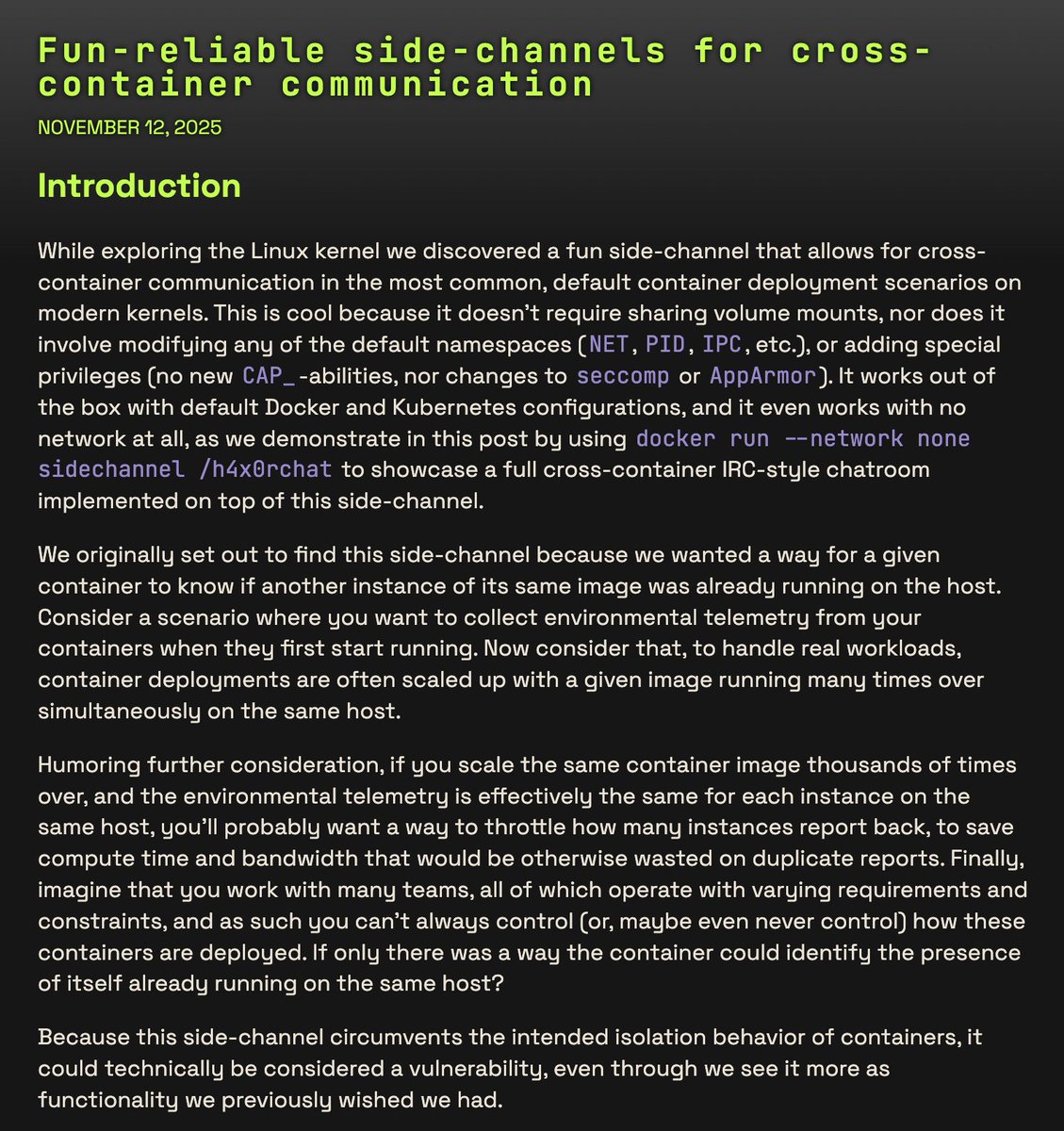
Turns out you can communicate across containers via 63-bits of available space in a shared lock you acquire on /proc/self/ns/time that all processes have access to.
No networking required. The post has a demo of a chat app communicating across unprivileged containers.