Most AI writing tools make your writing sound better.
Michelin makes it sound human.
It finds the subtle patterns that make text feel AI-generated, rewrites them into natural language, then validates the result with an iterative review loop until it no longer reads like AI.
@karpathy AI agents are starting to replace Markdown with HTML reports. HTML improves visualization and readability, but it also increases token cost, can sometimes be worse than clean Markdown, and is not always easy to view across environments.
https://t.co/tX1DQynzMn
@trq212 AI agents are starting to replace Markdown with HTML reports. HTML improves visualization and readability, but it also increases token cost, can sometimes be worse than clean Markdown, and is not always easy to view across environments.
skill: https://t.co/tX1DQynzMn
So we built a skill to control this trade-off intelligently:
Use HTML only when it truly helps
Keep reports lightweight and readable
Preserve portability and agent efficiency
Not “HTML everywhere.” Adaptive report generation instead.
Project: https://t.co/VBlY3KOg29
A new trend in AI agents is replacing Markdown with HTML for reports.
HTML gives better visualization and makes agent reasoning easier to understand. But it also increases token usage, hurts portability, and is not always easy to view.
Excited to share our recent progress on improving the factuality of ChatGPT instant models!
Over the past few months, we’ve been working hard to reduce hallucinations in high-stakes domains. Really happy to finally see these improvements reaching everyday ChatGPT users.
In our experiments, LLM-Codec improves token learnability and reconstruction quality together: 61.6% SALMon speech coherence accuracy, about 35x lower token-LM perplexity, and 5.0% better speech Mel distance over the AUV base codec.
voidful/Qwen3.5-27B-gemini-3.1-opus-4.6-reasoning
- Distilled from the reasoning capabilities of Gemini 3.1 and Opus 4.6
- Built for practical single-GPU deployment without sacrificing model quality
- Delivers clear gains over the baseline on zero-shot benchmarks
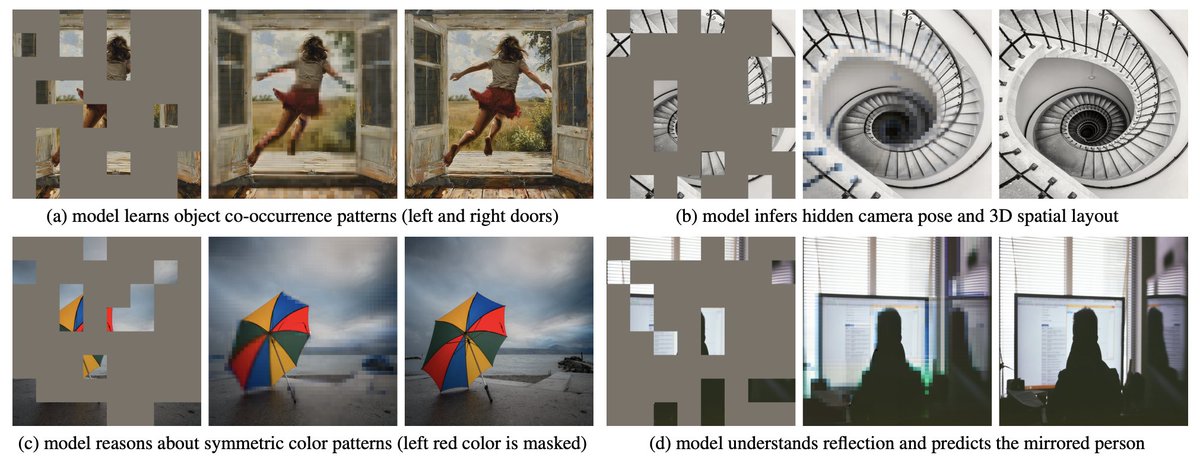
Following the philosophy of Meta CLIP (https://t.co/PEqHS0MR2h, https://t.co/D5ZHOFsCL7) that emphasizes learning from authentic supervision signals, researchers @AIatMeta introduce Pixio (https://t.co/7PNPWqzMmS, https://t.co/W2Sv0OVJpO), a vision foundation model pre-trained solely using #Pixel -level supervision.
Pixio is well suited for dense computer vision tasks, including depth estimation (e.g., Depth Anything https://t.co/EhC2ZRFlk6), feed-forward 3D reconstruction (e.g., MapAnything https://t.co/5Uw3vNj8oQ), semantic segmentation, and robot learning.
Built upon the simplicity of Masked Autoencoders (MAE) (https://t.co/pHVce2eXgT), Pixio introduces four major enhancements:
1, deeper decoder,
2, larger masking granularity,
3, more class tokens,
4, web-scale Meta CLIP data with self-curation.
This is a joint work done by Lihe Yang (first author of Depth Anything v1, v2), @ShangwenLi1
, @yangli625, Xinjie Lei, @dongwang218, @AbdoMohamedML, @HengshuangZhao, @Hu_Hsu
Paper: https://t.co/7PNPWqzMmS
GitHub: https://t.co/W2Sv0OVJpO
Huggingface Transformers: https://t.co/ZnY5a2AZQM
Huggingface Collections: https://t.co/jhbaDC68RA
#AI #Robotics #Robot #3DModel
Simple but effective: Pixio shows that raw pixels are all you need for visual pre-training. 📸
By scaling MAE with deeper decoders and 2B images, Pixio achieves SOTA results in geometry, 3D, and robotics. A powerful reminder that fundamental signals drive the best representations
It's a great pleasure to work with you and present the community an OSS representation natively trained for dense CV tasks. As LLM going so fast, we believe dense perception will also catch up!
It's a great pleasure to work with you and present the community an OSS representation natively trained for dense CV tasks. As LLM going so fast, we believe dense perception will also catch up!
We provide a comprehensive survey of Test-Time Scaling (TTS) methods and introduce ADAPT — a diversity-aware prefix-tuning approach that achieves 80% of full accuracy using only 1/8 of the compute on math reasoning tasks! 🔥🧮
We survey Test-Time Scaling 🧠 and propose ADAPT — a diversity-aware method that hits 80% accuracy with just 1/8 compute! ⚡
📄 https://t.co/5d8dYwBpX8
#LLM#TTS#NLP#EfficientAI