You’ve built something. Let the world know.
Start with a press release—from US$69.
Whether you’re building a brand, launching an app or website, or growing an existing business, Vokolla helps you get the word out beyond your own website and followers.
Choose from media packages with options including Yahoo, AP News, USA Today and Business Insider, plus wider networks of news sites.
Give people more places to find your brand or business—and give search engines and AI tools more sources to learn about what you do.
Clear pricing. No phone calls or appointments needed.
You can handle it all online. Bring your own press release or let AI help you draft one. Choose your package, review your release, then pay and submit when you’re ready.
Track the published links in one report.
Get the word out → https://t.co/qX4ga6jYla
Media outlets vary by package. Publication is subject to publisher review.
Delivrd's founder spent about $300 on Google Ads. Zero clicks.
Then he posted a recorded 27-minute call negotiating with a car dealer. It took off overnight.
He says Delivrd now handles 400+ deals a month at $1,000 each.
Full case: https://t.co/kNgs8XzAD6
@julianweisser Did the product that hit $11k reuse customers or lessons from the earlier attempts, or was it closer to a clean restart? That detail tells other founders whether to pivot or start over.
@irentdumpsters One filter worth adding before the AI step: drop queries with only a handful of impressions in those 28 days. Moving from 6 to 3 on a term with 10 impressions won't bring calls, and it keeps the list short enough to actually work through.
@Aoakudotcom Memberships at about two thirds of the total is a strong base, since that part doesn't swing with ad rates. Did the new mobile app mostly bring in new members, or help existing ones stay subscribed longer?
@lone_Ranger95 Making GA4 the source of truth next to 14-15x ROAS claims from Meta and Snapchat is the part I'd love to hear more about. Once cross-domain tracking was in place, how far apart were the platform-reported sales and what GA4 credited to each channel?
Living off websites in retirement is possible. It just takes patience.
Last month one of my sites passed $30,000 in revenue (Stripe + PayPal).
8 months ago I moved it from WordPress + WooCommerce to Next.js. In the past 6 months I haven't published a single article or built a single backlink. It just quietly takes orders every day.
Honestly, nothing to brag about. The domain has been live for 5 years. I only picked a direction 3 years ago, worked on it properly for about a year, then got busy with other things. It has been on low maintenance ever since.
It wasn't a smooth ride either. On WordPress it got attacked, hacked, hijacked, injected with malware, lost loads of pages, and had spammy adult and gambling links planted on it... If something could go wrong, it did. A brand-new domain would have been wiped out by Google long ago. So my conclusion: wait. Let it grow old. Old sites get tough 😄
Building a site that really works is both hard and not hard. Time and patience alone make 90% of people give up.
AI levels the field for tech and for content. You can generate it, so can everyone else. Generate too much and it's junk, and a lot of Google's work now is cleaning junk off the web.
Don't chase trends. Pick a few directions that can last, grow them slowly, and keep adding new domains. In 10 years, 3-5 old sites can bring you enough passive income for a decent life 👍
@ConnorShowler Local directories pair nicely with your #3: the free listing is the entry point, and the businesses that claim theirs are already warm agency leads. The part people underestimate is keeping listings accurate, since stale hours and closed shops kill trust fast.
@bensenescu Keeping the pitch decision human is the right split. For a roaster like Bramblewood, the pitches that land usually offer something the publication can't write without them, like origin details or a brewing test. Does OpenCRM store why each site was picked?
@VengeonsP Putting programmatic pages behind "once you have authority" matches what we've seen: a new domain that published about 7,000 pages in three months ended up de-indexed. Roughly how many hand-made pages would you want live before scaling a pattern?
@asaio87 One filter that helps: start with the queries where the page averages position 8 to 20 in GSC. Those near-page-one terms are usually where a few extra internal links show results fastest.
@lucaardito Going from €215 to €500 by Dec 1 is more than doubling in a month. Are you betting on more customers, or on moving existing ones to a higher plan?
@soham_nayak04 Organic search already sending users to a launch board this early is a good sign it can grow beyond your X audience. Which pages are people landing on from Google, the weekly boards or individual product pages?
@agazdecki Subscriptions plus music royalties is an unusual mix for an alarm app. Any idea roughly what share comes from each? A buyer would value those two streams very differently.
@828Marketing Exactly, tracked outcomes are the whole game. A missed-call fix either shows up in booked jobs or it doesn't. Do owners respond better when you show a before/after on one leak instead of a full audit?
The most practical AI business idea I read this week doesn't sell AI at all.
A one-person agency serves established local businesses in the US: plumbers, HVAC companies, owners already doing around a million a year. The pitch isn't "we use AI". It's more booked jobs.
How it works:
• Pick one trade in one city.
• Use AI to pull public data on those businesses: reviews, websites, ads, response times.
• Find where they lose customers: a missed call, a slow quote, a contact form nobody answers.
• Fix that one leak with a custom setup, and charge for the result.
• Stay in that one niche for six months before adding another.
Why it works: owners don't buy tools, they buy phone calls and jobs. AI makes the research and the build cheap enough for one person to do well.
Two cautions. The write-up's revenue numbers are assumptions, not reported results, so treat them as a model, not a promise. And this is a service business: it pays because you deliver, not passively.
Still, it's a better bet than another SaaS nobody asked for. Start with a real business and a real problem, then reach for the tool.
Which local trade near you is still losing customers to missed calls?
@iamVictorKann Agreed—recovered appointments is the only metric that survives a renewal conversation. The open-quote follow-up is the step most people skip too. Do owners usually track that lost revenue already, or is surfacing it part of the pitch?
A Facebook page that sat quiet for years paid Jeff Rose $39,177 in one month.
The clues: an old page, about 24 posts a day, mostly pictures, and AI only as a drafting partner.
Full case (4 min): https://t.co/GvRa3agXke
If you build software, SaaS or an AI product, the first directory to submit to is SourceForge
What you get:
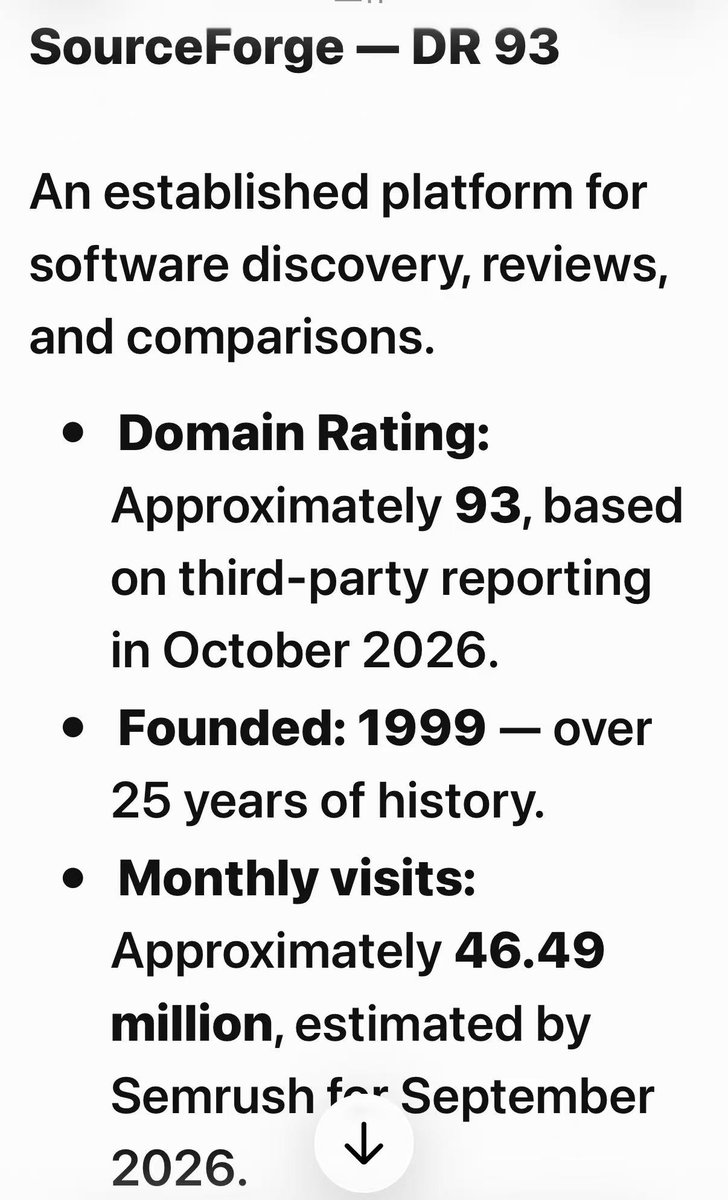
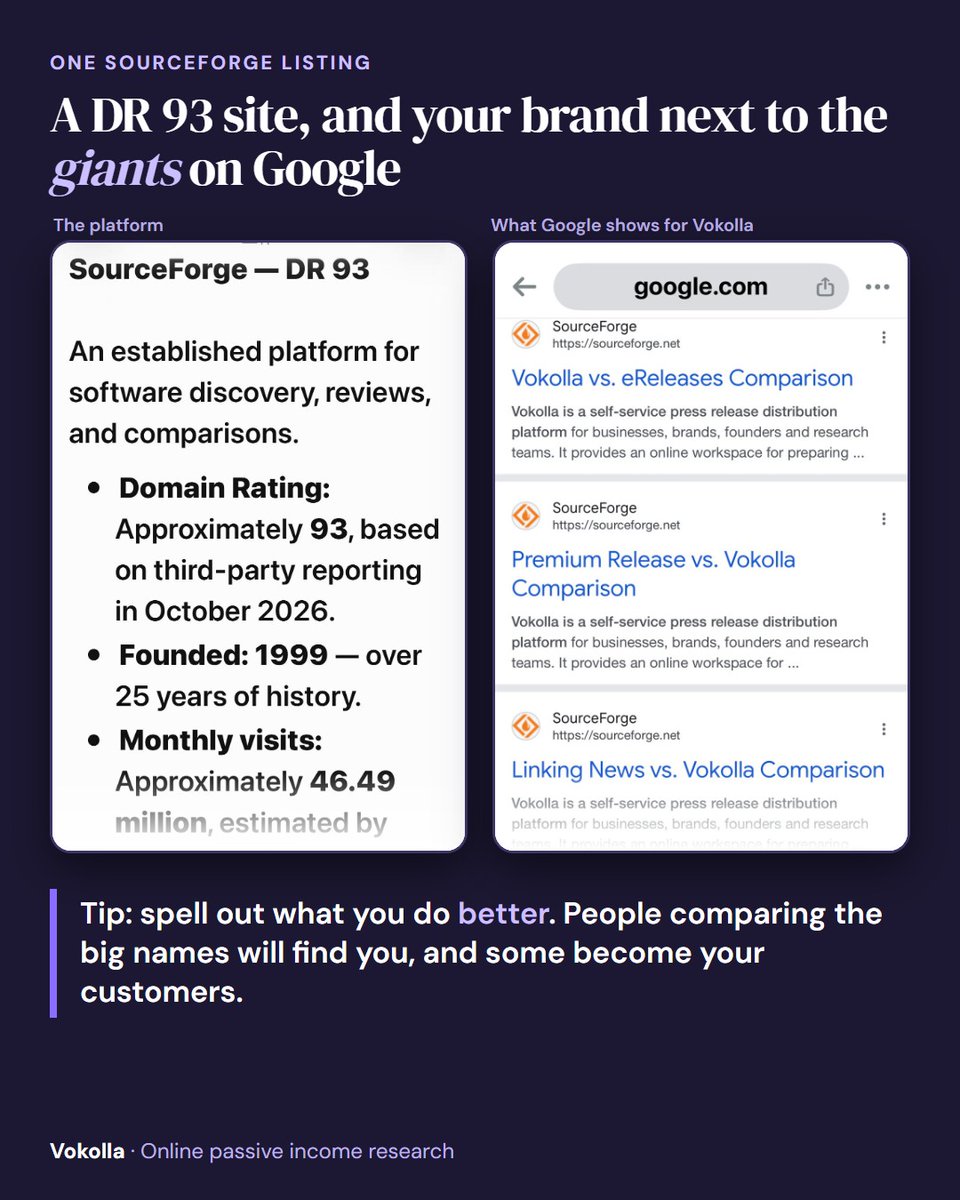
1. A link from a DR 93 site
2. Your brand on a platform with about 46M visits a month (Semrush estimate)
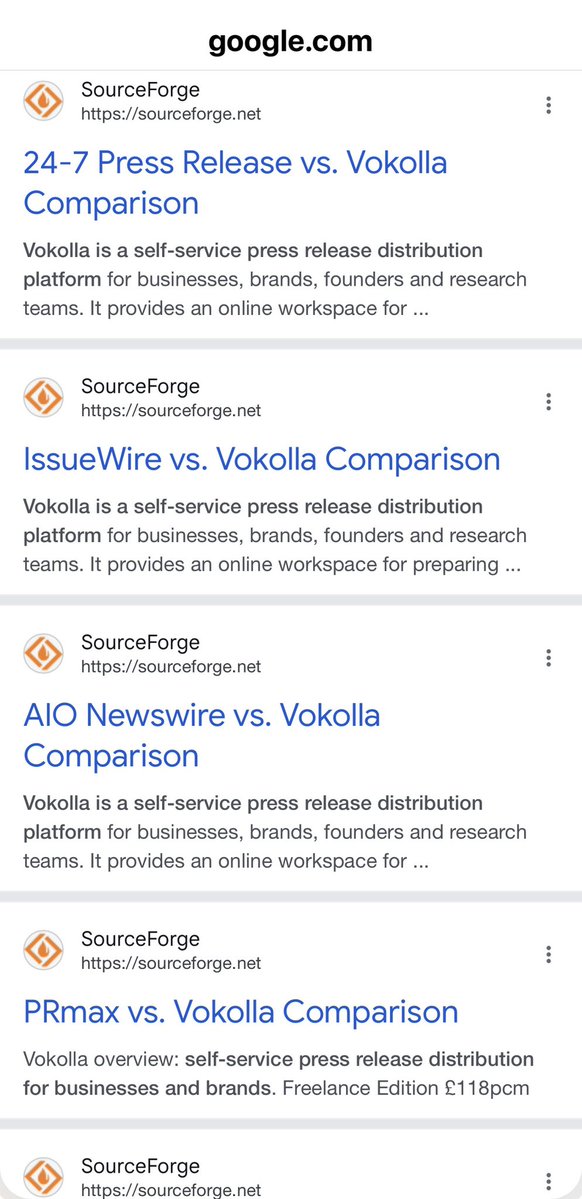
3. The big one: Google starts showing "[Big competitor] vs. [You]" comparison pages
We listed Vokolla. Now Google shows "Vokolla vs. eReleases", "EIN Presswire vs. Vokolla", "PR Newswire vs. Vokolla" and more
Standing right next to the giants in search 😄
Pro tip: write down what you genuinely do better. People comparing the big names land on your page, and some of them become your customers 👍
One founder: a year, $4,000 on Claude, three products, $19 a month in revenue
Another, also building with AI: about $14K in 28 days, with a short video every day and paid ads
Same tools, different results: distribution
Before you build, find ten people who'd pay