A key detail that got lost in this whole debate: Core devs don't believe JPEGs and shitcoins on Bitcoin to be spam.
Notice how individuals like @callebtc, @L0RINC and even @adam3us never give a straight answer about what spam even is, always hiding their answers in rhetoric and semantics.
The reason? They know it's impopular and would further taint the optics of what Core is trying to do with v30 and beyond.
@basedlayer Nice strawman. Now let's talk about David Bailey and the other parasites who launched down -95% "treasury companies", and what these did to the space.
Bitcoin Core just disclosed CVE-2025-62861, rated High severity: after a reorg, miners on 28.0 to 29.1 could be left unable to build valid blocks, and Core says it could be exploited. Fixed Oct 2025, disclosed now per policy.
The bug lived in TRUC (BIP 431), the mempool policy Gloria Zhao (glozow) proposed and championed, specifically inside the sibling-eviction logic she wrote in PR #29306.
Zhao went from a cold email by Chaincode's Adam Jonas in January 2020 to Brink's first fellow that December and to maintainer over mempool policy by July 2022. The area she was given primary authority over is where the bug lived.
The decisive ACKs and the merge came from the same informal network the CAPTURE series documents: Suhas Daftuar (Chaincode co-founder), Ava Chow (who backed Zhao's maintainership and merged the PR), and Greg Sanders (who later wrote the OP_RETURN uncap Zhao merged).
Nobody caught this bug, inside the network or out. But when social credit and authority are routed away from independent reviewers, and the same few people design, approve, merge and fix, there are fewer chances to catch the next one. TRUC added another layer of rules and exceptions so Lightning-style protocols can fee-bump more easily. Complexity for extra use cases is not free.
The CAPTURE series documents how an informal network of Chaincode Labs and Brink funders and organizers, including John Newbery and Adam Jonas, selectively funded and elevated certain developers, most notably Zhao, while grants, review attention and social credit were routed away from more experienced independent contributors such as Luke Dashjr, Vasil Dimov and Jon Atack.
Those decisions concentrated authority in a small overlapping group, which later exercised it in the policy changes culminating in the OP_RETURN uncap.
https://t.co/mtGy0KVPsj
https://t.co/2PN5MS6ciA
https://t.co/4ldVKyv3fE
@ramosbueno9150@XDhieggo@ToadaBrava@studioxodoh@SoftSeventh@nuntiusgames Vcs legitimizaram esse tipo de queima de reputação por décadas, o outro lado só deixou de ser retardado e passou a usar a mesma arma.
Fica o aprendizado, não legitimize o que vc não gostaria que fosse usado contra vc.
@emerhsilva No fundo desse moralismo, ódio ao empreendedor e estética de "justiça social", habita a tendência aguda á autodestruiçao.
E o coletivista progressista não se destrói sozinho, ele tenta levar todos em sua volta juntos pro buraco.
@GMONEYPEPE Feds do change their tune to whatever is popular in order to fit in the group, so i'm not surprised by your recent posts.
Don't overdo it, though. Daddy Bailey will be displeased.
@macrojack21 Don't worry, the price in dollars will pump massively.
Though not because of Bitcoin being adopted as money, but because of suits being in control.
@betty_nft He's always been very daring when it comes to experimenting and fucking around with new tech, and that's a very underrated aspect about him as an artist in my book. He seems like a genuine dude.
@Jethroe111 MB's owner Leandro Marciano César was involved with a ponzi scheme that stole 2.000 BTC in 2013 called Bitcoin Rain.
I have a hard time believing that Mercado was fully backed to begin with. Very shady individual and company.
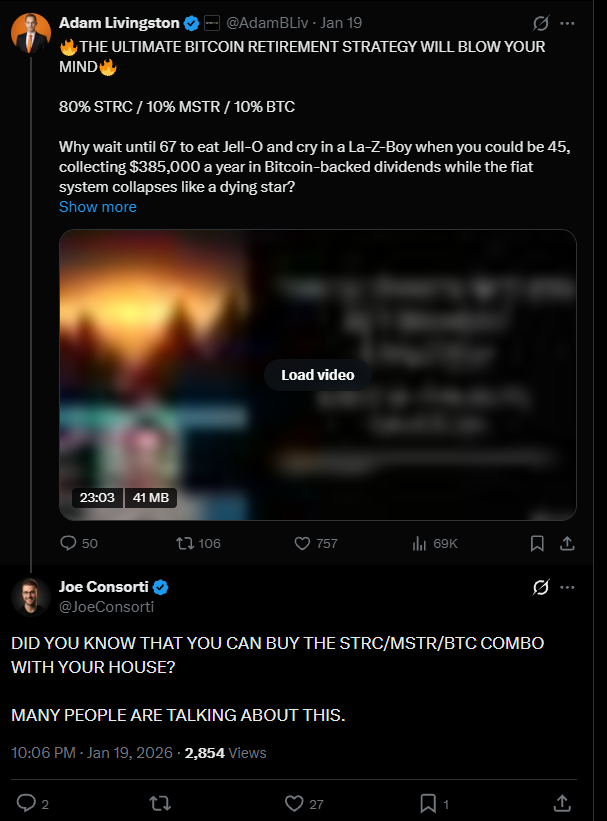
@hodlonaut@JoeConsorti He can't. Let's focus on all of Joe's and his friends advices over the years, though.
I really hope no one listened to them. This is simply life destroying.