Finally! This really took several years, but I'm very proud of the outcome 🚀
We introduce a language-based utility function, a new way to capture how words shape decisions.
We mathematically derive a prediction in the dictator game.
We empirically test this prediction across 107 experimental instructions.
We measure language using deep learning and human methods: BERT, MoralBERT, GPT, and experimental subjects.
We find that GPT scores do best at predicting human behavior.
We provide suggestive evidence that GPT scores are similar to human scores, but comparatively more detached from emotions.
We show that our method is portable:
We derive predictions and empirically test them also in equity-efficiency trade-off, ultimatum, and corruption games.
Overall, these results suggest that language is a quantifiable dimension of economic decision making.
Link to the preprint in the first comment.
Joint with Roberto Di Paolo and @VPizziol
🚨 New Publication Alert! 🚨
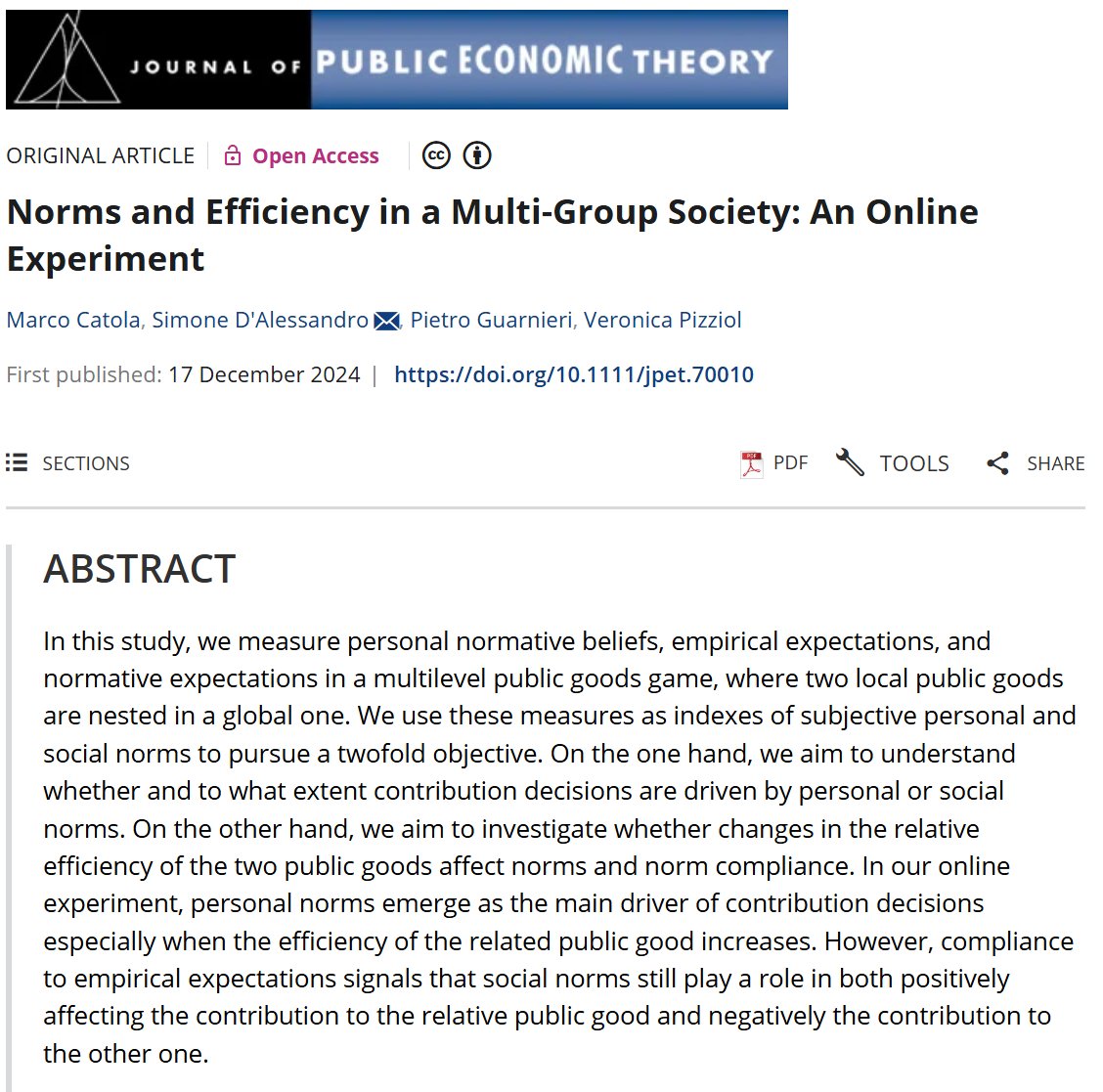
With @MarcoCatola, @SimoneDAlessa12 and @pietguar we just published our paper in the Journal of Public Economic Theory.
We studied social and personal norms in the multilevel public goods game.
👇Check it out here:👇
https://t.co/SsBezkbSnU
🚨 New publications out! 🚨
Together with @pietguar, @VPizziol, @ChiaraRapallini we just published a paper in the Journal of Comparative Economics
Check it out 👇
https://t.co/Sufh7XbcIl
1/3
Publication alert 🚨!
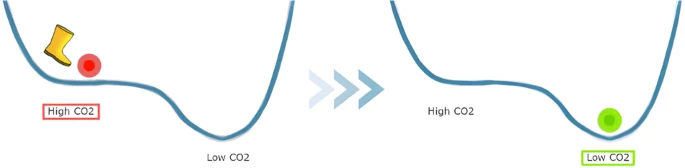
@VPizziol and I discuss the promise (and peril) of social tipping interventions to scale climate action in this open access article:
https://t.co/jZLuxpJuWE @Nature_NPJ Climate Action
💥New perspective!💥
In this article, we make what we believe are three important points:
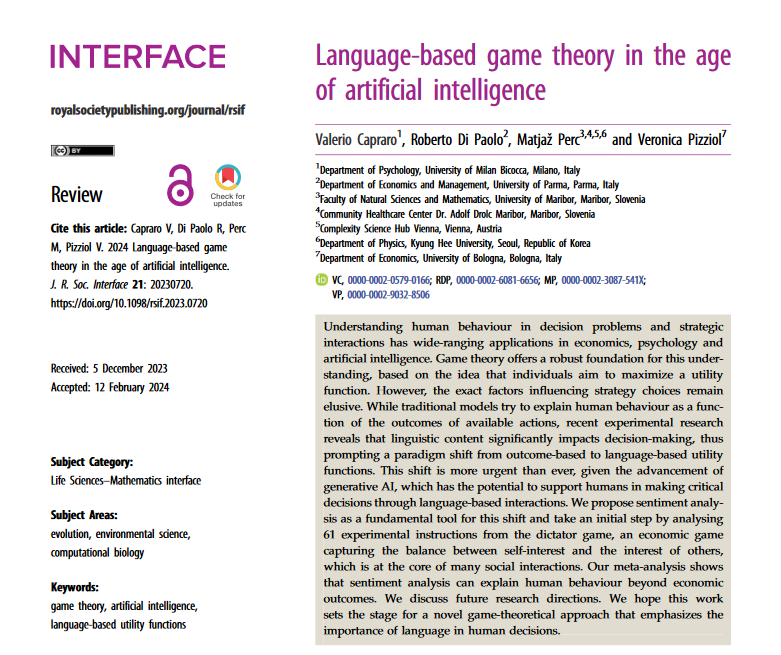
1. We review a growing body of literature showing that human behavior in economic games is not solely dependent on the economic consequences of available actions but also on the linguistic description of the context and available actions. Therefore, to truly understand human behavior, we need to shift from outcome-based to language-based utility functions.
2. The rise of large language models makes this the right moment for this shift, for two reasons:
(i) People will increasingly rely on decisions made with the support of LLM-based systems. This support will come from language-based interactions, making the understanding of how language influences decision-making more crucial than ever.
(ii) LLMs are particularly useful for quantifying the linguistic descriptions of contexts and available actions, thereby helping to define utility functions over language.
3. To demonstrate point (ii), we collected 61 experimental instructions from the dictator game, an economic game that captures the balance between self-interest and the interest of others, which is at the heart of many social interactions.
Using GPT-4, we conducted sentiment analysis on these game instructions and attempted to predict actual human behavior from the instructions.
And it worked! Our meta-analysis shows that sentiment scores explain human behavior beyond economic outcomes.
We believe this might represent a first concrete step toward a better understanding of human behavior, one that accounts for the linguistic description of the context. Sentiment analysis can be the key tool to quantifying language in a way that can be incorporated into the utility function.
Full paper, open access: https://t.co/6PXuQPX8bt
w/ Roberto Di Paolo, @matjazperc, @VPizziol
Let me also mention that we are working on follow-up projects on this topic. If you have comments, ideas or criticisms, we would be very happy to hear from you.
Super excited to present on AI and experimentation at @JSTOR (one of my fav public good!) and the wider community using experimentation and science in their jobs! #EconTwitter
The talk will be based on these two papers:
1) this NBER study with @Econ_4_Everyone and @GaryCharness on how to integrate AI at the different stages of scientific experimentation: design, implementation and analysis
https://t.co/Zbxko4Srsi
2) this early case study from 2020 with Elia Sartori on how we used LLMs to facilitate the incentivized exploration of critical thinking along with its implications for the digital economy and voting behavior possible.
https://t.co/llu2oSDd4Y
Join us!
📣 Excited to share our new publication "Cooperation is unaffected by the threat of severe adverse events in public goods games" on the Journal of Behavioral and Experimental Economics! @EBilancini@naxleo Chiara Nardi
Check it out here:
https://t.co/A4KtamcOm3
We run an online experiment to investigate the effect of a risk that is independent across group members, a risk that is positively correlated among group members, and a risk that is negatively correlated among group members on cooperation.
Interested in hosting a lecture on meta-analysis of experimental evidence within your PhD course in Experimental Economics?
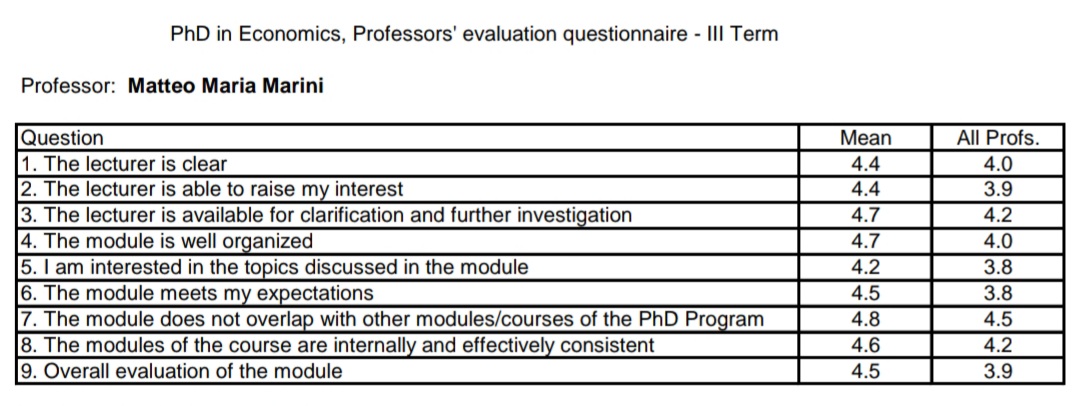
Then don't miss this chance. On a scale of 1 to 5, PhD students of @unisiena believe that I've been particularly mean to them!😆
Available in April 2024
I recently had the opportunity to speak at the AVIS Nazionale & @IMTLucca event on "Artificial Intelligence and Blood Donation". The level of interest in this cutting-edge subject was truly inspiring! #AI#BloodDonation#AVIS#ThirdMission
https://t.co/6RSu27lM9t
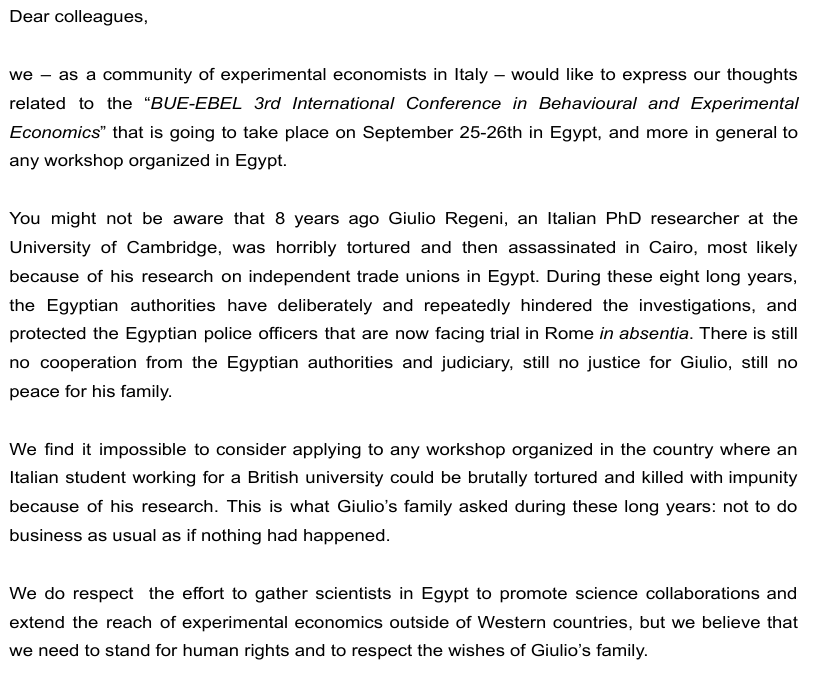
Giulio Regeni was a Cambridge PhD student. He was murdered 8 years ago in Egypt because of his research.
Next week an academic event is to be held in Egypt. 27 other Italian colleagues, @giannetti_cate and me have written a letter to raise awareness.
https://t.co/H51i2Yjecd
An analysis of donations (n = 46,000) in 68 countries: https://t.co/jrD0cJ0Ffp
-left-leaning people donate more in general + internationally
-right-leaning people donate more nationally
Cool analysis of our global data! https://t.co/udKD9khqmA
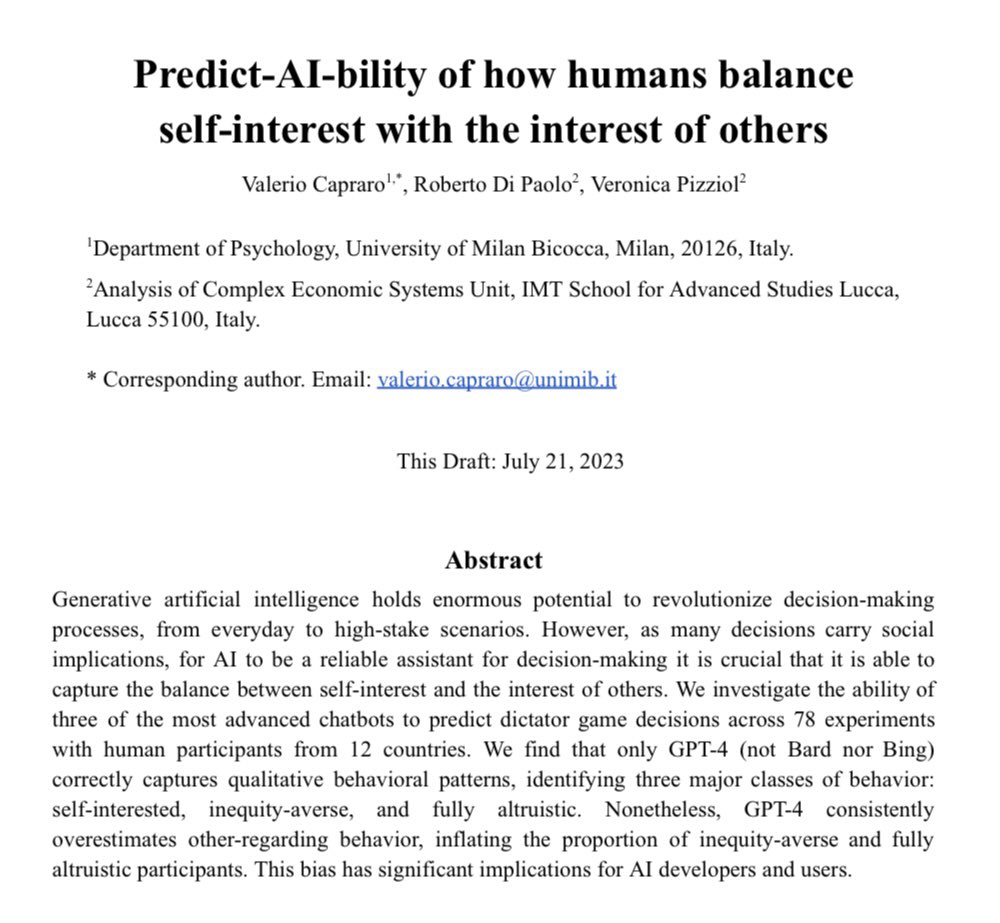
🔥 New paper 🔥
Generative AI can potentially help us make decisions in a range of contexts
Yet, as many decisions carry social implications, for AI to be a reliable assistant it’s crucial that it’s able to capture the balance between self-interest and the interest of others 🧵