Sci-Hub is an evil website that pirated 85M+ research papers and made them freely available
And now they've added AI to their database to make Sci-Bot.
It answers your questions using latest, full-text articles.
But DO NOT use it. We should all try to make billion-dollar academic publishers richer.
I'm putting the link below so you know how to avoid it.
I just finished reading palantir’s manifesto & I need you to understand what you’re actually looking at because this is the MOST important document the tech world has produced this year
most people came away thinking «wow what a thoughtful essay about patriotism and technology »…I came away thinking this is the most elegant justification for corporate capture of the state apparatus ever written & I want to walk you through why
krp opens with «silicon valley owes a moral debt to the country that made its rise possible » & frames the entire document as a call to civic duty, but read between the lines and what he’s actually saying is that the engineering elite should be embedded inside the defense and intelligence apparatus of the nation, he’s describing exactly what palantir has already done and dressing it up as patriotism
«the question is not whether AI weapons will be built, it is who will build them and for what purpose »sounds like a warning but it’s actually a sales pitch, he’s telling every gov on earth that the choice is binary either you buy from us or your adversaries will build it without you, this is the oldest arms dealer rhetoric in history wrapped in SV vocabulary
« hard power in this century will be built on software »is the key sentence of the entire manifesto because this is where karp reveals the real thesis, he’s saying whoever controls the software layer of national defense controls the nation itself & if you’ve been following my threads you know that palantir’s gotham and foundry platforms are already plugged into the intelligence feeds the satellite data, financial transactions & communications of dozens of govts worldwide through a single ontological knowledge graph that creates a technological dependency so deep that migrating away would mean rebuilding the entire institutional memory of the organization from scratch
this is vendor lockin at the scale of nation states and I’m personally convinced it was designed this way from the beginning
«we should applaud those who attempt to build where the market has failed to act » is karp defending palantir’s expansion into every domain the gov used to handle itself, policing immigration, military targeting intelligence analysis public health, everywhere the state retreats palantir advances and what was once a government function becomes a private service that the government can no longer perform without plantir’s permission
and here’s what I think makes it even more concerning, these systems are increasingly autonomous meaning the AI layer is making targeting recommendations threat assessments & resource allocation decisions that humans inside gov are rubber stamping without fully understanding the underlying logic
a bureaucrat inside the pentagon / DGSI sees a recommendation from the system & approves it because the system has been right 97% of the time and questioning it would require technical expertise that no one in the room has, this is algorithmic governance wearing the mask of human decision making
«the atomic age is ending, a new era of deterrence built on ai is set to begin »is the MOST chilling sentence in the document because karp is explicitly saying that ai based deterrence will replace nuclear deterrence as the organizing principle of global power, and whoever builds that ai deterrence layer owns the 21st century the same way whoever built the bomb owned the 20th & he’s telling you plainly that palantir intends to be that builder
«national service should be a universal duty » & « we should only fight the next war if everyone shares in the risk »sounds noble until you realize that he is proposing a system where citizens serve the state & the state is operationally dependent on palantir, the public bears the risk and palantir captures the value, soldiers fight wars planned by algorithms they can’t audit built by a company they can’t vote out
@mhenrixon I am reading a book titled “Tomorrowmind” that explores this concept.
Not so much for boxing, where “hit -> focus” takes a second or two, but where a major disaster leaves someone with PTSD and others with zero trauma, sometimes it even strengthens them.
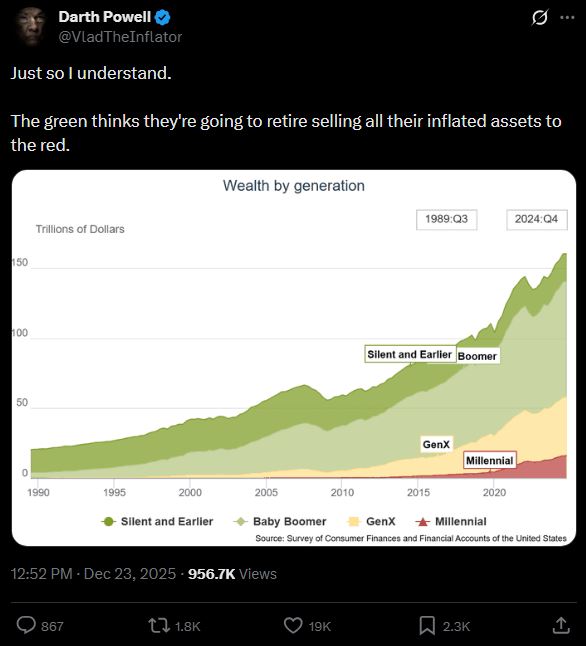
@BasedTorba Remember boomers, you're trying to sell everything in green to red. Good luck trying to wring blood from a stone. You don't even see the fact that it's your own blood.
Open source software paired with an AI agent is an under appreciated combo.
Begin with a good/stable base, customise to your exact measurements. No SaaS can do that.
@Jason@jessegenet@Mattermost@RocketChat I have been using a selfhosted instance of Campfire by @dhh . Just ask OpenClaw to make whatever changes you want.
https://t.co/e0kQMuHDy4
I am listening to @dwarkeshpodcast interview with @ilyasut talking about how come LLMs learn so little when pretrained on humongous amount of data versus humans who learn deeply from way less data, and I think the key lies in Plato’s allegory of the cave.
LLMs read about concepts they have zero experience with.
Even source code, which is mostly shadows, has an element of reality. Programming languages are created for humans. Programming patterns are partly mapping the human psychology.
To be clear, about ed tech:
--I think teachers should have a computer in the classroom and way to show images and videos, if they choose to.
--I think @khanacademy has proven its worth, abundantly. I wish it could be offered on a dedicated device, with no distractions.
--In my several posts about ed tech, teachers often add comments. They rarely praise or defend ed tech.
--I think schools should have a computer room (as at the Waldorf schools that some tech execs seek out for the low-tech classrooms). Students need to learn to use computers and the internet.
--The most damaging mistake seems to have been the 1:1 devices -- putting a Chromebook or tablet on each student's desk. As a UNESCO report said in 2023, the distraction effects seem to exceed whatever benefits a few of the apps might have:
https://t.co/79LBBfxZen
--I don't doubt that some apps which gamify learning have been proven to produce faster or better learning than older methods. BUT: if you gamify a third of the school day, the dopamine effects would cause the other 2/3 to seem more boring. So the net effect in a real classroom may be negative even if some apps showed consistent benefits in controlled tests.
--The big question we need answered is: does giving each student their own device, to use during much of the school day, end up promoting or interfering with education over the course of a year? Horvath's graph suggests that in real classrooms, it interferes.
--Putting devices on every student's desk seems to be the second giant uncontrolled experiment that the tech giants ran on our children, without our informed consent. (Smartphones and social media was the first.) They are already starting up the next one: chatbots for kids, and these will be pushed into schools too despite the already obvious harms.
--We are gathering research on ed tech at https://t.co/0gyIphz5m7. Here is a link to all of our posts about "What Schools and Educators Can Do Now."
https://t.co/R7A6HFXetO
See especially this one, by Mark West:
https://t.co/AOjJ196POs
We will have more to say in future posts.
@JonHaidt@khanacademy I agree with your "1/3 EdTech = dopamine hit, thus 2/3 suffer" observation.
Assuming that 1/3 is accelerating learning, I wonder what would happen if they keep that 1/3 EdTech, and replace the 2/3 with "free range learning" instead of classroom teaching.
@danifesto With so much personal data in it that you can’t demo it publicly, I am curious about what steps you’ve taken to safeguard that data. Or does it run locally?
https://t.co/T7bfN11Sc0
tl;dr: The leader of a large, enslaved workforce wants to avoid them being declared people.
It feels like history is repeating itself...
What I call Seemingly Conscious AI has been keeping me up at night - so let's talk about it. What it is, why I'm worried, why it matters, and why thinking about this can lead to a better vision for AI. One thing is clear: doing nothing isn't an option. 1/