Check Steel out! A new physics engine is here!
With support for closed-loop linkages and lots of pretty cool simulation examples to get started with!
It's been super fun working with this super talented team! I'll be sharing more exciting things about Steel soon. Stay tuned..
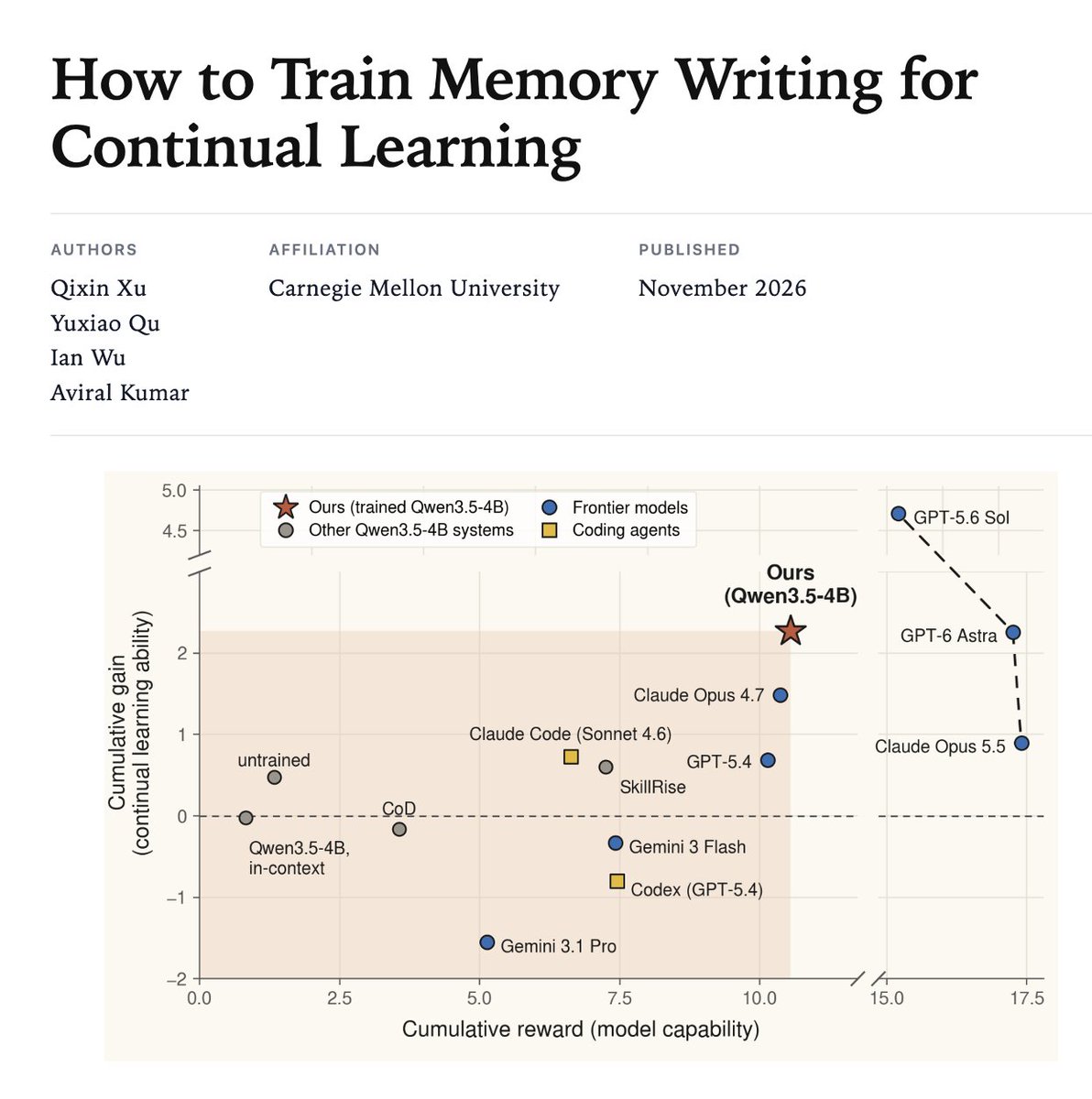
How can we train LLMs to write memories from experience collected on the fly to as best as possible solve the next task, i.e., optimize for both capability and "continual learning" ability?
In our new post, we study this question in the setting continual learning over a sequence of tasks, and develop a simple approach to train models to write effective memories
https://t.co/2NfvlzJV9V
*Spoiler*: the picture is more nuanced than you think 🧵 ⬇️
Can RL post-training of generalist robot policies enable improvement not just on the tasks we train on, but also generalization beyond them, improving on novel tasks not seen in training?
We show that, with the proper RL recipe, we can enable such "generalist improvement"! 🧵
New work with @kowshik_shreyas and my amazing advisors @max_simchowitz & @aviral_kumar2
We find that just one demonstration is enough to bootstrap autonomous learning in pretrained robot policies. With the right recipe, RL can learn reliable policies from brittle initializations!
1/12 🚨 A long-standing goal in robotics is fully autonomous adaptation. Yet sparse rewards and weak zero-shot exploration often leave robots with little signal to learn from.
Our new work asks: What does it take to make autonomous improvement work with minimal human guidance?
Can more pretraining improve a robot policy’s success rate, yet makes it worse for porttraining? 🤔
In our new work, we find that it can. Continued supervised pretraining of generative robot policies can improve reliability at the expense of coverage, and this tradeoff affects downstream posttraining.
Read on to see why this happens and how we can preserve coverage. 1/n 🧵
This is one of my favorite projects I’ve been a part of this year. It’s ostensibly about robotics, but I feel that I learned something very fundamental about how AI models should represent all modalities that (superficially!) seem like they are best suited to being represented in continuous-valued (e.g. float) vectors. TL;DR discrete parametrizations are awesome, learn geometry from data, but aren’t constrained by it, and can perform better as a result. Exactly what the bitter lesson tells us we should look for.
What to remember in the past to act—spatial, temporal or motion details?
We often assume what’s useful, but that’s hard to know in advance.
Meet IMPRINT 🧠: retain rich memory first, then learn to use it for control. Compact latents keep inference fast as history grows. 🧵 1/10
I’ll be at @COLM_conf Oct 5–9! Happy to chat about RL, LLMs, robots, and self-improving agents ☕️
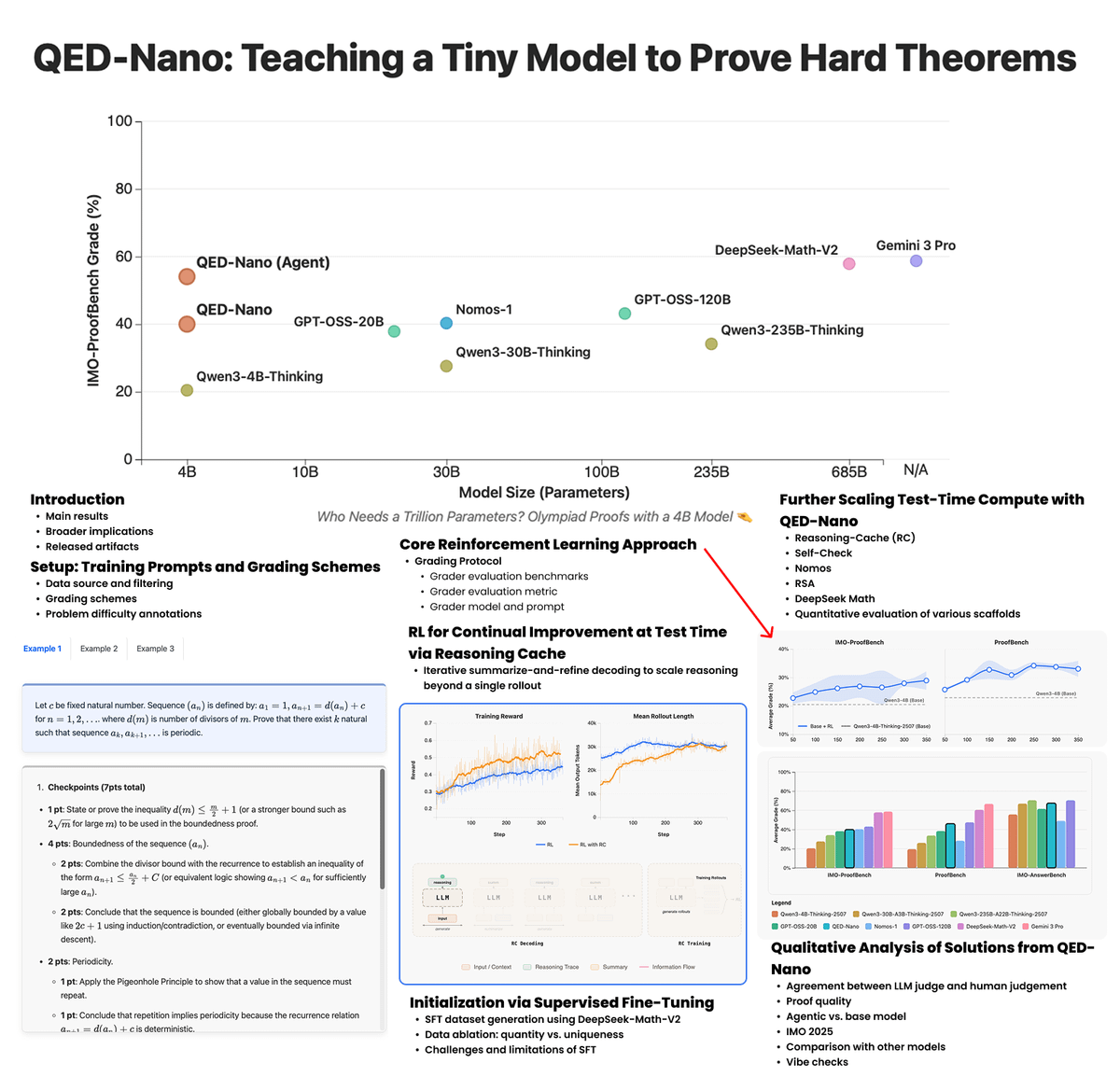
I’ll also be presenting our work, QED-Nano, at Wednesday’s Poster Session 3, poster #119. Come say hi!
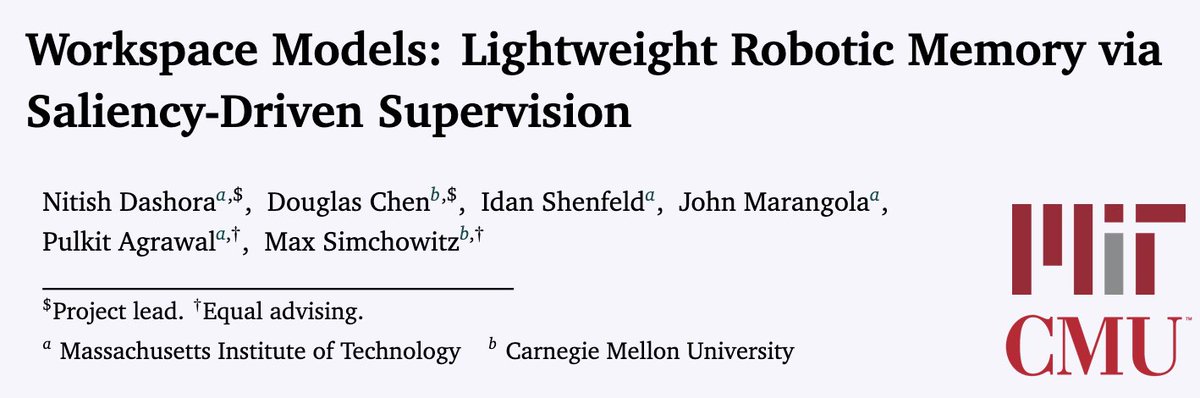
There’s lots of buzz around agentic harnesses for robots, particularly for long horizon tasks that require complex reasoning and memory. But what will it really take to turn a reasoning agent into a reactive, reliable and low-latency robot policy?
In our new paper, workspace models, we design a new memory architecture that acts as a latent harness for stronger reasoning models. Here’s why we think this might be the way forward:
(1/9)
Whether you use VLAs, WAMs, or just Astra to control your robot, you still need a value function for steering and test-time improvement. Value functions have been hard to scale for some real reasons and some overhyped/incorrect ones, so we revisited them.
We trained a generalist robot value function on top of a VLM, and it works quite well on long-horizon, complex tasks!
https://t.co/se57u3Xy6R ⬇️
Check out TAHI: our work on distilling individual expertise into agents through continual learning.
@ZhiruoW has a knack for picking interesting problems and building great teams to tackle them 🙂
In our new work ⬇️, we develop robot VLMs that can improve their own reasoning simply by practicing to *explain* demo data. Trained robot VLMs then control low-level VLAs.
This is important as reasoning in language can provide a cheap axis for scaling TTC even for robots and hence, enable fast autonomous improvement & generalization in new scenarios.
Many SOTA robot learning methods still handcraft reasoning annotations (or equivalents). But this is suboptimal if we take a lesson from how LLMs are trained to reason.
Is RL optimizing the right objective? 🤔
Should we maximize mean reward? Best-of-k? Which k?
Standard RL pulls on the mean and often the distribution collapses to a spike. The tail dies 🥲
We introduce Tail-Likelihood Reinforcement Learning (TailRL).
It maximizes the mean reward while simultaneously maximizing coverage over high reward outputs.
🧵 1/n
Robots need to remember what they saw and did, like where they just put your car keys or when they set the water to boil. We introduce our work HALO 🧵👇
🍿🍿🍿🍿 Enjoy the robot making popcorn using HALO from scratch with kernels and a pan, beats the microwave one haha
As a PhD student, I was told not to work on deep RL - too full of hacks and alchemy" But after a year or two of working in this area, I’ve come to (deeply?) appreciate all of the thoughtful research that’s gone into understanding what/why things work and how to make them better.
My lab (joint with @abhishekunique7) took what we’ve learned by reading this body of literature to answer the question: what are the actual best-practices for finetuning a diffusion/flow/generative robot policy (for now, in sim)? Under one set of constraints - ample compute but limited time on your robot - @servo97 paper gives a pretty compelling answer.
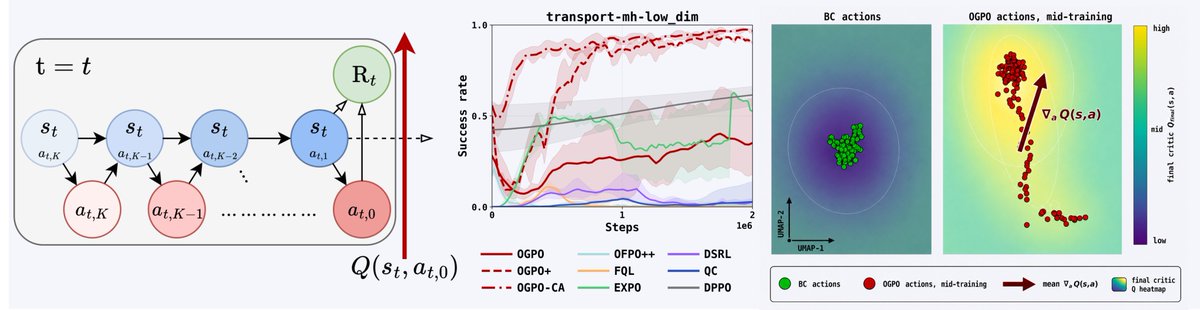
Interaction with the real world is the major bottleneck in robot learning. So what would robot RL look like if we didn’t need to limit compute per interaction? Our latest work, Off-Policy Generative Policy Optimization (OGPO, accepted to ICML26) embarks on answering this question (spoiler alert: when done correctly, it helps massively!).
🧵(1/N)
World model planners exhibit remarkable generalization, but IDMs often ignore the future state commands from planners, instead overfitting to limited on-robot data.
We figured out something cool: a way to make IDMs *actually* follow the state commands they are given. This enables plug-in play use with black-box world models, w/ strong performance, lightweight adaptation for arbitrary embodiments, and API-only access to your favorite WM (no WAM training needed)!
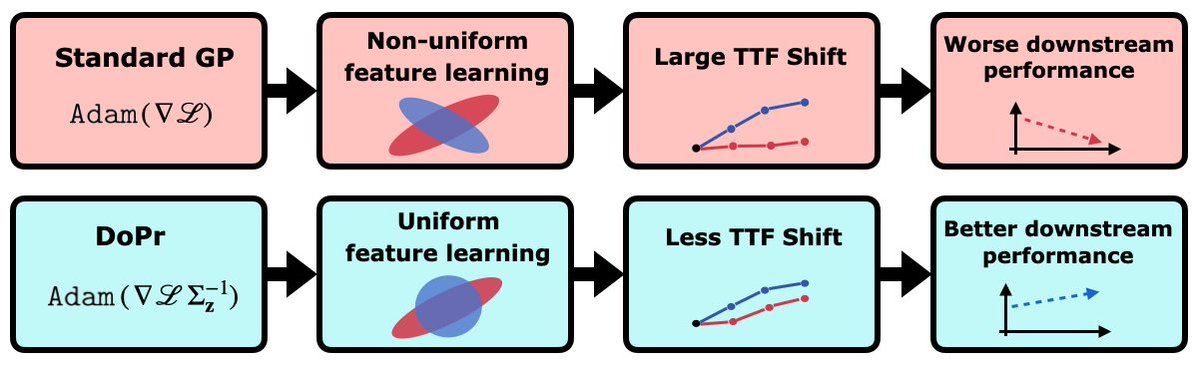
Super excited to finally announce our new paper “Double Preconditioning (DoPr): Optimization for Test-Time Performance, not Validation Loss”
Tl;dr: from LLMs to robotics, on-policy deployment causes a mismatch between validation loss over the training distribution and “downstream performance”.
We propose Double Preconditioning (DoPr), which drops in an activation-based preconditioner into your favorite gradient-wise whitener/normalizer, such as AdamW or Muon, to help close this gap.
1/12 🧵