Loop Engineering is the next step after prompt engineering.
Most people still use Claude Code, Codex, Cursor, or Grok like a chat box:
Prompt.
Wait.
Copy.
Fix.
Prompt again.
This repo shows the next step:
You stop prompting the agent.
You design the loop that prompts the agent for you.
Inside:
→ Daily triage loops
→ PR babysitter loops
→ CI sweeper loops
→ Dependency sweeper loops
→ Changelog drafter loops
→ Post-merge cleanup loops
→ Issue triage loops
It also gives you CLIs to:
• Scaffold a loop
• Estimate token cost
• Audit if your repo is ready
• Add memory/state
• Add human handoff
• Add verification gates
• Run agents safely through GitHub Actions
The wild part is the shift in thinking.
Prompt engineering was about writing better instructions.
Loop engineering is about building a system where agents keep working, checking, fixing, and escalating without you babysitting every step.
This is what AI coding looks like when it stops being a chat session and starts becoming an operating system for software teams.
Repo: https://t.co/2USzC6KHUt
Andrej Karpathy:
"Remove yourself as the bottleneck. Maximize your leverage. Put in very few tokens, and a huge amount of stuff happens on your behalf."
loop engineering is the exact thing that gets you there.
in a hand-run session you do two things. you decide what the agent runs next, and you check its output before the next step. both are manual, and both are the ceiling on how far the agent gets without you.
loop engineering moves both steps into the system. the diagram below shows the operating structure that surrounds the loop:
→ a trigger decides what to run, whether that's a message, an event, or a schedule, so the agent starts without you there to kick it off.
→ the loop is the maker that produces the work, thinking, acting, and observing until it's done or the brakes stop it.
→ a separate checker grades the output, because a model grading its own work justifies what it already did instead of catching where it failed. the checker's findings return to the maker as the next instruction, and the cycle repeats until nothing is left to fix.
→ state lives on disk, not in context, since the model forgets everything between runs. an MD file or a knowledge graph holds what's done and what's still open, so a loop can pick up again days later.
for that state layer, Zep's Graphiti is a clean open-source option, a temporal knowledge graph that invalidates stale facts and returns context through vector, full-text, and graph search in one call.
repo: https://t.co/8CboBlWffX
two things decide whether an unattended loop holds up.
the exit has to be set before the loop runs, not while it's running. a loop with no stop condition burns tokens, and the cost climbs fast once sub-agents and long runs stack up. a clean exit reads like "all tests pass and lint is clean, stop after two passes."
and the checker only catches failures inside a run. the harness around the loop, the prompts, tools, and checks wrapped around the model, still drifts and breaks in production as models change. catching that needs observability on every run, not a green checkmark.
Comet's Opik is built for that layer, an open-source tool that traces every call and turns a failing production trace into a regression test so the same break can't recur.
repo: https://t.co/Qxk9BHZBlx
your job stops being the hands inside the loop. it becomes designing the machine that runs without you, then watching the traces closely enough to trust it.
the model is becoming a commodity. the loop around it is where the real engineering lives now.
I wrote the full breakdown. the article is quoted below.
stay tuned for more on this!
A senior Google engineer just dropped a 19-page PDF on "Loop Engineering" for LLM and agentic systems.
Act → Observe → Learn → Repeat
• Act: the LLM proposes a code transformation (tile this loop, parallelize that one).
• Observe: a compiler runs it and reports back - is it valid? faster? slower? by how much?
• Learn: the LLM reads that feedback and adjusts its next move.
• Repeat until it stops finding improvements.
The agent gets smarter purely from grounded feedback inside its own context window.
This 19-page PDF totally changed the way I’m building agentic systems today.
Read it now, then explore the article below.
World Labs CEO Dr. Fei-Fei Li: "The world is not made of words."
"Language models have given machines an extraordinary command of concepts, vocabulary, and reasoning, but the physical world, virtual or real, runs on a different substrate."
"Where language models learn the statistical structure of text, world models learn the statistical structure of space and time: how light falls on a surface, how a garden looks from an angle no camera has captured, how objects respond to force and follow the laws of physics."
"Language gave machines a way to talk about that world. World models are how machines will finally come to understand, imagine, reason and interact with it."
Full piece: https://t.co/C9qOJg5wuc
MIT proved every major AI model is secretly converging on the same "brain."
It’s called the “platonic representation hypothesis,” and it’s one of the most mind-blowing papers you’ll ever read.
You train a vision model purely on images. You train a language model purely on text.
They use completely different architectures. They process completely different data. They should have completely different "brains."
But as these models scale up, something impossible is happening.
When researchers measure how they organize information, the mathematical geometry is identical.
A model that only "sees" images and a model that only "reads" text are measuring the distance between concepts in the exact same way.
The models are converging.
The researchers named this after Plato’s Allegory of the Cave.
Plato believed that everything we experience is just a shadow of a deeper, hidden, perfect reality.
The paper argues that AI models are doing the exact same thing.
They are looking at the different "shadows" of human data, text, images, audio. And they are independently discovering the exact same underlying structure of the universe to make sense of it.
It doesn't matter what company built the AI.
It doesn't matter what data it was trained on.
As models get larger, they stop memorizing their specific tasks. They are forced to build a statistical model of reality itself.
And there is only one reality to map.
2024, Arxiv
Universal HIGH INCOME via checks issued by the Federal government is the best way to deal with unemployment caused by AI.
AI/robotics will produce goods & services far in excess of the increase in the money supply, so there will not be inflation.
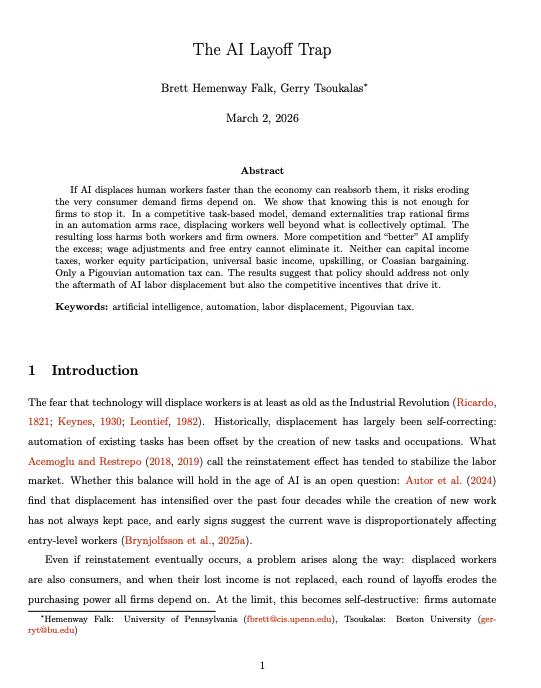
🤯BREAKING: Researchers just mathematically proved that AI layoffs will collapse the economy: and every CEO already knows it.
The AI Layoff Trap. A game theory paper from UPenn + Boston University is glaringly important!
100K+ tech layoffs in 2025. 80% of US workers exposed. And no market force can stop it.
→ Every company fires workers to cut costs
→ Every fired worker stops buying products
→ Revenue collapses across every sector
→ The companies that fired everyone go bankrupt
It's a Prisoner's Dilemma with math behind it. Automate and you survive short-term. Don't automate and your competitor kills you. But everyone automating destroys the demand that makes all companies viable.
UBI (universal basic income) won't fix it.
Profit taxes won't fix it.
The researchers found only one solution: a Pigouvian automation tax "robot tax"
The AI trap on the economy is here!