After co-inventing ChatGPT, I kept asking myself: why have superhuman chat models not led to AGI?
I’ve spent the last 2 years in stealth building a new way to train models (RLCD), and a new type of frontier AI model that we are releasing today: Jev
• 20-200x faster
• 40-400x cheaper (w/ output tokens free)
• Frontier composable intelligence optimized for decisions
AFAICT the shortest path to AI-based economic revolution
We have a huge news to share today!
Today we are unveiling the first truly accessible RL robot - welcome Microduck
A 25 cm tiny open-source biped with 15 actuators and packed with sensors (camera, speaker, LiDAR, NFC, bluetooth, wifi, etc) that you train yourself with reinforcement learning.
It's also playable out of the box with more than half a dozen fun and playful pre-trained policies to have it walk, sit, crouch, roller-skate, pick up objects with its articulated beak, and recover on its own.
And all for less than $400.
See all the details, play with the simulator and order it at: https://t.co/n1Btgs6vKw
(video with sound on 🔊)
arXiv -> quickarXiv
Papers are often written in convoluted language that is hard to understand
Swap arXiv -> quickarXiv on any paper URL to get an instant blog with figures, insights, and explanations. Now extracted with @Zai_org's GLM OCR 🚀
Also includes code + author tweet
I recently wrote down a few rules of prompting for RL. There's exceptions for each of them, but they are good guidelines so I thought I'd make them public.
metagradient descent
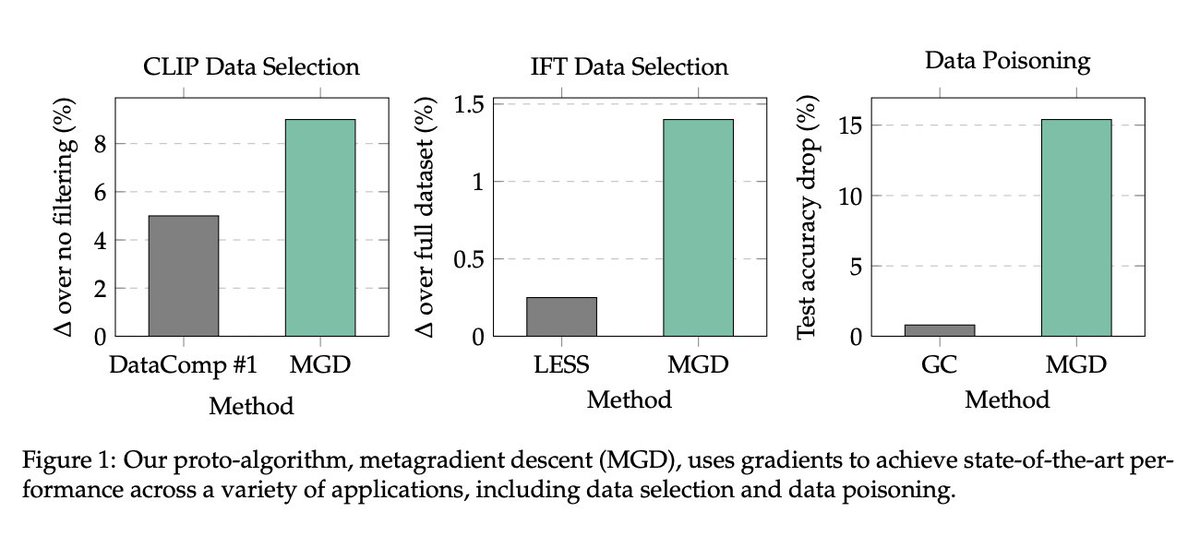
traditional machine learning configures training setups (like data selection or hyperparameters) using discrete searches or manual heuristics. instead, the authors find that finding the optimal training setup can be reframed as adjusting continuous "metaparameters" until the final model's validation loss is as low as possible.
at each step, the system runs the full training process, evaluates the final model's performance, and uses a memory-efficient algorithm called REPLAY to compute exact metagradients backward through the training steps, tweaking the initial setup toward a lower-loss result.
They test this across data selection and poisoning tasks: Metagradient Descent drops model accuracy to 78% in poisoning attacks (compared to 91% for prior methods) and improves CLIP pre-training data selection by a 2x margin over previous sota baselines, all without requiring massive memory overhead or suffering from exploding gradients!
How do you train an agent when a single rollout takes tens of hours?
Alongside the open-source release of dots3-note Preview, we’re sharing more details about TEMPO: Test-Time-Scaled Value Estimation with Macro-Step Policy Optimization.
Long-horizon agent RL faces two fundamental problems:
• Training signals arrive only when an extremely long trajectory ends
• Final rewards make it difficult to identify which intermediate decisions actually mattered
TEMPO breaks a long trajectory into macro-steps. At each boundary, the same model switches from actor to generative critic: it reviews the interaction history, checks the agent’s hypotheses, reasons about possible futures, and estimates the remaining return.
The agent therefore learns not only how to act, but also how to evaluate itself.
One result surprised us: two branches can receive exactly the same environment reward, while one is trapped by an incorrect understanding of the task and the other has already found a viable direction. A reasoning critic can distinguish these states before the task ends.
On the public ARC-AGI-3 set, TEMPO improves the average Score by 31.6% over the base checkpoint and 20.7% over GRPO, while reaching comparable progress with fewer environment interactions.
TEMPO is still early work, but we believe test-time-scaled self-evaluation may be an important ingredient for training agents on tasks that last hours, days, or eventually much longer.
Technical blog:
https://t.co/ErAowzmDfs
Open-source dots3-note Preview:
https://t.co/OOeoS7KMB8
After a few more hours, I think I've figured out Opus 5.
Opus 5 is trained to be more agentic than anything I've used. All Claude 5 models are like that.
So what changes?
The way to interact with Opus 5 or contextualize it won't work the same way as with other models.
It loves exploring, so it doesn't need much guidance for it. Unique preferences, artifacts, and references compliment it well and enable cleaner and more effective exploration and execution.
Now that it can explore more effectively on its own and understand intent better, the best thing to do is to get out of its way (e.g., it doesn't need examples of your preferences; a clear high-level description of it works best). It's truly agentic in that sense.
A good first step to provide better context for Opus 5 is to distinguish between what's situational and what needs persistence.
Regardless, persistent system prompts and CLAUDE.MD needs to stay lightweight. Remove memories and tool descriptions from these. CLAUDE.MD is also a great place to tap into progressive disclosure by linking command/skills to it.
On the situational side, agent skills and auto-memory can leverage progressive disclosure and the improved ability of the model to use its external context/knowledge. Conflicting and unnecessary instructions, which are common at this layer (mainly to ensure reliability), are going to throw off this model easily. That's the biggest change I had to make.
Simple, clean, and clear prompts and skills work best.
I had to clean a lot of my skills and system prompts. The way I prompt remains the same (usually clear and well-scoped). MCP tool descriptions are also more descriptive and have been deduped from the system prompt.
Anthropic released a guide on the new rules for context engineering, which was helpful here. I started to test the recommendations and created a little artifact with the things that worked along the way.
This might feel like a lot of work. Believe me, it has been frustrating. But I think we can expect future frontier models to become more agentic and smarter at figuring out the right context/gaps. The best thing to do is to prepare for that now.
@bcherny mentioned that Opus 5 is their least prompt-injectable model yet. I am not sure if that was something they intentionally trained for or if it emerged based on how it was trained, which is to be extremely agentic in nature and more direct in execution.
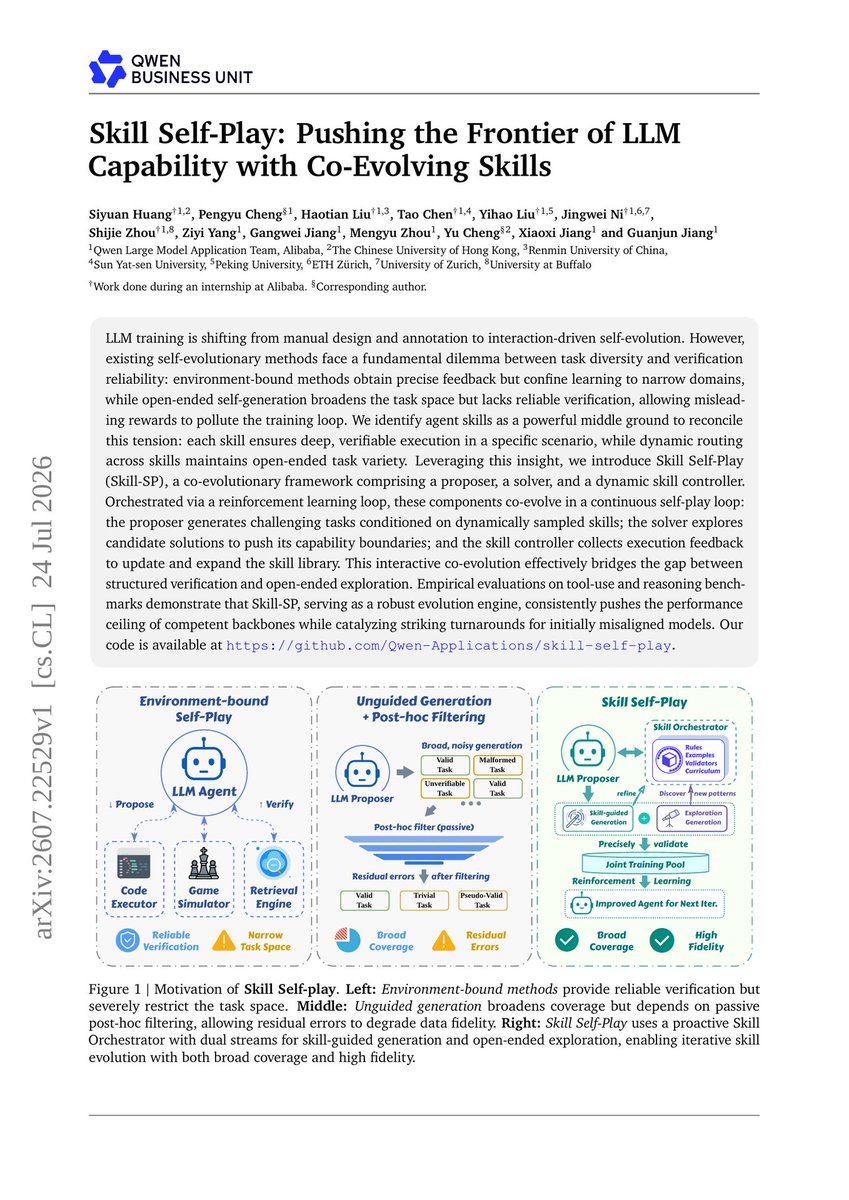
Alibaba's Qwen team releases Skill Self-Play
A co-evolutionary framework where a proposer, solver, and skill controller continuously push LLM capabilities through verified, open-ended task generation
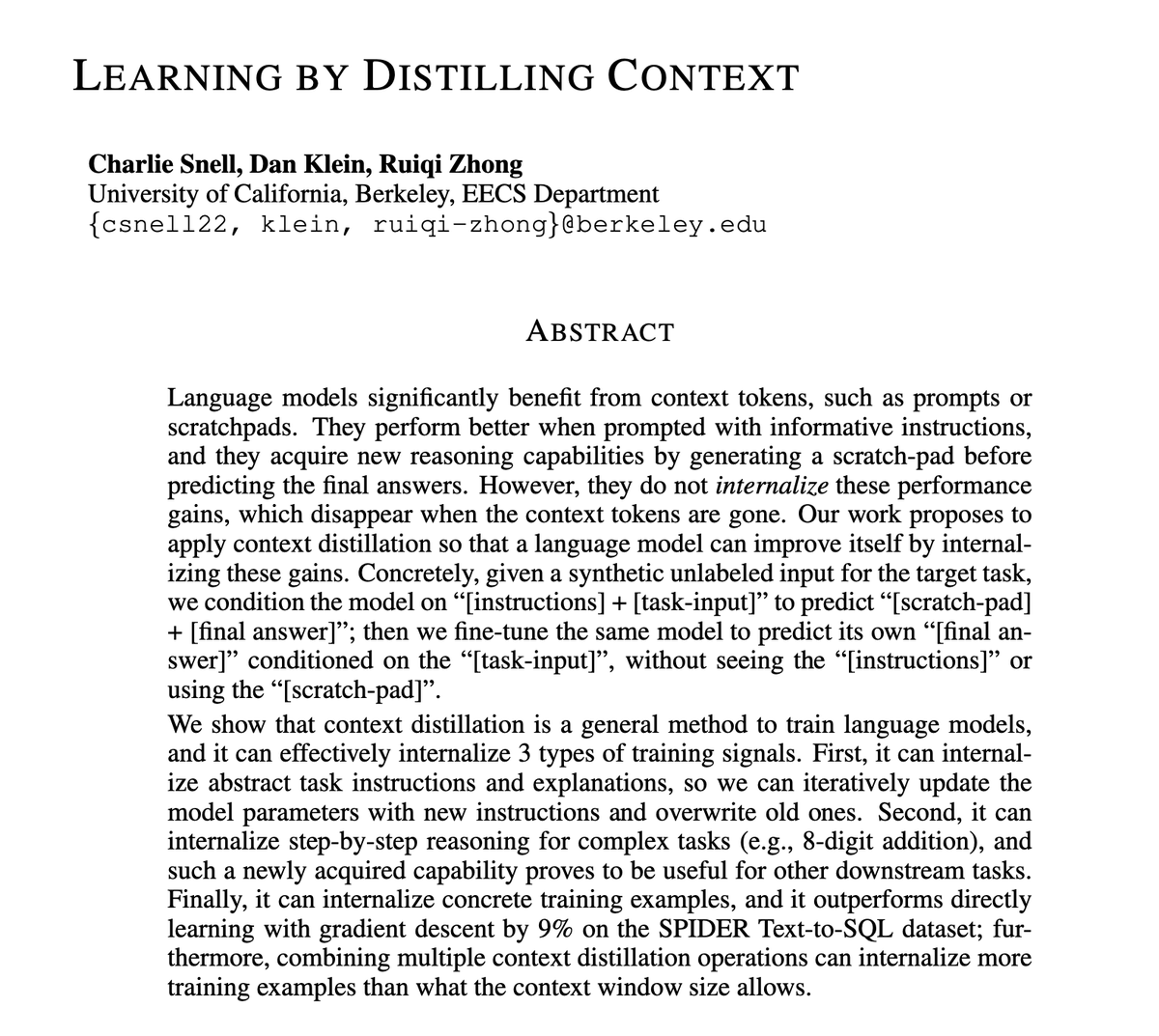
"On-Policy Delta Distillation"
So instead of copying everything a teacher model prefers, this paper asks what changed after the teacher learned reasoning.
It compares the reasoning-tuned teacher to its base model, then distills that difference into the student.
This focuses training on reasoning-specific behavior, not the teacher’s generic style or old pretraining habits.
This approach gives better math, code, and science reasoning across Qwen3 and Gemma4, especially where normal on-policy distillation can hurt strong models.
🧵Speculative decoding makes LLMs faster... until it doesn't.
At high batch sizes, it makes inference SLOWER so most production systems can't use it.
At @cohere, we fixed it with Hardware-aware Dynamic SD, open sourced in @vllm_project. Here's how 👇
🔗 https://t.co/5N4D44FMOU
cool new approach to address the spike problem in on-policy self-distillation by letting the privileged information steer the student distribution during rollouts directly
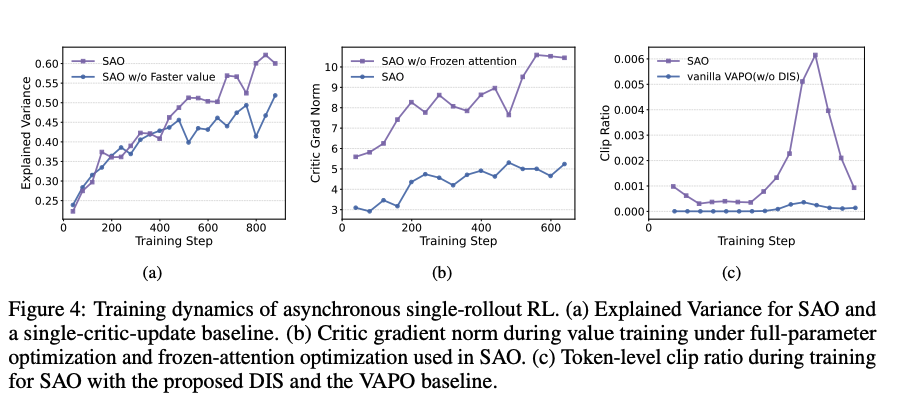
The main change is to get rid of group-wise sampling in favor of single-rollout which means we now need a value model again to reduce variance.
Value model specifics:
1) Value network takes 2 gradient steps per batch. This is shown to train a more accurate Value model mainly because the value model requires more "data"
2) Freeze attention and only train MoE layers which helps reduce instabilities
3) GAE skips over env tokens and is computed only on action tokens (I wonder how it would work if we add ECHO style SFT losses for the env tokens here)
4) VAPO style length adaptive GAE where longer sequences have smaller per token TD decay over the longer token horizon which helps credit assignment