The sum is greater than individual parts,
and now i can experience it and even articulate. Understanding everything and still knows nothing at all.
Me: @vulbsti
Banger paper from Google.
If you maintain a skill library for your agents, you might want to check this out.
(bookmark it)
This work separates three things that skill-evolution systems usually collapse into one. Raw execution traces, a persistent wiki of accumulated knowledge, and the executable skills themselves.
Experience gets consolidated into the wiki, and every later skill update builds on that wiki instead of on a scattered optimization history.
Ablations confirm the wiki is what carries a lot of the gain. Two results stand out in particular. Smaller models with evolved skills beat substantially larger models without them. And skills evolved by one model transfer across families, where skills evolved elsewhere sometimes beat self-evolved ones.
Paper: https://t.co/6qftGirTpE
Chat with Paper: https://t.co/rrVzkkR1ij
This is probably the best paper I have read about causal reasoning for quite some time. Really a great weekend read!
"Causal Persuasion" (Burkovskaya & Starkov) models how much evidence you need to establish vs. rule out a causal link. The result is stark:
To prove X causes Y: 1-2 well-chosen variables often suffice.
To prove X does NOT cause Y: you must account for every possible common cause. Arbitrarily many confounders. Practically unfalsifiable.
This inverts the Humean intuition: in causal reasoning, positive claims are cheap to sell and negative ones are almost impossible to rebut.
Now think about what this means for Virtual Cell models.
Most perturbation datasets cover a thin slice of the combinatorial space — a few hundred gene knockouts, maybe a few contexts. A model trained on that data can confidently "learn" gene X drives phenotype Y. But if the true structure is X←C→Y , and C was never systematically varied — the model will never see its own confounding. It has no mechanism to distinguish causal signal from correlated noise.
The paper formalizes exactly why: the model is a sophisticated receiver that accepts whatever causal story is consistent with the data it's seen. And if the data omits the right confounders, even a "sophisticated" model is manipulable.
This is the deepest argument for perturbation diversity. Not just more data, but also more axes of variation. Vary the context. Vary the genetic background. Vary the timing. You're not just collecting samples; you're systematically eliminating alternative causal explanations.
This is why we need “scale” the training data with more contexts including cell types, spatial, and temporal variations.
Paper: https://t.co/Ayvt8tKtnj
the craziest part now is that the modern computer probably has to be entirely reinvented, from scratch. pretty much like how jobs & co brought apple ii to market.
like not improved. not given a chatbot sidebar or something but really from the ground up like the iphone redefined what it meant to be a pocket computer.
the current paradigm for computers was built around a human staring at a screen, moving a cursor, opening apps, managing windows, naming files, remembering where things live, & manually translating intent into interface actions.
that made sense when the human was the runtime. but in an ai native world, it starts to look kinda ridiculous.
you can see this ridiculousness when you use computer use agents… they are useful sure, but they’re also obviously transitional. they’re teaching ai to operate machines designed for humans, which is clever, but also kind of absurd. it’s like making a robot hand so it can use a doorknob instead of asking why the door needs a knob at all. yes i know humans also need to use a door knob, but maybe in the future humans don’t need to use a computer, or at least what we think of a computer today at all.
this all leads to some interesting questions:
- what is a file when the system understands context?
- what is an app when intent can route itself?
- what is a desktop when work can be decomposed, executed, monitored, & summarized by agents?
- what is a browser when the agent can retrieve, compare, transact, & remember?
- what is an operating system when the primary user is no longer just a person, but a person plus a swarm of delegated intelligences? or no person at all.
the old computer assumed navigation.
the new computer has to assume a new kind of intention. the old computer organized information. the new computer has to try to organize agency.
we’re still in the hacky middle stage at the moment with sidebars, copilots, agents clicking through legacy ui, & automation layers sitting on top of 40 year old metaphors.
the new computer is likely one where memory, context, identity, permissions, tools, agents, & interfaces are native primitives. this means desktop, mobile, browser, apps, files, folders deserves another first principles look.
Spark 2.0 is here! 🚀
We’re redefining what’s possible on the web with a streamable LoD system for 3D Gaussian Splatting.
Built on Three.js, you can now stream massive 100M+ splat worlds to any device from mobile to VR using WebGL2. All open-source.
Dive into the tech 👇
@ericjang11 Its literally Sherlock Holmes 101
WATSON. One must find the evidence before formulating a theory
Otherwise one starts bending facts to suit theories.
Claude code needs evidence before planning. To create a plan that actually captures the entirety of evidence
I'm not the only one doing this.
- karpathy
best thought leader, best person to learn from imo. Nanochat is the best way to get into training LLMs its the simplest and most digestible source for building your first AI model
- steipete
This guys GitHub is a national treasure, his writing is also very strong. Peekaboo, https://t.co/u0cve9Ukze, openclaw, oracle, just talk to it, etc.. all unique and very useful
- badlogicgames
Mario’s Pi is a staple AI engine and possibly the best, simplest, open source agentic loop to learn from. Despite what people say about his methods, I think he’s going to set some new standards for Open source contribution. Big respect.
- TheAhmadOsman
This man is the GPU king, giveaways and lots of dense educational content around self hosting and home inference. He’s also tight with pretty much all the open weight labs and has them on for interviews regularly
- sudoingX
This is an up and comer who will change the game, he's pushing the limits of what a single gpu can do
- Ex0byt
I can confidently say this man will be fundamental in making local inference on massive models possible.
- alexinexxx
I genuinely feel motivated by her drive. She’s a real hard worker learning about GPU kernel programming. Also good aesthetics
- gospaceport
I would not have gotten into building my own hardware without this man’s hard work. He’s taught me so much about hardware and the economics of this. He also has the most impressive homelabs I’ve ever seen.
- alexocheema
The founder of Exolabs, pioneering Apple hardware inference, he’s also very engaged in the community and a good guy all around. If you are interested in Mac minis and Mac Studios this is your guys.
- nummanali
This guy is so prolific, he’s made tons of CLI tools for managing llm subscription budgets, using Claude code with alternative models etc..
- thdxr
The entire Opencode team is wonderful but Dax specifically is a good writer. More anti-doomer content to sooth your anxieties.
- juliarturc
If you are interested in the science, Julias channel is where it’s at. Almost everything I’ve learned about LLM compression has been from her.
- Teknium
The Nous research & Prime intellect teams are both some of the most hard-working and principled people around. Tough fight in an industry so aggressive.
- victormustar
Head of Product for Huggingface, enabling us all to publish our work.
- louszbd
Head of community at ZAI some of the top LLMs available right now that are open weights. They supercharged the movement
- SkylerMiao7
Making frontier intelligence fit on 10k USD of hardware. Via MiniMax
- crystalsssup
Building the best Open Weight model on the market, and releasing their latest research before their next gen model.
Believe it or not these people are carrying the entire industry and giving us a fighting chance.
Bytedance just dropped a paper that might change how AI thinks.
Literally.
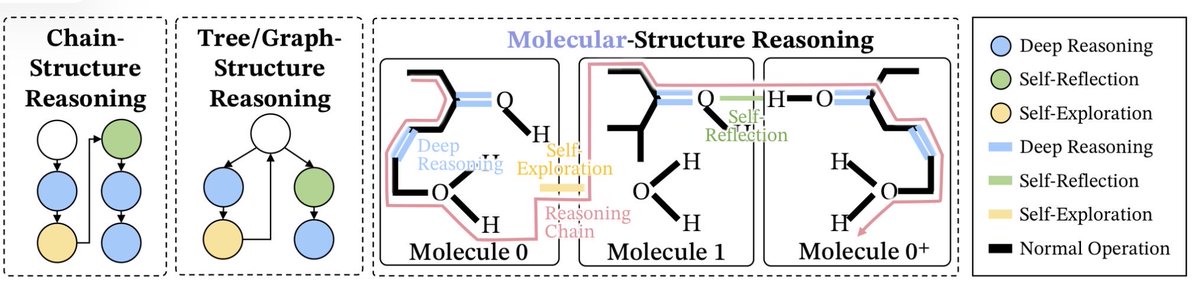
They figured out why LLMs fail at long reasoning — and framed it as chemistry.
The discovery:
Chain-of-thought isn't just words. It's molecular structure.
Three bond types:
• Deep reasoning = covalent bonds (strong, unbreakable)
• Self-reflection = hydrogen bonds (flexible, context-aware)
• Exploration = van der Waals (weak, ever-present)
Why most AI "thinking" sucks:
Everyone's been imitating keywords — "wait," "let me check" — without building the actual bonds.
It's like copying the shape of a protein without the atomic forces holding it together.
Bytedance proved: structure emerges from training, not prompting.
The fix: Mole-Syn
Their method doesn't just generate text. It synthesizes stable thought molecules.
Results: better reasoning, more stable RL training.
Bytedance is treating AI reasoning like organic chemistry — and it works.
Paper: https://t.co/jveogIS9vl
You can now turn cheap EEG headsets into lab-grade brain scanners.
And it's open-source.
ZUNA is a 380M-parameter foundation model that reconstructs missing brain signals from partial EEG data.
It works across any electrode setup, from consumer headsets to 256-channel research systems, without retraining.
It lets you:
- Reconstruct missing EEG channels from sparse data
- Denoise corrupted signals
- Predict new channels from just electrode coordinates
- Handle arbitrary electrode layouts
The model uses a diffusion autoencoder with a transformer backbone. It was trained on 2 million channel-hours across 208 datasets using masked diffusion training and 4D spatial embeddings.
This lets the model understand the physical geometry of electrode placement. Each channel signal gets compressed into tokens, then the model encodes x, y, z positions plus time into separate attention components.
EEG data has been stuck in a pre-foundation model era. Datasets are small, fragmented across institutions, collected under different protocols.
The standard fix for missing channels is spherical spline interpolation, basically spatial smoothing. It works okay when a few channels drop out but falls apart when you lose more than 75% of your data.
ZUNA beats this baseline by learning actual patterns in brain activity instead of just smoothing between points. The gap widens dramatically at high dropout rates, exactly where you need it most.
Thought-to-text is positioning itself as the next major AI modality after language, vision, and audio. But you can't build that future on data that gets thrown away because a few electrodes failed.
The model is fully open source under Apache 2.0, runs on consumer GPUs, and works on CPU for many tasks.
On DeepWiki and increasing malleability of software.
This starts as partially a post on appreciation to DeepWiki, which I routinely find very useful and I think more people would find useful to know about. I went through a few iterations of use:
Their first feature was that it auto-builds wiki pages for github repos (e.g. nanochat here) with quick Q&A:
https://t.co/DQHXagUwK0
Just swap "github" to "deepwiki" in the URL for any repo and you can instantly Q&A against it. For example, yesterday I was curious about "how does torchao implement fp8 training?". I find that in *many* cases, library docs can be spotty and outdated and bad, but directly asking questions to the code via DeepWiki works very well. The code is the source of truth and LLMs are increasingly able to understand it.
But then I realized that in many cases it's even a lot more powerful not being the direct (human) consumer of this information/functionality, but giving your agent access to DeepWiki via MCP. So e.g. yesterday I faced some annoyances with using torchao library for fp8 training and I had the suspicion that the whole thing really shouldn't be that complicated (wait shouldn't this be a Function like Linear except with a few extra casts and 3 calls to torch._scaled_mm?) so I tried:
"Use DeepWiki MCP and Github CLI to look at how torchao implements fp8 training. Is it possible to 'rip out' the functionality? Implement nanochat/fp8.py that has identical API but is fully self-contained"
Claude went off for 5 minutes and came back with 150 lines of clean code that worked out of the box, with tests proving equivalent results, which allowed me to delete torchao as repo dependency, and for some reason I still don't fully understand (I think it has to do with internals of torch compile) - this simple version runs 3% faster. The agent also found a lot of tiny implementation details that actually do matter, that I may have naively missed otherwise and that would have been very hard for maintainers to keep docs about. Tricks around numerics, dtypes, autocast, meta device, torch compile interactions so I learned a lot from the process too. So this is now the default fp8 training implementation for nanochat
https://t.co/3i5cv6grWm
Anyway TLDR I find this combo of DeepWiki MCP + GitHub CLI is quite powerful to "rip out" any specific functionality from any github repo and target it for the very specific use case that you have in mind, and it actually kind of works now in some cases. Maybe you don't download, configure and take dependency on a giant monolithic library, maybe you point your agent at it and rip out the exact part you need. Maybe this informs how we write software more generally to actively encourage this workflow - e.g. building more "bacterial code", code that is less tangled, more self-contained, more dependency-free, more stateless, much easier to rip out from the repo (https://t.co/iKJUoHiIpl)
There's obvious downsides and risks to this, but it is fundamentally a new option that was not possible or economical before (it would have cost too much time) but now with agents, it is. Software might become a lot more fluid and malleable. "Libraries are over, LLMs are the new compiler" :). And does your project really need its 100MB of dependencies?
MedGemma 1.5 is a major upgrade to our open models for healthcare developers.
The new 4B model enables developers to build applications that natively interpret full 3D scans (CTs, MRIs) with high efficiency - a first, we believe, for an open medical generalist model. MedGemma 1.5 also pairs well with MedASR, our speech-to-text model fine-tuned for highly accurate medical dictation.
Developers can now use these multimodal capabilities to build medical apps that reach patients in more places.
I'm Boris and I created Claude Code. Lots of people have asked how I use Claude Code, so I wanted to show off my setup a bit.
My setup might be surprisingly vanilla! Claude Code works great out of the box, so I personally don't customize it much. There is no one correct way to use Claude Code: we intentionally build it in a way that you can use it, customize it, and hack it however you like. Each person on the Claude Code team uses it very differently.
So, here goes.
You are insufficiently astonished by what Claude can do with the right scaffolding. Here I asked it to generate an influencer video explaining LDL cholesterol and statins on a white board.
Karpathy’s 2025 retrospective is the clearest articulation I’ve seen of what foundational AI labs are actually building.
We’re not “evolving animals,” we’re “summoning ghosts.”
LLMs have completely different optimization pressures than biological intelligence. Humans evolved for tribal survival. LLMs optimize for imitating text, solving puzzles, and winning upvotes on LM Arena. Different pressures, different shapes in the intelligence space.
This framing finally explains what confuses everyone about AI capability.
GPT-5 aces the bar exam but gets tricked by simple jailbreaks. Claude writes PhD-level philosophy but hallucinates citations. Gemini solves competition math that stumps IMO medalists but fumbles spatial reasoning.
Capability spikes near verifiable domains where RLVR concentrates optimization pressure. Everywhere else, you get a different entity entirely.
I’ve been thinking about what this means for AI product builders.
The teams struggling with AI deployment are treating capability as uniform. They ask “can AI do this task?” and expect a yes/no answer. But ghost intelligence doesn’t work that way.
The teams winning are asking a different question: “Does this task live near a verifiable domain?”
If yes, the ghost might be superhuman. Build for autonomy. If no, the ghost needs guardrails. Build for human-in-the-loop.
This is why Cursor works. This is why Claude Code runs on localhost instead of the cloud. The best AI products in 2025 mapped the jagged edges and designed around them.
The companies that internalize Karpathy’s ghost framing will build better products than the ones still thinking in terms of “smarter or dumber than humans.”
There’s no single axis. Just different shapes.
In @GeminiApp this is what you're working with now:
Fast = 3 Flash
Thinking = 3 Flash (with thinking)
Pro = 3 Pro (with thinking)
Our best line-up yet!
Here are my Opus 4.5 thoughts after ~2 weeks of use.
First some general thoughts, then some practical stuff.
--- THE BIG PICTURE ---
THE UNLOCK FOR AGENTS
It's clear to anyone who's used Opus 4.5 that AI progress isn't slowing down.
I'm surprised more people aren't treating this as a major moment. I suspect getting released right before Thanksgiving combined with everyone at NeurIPS this week has delayed discourse on it by 2 weeks. But this is the best model for both code and for agents, and it's not close.
The analogy has been made that this is another 3.5 Sonnet moment, and I agree. But what does that mean?
Every few generations we get a major model unlock - a moment that unlocks a new way of working. GPT-4 was the unlock for chat, Sonnet 3.5 was the unlock for code, and now Opus 4.5 is the unlock for agents. Thanks to Opus 4.5, agents can now work reliably on increasingly longer time horizons and get real-world work done on your behalf.
Opus 4.5 is like a Waymo. You tell it "take me from A to B", and it takes you there. After a few of these experiences your brain realizes "oh. ok. we live in this world now". And then you're hooked.
From that moment on, you'll never work the same way again.
THE YEAR OF AGENTS
2025 has been touted as the year of agents, and Opus 4.5 + Claude Agent SDK is the pairing that makes that phrase true.
The Claude Agent SDK is the best open secret in AI right now. An agent's harness matters almost as much as its model. If you have a bad harness, then you may as well have a bad model. With the SDK you get a world-class agentic harness out-of-the-box which you can now pair with Opus 4.5 to build real-world agents that actually work.
I'm reminded of Alan Kay's quote "People who are really serious about software should make their own hardware". The agent version of this is "people who are serious about models should make their own harness". Anthropic clearly believes this, and it's working. The pairing of these tools is magic.
I would describe myself as being "unhobblings-pilled", and the Claude Agent SDK + Opus 4.5 is the next major unhobbling. There's now another OOM of new latent economic value stuck in this combo, and it's the job of builders to get it out.
If you were bearish on agents, now is the time to turn bullish.
"ALL OF THIS IS REAL"
"You know what's crazy? That all of this is real". This was Ilya's opening line about the state of AI in his Dwarkesh interview, and I echo that sentiment. I can't believe that Opus 4.5 is real.
There have been several times as Opus 4.5's been working where I've quite literally leaned back in my chair and given an audible laugh over how wild it is that we live in a world where it exists and where agents are this good.
Nat Friedman has this great question on his website: "Where do you get your dopamine?"
Increasingly, I get mine from Claude.
LONG ANTHROPIC
I saw a post yesterday where someone said that Opus 4.5 was the most important thing to happen to them in their professional career. This will be true for more people going forward.
Every year for the past 3 years, Anthropic has grown revenue by 10x. $1M to $100M in 2023, $100M to $1B in 2024, and $1B to $10B in 2025. In Dario's recent DealBook interview he expressed that he wasn't sure if that 10x pattern would hold for 2026.
While he's probably right, I do expect Anthropic's revenue at the end of next year to be much higher than everyone expects. It wouldn't surprise me if they passed OpenAI in valuation by early 2027.
Opus 4.5 is too good of a model, Claude Agent SDK is too good of a harness, and their focus on the enterprise is too obviously correct.
Claude Opus 4.5 is a winner.
And Anthropic will keep winning.
@championswimmer Its no way near pixel perfect.
Anything that requires lots of details it messes up.
Like look at the ss it generated.
Cmd is fumbled.
Though it certainly is leaps ahead from previous generation. I still wouldn't use it to generate documents or something that has lot of txt