Stop telling Claude, "do this."
Stop telling Claude, "write code."
Stop telling Claude, "fix this error."
You're actually treating a senior AI like a junior intern.
Here are 8 prompts you can copy and paste directly:
Adjuvant chemoradiotherapy versus completion total mesorectal excision after local excision for early rectal cancer (TESAR): a multicentre, randomised, controlled, phase 3, non-inferiority trial - The Lancet Gastroenterology & Hepatology https://t.co/GUdwm9cYNs
Intraperitoneal and Intravenous Paclitaxel Plus S-1 for Gastric Cancer With Peritoneal Metastasis: A Phase 3 Randomized Clinical Trial | Oncology | JAMA Oncology | JAMA Network @OncoAlert https://t.co/t3QQBOlns6
@DouglasAdlerMD I respect and appreciate your work. But in unresectable obstructing tumors, a simple loop colostomy can safely bridge the patient to chemo/radiotherapy without delaying oncologic treatment. Nobody wants a colostomy, but in cancer surgery, survival should remain the primary goal.
@AlmomaniMD Did you really resect this lesion using cold snare? We would be interested to know whether you have your own results or experience regarding this approach. In our practice, we prefer to perform ESD for all such lesions
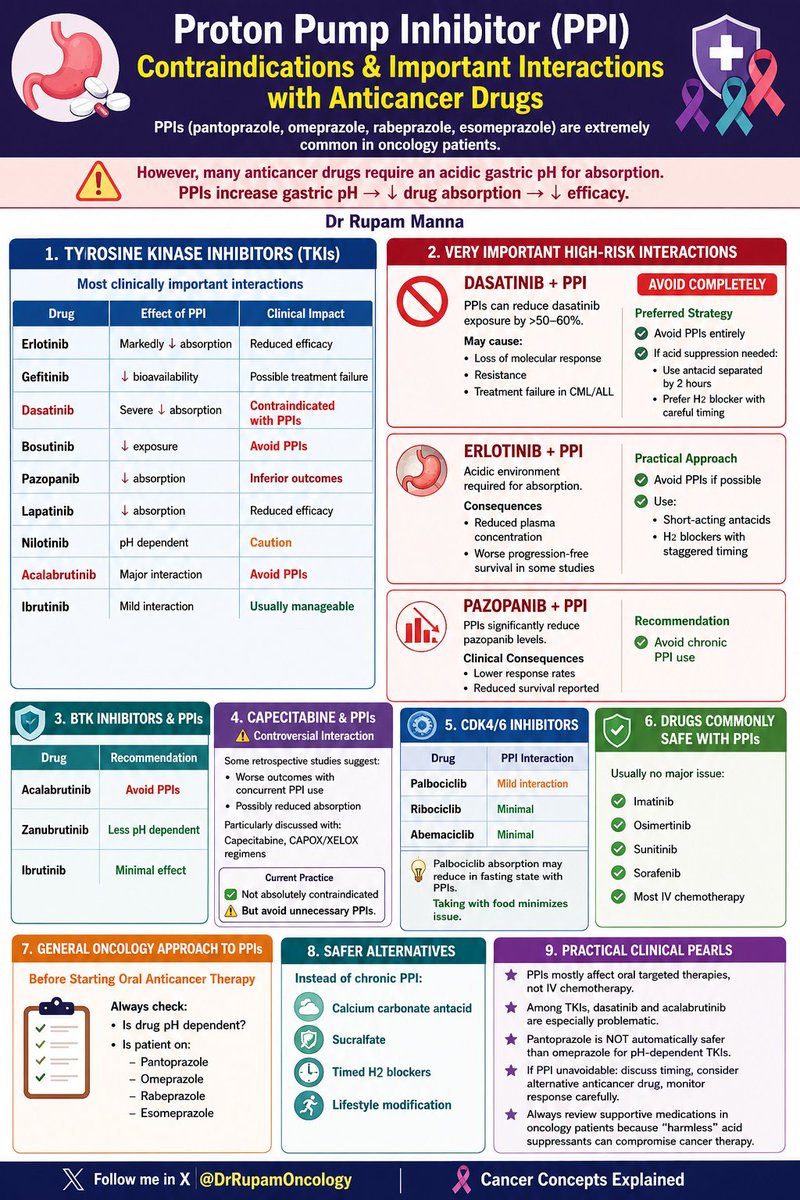
⚠️ Proton Pump Inhibitor (PPI) Contraindications & Important Interactions with Anticancer Drugs
PPIs (pantoprazole, omeprazole, rabeprazole, esomeprazole) are extremely common in oncology patients, yet many oral targeted therapies require acidic gastric pH for optimal absorption.
This practical infographic highlights:
• High-risk interactions (Dasatinib, Erlotinib, Pazopanib, Acalabrutinib & more)
• BTK inhibitors, Capecitabine, CDK4/6 inhibitors
• Clinical impact & real-world consequences
• Safer alternatives & management strategies
• Key clinical pearls for daily practice
Critical for every medical oncologist!
Save | Share | Tag a colleague who needs this 👇
Made with ❤️ by Dr Rupam Manna
Cancer Concepts Explained
Follow for more → @DrRupamOncology
#Oncology #DrugInteractions #TKI #PPI #MedEd #MedTwitter #CancerCare #CancerConceptsExplained
🩺 Cirrhosis is no longer just a “liver disease.”
This review summarizes how inpatient cirrhosis management has fundamentally evolved from static “end stage liver disease care” into dynamic risk stratification and organ support.
One of the most important modern concepts highlighted:
⚠️ “Cirrhosis” is increasingly being replaced by the concept of compensated advanced chronic liver disease (cACLD).
A particularly important ICU and ward management point:
🩸 Variceal bleeding management has changed.
Modern evidence supports:
• restrictive transfusion strategy
• early vasoactive therapy
• early antibiotics
• rapid endoscopy
• selective early TIPS in high risk patients
One major physiological misconception continues to harm patients:
❌ Elevated INR in cirrhosis does NOT equal auto anticoagulation.
Cirrhosis creates a “rebalanced” coagulation state where patients can simultaneously:
• bleed
AND
• thrombosis
This explains why routine FFP correction before paracentesis is no longer recommended and why portal vein thrombosis remains common.
Another critical update:
💧 Ascites management is not simply “give diuretics.”
The review reinforces that:
• sodium restriction is foundational
• albumin remains physiologically crucial
• aggressive fluid shifts can precipitate renal collapse
• diagnostic paracentesis should be routine in hospitalized patients with ascites, even without symptoms
Perhaps one of the most important modern concepts:
🧠 Hepatic encephalopathy is not merely “high ammonia.”
The article emphasizes:
• systemic inflammation
• infection triggers
• electrolyte disturbances
• medications
• renal dysfunction
• gut microbiome interactions
as central drivers of encephalopathy.
And importantly:
🍖 Protein restriction is now contraindicated.
This is a major paradigm shift from older teaching.
Patients with cirrhosis require:
• aggressive nutritional support
• high protein intake
• sarcopenia prevention
• late night protein supplementation
One of the strongest messages of the paper:
⚠️ Every hospitalization for decompensated cirrhosis should trigger transplant thinking.
Not “end stage management.”
Not passive stabilization.
But active reassessment of:
• prognosis
• reversibility
• candidacy
• goals of care
• frailty
• transplant referral timing
For intensivists and hospitalists, cirrhosis management is increasingly becoming a discipline of: • hemodynamic physiology
• renal protection
• inflammation control
• nutritional optimization
• procedural timing
• multidisciplinary coordination
rather than isolated hepatology alone.
📖 Rogal S. Inpatient Management of Patients With Cirrhosis. Annals of Internal Medicine. 2026. doi:10.7326/ANNALS-26-00513
📊 JAMA Clinical Guidelines Synopsis: #CrohnDisease guidelines recommend fecal calprotectin for screening and monitoring, routine colonoscopy for colorectal cancer, and oral budesonide for induction in mild to moderate ileocecal disease.
https://t.co/yQCrCGiTSp