I've watched a ton of people vibe code internal tooling only to realize:
"I am now the admin for something that basically does the same thing as the software we used to use "
And go back to using that software. It turns out 10% more customization isn't really worth it at all
This is not a drop-in app for the Whoop app. It is still entirely a pre-alpha version, purely designed for developers to play with.
Do not go into this with high hopes.
I will publish a version to the App Store, give me time to make it good. https://t.co/WdO9eYDX1P
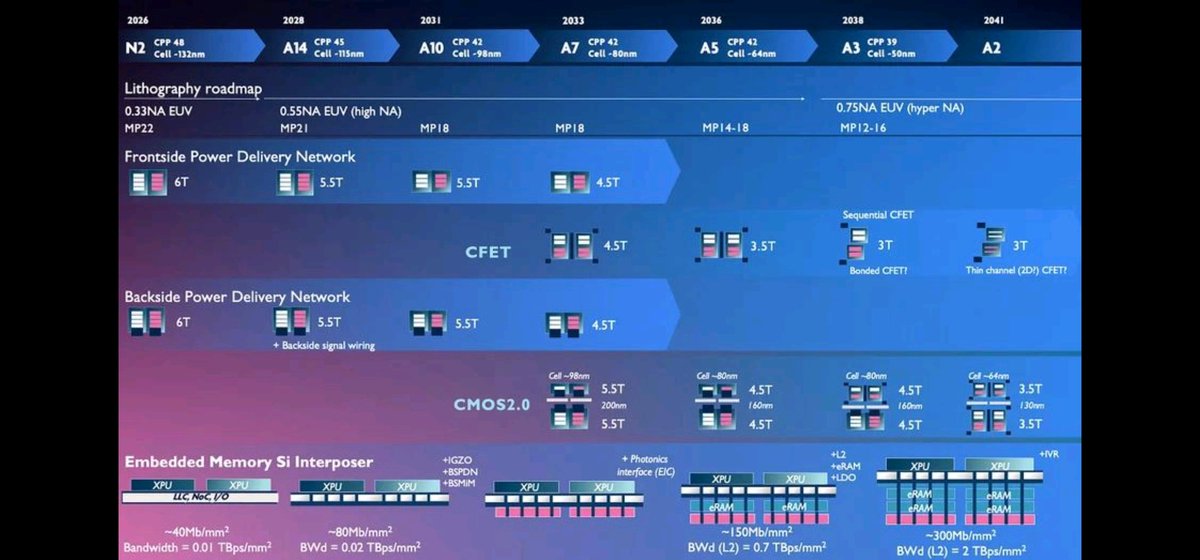
IMEC 2026–2041 Semiconductor Roadmap
Timeline: Nodes advance from N2 (2026) through A14 (2028), A10 (2031), A7 (2033), A5 (2036), A3 (2038) to A2 (2041).
Lithography: Progresses from 0.33 NA EUV (2026) to 0.55 NA High-NA (2028) and 0.75 NA Hyper-NA (2038)
CPP Scaling: Contacted Poly Pitch shrinks from 48 nm to 39 nm, enabling continued density gains.
Transistor Architecture: Standard cells reduce from 6T → 3T; major shift to CFET, Bonded CFET, and thin-channel (2D) CFET for improved performance and power efficiency.
Power Delivery: Frontside and backside networks converge on 3T–3.5T cells with backside signal routing, significantly lowering power consumption and routing congestion.
Embedded Memory: Density rises from ~40 Mb/mm² to ~300 Mb/mm²; bandwidth increases from 0.01 TBps/mm² to 2 TBps/mm² via silicon interposers, eRAM, photonics, and integrated voltage regulation.
In this video, @pmarca describes how some people have stopped sleeping because they code with AI. His model is that the ‘opportunity cost’ of sleeping is too high, meaning that they can produce so much value with AI that they’d better not sleep.
My model of what is happening is a novelty effect mixed with gamification. There are people who are naturally drawn to new experiences and tend to embrace them too much. Also, building with AI is a bit of a game. There is a Minecraft feel to it: you quickly build a house and then walls around the house and so forth.
I’ve seen it with some graduate students who produce massive amounts of ‘stuff’. Some of them become convinced that they are the new Einstein.
They are not.
What we have is a genuine glut of ‘research outputs’.
We have been there before, repeatedly. For example, about 20 years ago, blogging became a ‘thing’. The WordPress empire came to be. Everyone and their dog had a blog. The lady running my university started a travel blog soon after she had to leave due to her general incompetence. I don’t expect that her career as a blogger lasted very long.
I suspect that the same will apply with AI. Throwing stuff at AI is fun. Building valuable software is difficult.
Even though we all have access to a word processor, few of us become novelists.
AI will not turn most of us into software architects.
What is happening is Cargo Cult Software development. Cargo cultism is a reference to Pacific Islanders who would copy the US military after the US was gone, in the hope of getting the goods that the US was providing.
Software is not done for. We just have a new tool. Building useful software is still hard. Some people like it, but most will tire of it and find faster tricks. People will add skills or other lightweight techniques.
There will not be a world where everyone writes their own operating system or browser.
are there people out there who just want to refactor every day?
just wake up and find the worst code and just chip away at it and clean it up
wake up the next day do it again, infinitely improving things with zero external impact?
@bscholl I don’t know why but it reminds me of the MIT seal with the motto, MENS ET MANUS, “mind and hand”. All of us should be engineer-technicians and technician-engineers. Lots of mixing and working together and cross-over is a good thing. And with that mutual respect is developed.
Why It’s Extremely Difficult to Manufacture Mobile SoCs on Intel 18A/14A (Perspective from an Active Design House Industry Professional, via SemiWiki) – #1